Welcome to Journal of Automotive Safety and Energy,

Journal of Automotive Safety and Energy ›› 2025, Vol. 16 ›› Issue (4): 638-647.DOI: 10.3969/j.issn.1674-8484.2025.04.014
• Intelligent Driving and Intelligent Transportation • Previous Articles Next Articles
WANG Lin1,2( ), CHEN Qinghua3, YE Hongling1, WANG Pengfei1, XU Chi1,2, QIAN Aiwen1
Received:2025-02-18
Revised:2025-04-10
Online:2025-08-30
Published:2025-08-27
CLC Number:
WANG Lin, CHEN Qinghua, YE Hongling, WANG Pengfei, XU Chi, QIAN Aiwen. Simulation of intelligent vehicle trajectory tracking based on neural network adaptive MPC[J]. Journal of Automotive Safety and Energy, 2025, 16(4): 638-647.
Add to citation manager EndNote|Ris|BibTeX
URL: https://www.journalase.com/EN/10.3969/j.issn.1674-8484.2025.04.014
| v / (km·h-1) | 横向位移偏差峰值/ m | 横向位移偏差均方根/ m | 横摆角偏差峰值/ (°) | 横摆角偏差均方根/ (°) | ||||
|---|---|---|---|---|---|---|---|---|
| BPMPC | MPC | BPMPC | MPC | BPMPC | MPC | BPMPC | MPC | |
| 30 | 0.469 8 | 0.526 4 | 0.171 4 | 0.186 4 | 3.268 0 | 5.754 9 | 0.994 9 | 1.981 3 |
| 35 | 0.427 7 | 0.560 0 | 0.164 6 | 0.199 0 | 3.339 0 | 5.672 7 | 1.015 2 | 1.955 0 |
| 40 | 0.389 7 | 0.593 3 | 0.159 5 | 0.210 9 | 3.383 5 | 5.560 6 | 1.021 9 | 1.914 4 |
| 45 | 0.356 8 | 0.626 0 | 0.157 1 | 0.222 7 | 3.397 8 | 5.405 1 | 1.019 1 | 1.861 3 |
| 50 | 0.332 3 | 0.659 3 | 0.158 1 | 0.234 5 | 3.384 0 | 5.224 4 | 1.003 8 | 1.796 5 |
| 55 | 0.374 8 | 0.693 9 | 0.163 2 | 0.246 6 | 3.293 7 | 4.997 1 | 0.970 7 | 1.719 4 |
| 60 | 0.398 0 | 0.728 2 | 0.166 9 | 0.258 5 | 3.113 3 | 4.739 0 | 0.897 7 | 1.621 0 |
| 65 | 0.352 3 | 0.659 0 | 0.146 1 | 0.261 7 | 2.886 7 | 4.486 4 | 0.826 6 | 1.493 2 |
| v / (km·h-1) | 横向位移偏差峰值/ m | 横向位移偏差均方根/ m | 横摆角偏差峰值/ (°) | 横摆角偏差均方根/ (°) | ||||
|---|---|---|---|---|---|---|---|---|
| BPMPC | MPC | BPMPC | MPC | BPMPC | MPC | BPMPC | MPC | |
| 30 | 0.469 8 | 0.526 4 | 0.171 4 | 0.186 4 | 3.268 0 | 5.754 9 | 0.994 9 | 1.981 3 |
| 35 | 0.427 7 | 0.560 0 | 0.164 6 | 0.199 0 | 3.339 0 | 5.672 7 | 1.015 2 | 1.955 0 |
| 40 | 0.389 7 | 0.593 3 | 0.159 5 | 0.210 9 | 3.383 5 | 5.560 6 | 1.021 9 | 1.914 4 |
| 45 | 0.356 8 | 0.626 0 | 0.157 1 | 0.222 7 | 3.397 8 | 5.405 1 | 1.019 1 | 1.861 3 |
| 50 | 0.332 3 | 0.659 3 | 0.158 1 | 0.234 5 | 3.384 0 | 5.224 4 | 1.003 8 | 1.796 5 |
| 55 | 0.374 8 | 0.693 9 | 0.163 2 | 0.246 6 | 3.293 7 | 4.997 1 | 0.970 7 | 1.719 4 |
| 60 | 0.398 0 | 0.728 2 | 0.166 9 | 0.258 5 | 3.113 3 | 4.739 0 | 0.897 7 | 1.621 0 |
| 65 | 0.352 3 | 0.659 0 | 0.146 1 | 0.261 7 | 2.886 7 | 4.486 4 | 0.826 6 | 1.493 2 |
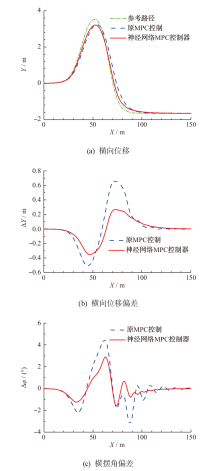
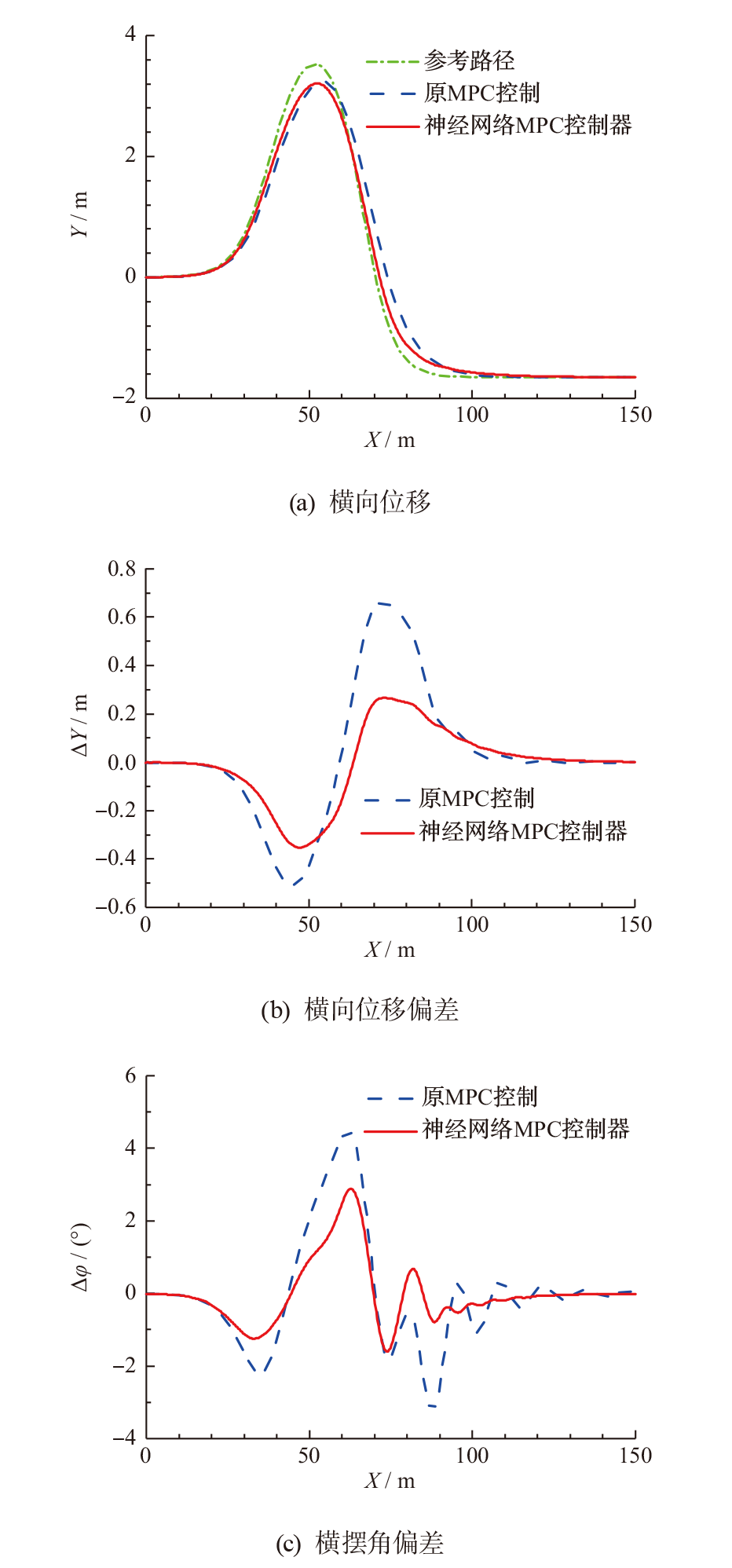
| 路面附着系数 | 横向位移偏差峰值/ m | 横向位移偏差均方根/ m | 横摆角偏差峰值/ (°) | 横摆角偏差均方根/ (°) | ||||
|---|---|---|---|---|---|---|---|---|
| BPMPC | MPC | BPMPC | MPC | BPMPC | MPC | BPMPC | MPC | |
| 0.35 | 0.671 6 | 1.047 3 | 0.287 3 | 0.396 2 | 4.799 2 | 8.510 9 | 1.414 0 | 2.802 6 |
| 0.5 | 0.605 2 | 0.896 5 | 0.249 8 | 0.332 0 | 4.281 1 | 7.692 8 | 1.272 7 | 2.564 9 |
| 0.75 | 0.492 5 | 0.595 0 | 0.184 5 | 0.212 4 | 3.431 2 | 6.107 7 | 1.038 8 | 2.090 1 |
| 0.85 | 0.446 6 | 0.454 9 | 0.158 5 | 0.169 7 | 3.108 4 | 5.389 7 | 0.954 1 | 1.867 4 |
| 路面附着系数 | 横向位移偏差峰值/ m | 横向位移偏差均方根/ m | 横摆角偏差峰值/ (°) | 横摆角偏差均方根/ (°) | ||||
|---|---|---|---|---|---|---|---|---|
| BPMPC | MPC | BPMPC | MPC | BPMPC | MPC | BPMPC | MPC | |
| 0.35 | 0.671 6 | 1.047 3 | 0.287 3 | 0.396 2 | 4.799 2 | 8.510 9 | 1.414 0 | 2.802 6 |
| 0.5 | 0.605 2 | 0.896 5 | 0.249 8 | 0.332 0 | 4.281 1 | 7.692 8 | 1.272 7 | 2.564 9 |
| 0.75 | 0.492 5 | 0.595 0 | 0.184 5 | 0.212 4 | 3.431 2 | 6.107 7 | 1.038 8 | 2.090 1 |
| 0.85 | 0.446 6 | 0.454 9 | 0.158 5 | 0.169 7 | 3.108 4 | 5.389 7 | 0.954 1 | 1.867 4 |
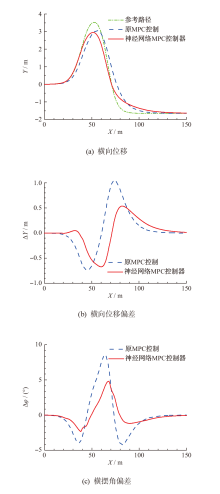
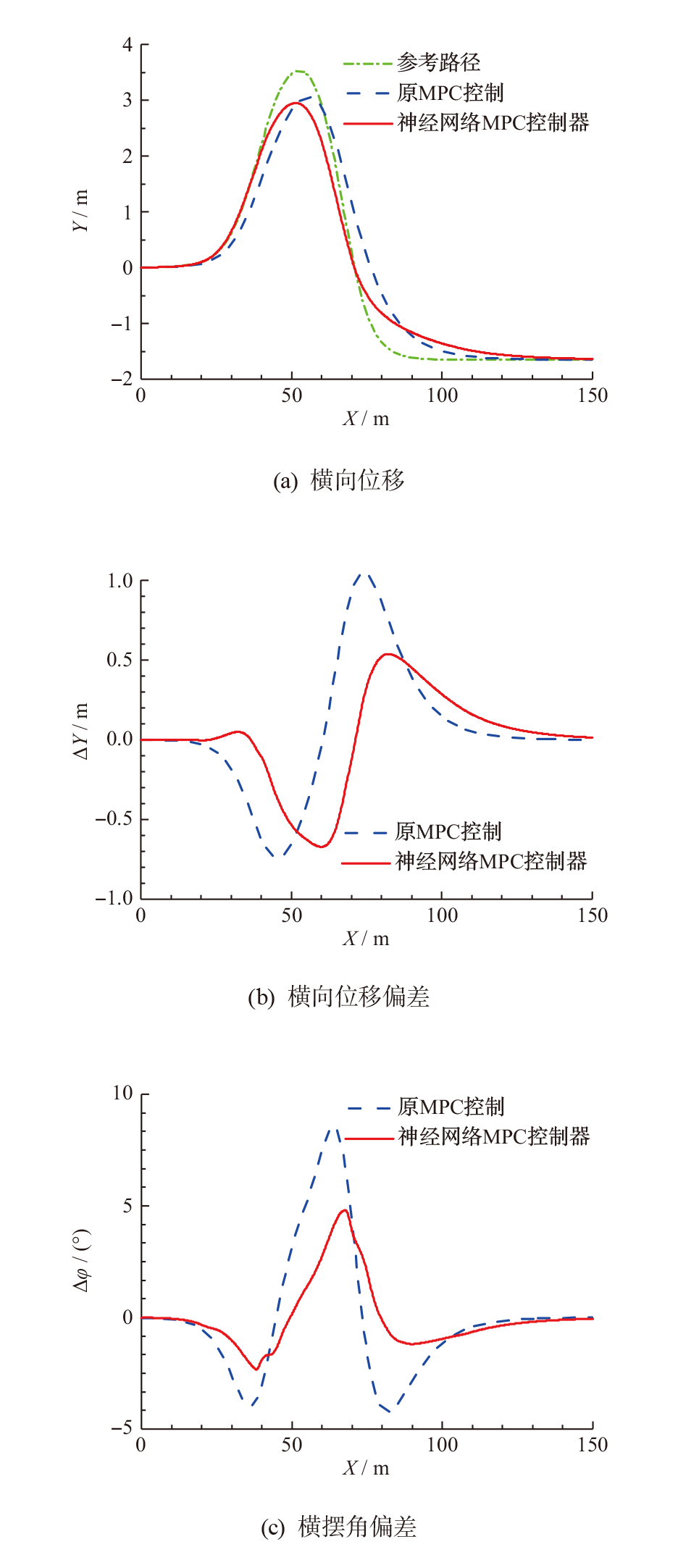
| [1] | 徐明泽, 刘清河. 基于LQR和PID的智能车轨迹跟踪控制算法设计与仿真[J]. 太原理工大学学报, 2022, 53(5): 52-53. |
| XU Mingze, LIU Qinghe. Design and simulation of intelligent vehicle trajectory tracking control algorithm based on LQR and PID[J]. J Taiyuan Univ Tech, 2022, 53(5): 52-53. (in Chinese) | |
| [2] | 王怡萌, 仝秋红, 孙照翔, 等. 基于GA-PSO的智能汽车横向LQR控制器优化设计[J]. 汽车技术, 2024(3): 47-55. |
| WANG Yimeng, TONG qiuhong, SUN Zhaoxiang, et al. Optimization design of lateral LQR controller for intelligent vehicle based on GA-PSO[J]. Autom Tech, 2024(3): 47-55. (in Chinese) | |
| [3] | 张炳力, 吕敏煜, 程进, 等. 两点预瞄轨迹跟踪横向控制系统[J]. 电子测量与仪器学报, 2019, 33(5): 158-163. |
| ZHANG Bingli, Lü Minyu, CHENG Jin, et al. Track tracking lateral control system with two-point preview[J]. J Electr Meas Instrum, 2019, 33(5):158-163. (in Chinese) | |
| [4] | 邹俊逸, 吴伟伟, 严运兵, 等. 城市路况下基于模型预测控制的汽车主动避撞策略[J]. 武汉科技大学学报, 2017, 66(2): 952-964. |
| ZOU Junyi, WU Weiwei, YAN Yunbing, et al. Active collision avoidance strategy based on model predictive control for vehicles under urban road conditions[J]. J Wuhan Univ Sci Tech, 2017, 66(2): 952-964. (in Chinese) | |
| [5] | JI Jie, Khajepour A, Melek W W, et al. Path planning and tracking for vehicle collision avoidance based on model predictive control with multi-constraints[J]. IEEE Trans Vehi Tech, 2017, 66(2): 952-964. |
| [6] | CHEN Shuping, XIONG Guangming, CHEN Huiyan, et al. MPC-based path tracking with PID speed control for high-speed autonomous vehicles considering time-optimal travel[J]. J Cent South Univ, 2020, 27(12): 3702-3720. |
| [7] | 张新荣, 许权宁, 宫新乐, 等. 人机共驾车辆路径跟踪集成控制策略[J]. 汽车安全与节能学报, 2022, 13(4): 686-695. |
| ZHANG Xinrong, XU Quanning, GONG Xinle, et al. Integrated control strategy for path tracking of human machine co-driving vehicle[J]. J Autom Safe Energ, 2022, 13(4): 686-695. (in Chinese) | |
| [8] | Earl C E, Gerdes J C. Model predictive control for vehicle stabilization at the limits of handling[J]. IEEE Trans Contr Syst Tech, 2013, 21(4): 1258-1269. |
| [9] | CUI Qingjia, DING Rongjun, WEI Chongfeng, et al. Path-tracking and lateral stabilisation for autonomous vehicles by using the steering angle envelope[J]. Vehi Syst Dyna, 2021, 59(11): 1672-1696. |
| [10] |
李韶华, 杨泽坤, 王雪玮. 基于T-S模糊变权重MPC的智能车轨迹跟踪控制[J]. 机械工程学报, 2023, 59(4): 199-212.
doi: 10.3901/JME.2023.04.199 |
| LI Shaohua, YANG Zekun, WANG Xuewei. Trajectory tracking control of an intelligent vehicle based on T-S fuzzy variable weight MPC[J]. J Mech Engi, 2023, 59(4): 199-212. (in Chinese) | |
| [11] | 杨泽坤, 李韶华, 王振峰. 基于自适应变参数MPC的分布式驱动智能车轨迹跟踪控制[J]. 机械工程学报, 2024, 60(6): 363-377. |
| YANG Zekun, LI Shaohua, WANG Zhenfeng. Trajectory tracking control of distributed driving intelligent vehicles based on adaptive variable parameter MPC[J]. J Mech Engi, 2024, 60(6): 363-377. (in Chinese) | |
| [12] |
石贞洪, 江洪, 于文浩, 等. 适用于路径跟踪控制的自适应MPC算法研究[J]. 计算机工程与应用, 2020, 56(21): 266-271.
doi: 10.3778/j.issn.1002-8331.1912-0397 |
| SHI Zhenhong, JIANG Hong, YU Wenhao, et al. Research on adaptive MPC algorithm for path tracking control[J]. Comput Engi Appl, 2020, 56(21): 266-271. (in Chinese) | |
| [13] |
金辉, 鲁坤. 基于多参数自适应优化的智能车轨迹跟踪[J]. 中国公路学报, 2023, 36(5): 260-272.
doi: 10.19721/j.cnki.1001-7372.2023.05.022 |
| JIN Hui, LU Kun. Intelligent vehicle trajectory tracking based on multi-parameter adaptive optimization[J]. China J High Transport, 2023, 36(5): 260-272. (in Chinese) | |
| [14] | WANG Huiran, WANG Qidong, CHEN Wuwei, et al. Path tracking based on model predictive control with variable predictive horizon[J]. Trans Inst Meas Contr, 2021, 43(12): 2676-2688. |
| [15] |
杜荣华, 胡鸿飞, 高凯, 等. 基于变预测时域MPC的自动驾驶汽车轨迹跟踪控制研究[J]. 机械工程学报, 2022, 58(24): 275-288.
doi: 10.3901/JME.2022.24.275 |
| DU Ronghua, HU Hongfei, GAO Kai, et al. Research on trajectory tracking control of autonomous vehicle based on MPC with variable predictive horizon[J]. J Mech Engi, 2022, 58(24): 275-288. (in Chinese) | |
| [16] | WAN Yingxue, ZENG Ling. Active collision avoidance system design based on model predictive control with varying sampling time[J]. Autom Inno, 2020, 3(1): 62-72. |
| [17] | Amer N H, Zamzuri H, Hudha K, et al. Modelling and control strategies in path tracking control for autonomous ground vehicles: A review of state of the art and challenges[J]. J Intel Robot Syst, 2017, 86(2): 225-254. |
| [18] | 龚建伟, 刘凯, 齐建永. 无人驾驶车辆模型预测控制[M]. 北京: 北京理工大学出版社, 2019: 27-146. |
| GONG Jianwei, LIU Kai, QI Jianyong. Model Predictive Control for Self-Driving Vehicles[M]. Beijing: Beijing Institute of Technology Press, 2019: 27-146. (in Chinese) |
| [1] | YUAN Hong, HUANG Kaisheng, TIAN Guangyu. From decoupling to synergy: A paradigm shift in data and computation co-scheduling for intelligent connected vehicles [J]. Journal of Automotive Safety and Energy, 2026, 17(1): 1-17. |
| [2] | HAN Dongming, CHENG Sizhe, WANG Jinxiang, LIU Yahui, YIN Guodong. Predictive cooperative-adaptive cruise-control for the intelligent- connected vehicles in the mixed traffic [J]. Journal of Automotive Safety and Energy, 2026, 17(1): 130-139. |
| [3] | FU Xueqing, CHEN Chuang, ZHOU Daoqing, ZHANG Yan, CAO Xiaolin, LI Xin, JI Jianbo, CHEN Peng, XUE Xingxu, LI Yaozong. Research on effects of flame tube hole diameters on combustor combustion performance based on neural network [J]. Journal of Automotive Safety and Energy, 2026, 17(1): 88-95. |
| [4] | QIU Zhaoyu, ZHU Xiaoyuan, TIAN Guangyu, YIN Guodong. Fault-tolerant and safety control of intelligent connected vehicles under stealthy network attacks [J]. Journal of Automotive Safety and Energy, 2025, 16(6): 914-922. |
| [5] | DAI Lihong, JIN Nini, MO Zonghua, HU Peng, WAN Wenjun, LIU Haoye, WANG Tianyou. Hierarchical energy management strategy for PHEVs based on segmented SOC trajectory prediction [J]. Journal of Automotive Safety and Energy, 2025, 16(5): 736-746. |
| [6] | ZHENG Xunjia, CAO Zeyi, CHEN Xing, LIU Hui, GAO Jianjie. Trajectory tracking control based on adaptive prediction time-domain MPC [J]. Journal of Automotive Safety and Energy, 2025, 16(5): 773-783. |
| [7] | GAO Chaojun, LI Yicheng, CAI Yingfeng, WANG Hai, JIANG Jin. Research on AEB control of autonomous vehicles based on sensor fusion perception [J]. Journal of Automotive Safety and Energy, 2025, 16(4): 629-637. |
| [8] | FANG Xibo, NING Yigao, ZHAO Xuan, ZHOU Meng. Adaptive identification of dynamic parameters for commercial buses based on SQP and GRNN [J]. Journal of Automotive Safety and Energy, 2025, 16(4): 648-656. |
| [9] | YU Anjun, LI Yingdi, YANG Zheyi, FU Chongyu, TONG Weiping, YU Jia, LIU Yunhai, LIU Zhiyuan. Highway traffic flow prediction approach based on multi-dimensional attention mechanism [J]. Journal of Automotive Safety and Energy, 2025, 16(3): 463-469. |
| [10] | LI Ziyuan, LIU Qiang, LI Dingli, LI Zilong. Blind spot traffic strategy for intelligent connected vehicles based on deep reinforcement learning [J]. Journal of Automotive Safety and Energy, 2025, 16(3): 470-477. |
| [11] | WANG Yifei, LI Yonghang, ZHANG Yali, WANG Chang, WANG Taiqi, YUAN Huazhi. Lane detection algorithm based on adaptive segmentation network [J]. Journal of Automotive Safety and Energy, 2025, 16(3): 478-486. |
| [12] | ZHANG Shuo, LI Xiao, CHEN Yisong, ZHAO Xuan, YU Qiang, YU Man. Research on adaptive trajectory tracking control method for intelligent vehicle [J]. Journal of Automotive Safety and Energy, 2025, 16(2): 303-314. |
| [13] | RONG Hai, JIANG Jianzhong, YAO Zaiqi, MA Kai, DU Kenan. Multidisciplinary design optimization of a vehicle body for lightweight based on a neural network surrogate model [J]. Journal of Automotive Safety and Energy, 2025, 16(1): 32-42. |
| [14] | ZHANG Licheng, YA Jingtian, PENG Kun, YANG Ran. Impact of Jerk on neural network based fuel consumption predicting models [J]. Journal of Automotive Safety and Energy, 2025, 16(1): 117-126. |
| [15] | WU Suzhen, DING Qirui. Analysis and optimization of the influence of drag reduction device on the aerodynamic characteristics of flat truck [J]. Journal of Automotive Safety and Energy, 2024, 15(6): 915-922. |
| Viewed | ||||||
|
Full text |
|
|||||
|
Abstract |
|
|||||
