Welcome to Journal of Automotive Safety and Energy,

Journal of Automotive Safety and Energy ›› 2025, Vol. 16 ›› Issue (4): 629-637.DOI: 10.3969/j.issn.1674-8484.2025.04.013
• Intelligent Driving and Intelligent Transportation • Previous Articles Next Articles
GAO Chaojun1( ), LI Yicheng1, CAI Yingfeng1, WANG Hai1, JIANG Jin2
Received:2025-01-21
Revised:2025-04-16
Online:2025-08-30
Published:2025-08-27
CLC Number:
GAO Chaojun, LI Yicheng, CAI Yingfeng, WANG Hai, JIANG Jin. Research on AEB control of autonomous vehicles based on sensor fusion perception[J]. Journal of Automotive Safety and Energy, 2025, 16(4): 629-637.
Add to citation manager EndNote|Ris|BibTeX
URL: https://www.journalase.com/EN/10.3969/j.issn.1674-8484.2025.04.013
| 场景 | vs / (m·s-1) | vf / (m·s-1) | dr0 / m | af / (m·s-2) |
|---|---|---|---|---|
| CCRs1 | 5.56 | 0 | 50 | 0 |
| CCRs2 | 11.11 | 0 | 50 | 0 |
| CCRm1 | 8.33 | 5.56 | 50 | 0 |
| CCRm2 | 18.06 | 5.56 | 50 | 0 |
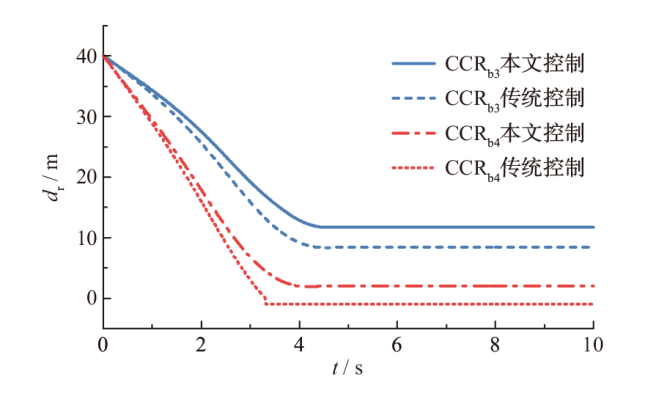
| CCRb1 | 13.90 | 13.90 | 40 | -2 |
| CCRb2 | 13.90 | 13.90 | 40 | -4 |
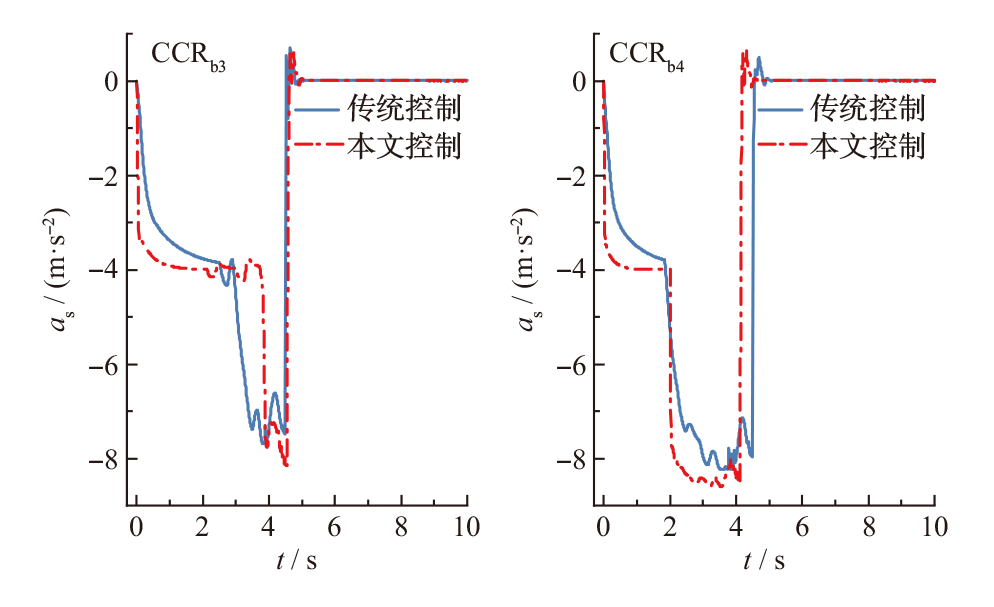
| CCRb3 | 20.00 | 13.90 | 40 | -6 |
| CCRb4 | 25.00 | 13.90 | 40 | -6 |
| 场景 | vs / (m·s-1) | vf / (m·s-1) | dr0 / m | af / (m·s-2) |
|---|---|---|---|---|
| CCRs1 | 5.56 | 0 | 50 | 0 |
| CCRs2 | 11.11 | 0 | 50 | 0 |
| CCRm1 | 8.33 | 5.56 | 50 | 0 |
| CCRm2 | 18.06 | 5.56 | 50 | 0 |
| CCRb1 | 13.90 | 13.90 | 40 | -2 |
| CCRb2 | 13.90 | 13.90 | 40 | -4 |
| CCRb3 | 20.00 | 13.90 | 40 | -6 |
| CCRb4 | 25.00 | 13.90 | 40 | -6 |
| [1] | 中华人民共和国公安部. 全国机动车保有量达4.53亿辆/驾驶人达5.42亿人[R/OL]. (2025-01-18) https://www.mps.gov.cn/n2254314/n6409334/c9939035/content.html. |
| Ministry of Public Security of the People's Republic of China. The number of motor vehicles in China has reached 453 million, and the number of drivers has reached 542 million[R/OL]. (2025-01-18) https://www.mps.gov.cn/n2254314/n6409334/c9939035/content.html. (in Chinese) | |
| [2] | 国柳鹏, 赵克刚, 梁志豪, 等. 基于深度强化学习CLPER-DDPG的车辆纵向速度规划[J]. 汽车安全与节能学报, 2024, 15(5): 702-710. |
| GUO Liupeng, ZHAO Kegang, LIANG Zhihao, et al. Vehicle longitudinal speed planning based on deep reinforcement learning CLPER-DDPG[J]. J Autom Safe Energ, 2024, 15(5): 702-710. (in Chinese) | |
| [3] |
辛佳庚, 杨复钰, 张宝迪, 等. 基于融合算法的电动汽车AEB控制策略[J]. 北京交通大学学报, 2021, 45(6): 77-86, 93.
doi: 10.11860/j.issn.1673-0291.20210029 |
|
XIN Jiageng, YANG Fuyu, ZHANG Baodi, et al. AEB control strategy of electric vehicle based on fusion algorithm[J]. J Beijing Jiaotong Univ, 2021, 45(6): 77-86, 93. (in Chinese)
doi: 10.11860/j.issn.1673-0291.20210029 |
|
| [4] | 胡朝辉, 黄顺霞, 杜展鹏, 等. 基于横向安全距离模型的主动避障算法[J]. 汽车工程, 2020, 42(5): 581-587. |
| HU Zhaohui, HUANG Shunxia, DU Zhanpeng, et al. Active obstacle avoidance algorithm based on lateral safety distance model[J]. Autom Engineering, 2020, 42(5): 581-587. (in Chinese) | |
| [5] | 兰凤崇, 余蒙, 李诗成, 等. 考虑预碰撞时间的自动紧急制动系统分层控制策略研究[J]. 汽车工程, 2020, 42(2): 206-214. |
| LAN Fengchong, YU Meng, LI Shicheng, et al. Research on hierarchical control strategy for automatic emergency braking system with consideration of time-to-collision[J]. Autom Engineering, 2020, 42(2): 206-214. (in Chinese) | |
| [6] | 郭祥靖, 孙攀, 邓杰, 等. 基于BP神经网络算法预测的重型半挂汽车列车AEB控制策略研究[J]. 汽车工程, 2021, 43(9): 1350-1359, 1366. |
| GUO Xiangjing, SUN Pan, DENG Jie, et al. Research on AEB control strategy of a heavy tractor-semitrailer combination based on BP neural network algorithm prediction[J]. Autom Engineering, 2021, 43(9): 1350-1359, 1366. (in Chinese) | |
| [7] | 胡远志, 刘俊生, 何佳, 等. 基于激光雷达点云与图像融合的车辆目标检测方法[J]. 汽车安全与节能学报, 2019, 10(4): 451-458. |
| HU Yuanzhi, LIU Junsheng, HE Jia, et al. Vehicle target detection method based on lidar point cloud and image fusion[J]. J Autom Safe Energ, 2019, 10(4): 451-458. (in Chinese) | |
| [8] | LI Yicheng, ZHONG Wei, CAI Yingfeng, et al. A new visual sensing system for motion state estimation of lateral localization of intelligent vehicles[J]. Measurement, 2024, 237: 115212. |
| [9] | CUI Yaodong, CHEN Ren, CHU Wenbo, et al. Deep learning for image and point cloud fusion in autonomous driving: A review[J]. IEEE Trans Intel Transport Syst, 2022, 23(2): 722-739. |
| [10] | ZHANG Lei, LI Xu, TANG Kaichen, et al. FS-Net: LiDAR-camera fusion with matched scale for 3D object detection in autonomous driving[J]. IEEE Trans Intel Transport Syst, 2023, 24(11): 12154-12165. |
| [11] | 李从庆. 基于障碍物聚类分析的物流无人车环境感知研究[J]. 佳木斯大学学报(自然科学版), 2024, 42(6): 138-141. |
| LI Congqing. Research on environment perception of logistics autonomous vehicles based on obstacle clustering analysis[J]. J Jiamusi Univ (Nat Sci Edit), 2024, 42(6): 138-141. (in Chinese) | |
| [12] | 李研芳, 黄影平. 基于激光雷达和相机融合的目标检测[J]. 电子测量技术, 2021, 44(5): 112-117. |
| LI Yanfang, HUANG Yingping. Target detection based on fusion of lidar and camera[J]. Elect Meas Tech, 2021, 44(5): 112-117. (in Chinese) | |
| [13] | 刘永涛, 刘传攀, 刘湘安, 等. 基于自适应采样时间MPC的自动紧急制动系统[J]. 汽车工程, 2023, 45(1): 32-41. |
| LIU Yongtao, LIU Chuanpan, LIU Xiangan, et al. Automatic emergency braking system based on model predictive control with adaptive sampling time[J]. Autom Engineering, 2023, 45(1): 32-41. (in Chinese) | |
| [14] | 陆颖, 陈烨, 杨鹏, 等. 基于自适应权重MPC的AEB-P控制策略研究[J]. 河北科技大学学报, 2024, 45(4): 341-350. |
| LU Ying, CEHN Ye, YANG Peng, et al. Research on AEB-P control strategy based on adaptive weight MPC[J]. J Hebei Univ Sci Tech, 2024, 45(4): 341-350. (in Chinese) | |
| [15] | 段顺昌, 白先旭, 石琴, 等. 汽车自动紧急制动系统控制策略的预期功能安全设计[J]. 汽车工程, 2022, 44(9): 1305-1317, 1338. |
| DUAN Shunchang, BAI Xianxu, SHI Qin, et al. The design of the safety of the intended functionality of the control strategies for vehicle automatic emergency braking system[J]. Autom Engineering, 2022, 44(9): 1305-1317, 1338. (in Chinese) | |
| [16] | WANG Dingran, TAN Jiasheng, WANG Hong, et al. SDS-YOLO: An improved vibratory position detection algorithm based on YOLOv11[J]. Measurement, 2025, 244: No 116518. |
| [17] |
李彬, 李生林. 改进YOLOv11n的无人机小目标检测算法[J]. 计算机工程与应用, 2025, 61(7): 96-104.
doi: 10.3778/j.issn.1002-8331.2411-0072 |
| LI Bin, LI Shenglin. Improved YOLOv11n small object detection algorithm in UAV view[J]. Comput Engi Appl, 2025, 61(7): 96-104. (in Chinese) | |
| [18] | CHEN Jianhong, LIN Guohan, Yelamandala C, et al. High-accuracy mapping design based on multi-view images and 3d lidar point clouds[C]// IEEE Int’l Conf Consum Electr (ICCE), Kuala Lumpur, Malaysia: IEEE Press, 2020: 1-2. |
| [19] | 张晨, 刘畅, 赵津, 等. 基于多尺度注意力机制的实时激光雷达点云语义的分割[J]. 汽车安全与节能学报, 2024, 15(4): 591-601. |
| ZHANG Chen, LIU Chang, ZHAO Jin, et al. Semantic segmentation of real-time LiDAR point clouds based on multi-scale self-attention[J]. J Autom Safe Energ, 2024, 15(4): 591-601. (in Chinese) | |
| [20] |
张炳力, 潘泽昊, 姜俊昭, 等. 基于交叉注意力机制的多模态感知融合方法[J]. 中国公路学报, 2024, 37(3): 181-193.
doi: 10.19721/j.cnki.1001-7372.2024.03.009 |
| ZHANG Bingli, PAN Zehao, JIANG junzhao, et al. Multi-modal perception fusion method based on cross attention[J]. China J Highw Transport, 2024, 37(3): 181-193. (in Chinese) | |
| [21] | WANG Yuzhong, JIN Qibing, ZHANG Ridong. Improved fuzzy PID controller design using predictive functional control structure[J]. ISA Trans, 2017, 71: 354-363. |
| [1] | ZHAO Jian, GONG Jue, FAN Kefeng, LIU Pengbo, LI Linhui, WANG Xiang, XU Zheng, DONG Zeyuan, YAO Nianmin. Safety and protection technologies for intelligent vehicles with strongly coupled structural, functional and information domains [J]. Journal of Automotive Safety and Energy, 2025, 16(6): 813-831. |
| [2] | DENG Gongxun, CAI Yani, LEI Feibing, LIU Hengjin, QI Lulin, FAN Yubo. Effect of vehicle crash severity and advanced restraint system parameters on occupant injuries [J]. Journal of Automotive Safety and Energy, 2025, 16(5): 698-706. |
| [3] | ZHENG Xunjia, CAO Zeyi, CHEN Xing, LIU Hui, GAO Jianjie. Trajectory tracking control based on adaptive prediction time-domain MPC [J]. Journal of Automotive Safety and Energy, 2025, 16(5): 773-783. |
| [4] | WANG Lin, CHEN Qinghua, YE Hongling, WANG Pengfei, XU Chi, QIAN Aiwen. Simulation of intelligent vehicle trajectory tracking based on neural network adaptive MPC [J]. Journal of Automotive Safety and Energy, 2025, 16(4): 638-647. |
| [5] | FANG Xibo, NING Yigao, ZHAO Xuan, ZHOU Meng. Adaptive identification of dynamic parameters for commercial buses based on SQP and GRNN [J]. Journal of Automotive Safety and Energy, 2025, 16(4): 648-656. |
| [6] | LIU Yu, ZHANG Huida, WU Xiaofan, JIANG Han, LI Guibing. Comparative analysis of driver response between Chinese and western drivers under various collision conditions [J]. Journal of Automotive Safety and Energy, 2025, 16(3): 376-385. |
| [7] | CHENG Rui, LU Chuncheng, YUAN Quan, CUI Tao, To. Jeremy, WANG Tao. Evaluation on the complexity of scenarios for VRU on urban roads based on self-organizing K-means [J]. Journal of Automotive Safety and Energy, 2025, 16(3): 386-395. |
| [8] | ZOU Tiefang, FU Xijun, LI Yanchun. Intelligent vehicle grading warning and braking system based on projection warning [J]. Journal of Automotive Safety and Energy, 2025, 16(3): 405-413. |
| [9] | ZHANG Xu, TAN Huiying, WU Weihai, XIE Zongfa. Two-stroke braking performance of diesel engine equipped with variable valve mechanism [J]. Journal of Automotive Safety and Energy, 2025, 16(2): 243-251. |
| [10] | ZHANG Shuo, LI Xiao, CHEN Yisong, ZHAO Xuan, YU Qiang, YU Man. Research on adaptive trajectory tracking control method for intelligent vehicle [J]. Journal of Automotive Safety and Energy, 2025, 16(2): 303-314. |
| [11] | HAN Yong, XU Guochao, LI Mingwang, PAN Di, ZHANG Haiyang. Near and far end occupant injury risk in non-regulatory side impact conditions [J]. Journal of Automotive Safety and Energy, 2025, 16(1): 57-65. |
| [12] | LIU Yang, ZHAN Jiahao, LI Shen, LI Xiaopeng, CHEN Jun. Future of autonomous driving: Single autonomous driving and intelligent vehicle-infrastructure collaboration systems [J]. Journal of Automotive Safety and Energy, 2024, 15(5): 611-633. |
| [13] | SHI Tianjing, LI Xu. Traffic flow parameter prediction method based on dynamic graphs self-attention [J]. Journal of Automotive Safety and Energy, 2024, 15(5): 680-688. |
| [14] | HUANG Chen, JIA Dingpeng, SUN Xiaoqiang, XU Qing. Intelligent vehicle path planning method based on peripheral vehicle trajectory prediction [J]. Journal of Automotive Safety and Energy, 2024, 15(5): 753-762. |
| [15] | JIANG Jian, WANG Ping. Diagnosis of residual bidirectional LSTM automotive motor bearings with attention mechanism [J]. Journal of Automotive Safety and Energy, 2024, 15(4): 511-519. |
| Viewed | ||||||
|
Full text |
|
|||||
|
Abstract |
|
|||||
