Welcome to Journal of Automotive Safety and Energy,

Journal of Automotive Safety and Energy ›› 2025, Vol. 16 ›› Issue (1): 32-42.DOI: 10.3969/j.issn.1674-8484.2025.01.003
• Automotive Safety • Previous Articles Next Articles
RONG Hai1,3( ), JIANG Jianzhong1,4, YAO Zaiqi2,*(), MA Kai2, DU Kenan2
Received:2024-08-28
Revised:2024-09-18
Online:2025-02-28
Published:2025-03-04
CLC Number:
RONG Hai, JIANG Jianzhong, YAO Zaiqi, MA Kai, DU Kenan. Multidisciplinary design optimization of a vehicle body for lightweight based on a neural network surrogate model[J]. Journal of Automotive Safety and Energy, 2025, 16(1): 32-42.
Add to citation manager EndNote|Ris|BibTeX
URL: https://www.journalase.com/EN/10.3969/j.issn.1674-8484.2025.01.003
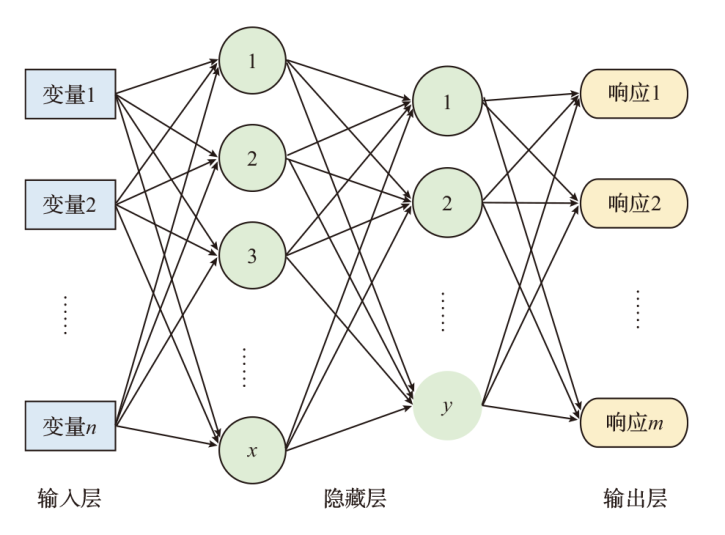
| 模型编号 | #1 | #2 | #3 | #4 | #5 | #6 |
|---|---|---|---|---|---|---|
| 输入层神经元个数 | 29 | 29 | 32 | 32 | 82 | 82 |
| 输出层神经元个数 | 1 | 1 | 4 | 1 | 2 | 2 |
| 输出层激活函数 | 线性 | 线性 | 线性 | 线性 | 线性 | 线性 |
| 隐藏层层数 | 3 | 3 | 4 | 3 | 2 | 2 |
| 隐藏层神经元个数 | 18 | 21 | 20 | 20 | 15 | 12 |
| 隐藏层激活函数 | ReLU | ReLU | ReLU | ReLU | ReLU | ReLU |
| 模型编号 | #1 | #2 | #3 | #4 | #5 | #6 |
|---|---|---|---|---|---|---|
| 输入层神经元个数 | 29 | 29 | 32 | 32 | 82 | 82 |
| 输出层神经元个数 | 1 | 1 | 4 | 1 | 2 | 2 |
| 输出层激活函数 | 线性 | 线性 | 线性 | 线性 | 线性 | 线性 |
| 隐藏层层数 | 3 | 3 | 4 | 3 | 2 | 2 |
| 隐藏层神经元个数 | 18 | 21 | 20 | 20 | 15 | 12 |
| 隐藏层激活函数 | ReLU | ReLU | ReLU | ReLU | ReLU | ReLU |
| 工况 | 性能指标 | FCNN | RSM | Kriging |
|---|---|---|---|---|
| FRB | IFRB | 0.92 | 0.81 | 0.79 |
| aFRB | 0.88 | 0.78 | 0.79 | |
| MDB | IMDB1~IMDB4 | 0.91 | 0.80 | 0.82 |
| RP | IRP | 0.91 | 0.81 | 0.83 |
| 模态 | Mt / Mb | 0.99/0.94 | 0.96/0.91 | 0.95/0.92 |
| 刚度 | St / Sb | 0.99/0.98 | 0.98/0.98 | 0.97/0.98 |
| 工况 | 性能指标 | FCNN | RSM | Kriging |
|---|---|---|---|---|
| FRB | IFRB | 0.92 | 0.81 | 0.79 |
| aFRB | 0.88 | 0.78 | 0.79 | |
| MDB | IMDB1~IMDB4 | 0.91 | 0.80 | 0.82 |
| RP | IRP | 0.91 | 0.81 | 0.83 |
| 模态 | Mt / Mb | 0.99/0.94 | 0.96/0.91 | 0.95/0.92 |
| 刚度 | St / Sb | 0.99/0.98 | 0.98/0.98 | 0.97/0.98 |
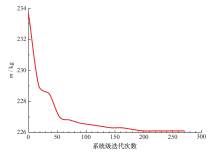
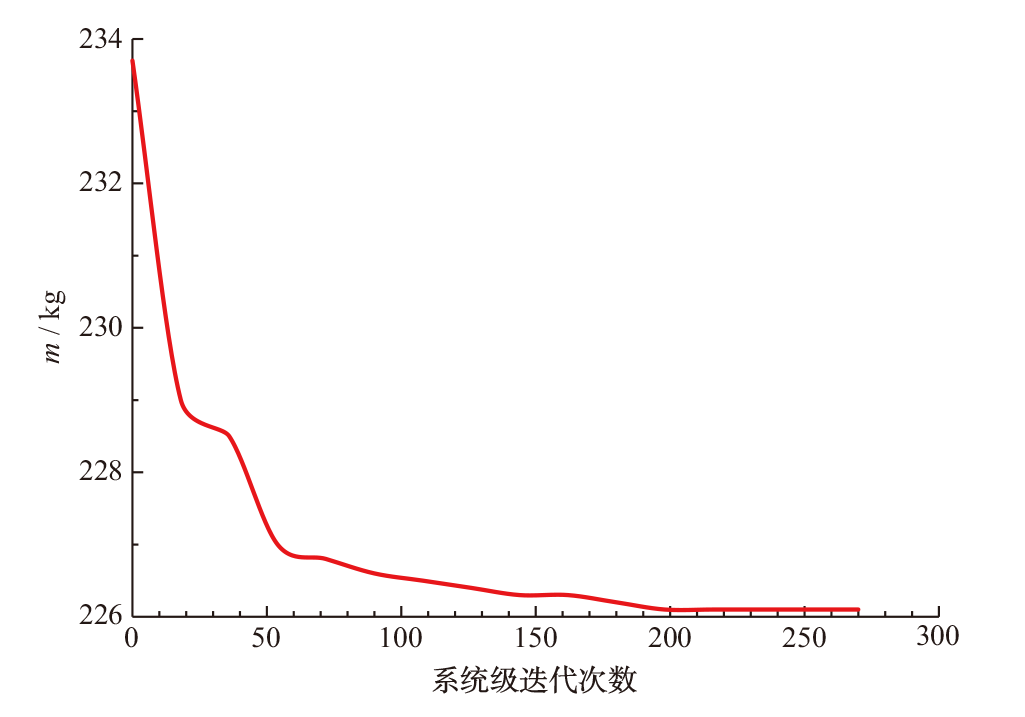
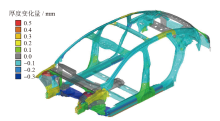
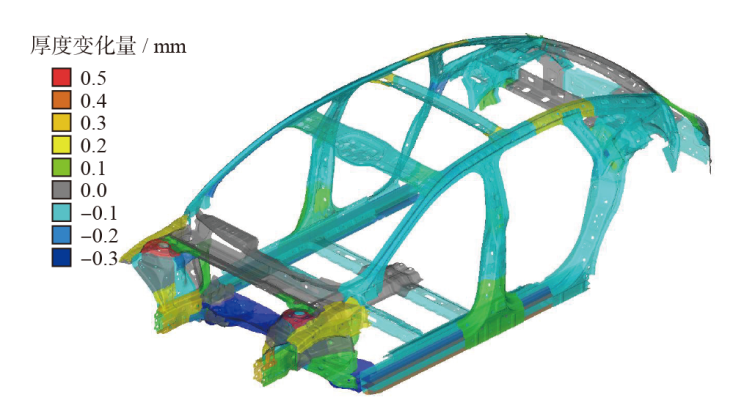
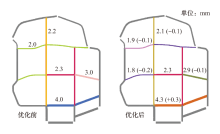
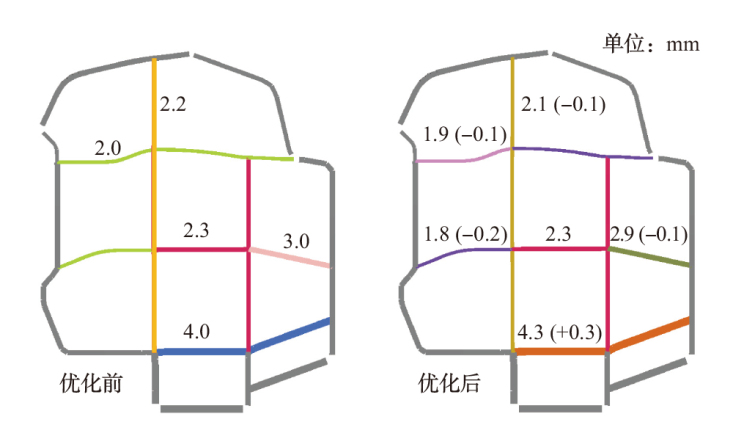
| 工况 | 性能指标 | 基础值 | 优化 结果 | 验证 结果 | 变化量 | 性能 评价 |
|---|---|---|---|---|---|---|
| FRB | IFRB / mm | 35.3 | 31.8 | 33.4 | -1.9 | 提升 |
| aFRB / g | 32.7 | 32.9 | 34.7 | +2.0 | 下降 | |
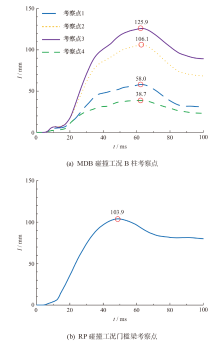
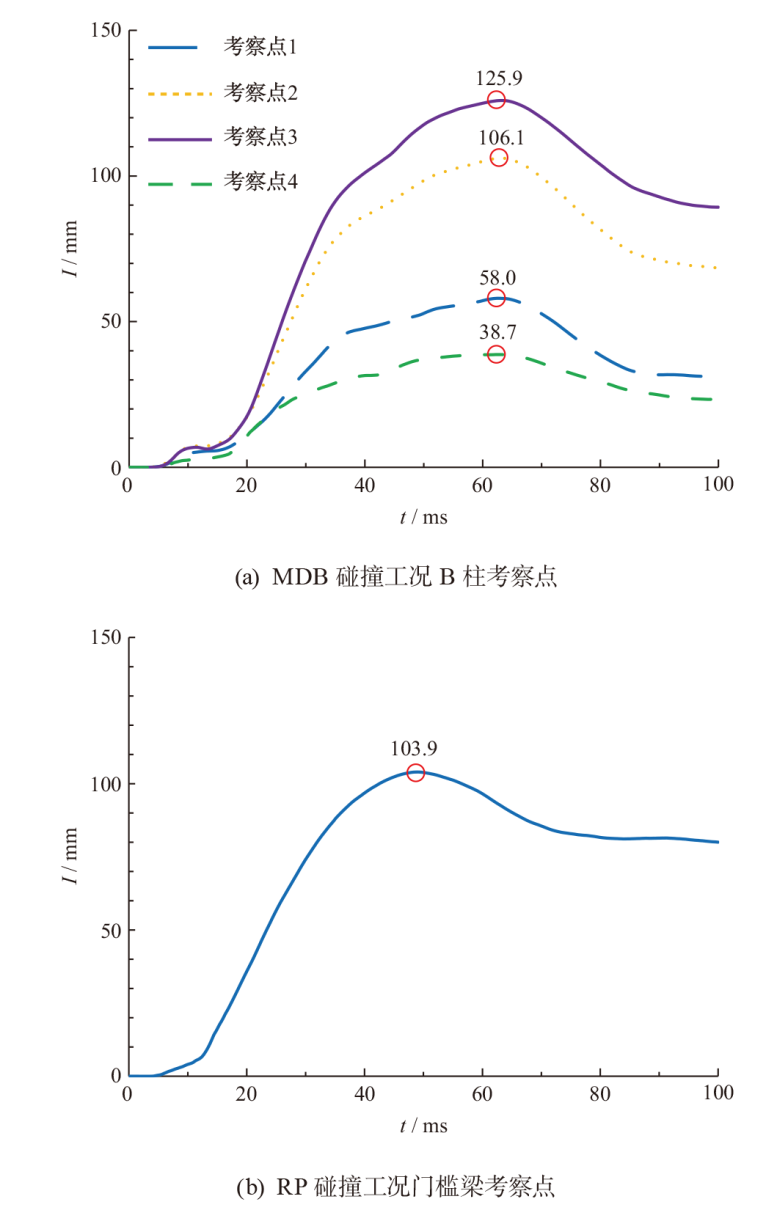
| MDB | IMDB1 / mm | 58.0 | 58.4 | 57.0 | -1.0 | 提升 |
| IMDB2 / mm | 106.1 | 105.7 | 105.4 | -0.7 | 提升 | |
| IMDB3 / mm | 125.9 | 124.6 | 123.4 | -2.5 | 提升 | |
| IMDB4 / mm | 38.7 | 37.6 | 39.1 | +0.4 | 下降 | |
| RP | IRP / mm | 103.9 | 102.9 | 105.7 | +1.8 | 下降 |
| 模态 | Mt / Hz | 55.2 | 55.5 | 55.7 | +0.5 | 提升 |
| Mb / Hz | 59.8 | 60.3 | 60.7 | +0.9 | 提升 | |
| 刚度 | St / [kN·m(°)-1] | 39.743 | 39 674 | 39 695 | -48.0 | 下降 |
| Sb / (kN·mm-1) | 14.920 | 14 957 | 14 948 | +28.0 | 提升 | |
| 质量 | m / kg | 233.7 | 226.2 | 226.2 | -7.5 | 减重 |
| 工况 | 性能指标 | 基础值 | 优化 结果 | 验证 结果 | 变化量 | 性能 评价 |
|---|---|---|---|---|---|---|
| FRB | IFRB / mm | 35.3 | 31.8 | 33.4 | -1.9 | 提升 |
| aFRB / g | 32.7 | 32.9 | 34.7 | +2.0 | 下降 | |
| MDB | IMDB1 / mm | 58.0 | 58.4 | 57.0 | -1.0 | 提升 |
| IMDB2 / mm | 106.1 | 105.7 | 105.4 | -0.7 | 提升 | |
| IMDB3 / mm | 125.9 | 124.6 | 123.4 | -2.5 | 提升 | |
| IMDB4 / mm | 38.7 | 37.6 | 39.1 | +0.4 | 下降 | |
| RP | IRP / mm | 103.9 | 102.9 | 105.7 | +1.8 | 下降 |
| 模态 | Mt / Hz | 55.2 | 55.5 | 55.7 | +0.5 | 提升 |
| Mb / Hz | 59.8 | 60.3 | 60.7 | +0.9 | 提升 | |
| 刚度 | St / [kN·m(°)-1] | 39.743 | 39 674 | 39 695 | -48.0 | 下降 |
| Sb / (kN·mm-1) | 14.920 | 14 957 | 14 948 | +28.0 | 提升 | |
| 质量 | m / kg | 233.7 | 226.2 | 226.2 | -7.5 | 减重 |
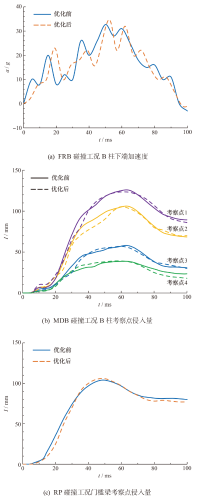
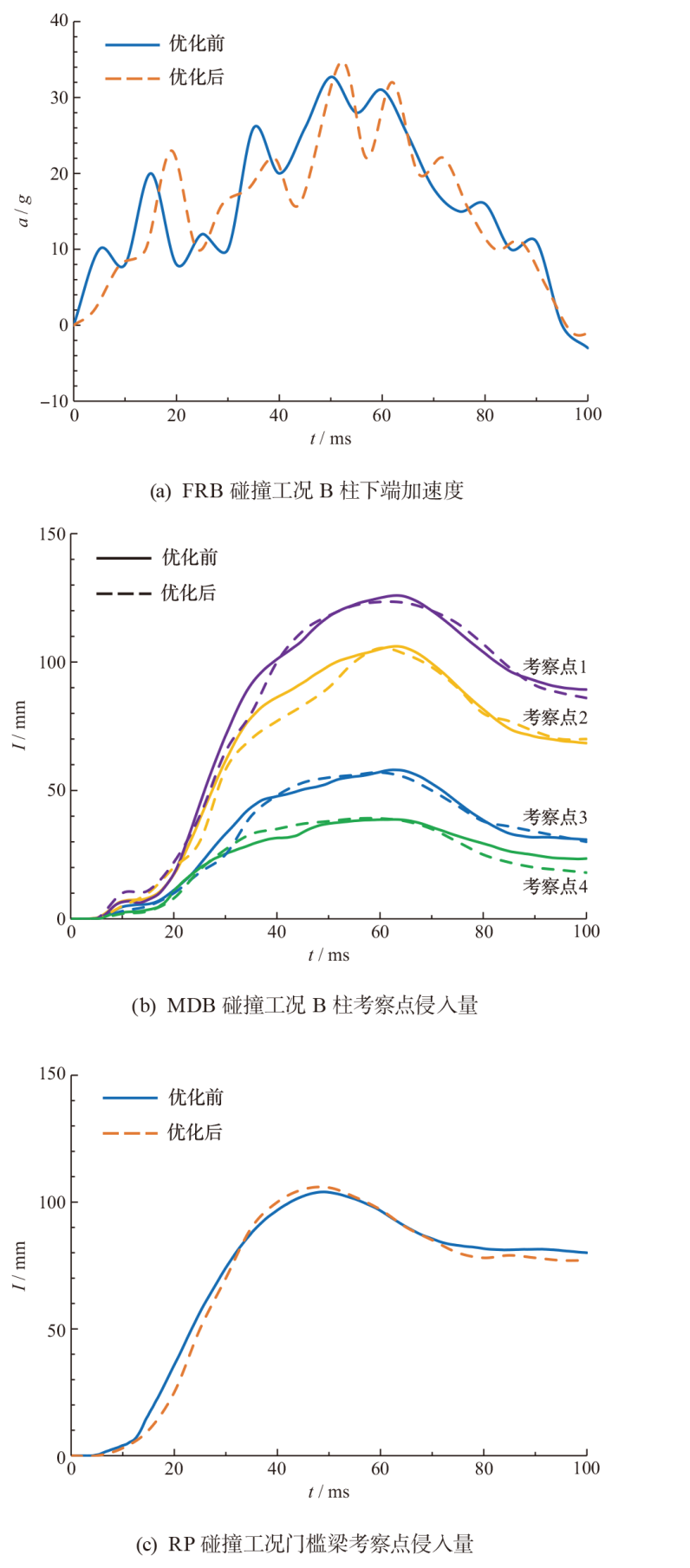
| [1] | Kodiyalam S, Yang R J, Gu L, et al. Multidisciplinary design optimization of a vehicle system in a scalable, high performance computing environment[J]. Struct Multidiscip Opti, 2004, 26(3-4): 256-263. |
| [2] | 史国宏, 陈勇, 杨雨泽, 等. 白车身多学科轻量化优化设计应用[J]. 机械工程学报, 2012, 48(8): 110-114. |
| SHI Guohong, CHEN Yong, YANG Yuze, et al. BIW architecture multidisciplinary light weight optimization design[J]. J Mech Eng, 2012, 48(8): 110-114. (in Chinese) | |
| [3] | Ryberg A B, Nilsson L. A metamodel-based multidisciplinary design optimization process for automotive structures[J]. Engi Compu, 2015, 31(4): 711-728. |
| [4] | 刘钊, 李晗, 朱平. 基于粒子群算法的轿车车身多学科优化设计[J]. 汽车工程, 2018, 40(3): 251-258. |
| LIU Zhao, LI Han, ZHU Ping. Multidisciplinary design optimization of car body based on particle swarm algorithm[J]. Autom Engineerin, 2018, 40(3): 251-258. (in Chinese) | |
| [5] | 段利斌, 周华锦, 杜展鹏, 等. 基于SHCA-T算法的车身骨架多工况耐撞性优化设计[J]. 汽车工程, 2023, 45(2): 304-312. |
| DUAN Libin, ZHOU Huajin, DU Zhanpeng, et al. Multi working condition crashworthiness optimization design of body frame based on SHCA-T algorithm[J]. Autom Engineerin, 2023, 45(2): 304-312. (in Chinese) | |
| [6] | Queipo N V, Haftka R T, Shyy W, et al. Surrogate-based analysis and optimization[J]. Prog Aerosp Sc, 2005, 41(1): 1-28. |
| [7] | 程雨婷. 基于协同优化方法的汽车车身性能多学科优化[D]. 北京: 北京理工大学, 2016. |
| CHENG Yuting. Multidisciplinary design optimization of vehicle body performance based on collaborative optimization[D]. Beijing: Beijing Institute of Technology, 2016. (in Chinese) | |
| [8] | LI Han, LIU Zhao, ZHU Ping. An improved multi-objective optimization algorithm with mixed variables for automobile engine hood lightweight design[J]. J Mech Sci Tec, 2021, 35(5): 2073-2082. |
| [9] | LI Zhixiang, MA Wen, YAO Shuguang, et al. A machine learning based optimization method towards removing undesired deformation of energy-absorbing structures[J]. Struct Multidiscip Opti, 2021, 64(2): 919-934. |
| [10] | 王居闯, 曹清林, 邱睿, 等. 在侧面碰撞中电动汽车电池模块破损的预测[J]. 汽车安全与节能学报, 2024, 15(2): 169-177. |
| WANG Juchuang, CAO Qinglin, QIU Rui, et al. Prediction of battery-module damage in electric-vehicle side-collisions[J]. J Autom Safe Ener, 2024, 15(2): 169-177. (in Chinese) | |
| [11] | 陈延展. 基于机器学习与智能优化的车身薄壁结构轻量化设计[D]. 长沙: 湖南大学, 2022. |
| CHEN Yanzhan. Lightweight design of thin-wall structure based on machine learning and intelligent optimization[D]. Changsha: Hunan University, 2022. (in Chinese) | |
| [12] | National Highway Traffic Safety Administration. USDOT releases 2016 fatal traffic crash data[EB/OL]. (2016-10-06) https://www.nhtsa.gov/press-releases/usdot-releases2016-fatal-traffic-crash-data. |
| [13] | 中国汽车技术研究中心有限公司. C-NCAP管理规则(2021年版)[S]. 天津: 中国汽车技术研究中心有限公司, 2019. |
| China Automotive Technology and Research Center Co., Ltd. C-NCAP Management Regulation (2021 Edition)[S]. Tianjin: China Automotive Technology and Research Center Co., Ltd, 2019. (in Chinese) | |
| [14] | 黄焕军, 张博文, 吴光强, 等. 基于组合代理模型的车身多学科设计优[J]. 汽车工程, 2016, 38(9): 1107-1113. |
| HUANG Huanjun, ZHANG Bowen, WU Guangqiang, et al. Multidisciplinary design optimization of vehicle body based on ensemble surrogates[J]. Autom Engineerin, 2016, 38(9): 1107-1113. (in Chinese) | |
| [15] | 肖海涛, 董江涛, 王月, 等. 某车型侧面柱碰车身结构耐撞性优化[J]. 汽车安全与节能学报, 2015, 6(2): 156-163. |
| XIAO Haitao, DONG Jiangtao, WANG Yue, et al. Optimization of body structure crashworthiness in side pole impact for a car[J]. J Autom Safe Ener, 2015, 6(2): 156-163. (in Chinese) | |
| [16] | XU Zhongming, ZHANG Liang, ZHANG Zhifei, et al. Research on pole and moving deformable barrier side impact of passenger car based on simulation test[J]. J Syst Simula, 2013, 25(1): 170-175. |
| [17] | 马骊凕, 朱智民, 安占飞, 等. 轿车白车身模态分析[J]. 振动与冲击, 2013, 32(21): 214-218. |
| MA Liming, ZHU Zhimin, AN Zhanfei, et al. Modal analysis of a car BIW[J]. J Vibrat Shoc, 2013, 32(21): 214-218. (in Chinese) | |
| [18] | XIONG Feng, WANG Dengfeng, CHEN Shuming, et al. Multi-objective lightweight and crashworthiness optimization for the side structure of an automobile body[J]. Struct Multidiscip Opti, 2018, 58(4): 1-21. |
| [19] | 沈保山, 范圣耀, 钟兵, 等. 基于隐式参数化的车身轻量化设计[J]. 机械设计, 2022, 39(8): 109-113. |
| SHEN Baoshan, FAN shengyao, ZHONG Bing, et al. Lightweight design of car body based on implicit parameterization[J]. J Mach Desi, 2022, 39(8): 109-113. (in Chinese) | |
| [20] | Kroo I, Altus S, Braun R, et al. Multidisciplinary optimization methods for aircraft preliminary design[R]. AIAA-1994-4325. |
| [21] | 杨丽丽. 多学科协同优化及其不确定性和多目标性研究[D]. 上海: 上海交通大学, 2018. |
| YANG Lili. Research on multidisciplinary collaborative optimization and its uncertainty and multiobjectivity[D]. Shanghai: Shanghai Jiao Tong University, 2018. (in Chinese) | |
| [22] | Alexandrov N M, Lewis R M. Analytical and computational aspects of collaborative optimization for multidisciplinary design[J]. AIAA , 2002, 40(2): 301-309. |
| [23] | XIA Yufei, LIU Chuanzhe, LI Yuying, et al. A boosted decision tree approach using Bayesian hyper-parameter optimization for credit scoring[J]. Expert Syst App, 2017, 78: 225-241. |
| [24] | Rumelhart D E, Hinton G, Williams R J. Learning representations by back-propagating errors[J]. Natur, 1986, 323(6088) : 533-536. |
| [25] | Draper N R, Smith H. Applied Regression Analysis (3rd Edit)[M]. New York: Wiley, 1998: 1-13. |
| [26] | Fukuda E H, Drummond L M G, Raupp F M P. An external penalty-type method for multicriteria[J]. TO, 2016, 24(2): 493-513. |
| [1] | HAN Dongming, CHENG Sizhe, WANG Jinxiang, LIU Yahui, YIN Guodong. Predictive cooperative-adaptive cruise-control for the intelligent- connected vehicles in the mixed traffic [J]. Journal of Automotive Safety and Energy, 2026, 17(1): 130-139. |
| [2] | FU Xueqing, CHEN Chuang, ZHOU Daoqing, ZHANG Yan, CAO Xiaolin, LI Xin, JI Jianbo, CHEN Peng, XUE Xingxu, LI Yaozong. Research on effects of flame tube hole diameters on combustor combustion performance based on neural network [J]. Journal of Automotive Safety and Energy, 2026, 17(1): 88-95. |
| [3] | QIU Zhaoyu, ZHU Xiaoyuan, TIAN Guangyu, YIN Guodong. Fault-tolerant and safety control of intelligent connected vehicles under stealthy network attacks [J]. Journal of Automotive Safety and Energy, 2025, 16(6): 914-922. |
| [4] | WANG Lin, CHEN Qinghua, YE Hongling, WANG Pengfei, XU Chi, QIAN Aiwen. Simulation of intelligent vehicle trajectory tracking based on neural network adaptive MPC [J]. Journal of Automotive Safety and Energy, 2025, 16(4): 638-647. |
| [5] | FANG Xibo, NING Yigao, ZHAO Xuan, ZHOU Meng. Adaptive identification of dynamic parameters for commercial buses based on SQP and GRNN [J]. Journal of Automotive Safety and Energy, 2025, 16(4): 648-656. |
| [6] | YU Anjun, LI Yingdi, YANG Zheyi, FU Chongyu, TONG Weiping, YU Jia, LIU Yunhai, LIU Zhiyuan. Highway traffic flow prediction approach based on multi-dimensional attention mechanism [J]. Journal of Automotive Safety and Energy, 2025, 16(3): 463-469. |
| [7] | ZHANG Licheng, YA Jingtian, PENG Kun, YANG Ran. Impact of Jerk on neural network based fuel consumption predicting models [J]. Journal of Automotive Safety and Energy, 2025, 16(1): 117-126. |
| [8] | ZHANG Chen, LIU Chang, ZHAO Jin, WANG Guangwei, XU Qing. Semantic segmentation of real-time LiDAR point clouds based on multi-scale self-attention [J]. Journal of Automotive Safety and Energy, 2024, 15(4): 591-601. |
| [9] | WANG Juchuang, CAO Qinglin, QIU Rui, SONG Liuwei, GUO Ping'an, ZHAO Gang. Prediction of battery-module damage in electric-vehicle side-collisions [J]. Journal of Automotive Safety and Energy, 2024, 15(2): 169-177. |
| [10] | WANG Danqi, WU Lintao, NIE Bingbing, CHE Wenchuan, ZOU Tiefang, ZHANG Junyuan. Impact damage analysis and minimum penetration energy prediction of CFRP laminated cylindrical shell for automotive applications [J]. Journal of Automotive Safety and Energy, 2024, 15(1): 29-38. |
| [11] | ZHU Bo, ZHANG Jiwei, TAN Dongkui, HU Xudong. End-to-end autonomous driving method based on multi-source sensor and navigation map [J]. Journal of Automotive Safety and Energy, 2022, 13(4): 738-749. |
| [12] | WEI Meng, WANG Qiao, YE Min, LIAN Gaoqi, XU Xinxin. Remaining useful life prediction of lithium-ion batteries based on dropout Monte Carlo recurrent neural network [J]. Journal of Automotive Safety and Energy, 2022, 13(3): 541-549. |
| [13] | ZHU Yan, XIE Zhongzhi, YU Wen, LI Shusheng, ZHANG Xun. Fatigue-driving detect-technology in low light environment based on facial feature points [J]. Journal of Automotive Safety and Energy, 2022, 13(2): 282-289. |
| [14] | WANG Baolin, XIA Huaicheng, DONG Qianqian. Correction for pulse number of indirect tire pressure monitoring system under vehicle turning condition [J]. Journal of Automotive Safety and Energy, 2021, 12(4): 507-515. |
| [15] | ZHANG Ping, CHI Zhicheng, CHEN Yifan, HUI Fei. Multiple object tracking algorithm integrated with attention mechanism for autonomous vehicles [J]. Journal of Automotive Safety and Energy, 2021, 12(4): 516-521. |
| Viewed | ||||||
|
Full text |
|
|||||
|
Abstract |
|
|||||
