Welcome to Journal of Automotive Safety and Energy,

Journal of Automotive Safety and Energy ›› 2024, Vol. 15 ›› Issue (6): 895-904.DOI: 10.3969/j.issn.1674-8484.2024.06.011
• Automotive Energy Efficiency and Environment Protection • Previous Articles Next Articles
LI Xinguang1( ), SUN Chongxiao2, QU Dayi1, YU Wenchang1, HU Han2
Received:2023-11-01
Revised:2024-05-01
Online:2024-12-31
Published:2025-01-01
CLC Number:
LI Xinguang, SUN Chongxiao, QU Dayi, YU Wenchang, HU Han. Eco-driving strategy for mixed traffic flow of connected automated vehicles considering intersection start-stop wave[J]. Journal of Automotive Safety and Energy, 2024, 15(6): 895-904.
Add to citation manager EndNote|Ris|BibTeX
URL: https://www.journalase.com/EN/10.3969/j.issn.1674-8484.2024.06.011
| 仿真时间 | 1 200 s | 路侧设备通信范围 | 300 m |
|---|---|---|---|
| 驾驶人反应时间,τ | 1 s | 道路最高限速,vmax | 50 km / h |
| 信号周期,S | 90 s | 车辆最大加速度,amax | 2.5 m / s2 |
| 红灯时间,Tr | 42 s | 车辆最大减速度,amim | -2.5 m / s2 |
| 绿灯时间,Tg | 42 s | 车身长度,l | 4.5 m |
| 黄灯时间,Ty | 3 s | 最小车间距,S0 | 1.5 m |
| 仿真时间 | 1 200 s | 路侧设备通信范围 | 300 m |
|---|---|---|---|
| 驾驶人反应时间,τ | 1 s | 道路最高限速,vmax | 50 km / h |
| 信号周期,S | 90 s | 车辆最大加速度,amax | 2.5 m / s2 |
| 红灯时间,Tr | 42 s | 车辆最大减速度,amim | -2.5 m / s2 |
| 绿灯时间,Tg | 42 s | 车身长度,l | 4.5 m |
| 黄灯时间,Ty | 3 s | 最小车间距,S0 | 1.5 m |
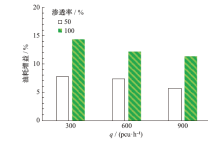
| 交通流 (pcu·h-1) | 网联车渗透率 % | 平均燃油消耗量 (g·s-1) | CO2排放量 (g·s-1) | CO排放量 (g·s-1) | HC排放量 (g·s-1) | NOx排放量 (g·s-1) |
|---|---|---|---|---|---|---|
| 300 | 0 | 0.465 3 | 8.127 9 | 0.041 6 | 0.004 7 | 0.004 8 |
| 50 | 0.433 7 | 7.577 7 | 0.037 1 | 0.004 6 | 0.004 1 | |
| 100 | 0.392 1 | 6.853 2 | 0.031 9 | 0.004 5 | 0.003 3 | |
| 600 | 0 | 0.494 2 | 8.764 5 | 0.044 2 | 0.005 0 | 0.005 2 |
| 50 | 0.457 7 | 8.119 2 | 0.038 8 | 0.005 1 | 0.004 2 | |
| 100 | 0.433 7 | 7.695 0 | 0.035 8 | 0.005 0 | 0.003 7 | |
| 900 | 0 | 0.535 6 | 9.431 6 | 0.047 5 | 0.005 5 | 0.005 4 |
| 50 | 0.505 0 | 8.540 1 | 0.040 0 | 0.005 5 | 0.004 2 | |
| 100 | 0.474 5 | 8.359 9 | 0.038 6 | 0.005 5 | 0.004 0 |
| 交通流 (pcu·h-1) | 网联车渗透率 % | 平均燃油消耗量 (g·s-1) | CO2排放量 (g·s-1) | CO排放量 (g·s-1) | HC排放量 (g·s-1) | NOx排放量 (g·s-1) |
|---|---|---|---|---|---|---|
| 300 | 0 | 0.465 3 | 8.127 9 | 0.041 6 | 0.004 7 | 0.004 8 |
| 50 | 0.433 7 | 7.577 7 | 0.037 1 | 0.004 6 | 0.004 1 | |
| 100 | 0.392 1 | 6.853 2 | 0.031 9 | 0.004 5 | 0.003 3 | |
| 600 | 0 | 0.494 2 | 8.764 5 | 0.044 2 | 0.005 0 | 0.005 2 |
| 50 | 0.457 7 | 8.119 2 | 0.038 8 | 0.005 1 | 0.004 2 | |
| 100 | 0.433 7 | 7.695 0 | 0.035 8 | 0.005 0 | 0.003 7 | |
| 900 | 0 | 0.535 6 | 9.431 6 | 0.047 5 | 0.005 5 | 0.005 4 |
| 50 | 0.505 0 | 8.540 1 | 0.040 0 | 0.005 5 | 0.004 2 | |
| 100 | 0.474 5 | 8.359 9 | 0.038 6 | 0.005 5 | 0.004 0 |

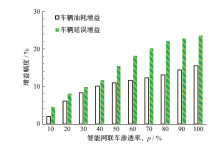
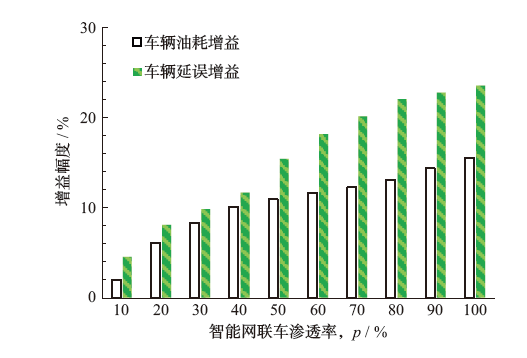
| 网联车渗透率 % | 平均燃油消耗量(g·s-1) | CO2排放量 (g·s-1) | CO排放量 (g·s-1) | HC排放量 (g·s-1) | NOx排放量 (g·s-1) | 延误时间 s |
|---|---|---|---|---|---|---|
| 0 | 0.494 2 | 8.764 5 | 0.044 2 | 0.005 0 | 0.005 2 | 34.599 3 |
| 10 | 0.484 5 | 8.669 3 | 0.043 5 | 0.005 1 | 0.005 0 | 33.043 3 |
| 20 | 0.464 4 | 8.110 6 | 0.040 3 | 0.004 8 | 0.004 6 | 31.804 4 |
| 30 | 0.453 2 | 7.957 8 | 0.038 5 | 0.004 9 | 0.004 2 | 31.202 5 |
| 40 | 0.444 4 | 7.883 4 | 0.037 9 | 0.004 9 | 0.004 1 | 30.566 2 |
| 50 | 0.440 3 | 7.810 7 | 0.037 3 | 0.004 9 | 0.004 0 | 29.263 6 |
| 60 | 0.436 7 | 7.747 4 | 0.037 1 | 0.004 9 | 0.004 0 | 28.309 0 |
| 70 | 0.433 7 | 7.693 1 | 0.036 9 | 0.004 8 | 0.004 0 | 27.632 0 |
| 80 | 0.429 4 | 7.618 5 | 0.036 3 | 0.004 8 | 0.003 9 | 26.961 1 |
| 90 | 0.423 3 | 7.509 5 | 0.034 9 | 0.004 8 | 0.003 6 | 26.714 7 |
| 100 | 0.417 2 | 7.402 6 | 0.034 4 | 0.004 8 | 0.003 6 | 26.444 7 |
| 网联车渗透率 % | 平均燃油消耗量(g·s-1) | CO2排放量 (g·s-1) | CO排放量 (g·s-1) | HC排放量 (g·s-1) | NOx排放量 (g·s-1) | 延误时间 s |
|---|---|---|---|---|---|---|
| 0 | 0.494 2 | 8.764 5 | 0.044 2 | 0.005 0 | 0.005 2 | 34.599 3 |
| 10 | 0.484 5 | 8.669 3 | 0.043 5 | 0.005 1 | 0.005 0 | 33.043 3 |
| 20 | 0.464 4 | 8.110 6 | 0.040 3 | 0.004 8 | 0.004 6 | 31.804 4 |
| 30 | 0.453 2 | 7.957 8 | 0.038 5 | 0.004 9 | 0.004 2 | 31.202 5 |
| 40 | 0.444 4 | 7.883 4 | 0.037 9 | 0.004 9 | 0.004 1 | 30.566 2 |
| 50 | 0.440 3 | 7.810 7 | 0.037 3 | 0.004 9 | 0.004 0 | 29.263 6 |
| 60 | 0.436 7 | 7.747 4 | 0.037 1 | 0.004 9 | 0.004 0 | 28.309 0 |
| 70 | 0.433 7 | 7.693 1 | 0.036 9 | 0.004 8 | 0.004 0 | 27.632 0 |
| 80 | 0.429 4 | 7.618 5 | 0.036 3 | 0.004 8 | 0.003 9 | 26.961 1 |
| 90 | 0.423 3 | 7.509 5 | 0.034 9 | 0.004 8 | 0.003 6 | 26.714 7 |
| 100 | 0.417 2 | 7.402 6 | 0.034 4 | 0.004 8 | 0.003 6 | 26.444 7 |
| [1] | 杨澜, 赵祥模, 吴国垣. 智能网联汽车协同生态驾驶策略综述[J]. 交通运输工程学报, 2020, 20(5): 58-72. |
| YANG Lan, ZHAO Xiangmo, WU Guohuan, et al. A review of cooperative eco-driving strategies for intelligent connected vehicles[J]. J Transport Engineering, 2020, 20(5): 58-72. (in Chinese) | |
| [2] | 陈志军, 张晶明, 熊盛光. 智能网联车辆生态驾驶研究现状及展望[J]. 交通信息与安全, 2022, 40(4): 13-25. |
| CHEN Zhijun, ZHANG Jingming, XIONG Shengguan et al. Current status and outlook of research on eco-driving of intelligent connected vehicles[J]. Traf Info Safe, 2022, 40(4): 13-25. (in Chinese) | |
| [3] |
卢凯, 张杰华, 邓兴栋. 基于车速与信号协同优化的区域绿波协调控制模型[J]. 中国公路学报, 2021, 34(7): 31-41.
doi: 10.19721/j.cnki.1001-7372.2021.07.002 |
| LU Kai, ZHANG Jiehua, DENG Xingdong, et al. A coordinated control model of regional green wave based on cooperative optimization of vehicle speed and signal[J]. China J Highw Transport, 2021, 34(7): 31-41. (in Chinese) | |
| [4] |
王昊, 彭显玥. 临界饱和状态交通干线协调控制模型[J]. 中国公路学报, 2022, 35(7): 228-240.
doi: 10.19721/j.cnki.1001-7372.2022.07.019 |
|
WANG Hao, PENG Xianyue. Coordinated control model for traffic arteries in critical saturation state[J]. Chin J Highw Transport, 2022, 35(7): 228-240. (in Chinese)
doi: 10.19721/j.cnki.1001-7372.2022.07.019 |
|
| [5] | 冉斌, 谭华春, 张健. 智能网联交通技术发展现状及趋势[J]. 汽车安全与节能学报, 2018, 9(2): 119-130. |
| RAN Bin, TAN Huachun, ZHANG Jian, et al. Development status and trend of connected automated vehicle highway system[J]. Autom Safe Energ, 2018, 9(2): 119-130. | |
| [6] | TANG Tieqiao, YI Zhiyan, ZHANG Jian, et al. A speed guidance strategy for multiple signalized intersections based on car-following model[J]. Phys A: Statist Mech Its Appl, 2018, 496: 399-409. |
| [7] | LI Xiaopeng, GHIASI Amir, XU Zhigang, et al. A piecewise trajectory optimization model for connected automated vehicles: Exact optimization algorithm and queue propagation analysis[J]. Transport Res Part B: Methodolog, 2018, 118: 429-456. |
| [8] | 黄意然, 宋国华, 彭飞. 考虑排队长度的信号交叉口生态驾驶轨迹优化[J]. 交通运输工程与信息学报, 2022, 20(3): 43-56. |
| HUANG Yiran, SONG Guohua, PENG Fei, et al. Trajectory optimization for eco-driving taking into account queuing length at signalized intersections[J]. J Transport Engi Info, 2022, 20(3): 43-56. (in Chinese) | |
| [9] | LIN Qingfeng, LI Shengbo Eben, DU Xuejin, et al. Minimize the fuel consumption of connected vehicles between two red-signalized intersections in urban traffic[J]. IEEE Trans Vehi Tech, 2018, 67(10): 9060-9072. |
| [10] | XIN Qi, FU Rui, YUAN Wei, et al. Predictive intelligent driver model for eco-driving using upcoming traffic signal information[J]. Phys A: Statist Mech Its Appl, 2018, 508: 806-823. |
| [11] | LIU Meiqi, WANG Meng, Serge H. Optimal platoon trajectory planning approach at arterials[J]. Transport Res Record, 2019, 2673(9): 214-226. |
| [12] | 刘显贵, 王晖年, 洪经纬. 网联环境下交叉口车速控制策略及优化[J]. 交通运输系统工程与信息, 2021, 21(2): 82-90. |
| LIU Xiangui, WANG Huinian, HONG Jingwei, et al. Signal intersection speed control strategy and optimization in a networked environment[J]. Transport Syst Engi Info, 2021, 21(2): 82-90. (in Chinese) | |
| [13] |
罗瑞发, 郝慧君, 徐桃让, 等. 考虑时延的网联车混合交通流基本图模型[J]. 华南理工大学学报(自然科学版), 2023, 51(1): 106-113.
doi: 10.12141/j.issn.1000-565X.210702 |
| LUO Ruifa, HAO Huijun, XU Taorang, et al. Fundamental diagram model of mixed traffic flow of connected vehicles considering time delay.[J]. J South Chin Univ Tech (Nat Sci Edit), 2023, 51(1): 106-113. (in Chinese) | |
| [14] | SUN Pengyuan, Daisik N, Jayakrishnan R, et al. An eco-driving algorithm based on vehicle to infrastructure (V2I) communications for signalized intersections[J]. Transport Res Part C, 2022, 144: 103876. |
| [15] |
杜煜, 上官伟, 柴琳果. 交叉口基于出发时刻预测的生态驾驶方法[J]. 中国公路学报, 2022, 35(6): 277-288.
doi: 10.19721/j.cnki.1001-7372.2022.06.023 |
|
DU Yi, SHANGGUAN Wei, CHAI Linguo, et al. An ecological driving method based on departure moment prediction at signalized intersections[J]. Chin J Highw Transport, 2022, 35(6): 277-288. (in Chinese)
doi: 10.19721/j.cnki.1001-7372.2022.06.023 |
|
| [16] | 于少伟, 秦瑞伶, 关京京. 利用通行能力余量的智能网联车队生态驾驶模型[J]. 山东大学学报(工学版), 2022, 52(6): 23-29, 49. |
| YU Shaowei, QIN Reiling, GUAN Jingjing, et al. An eco-driving model for intelligent networked fleets using capacity margin[J]. J Shandong Univ (Engi Edit), 2022, 52(6): 23-29, 49. (in Chinese) | |
| [17] | 羊钊, 刘攀, 朱仁伟. 基于冲击波理论的交叉口最大广义排队长度计算方法[J]. 长安大学学报(自然科学版), 2015, 35(S1): 154-159. |
| YANG Zhao, LIU Pan, ZHU Renwei, et al. Estimation of the maximum queue length at signalized intersections based on shockwave theory[J]. J Chang'an Univ (Nat Sci Edit), 2015, 35(S1): 154-159. (in Chinese) | |
| [18] | 孙崇效, 李昕光, 胡含. 考虑二次排队的智能网联车生态驾驶策略[J]. 交通运输工程与信息学报, 2023, 21(4): 92-102. |
| SUN Chongxiao, LI Xinguang, HU Han, et al. An eco-driving strategy for intelligent connected vehicles considering secondary queuing[J]. J Transport Engi Info, 2023, 21(4): 92-102. (in Chinese) | |
| [19] | 王文璇, 阎莹, 吴兵. 智能网联信息下车辆跟驰模型构建及行为影响分析[J]. 同济大学学报(自然科学版), 2022, 50(12): 1734-1742. |
| WANG Wenxuan, YAN Ying, WU Bing. Development and performance of a cooperative adaptive cruise control car-following model[J]. J Tongji Univ (Nat Sci), 2022, 50(12): 1734-1742. (in Chinese) |
| [1] | HAN Dongming, CHENG Sizhe, WANG Jinxiang, LIU Yahui, YIN Guodong. Predictive cooperative-adaptive cruise-control for the intelligent- connected vehicles in the mixed traffic [J]. Journal of Automotive Safety and Energy, 2026, 17(1): 130-139. |
| [2] | LIANG Yuchen, DUAN Weijian, ZHANG Shi, ZHU Xinglin, XU Jin. Mental workload variations of drivers navigating over the differential types of interchange ramps [J]. Journal of Automotive Safety and Energy, 2025, 16(6): 851-858. |
| [3] | YU Qian, GUO Yuanyuan, YANG Mingpeng, ZHANG Yuting. Eco-car-following strategy based on the CO2 emission characteristics of car-following pairs [J]. Journal of Automotive Safety and Energy, 2025, 16(4): 577-586. |
| [4] | WU Qingfu, YUAN Manrong, HAO Shuaijie, LIU Jiawei, NIU Shifeng, LIU Jinfeng. Characteristic indicators of driver stress response in emergency situations [J]. Journal of Automotive Safety and Energy, 2025, 16(1): 43-49. |
| [5] | ZHANG Licheng, YA Jingtian, PENG Kun, YANG Ran. Impact of Jerk on neural network based fuel consumption predicting models [J]. Journal of Automotive Safety and Energy, 2025, 16(1): 117-126. |
| [6] | ZHANG Fuchun, YIN Yanli, MA Yongjuan, XIAO Hangyang, CHEN Haixin, YU Kai. Ecological driving and hierarchical control of energy management for networked hybrid electric vehicle queues [J]. Journal of Automotive Safety and Energy, 2025, 16(1): 159-169. |
| [7] | YAO Ronghan, XU Wentao, LIN Zijing, WANG Libing. Multi-objective bi-level programming model for optimization design of bus-HOV lanes [J]. Journal of Automotive Safety and Energy, 2024, 15(5): 711-722. |
| [8] | LIU Yi, GONG Xinle, TANG Yun, HU Man, MA Jie, QIN Yi, WU Fei, PU Huayan, LUO Jun. An iterative optimization-based predictive control method for eco-driving of unmanned vehicles [J]. Journal of Automotive Safety and Energy, 2023, 14(1): 80-88. |
| [9] | SUN Chao, LIU Bo, SUN Fengchun. Review of energy-saving planning and control technology for new energy vehicles [J]. Journal of Automotive Safety and Energy, 2022, 13(4): 593-616. |
| [10] | YANG Jinsong, ZHAO Dezong, JIANG Jingjing, LAN Jianglin, LI Liang. Two-stage eco-driving control strategy for heterogeneous connected and automated vehicle platoons [J]. Journal of Automotive Safety and Energy, 2022, 13(4): 676-685. |
| [11] | ZOU Tiefang, WU Liangwei, HU Lin, NIE Bingbing, WANG Fang. Influence of bicycle seat height on the back lean forward angle and head injury of cyclists [J]. Journal of Automotive Safety and Energy, 2022, 13(1): 95-103. |
| [12] | SHUAI Shijin, WANG Zhi, MA Xiao, XU Hongming, HE Xin, WANG Jianxin. Low carbon and zero carbon technology paths and key technologies of ICEs under the background of carbon neutrality [J]. Journal of Automotive Safety and Energy, 2021, 12(4): 417-439. |
| [13] | ZHANG Rui, YAO Enjian, ZHANG Yongsheng. Multi-modal dynamic traffic assignment model with the addition of electric vehicles [J]. Journal of Automotive Safety and Energy, 2021, 12(4): 540-550. |
| [14] | FU Xueqing, WANG Baosen, YANG Jianjun, GAO Haiyang, HE Bangquan, ZHAO Hua, GUO Wencui, LIU Shuangxi. Eco-driving strategy at ramp road for hybrid electric vehicles based on two-state dynamic programming [J]. Journal of Automotive Safety and Energy, 2021, 12(3): 373-379. |
| [15] | WANG Jianqiang, YU Qianwen, LI Shengbo, DUAN Ning, LI Keqiang. Eco speed optimization based on real-time information of road gradient [J]. Journal Of Automotive Safety And Energy, 2014, 5(03): 257-262. |
| Viewed | ||||||
|
Full text |
|
|||||
|
Abstract |
|
|||||
