欢迎访问《汽车安全与节能学报》,

汽车安全与节能学报 ›› 2026, Vol. 17 ›› Issue (2): 236-243.DOI: 10.3969/j.issn.1674-8484.2026.02.009
张钞威( ), 李颂*(), 吕柏苍, 康秀臣, 丁开放, 白亚宸, 王子奕
收稿日期:2025-10-11
修回日期:2026-01-25
出版日期:2026-04-30
发布日期:2026-04-30
通讯作者:
李颂,副教授,E-mail:lisong_0914@163.com。
作者简介:张钞威(1998—),男(汉),河南,硕士研究生。E-mail:19824794391@163.com。
基金资助:
ZHANG Chaowei(), LI Song*(), LÜ Baicang, KANG Xiuchen, DING Kaifang, BAI Yachen, WANG Ziyi
Received:2025-10-11
Revised:2026-01-25
Online:2026-04-30
Published:2026-04-30
摘要:
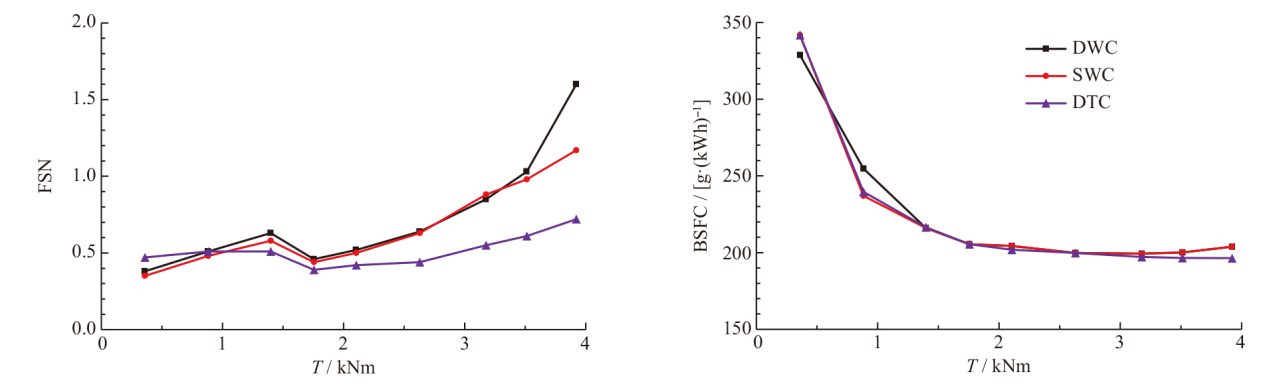
为优化涡轮增压器的热管理策略并平衡其节能与排放性能,以船用动力为平台,采用仿真与试验相结合的方法,对比了干式(DTC)、单水冷(SWC)与双水冷(DWC) 3种涡轮增压器排气装置的冷却特性。结果表明: 双水冷方案将排气管出口温度显著降低32 ℃,滤纸式烟度(FSN) = 1.6,超出国家标准限值(1.5),燃油消耗率(BSFC) = 203.8 g/kWh,较干式方案 (196.4 g/kWh) 升高约3.8%;单水冷方案在维持合理排气管出口温度(418 ℃)的同时,FSN = 1.17,满足排放法规,BSFC = 204.9 g/kWh 与双水冷方案相当。从而,单水冷方案在热管理、排放合规性与燃油经济性之间取得了最佳平衡,是综合性能最优的工程适用方案。
中图分类号:
张钞威, 李颂, 吕柏苍, 康秀臣, 丁开放, 白亚宸, 王子奕. 3种冷却结构的涡轮增压器性能的对比分析与试验[J]. 汽车安全与节能学报, 2026, 17(2): 236-243.
ZHANG Chaowei, LI Song, LÜ Baicang, KANG Xiuchen, DING Kaifang, BAI Yachen, WANG Ziyi. Performance analysis and its experiments of turbochargers with 3 types of cooling structures[J]. Journal of Automotive Safety and Energy, 2026, 17(2): 236-243.
| 参数名称 | 符号 | 定义标准 |
|---|---|---|
| 涡轮进口温度 | θtur,in | SAE J1828 |
| 涡端进口温度 | θt,in | SAE J1828 |
| 涡轮出口温度 | θt,out | SAE J1828 |
| 排气管出口温度 | θex,out | ISO 15550∶2016 |
| 进出口温差 | Δθtur,ex | SAE J1828 |
| 冷却水入口温度 | θcw,in | ISO 15550∶2016 |
| 冷却水出口温度 | θcw,out | ISO 15550∶2016 |
| 中冷后气体温度 | θic,out | ISO 15550∶2016 |
| 中冷后气体压力 | pic,out | ISO 15550∶2016 |
| 进口压力 | pin | SAE J1828 |
| 出口压力 | pout | SAE J1828 |
| 整机压损 | Δptotal | SAE J1828 |
| 膨胀比 | π | ISO 3046-1∶2002 |
| 燃油消耗率 | BSFC | ISO 3046-1∶2002 |
| 滤纸式烟度 | FSN | ISO 10054∶1998 |
| 参数名称 | 符号 | 定义标准 |
|---|---|---|
| 涡轮进口温度 | θtur,in | SAE J1828 |
| 涡端进口温度 | θt,in | SAE J1828 |
| 涡轮出口温度 | θt,out | SAE J1828 |
| 排气管出口温度 | θex,out | ISO 15550∶2016 |
| 进出口温差 | Δθtur,ex | SAE J1828 |
| 冷却水入口温度 | θcw,in | ISO 15550∶2016 |
| 冷却水出口温度 | θcw,out | ISO 15550∶2016 |
| 中冷后气体温度 | θic,out | ISO 15550∶2016 |
| 中冷后气体压力 | pic,out | ISO 15550∶2016 |
| 进口压力 | pin | SAE J1828 |
| 出口压力 | pout | SAE J1828 |
| 整机压损 | Δptotal | SAE J1828 |
| 膨胀比 | π | ISO 3046-1∶2002 |
| 燃油消耗率 | BSFC | ISO 3046-1∶2002 |
| 滤纸式烟度 | FSN | ISO 10054∶1998 |
| 工况 | n / (万r·min-1) | 气体域 | 冷却水域 | |||||
|---|---|---|---|---|---|---|---|---|
| qm,in / (kg·s-1) | θtur,in / ℃ | 出口条件 | qm,in / (kg·s-1) | θtur,in / ℃ | pout / kPa | |||
| 额定 | 7.0 | 0.20 | 750 | 自由流出 | 7.0 | 73 | 200 | |
| 怠速 | 5.0 | 0.15 | 650 | 自由流出 | 7.0 | 73 | 200 | |
| 工况 | n / (万r·min-1) | 气体域 | 冷却水域 | |||||
|---|---|---|---|---|---|---|---|---|
| qm,in / (kg·s-1) | θtur,in / ℃ | 出口条件 | qm,in / (kg·s-1) | θtur,in / ℃ | pout / kPa | |||
| 额定 | 7.0 | 0.20 | 750 | 自由流出 | 7.0 | 73 | 200 | |
| 怠速 | 5.0 | 0.15 | 650 | 自由流出 | 7.0 | 73 | 200 | |
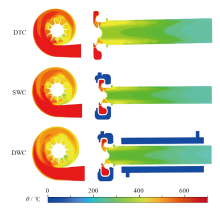
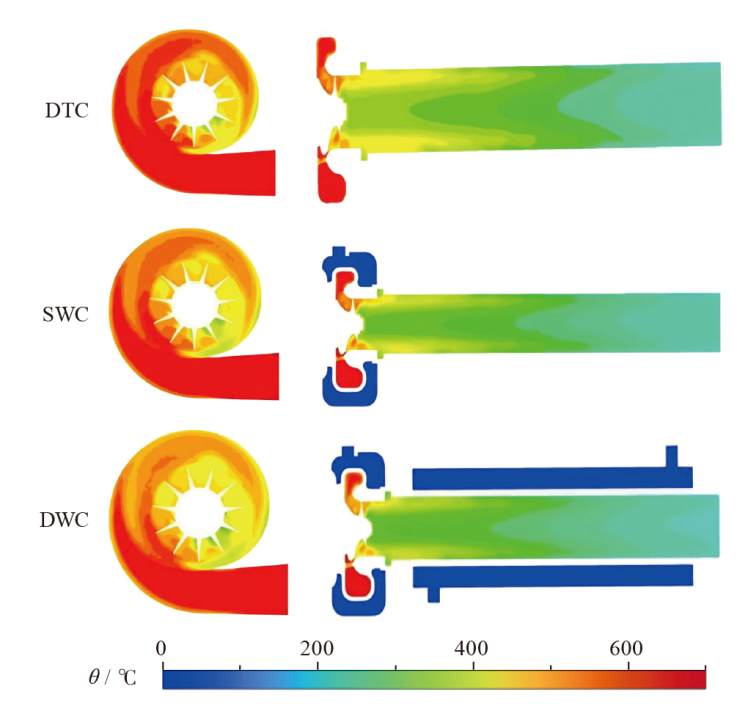
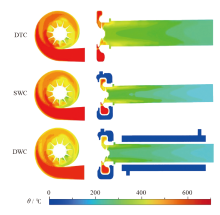
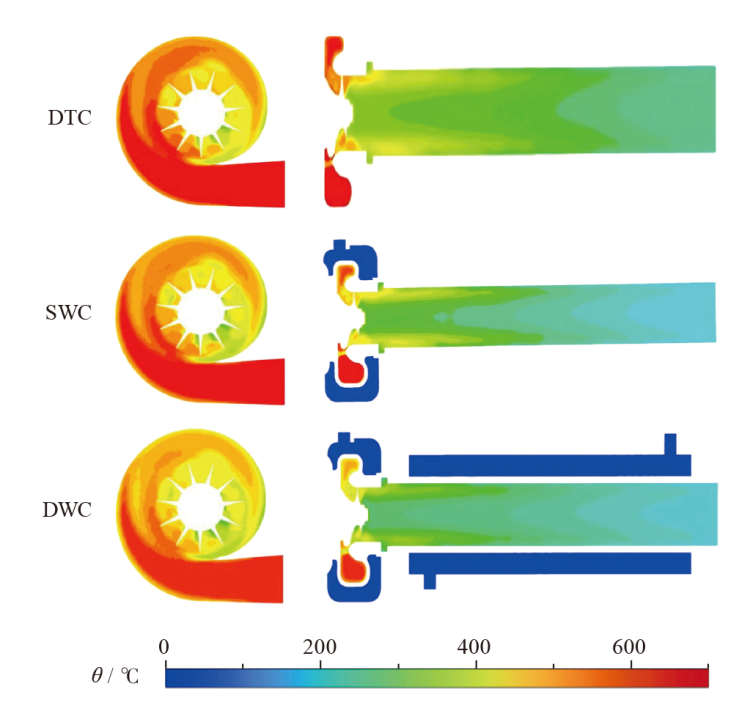
| 工况 | 结构 | θtur,in / ℃ | θt,out / ℃ | θex,out / ℃ | Δθtur,ex / ℃ |
|---|---|---|---|---|---|
| 额定 | DTC | 752 | 667 | 436 | 316 |
| SWC | 752 | 613 | 387 | 365 | |
| DWC | 752 | 596 | 334 | 418 | |
| 怠速 | DTC | 648 | 563 | 323 | 325 |
| SWC | 648 | 523 | 295 | 353 | |
| DWC | 648 | 507 | 264 | 384 |
| 工况 | 结构 | θtur,in / ℃ | θt,out / ℃ | θex,out / ℃ | Δθtur,ex / ℃ |
|---|---|---|---|---|---|
| 额定 | DTC | 752 | 667 | 436 | 316 |
| SWC | 752 | 613 | 387 | 365 | |
| DWC | 752 | 596 | 334 | 418 | |
| 怠速 | DTC | 648 | 563 | 323 | 325 |
| SWC | 648 | 523 | 295 | 353 | |
| DWC | 648 | 507 | 264 | 384 |
| 工况 | 结构 | pin / kPa | pout / kPa | Δptotal / kPa | π |
|---|---|---|---|---|---|
| 额定 | DTC | 125 | 59 | 66 | 2.12 |
| SWC | 117 | 47 | 70 | 2.49 | |
| DWC | 113 | 39 | 74 | 2.90 | |
| 怠速 | DTC | 115 | 55 | 60 | 2.09 |
| SWC | 107 | 44 | 63 | 2.43 | |
| DWC | 103 | 38 | 65 | 2.71 |
| 工况 | 结构 | pin / kPa | pout / kPa | Δptotal / kPa | π |
|---|---|---|---|---|---|
| 额定 | DTC | 125 | 59 | 66 | 2.12 |
| SWC | 117 | 47 | 70 | 2.49 | |
| DWC | 113 | 39 | 74 | 2.90 | |
| 怠速 | DTC | 115 | 55 | 60 | 2.09 |
| SWC | 107 | 44 | 63 | 2.43 | |
| DWC | 103 | 38 | 65 | 2.71 |
| [1] |
ZHAO Dan, LI Lei. Effect of choked outlet on transient energy growth analysis of a thermoacoustic system[J]. Appl Energ, 2015, 160: 502-510.
doi: 10.1016/j.apenergy.2015.09.078 URL |
| [2] |
Mezher H, Chalet D, Migaud J, et al. The application of a wave action design technique with minimal cost on a turbocharged engine equipped with water cooled charge air cooler aimed for energy management[J]. Energy Procedia, 2013, 36: 948-957.
doi: 10.1016/j.egypro.2013.07.108 URL |
| [3] |
SU Jianye, XU Min, LI Tie, et al. Combined effects of cooled EGR and a higher geometric compression ratio on thermal efficiency improvement of a downsized boosted spark-ignition direct-injection engine[J]. Energ Conv Manag, 2014, 78: 65-73.
doi: 10.1016/j.enconman.2013.10.041 URL |
| [4] | 黄立, 陈晓轩, 李先南, 等. 船用柴油机涡轮增压技术发展现状[J]. 推进技术, 2020, 41(11): 2438-2449. |
| HUANG Li, CHEN Xiaoxuan, LI Xiannan, et al. Develop-ment status of turbocharging technology for marine diesel engines[J]. J Prop Tech, 2020, 41(11): 2438-2449. (in Chinese) | |
| [5] | Salameh G, Goumy G, Chesse P. Water cooled turbocharger heat transfer model initialization: Turbine and compressor quasi-adiabatic maps generation[J]. Appl Ther Engi, 2021, 185: Paper No 116430. |
| [6] | LU Chunping, LI Jianyu, TAN Dongli. Analysis on the influence mechanism of cooling water on turbocharger and optimum coolant mass flow rate intelligent prediction[J]. Math Prob Engi, 2021, 2021(1): 1-12. |
| [7] | 李伟, 李国祥, 白书站, 等. 涡轮增压器水冷中间壳回热改善试验研究[J]. 内燃机与配件, 2021(4): 44-45. |
| LI Wei, LI Guoxiang, BAI Shuzhan, et al. Experimental study on heat recovery improvement of water-cooled intermediate shell of turbocharger[J]. Int’l Combut Engi Acces, 2021(4): 44-45. (in Chinese) | |
| [8] | Ziad Y, Khalfallah S, Chenafi A, et al. Numerical and experimental investigation of a cooling technique of a turbocharger radial turbine[J]. J Brazi Soc Mech Sci Engi, 2024, 46(5): 1-10. |
| [9] | 龚金科, 章滔, 胡辽平, 等. 涡轮增压器水冷轴承体冷却性能仿真研究[J]. 汽车工程, 2014, 36(3): 383-388. |
| GONG Jinke, ZHANG Tao, HU Liaoping, et al. Simulation study on cooling performance of water-cooled bearing housing for turbocharger[J]. Autom Engineering, 2014, 36(3): 383-388. (in Chinese) | |
| [10] | 宁波威孚天力增压技术股份有限公司. 一种轻量化水冷涡轮壳涡轮增压器: CN 222615407 U[P]. 2024. |
| Ningbo Weifu Tianli Pressurization Technology Co., LTD. A lightweight water-cooled turbine housing turbocharger: CN 222615407 U[P]. 2024. (in Chinese) | |
| [11] | 石永康, 陈振雷, 王勇, 等. 基于流固耦合的涡轮增压器涡轮机温度场分析[J]. 宁波大学学报: (理工版), 2021, 34(3): 7-12. |
| SHI Yongkang, CHEN Zhenlei, WANG Yong, et al. Analysis of turbine temperature field of turbocharger based on fluid-structure coupling[J]. J Ningbo Univ (Sci Engi Ed), 2021, 34(3): 7-12. (in Chinese) | |
| [12] | Romagnoli A, Martinez-Botas R. Heat transfer analysis in a turbocharger turbine: An experimental and computational evaluation[J]. Appl Therm Engi, 2012, 38: 58-77. |
| [13] | WU Binyang, JIA Zhi, LI Zhenguo, et al. Different exhaust temperature management technologies for heavy-duty diesel engines with regard to thermal efficiency[J]. Appl Therm Engi, 2021, 186: 116495. |
| [14] | Alaviyoun S, Ziabasharhagh M, Mohammadi A. A three-dimensional conjugate heat transfer model of a turbocharger turbine housing[J]. Iran J Sci Tech (Trans Mech Engi), 2022, 46(1): 71-84. |
| [1] | 董佳硕, 丹聃, 魏名山, 赵一航, 张杨军. 基于平板热管的动力电池热管理系统[J]. 汽车安全与节能学报, 2026, 17(2): 209-217. |
| [2] | 吴祥成, 郭俊轩, 陈华宇, 苏良彬, 卢金. 基于储能箱的电动汽车集成式热管理系统设计及性能分析[J]. 汽车安全与节能学报, 2026, 17(2): 244-252. |
| [3] | 郑松峰, 钱多德, 龚震, 钱叶剑. 基于气动与热平衡特性的混动轻卡主动进气格栅技术[J]. 汽车安全与节能学报, 2025, 16(5): 757-765. |
| [4] | 刘金祎, 王炎, 庞英杰, 于瑞广, 牟瑞涛, 卢兰光, 李亚伦, 王贺武, 张立磊, 李明明. 储能电站锂离子电池系统风液双循环优化设计[J]. 汽车安全与节能学报, 2025, 16(4): 568-576. |
| [5] | 谢元鹏, 张甫仁, 谭海坤, 肖康, 邱帅帅, 孙世政. 锂离子电池新型分支通道翅片液体冷却板的设计优化[J]. 汽车安全与节能学报, 2025, 16(3): 443-451. |
| [6] | 邱帅帅, 张甫仁, 孙世政, 陶远兵, 陶佳辉, 谭海坤. 基于多目标优化的液冷板散热性能分析[J]. 汽车安全与节能学报, 2024, 15(6): 905-914. |
| [7] | 丁玉杰, 甘全全, 邵扬斌, 徐梁飞, 李建秋, 欧阳明高. 各向异性膨胀石墨双极板对燃料电池性能的影响[J]. 汽车安全与节能学报, 2024, 15(4): 526-535. |
| [8] | 李龙辉, 张甫仁, 黄郅凯, 李雪, 赵浩东, 史亚洲, 孙世政, 赵海波. 水轮型翅片组耦合均温板的多目标及拓扑优化[J]. 汽车安全与节能学报, 2024, 15(2): 208-217. |
| [9] | 王君琦, 李勇滔, 郑伟光, 张彦会, 陈子邮, 许恩永, 李育方, 王善超. 神经网络识别和Markov链预测的商用车APU控制策略[J]. 汽车安全与节能学报, 2023, 14(5): 600-608. |
| [10] | 赵浩东, 张甫仁, 路兴隆, 黄郅凯, 李雪, 孙世政. 仿生四叶草型翅片液冷板与传热特性[J]. 汽车安全与节能学报, 2023, 14(5): 637-647. |
| [11] | 李雪, 张甫仁, 路兴隆, 黄郅凯, 赵浩东, 史亚洲. 锂离子动力电池蛇形通道液体冷却板的性能优化[J]. 汽车安全与节能学报, 2023, 14(3): 385-392. |
| [12] | 柳炽伟, 郭美华. 基于DTBN与T-S故障树的电池热管理系统可靠性分析[J]. 汽车安全与节能学报, 2023, 14(2): 173-181. |
| [13] | 雍安姣, 项阳, 付永宏, 汪爽, 郭廷, 王勇. 搭配低温散热器的PHEV电池冷却系统的节能效果[J]. 汽车安全与节能学报, 2022, 13(4): 796-803. |
| [14] | 宋波, 孙凯, 车志钊, 陈锐, 刘怀宇, 任美林, 王天友. 能量管理策略对燃料电池客车热管理系统性能的影响[J]. 汽车安全与节能学报, 2022, 13(3): 526-534. |
| [15] | 单春贤, 夏灯富, 刘朝阳, 唐爱坤. 基于热电耦合液体冷却的动力电池热管理系统的实验研究[J]. 汽车安全与节能学报, 2022, 13(3): 535-540. |
| 阅读次数 | ||||||
|
全文 |
|
|||||
|
摘要 |
|
|||||
