欢迎访问《汽车安全与节能学报》,

汽车安全与节能学报 ›› 2024, Vol. 15 ›› Issue (4): 526-535.DOI: 10.3969/j.issn.1674-8484.2024.04.009
丁玉杰1( ), 甘全全2,3, 邵扬斌2, 徐梁飞2, 李建秋2, 欧阳明高2
收稿日期:2023-10-30
修回日期:2024-03-05
出版日期:2024-08-31
发布日期:2024-09-05
作者简介:丁玉杰(1992—),男(汉),陕西,副研究员。E-mail:dingyujie@gzhu.edu.cn。
基金资助:
DING Yujie1(), GAN Quanquan2,3, SHAO Yangbin2, XU Liangfei2, LI Jianqiu2, OUYANG Minggao2
Received:2023-10-30
Revised:2024-03-05
Online:2024-08-31
Published:2024-09-05
摘要:
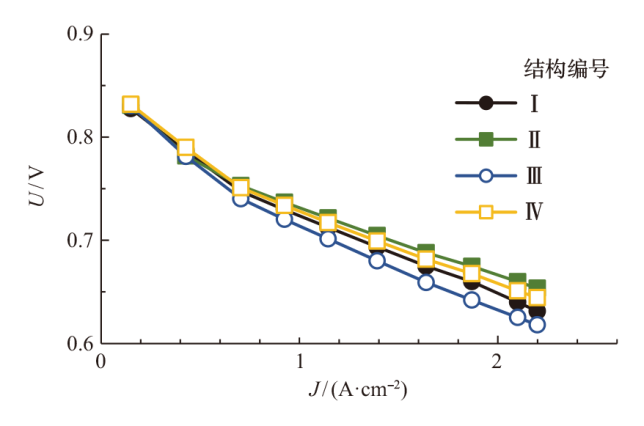
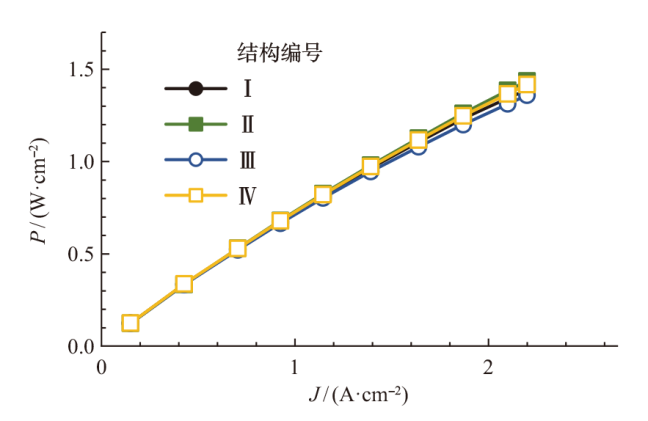
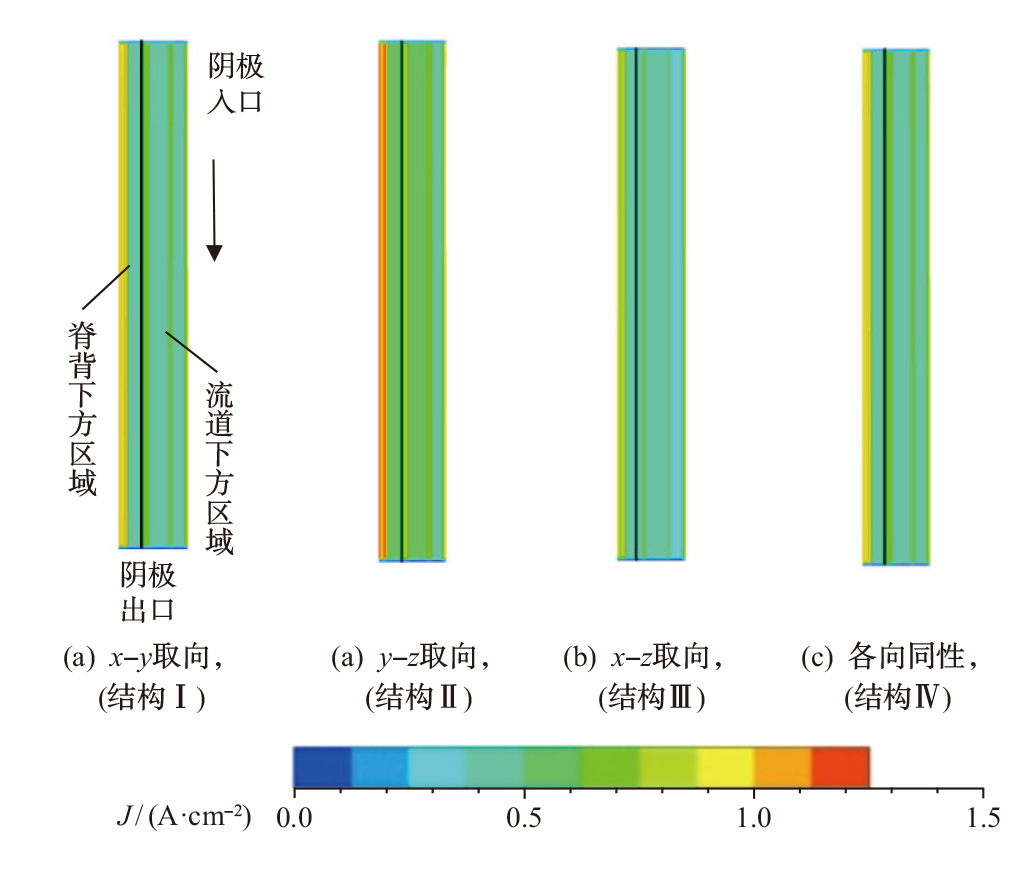
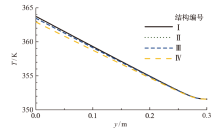
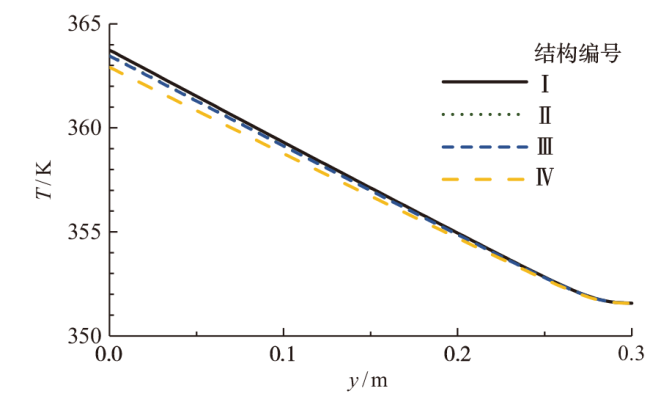
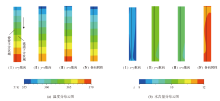
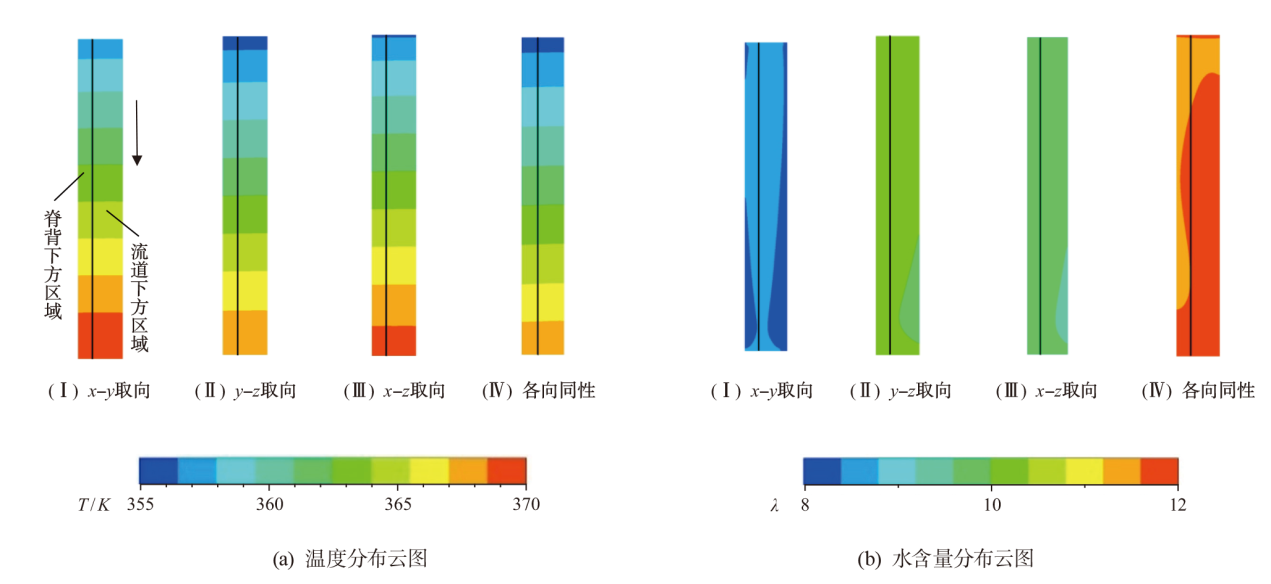
该文分析了膨胀石墨双极板(EGBPs)各向异性结构对燃料电池水热管理与输出性能的影响。建立了三维两相非等温数值模型,对比了4种典型复合材料结构下温度、电流密度、水含量等参数的分布特征,揭示了双极板传热特性与输出性能的耦合效应。结果表明:沿质子传递方向热导率(kz)对燃料电池性能具有显著影响,在2.2 A cm-2电流密度下,将kz从常规结构的5 W·m-1·K-1提升至280 W·m-1·K-1,可以使输出性能提高22 mV;沿流道气体流动方向的热导率(ky)是影响散热能力的关键因素,将ky与kz提高至280 W·m-1·K-1,或者实现各向同性结构(kx = ky = kz = 20 W·m-1·K-1),均能够使膜电极组件(MEA)核心区域的温度降低2 ℃左右。因此,提高ky与kz并实现各向同性结构是膨胀石墨双极板技术的未来发展目标之一。
中图分类号:
丁玉杰, 甘全全, 邵扬斌, 徐梁飞, 李建秋, 欧阳明高. 各向异性膨胀石墨双极板对燃料电池性能的影响[J]. 汽车安全与节能学报, 2024, 15(4): 526-535.
DING Yujie, GAN Quanquan, SHAO Yangbin, XU Liangfei, LI Jianqiu, OUYANG Minggao. Influence of anisotropic conductive expanded graphite bipolar plates on performance of proton exchange membrane fuel cell[J]. Journal of Automotive Safety and Energy, 2024, 15(4): 526-535.


| 结构编号 | 石墨片层取向 | 热导率,k / (W·m-1·K-1) | 电导率,σ / (S·cm-1) | |||||
|---|---|---|---|---|---|---|---|---|
| x方向 | y方向 | z方向 | x方向 | y方向 | z方向 | |||
| Ⅰ | x - y | 280 | 280 | 5 | 1 100 | 1 100 | 20 | |
| Ⅱ | y - z | 5 | 280 | 280 | 20 | 1 100 | 1 100 | |
| Ⅲ | x - z | 280 | 5 | 280 | 1 100 | 20 | 1 100 | |
| Ⅳ | 各向同性 | 20 | 20 | 20 | 100 | 100 | 100 | |
| 结构编号 | 石墨片层取向 | 热导率,k / (W·m-1·K-1) | 电导率,σ / (S·cm-1) | |||||
|---|---|---|---|---|---|---|---|---|
| x方向 | y方向 | z方向 | x方向 | y方向 | z方向 | |||
| Ⅰ | x - y | 280 | 280 | 5 | 1 100 | 1 100 | 20 | |
| Ⅱ | y - z | 5 | 280 | 280 | 20 | 1 100 | 1 100 | |
| Ⅲ | x - z | 280 | 5 | 280 | 1 100 | 20 | 1 100 | |
| Ⅳ | 各向同性 | 20 | 20 | 20 | 100 | 100 | 100 | |
| 厚度 (j = GDL, MPL, CL, PEM) | δj = 151, 10, 15, 18 μm |
| 孔隙率(j = GDL, MPL, CL) | εj = 0.77, 0.6, 0.5 |
| 绝对渗透率(j = GDL, MPL, CL, PEM) | Kj = 23, 0.25, 0.1, 1.0×10⁻⁶ μm2 |
| CL曲折度 | τd = 1.5 |
| 扩散系数[ | D0, i = 2.652×10⁻⁵, 1.055×10⁻⁴ m2 s-1 |
| 活性比表面积 | a0 = 5.0×10⁷ m2 m-3 |
| 阳极/阴极参考交换电流密度 | ja,ref = 500 A m-2, jc,ref = 10 μm-2 |
| 参考H2/O2浓度 | CH2,ref = 56.4 mol m-3, CO2,ref = 3.39 mol m-3 |
| 阳极/阴极传递系数 | αa,a = 0.5, αa,c = 1.5, αc,a = 3, αc,c = 1 |
| 阳极/阴极反应级数 | γH2 = 0.5, γO2 = 1 |
| 活化能 | ΔG = 8.314 kJ mol-1 |
| 焓差 | ΔS = -163.3 J (mol K)-1 |
| 参考温度 | Tref = 343 K |
| 电导率[ | σs, j = 5.0 kS m-1 |
| 膜干态密度 | ρm = 1.98 t m-3 |
| 膜离子交换当量 | EW = 1.1 kg mol-1 |
| 阳极/阴极CL中离聚物体积分数 | lm,a = 0.6, lm,c = 0.6 |
| 厚度 (j = GDL, MPL, CL, PEM) | δj = 151, 10, 15, 18 μm |
| 孔隙率(j = GDL, MPL, CL) | εj = 0.77, 0.6, 0.5 |
| 绝对渗透率(j = GDL, MPL, CL, PEM) | Kj = 23, 0.25, 0.1, 1.0×10⁻⁶ μm2 |
| CL曲折度 | τd = 1.5 |
| 扩散系数[ | D0, i = 2.652×10⁻⁵, 1.055×10⁻⁴ m2 s-1 |
| 活性比表面积 | a0 = 5.0×10⁷ m2 m-3 |
| 阳极/阴极参考交换电流密度 | ja,ref = 500 A m-2, jc,ref = 10 μm-2 |
| 参考H2/O2浓度 | CH2,ref = 56.4 mol m-3, CO2,ref = 3.39 mol m-3 |
| 阳极/阴极传递系数 | αa,a = 0.5, αa,c = 1.5, αc,a = 3, αc,c = 1 |
| 阳极/阴极反应级数 | γH2 = 0.5, γO2 = 1 |
| 活化能 | ΔG = 8.314 kJ mol-1 |
| 焓差 | ΔS = -163.3 J (mol K)-1 |
| 参考温度 | Tref = 343 K |
| 电导率[ | σs, j = 5.0 kS m-1 |
| 膜干态密度 | ρm = 1.98 t m-3 |
| 膜离子交换当量 | EW = 1.1 kg mol-1 |
| 阳极/阴极CL中离聚物体积分数 | lm,a = 0.6, lm,c = 0.6 |
| 边界 | 类型 | 取值 |
|---|---|---|
| 阳极(a)、阴极(b)气体流道入口 | 质量入口 | |
| 阳极(a)、阴极(b)气体流道出口 | 压力出口 | pb,a, pb,c |
| 阳极(a)、阴极(b)双极板端面 | 壁面 | $\varphi_{\mathrm{e}}=0 ; \frac{\partial \varphi_{\mathrm{m}}}{\partial y}=0 ; q_{\mathrm{h}, \text { cool }, \mathrm{a}}=\frac{q_{\mathrm{h}, \text { cool }}}{2} \quad \varphi_{\mathrm{e}}=U ; \frac{\partial \varphi_{\mathrm{m}}}{\partial y}=0 ; q_{\mathrm{h}, \text { cool, } \mathrm{a}}=\frac{q_{\mathrm{h}, \mathrm{cool}}}{2}$ |
| 侧面边界 | 对称边界 | $\frac{\partial \varphi_{\mathrm{m}}}{\partial x}=0 ; \frac{\partial \varphi_{\mathrm{m}}}{\partial z}=0 ; \frac{\partial \varphi_{\mathrm{e}}}{\partial x}=0 ; \frac{\partial \varphi_{\mathrm{e}}}{\partial z}=0$ |
| 边界 | 类型 | 取值 |
|---|---|---|
| 阳极(a)、阴极(b)气体流道入口 | 质量入口 | |
| 阳极(a)、阴极(b)气体流道出口 | 压力出口 | pb,a, pb,c |
| 阳极(a)、阴极(b)双极板端面 | 壁面 | $\varphi_{\mathrm{e}}=0 ; \frac{\partial \varphi_{\mathrm{m}}}{\partial y}=0 ; q_{\mathrm{h}, \text { cool }, \mathrm{a}}=\frac{q_{\mathrm{h}, \text { cool }}}{2} \quad \varphi_{\mathrm{e}}=U ; \frac{\partial \varphi_{\mathrm{m}}}{\partial y}=0 ; q_{\mathrm{h}, \text { cool, } \mathrm{a}}=\frac{q_{\mathrm{h}, \mathrm{cool}}}{2}$ |
| 侧面边界 | 对称边界 | $\frac{\partial \varphi_{\mathrm{m}}}{\partial x}=0 ; \frac{\partial \varphi_{\mathrm{m}}}{\partial z}=0 ; \frac{\partial \varphi_{\mathrm{e}}}{\partial x}=0 ; \frac{\partial \varphi_{\mathrm{e}}}{\partial z}=0$ |
| [1] | Cullen D A, Neyerlin K C, Ahluwalia R K, et al. New roads and challenges for fuel cells in heavy-duty transportation[J]. Nat Energy, 2021, 6(5): 462-474. |
| [2] | ZENG Ziyun, BAO Cheng, LI Chuanxiang, et al. A modeling study on water and thermal management and cold startup of unmanned aerial vehicle fuel cell system[J]. eTransp, 2023, 15: Paper No 100222. |
| [3] | ZHAO Lei, HONG Jichao, YUAN Hao, et al. A novel pre-diagnosis method for health status of proton exchange membrane fuel cell stack based on entropy algorithms[J]. eTransp, 2023, 18: Paper No 100278. |
| [4] | LI Jiawen, CHENG Yuanyuan, YU Hengwen, et al. Multi-agent deep meta-reinforcement learning-based active fault tolerant gas supply management system for proton exchange membrane fuel cells[J]. eTransp, 2023, 18: Paper No 100282. |
| [5] | WANG Qianqian, LI Bing, YANG Daijun, et al. Research progress of heat transfer inside proton exchange membrane fuel cells[J]. J Power Sources, 2021, 492: Paper No 229613. |
| [6] | Islam M R, Shabani B, Rosengarten G, et al. The potential of using nanofluids in PEM fuel cell cooling systems: A review[J]. Renew Sustain Energy Rev, 2015, 48: 523-539. |
| [7] | Zakaria I A, Mohamed W A N W, Zailan M B, et al. Experimental analysis of SiO2-Distilled water nanofluids in a Polymer Electrolyte Membrane fuel cell parallel channel cooling plate[J]. Int J Hydr Energy, 2019, 44(47): 25850-25862. |
| [8] | ZHANG Yong, HE Shirong, JIANG Xiaohui, et al. Three-dimensional multi-phase simulation of different flow fields with cooling channel in proton exchange membrane fuel cell[J]. Int J Hydr Energy, 2022, 47(89): 37929-37944. |
| [9] | ZHANG Guobin, QU Zhiguo, WANG Yun. Proton exchange membrane fuel cell of integrated porous bipolar plate-gas diffusion layer structure: Entire morphology simulation[J]. eTransp, 2023, 17: Paper No 100250. |
| [10] | Sadeghi E, Djilali N, Bahrami M. A novel approach to determine the in-plane thermal conductivity of gas diffusion layers in proton exchange membrane fuel cells[J]. J Power Sources, 2011, 196(7): 3565-3571. |
| [11] | HOU Jian, LI Qiang, LIAO Changlin, et al. Layered model of through-plane effective thermal conductivity of the gas diffusion backing in proton exchange membrane fuel cell based on X-ray computed tomography statistical information[J]. J Power Sources, 2022, 535: Paper No 231426. |
| [12] | HU Donghai, WANG Yuteng, LI Jianwei, et al. Investigation of optimal operating temperature for the PEMFC and its tracking control for energy saving in vehicle applications[J]. Energy Convers Mana, 2021, 249: Paper No 114842. |
| [13] | ZHU Runqi, XING Lu, TU Zhengkai. Simulations and analysis of high-temperature proton exchange membrane fuel cell and its cooling system to power an automotive vehicle[J]. Energy Convers Mana, 2022, 253: Paper No 115182. |
| [14] | CHEN Qin, ZHANG Guobin, ZHANG Xuzhong, et al. Thermal management of polymer electrolyte membrane fuel cells: A review of cooling methods, material properties, and durability[J]. Appl Energy, 2021, 286: Paper No 116496. |
| [15] | ZHANG Guangsheng, Kandlikar S G. A critical review of cooling techniques in proton exchange membrane fuel cell stacks[J]. Int J Hydr Energy, 2012, 37(3): 2412-2429. |
| [16] | Bock R, Karoliussen H, Pollet B G, et al. The influence of graphitization on the thermal conductivity of catalyst layers and temperature gradients in proton exchange membrane fuel cells[J]. Int J Hydr Energy, 2020, 45(2): 1335-1342. |
| [17] | WANG Qianqian, TANG Fumin, LI Bing, et al. Study on the thermal transient of cathode catalyst layer in proton exchange membrane fuel cell under dynamic loading with a two-dimensional model[J]. Chem Eng J, 2022, 433: Paper No 133667. |
| [18] | WANG Yun. Porous-media flow fields for polymer electrolyte fuel cells: I. Low humidity operation[J]. J Electrochem Soc, 2009, 156(10): Paper No B1124. |
| [19] | ZHANG Guobin, YUAN Hao, WANG Yun, et al. Three-dimensional simulation of a new cooling strategy for proton exchange membrane fuel cell stack using a non-isothermal multiphase model[J]. Appl Energy, 2019, 255: Paper No 113865. |
| [20] | WANG Qianqian, TANG Fumin, LI Bing, et al. Investigation of the thermal responses under gas channel and land inside proton exchange membrane fuel cell with assembly pressure[J]. Appl Energy, 2022, 308: Paper No 118377. |
| [21] | Antunes R A, de Oliveira M C L, Ett G, et al. Carbon materials in composite bipolar plates for polymer electrolyte membrane fuel cells: A review of the main challenges to improve electrical performance[J]. J Power Sources, 2011, 196(6): 2945-2961. |
| [22] | Jeong K I, Oh J, Song S A, et al. A review of composite bipolar plates in proton exchange membrane fuel cells: Electrical properties and gas permeability[J]. Compos Struct, 2021, 262: Paper No 113617. |
| [23] | Kopasz J P, Benjamin T G, Schenck D. 2017 bipolar plate workshop summary report[R]. Argonne National Lab (ANL), USA, 137641, 2017. |
| [24] | HU Bin, CHEN Lun, GUO Chao, et al. Constructing three-dimensional conductive network in composite bipolar plates by sacrificial materials for improvement of proton exchange membrane fuel cell performance[J]. J Power Sources, 2022, 552: Paper No 232261. |
| [25] | Saadat N, Dhakal H N, Jaffer S, et al. Expanded and nano-structured carbonaceous graphite for high performance anisotropic fuel cell polymer composites[J]. Compos Sci Technol, 2021, 207: Paper No 108654. |
| [26] | 肖丽仙, 何永泰. 基于叠层定向结构调控的高导热柔性聚偏氟乙烯/膨胀石墨复合材料(英文)[J]. 传感技术学报, 2018, 31(8): 1181-1186. |
| XIAO Lixian, HE Yongtai. Research on Thermal Mechanism and Preparation Technology of PVDF/EG High-Thermal Conductivity Laminated Composite[J]. Chinese J Sens Actuators, 2018, 31(8): 1181-1186. | |
| [27] |
朱从懿, 李笑晖, 甘全全. 乙二醇基冷却液污染对质子交换膜燃料电池电堆的影响及恢复措施[J]. 电化学, 2021, 27(6): 698-704.
doi: 10.13208/j.electrochem.210106 |
|
ZHU Congyi, LI Xiaohui, GAN Quanquan. Effect of glycol based coolant pollution on PEM fuel cells stack and recovery measures. J Electrochem, 2021, 27(6): 698-704. (in Chinese)
doi: 10.13208/j.electrochem.210106 |
|
| [28] | Bird R B. Transport Phenomena, 2nd Ed[M]. USA, New York: John Wiley & Sons Incorporation, 2002: 517-522. |
| [29] | Springer T E, Zawodzinski T A, Gottesfeld S. Polymer electrolyte fuel cell model[J]. J Electrochem Soc, 1991, 138(8): 2334-2342. |
| [30] | DING Yujie, FU Xi, XU Liangfei, et al. Scaling analysis of diffusion-reaction process in proton exchange membrane fuel cell with the second Damköhler number[J]. Chem Eng J, 2023, 465: Paper No 143011. |
| [1] | 张硌, 蒲东义, 胡松, 樊芷君, 陈东方, 徐晓明. PEM燃料电池凸台流道性能三维仿真分析及结构参数优化[J]. 汽车安全与节能学报, 2024, 15(4): 545-552. |
| [2] | 朱鑫宁, 王茜, 刘荣康, 朱思明, 张剑波, 周伟. 质子交换膜燃料电池随行波流场设计与传质特性[J]. 汽车安全与节能学报, 2024, 15(3): 351-359. |
| [3] | 刘永峰, 张璐, 裴普成, 刘鑫桐, 禹永帅. 相对湿度对PEMFC加载过程中动态响应的影响分析[J]. 汽车安全与节能学报, 2023, 14(1): 89-97. |
| [4] | 史启通, 冯聪, 李冰, 张存满, 明平文. 气体扩散层变形模量与脊槽转角半径优化设计[J]. 汽车安全与节能学报, 2023, 14(1): 98-105. |
| [5] | 鲁大钢, 衣丰艳, 胡东海, 程善. 考虑PEMFC动态降载特性的FCV制动能量回收协调控制[J]. 汽车安全与节能学报, 2022, 13(2): 350-357. |
| [6] | 章俊良, 程明, 罗夏爽, 李慧媛, 罗柳轩, 程晓静, 闫晓晖, 沈水云. 车用燃料电池电堆关键技术研究现状[J]. 汽车安全与节能学报, 2022, 13(1): 1-28. |
| [7] | 黄福森, 汪尚尚, 李 哲, 等. 过冷水对质子交换膜燃料电池零下启动能力与特性的影响[J]. 汽车安全与节能学报, 2019, 10(1): 82-87. |
| [8] | 王诚,黄俊,赵波,肖宇, 赵鹏程,李建秋,张剑波. PEMFC 全车况性能衰减的研究进展[J]. JASE, 2016, 07(01): 86-93. |
| [9] | 冯旭宁, 李建军, 王莉, 高剑, 何向明, 欧阳明高. 锂离子电池各向异性导热的实验与建模[J]. 汽车安全与节能学报, 2012, 3(2): 158-164. |
| [10] | Erich Ramschak, Nicolas Fouquet, Harald Brandstaetter, Viktor Hacker. 包含寿命监测的在线燃料电池监测和运行状态识别(英文)[J]. 汽车安全与节能学报, 2011, 2(1): 45-52. |
| 阅读次数 | ||||||
|
全文 |
|
|||||
|
摘要 |
|
|||||
