Welcome to Journal of Automotive Safety and Energy,

Journal of Automotive Safety and Energy ›› 2025, Vol. 16 ›› Issue (6): 934-944.DOI: 10.3969/j.issn.1674-8484.2025.06.013
• Intelligent Driving and Intelligent Transportation • Previous Articles Next Articles
WU Hangzhe1( ), JIAO Yizhou2, LIU Yang1, ZHONG Wei3, WANG Shuihe2, GUO Jinghua2,*(), ZHAO Jian4
Received:2025-10-18
Revised:2025-11-10
Online:2025-12-31
Published:2026-01-12
CLC Number:
WU Hangzhe, JIAO Yizhou, LIU Yang, ZHONG Wei, WANG Shuihe, GUO Jinghua, ZHAO Jian. Predictive trajectory tracking control by a linear time-varying model for emergency collision avoidance of autonomous vehicles[J]. Journal of Automotive Safety and Energy, 2025, 16(6): 934-944.
Add to citation manager EndNote|Ris|BibTeX
URL: https://www.journalase.com/EN/10.3969/j.issn.1674-8484.2025.06.013
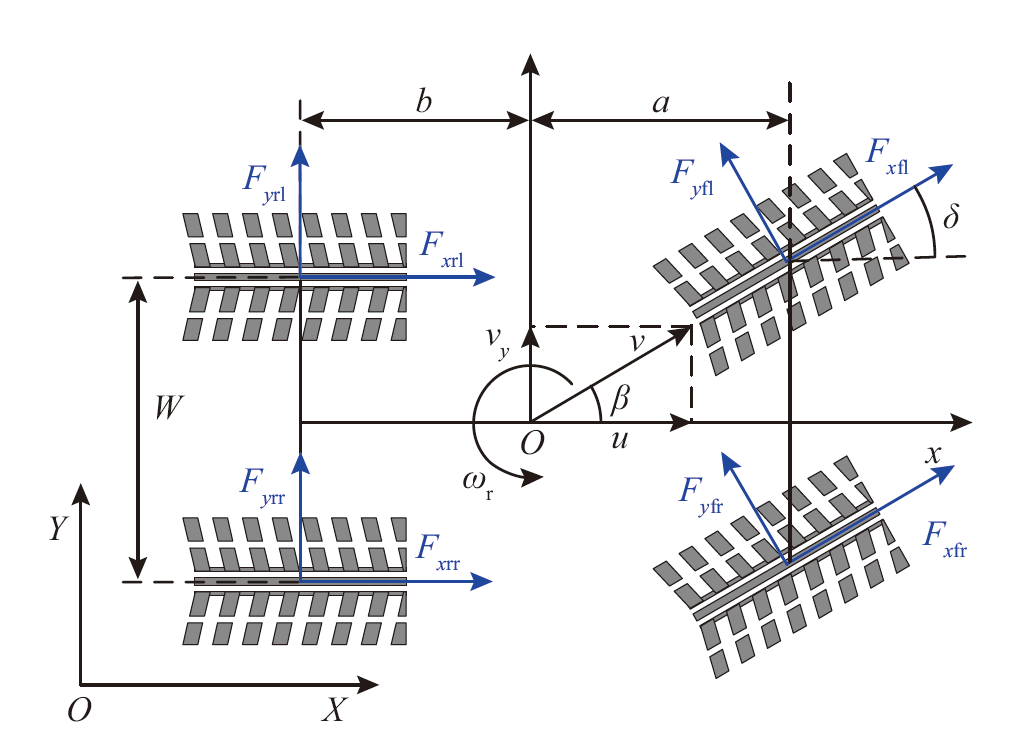
| 整车质量,m | 1.890 t |
| 簧上质量,ms | 1.723 t |
| 质心高度,H | 0.60 m |
| 侧倾高度,h | 0.54 m |
| 轮距,W | 1.625 m |
| 前轴到质心距离,Lf,a | 1.421 m |
| 后轴到质心距离,Lr,b | 1.479 m |
| 悬架侧倾刚度,Kφ | 25 kNm·rad-1 |
| 悬架侧倾阻尼,Cφ | 2.0 kNm·s·rad-1 |
| 前轮轮胎侧偏刚度,Kαf | 66.9 kN·rad-1 |
| 后轮轮胎侧偏刚度,Kαr | 62.7 kN·rad-1 |
| x轴转动惯量,Ix | 1.243 t·m2 |
| z轴转动惯量,Iz | 4.175 t·m2 |
| 整车质量,m | 1.890 t |
| 簧上质量,ms | 1.723 t |
| 质心高度,H | 0.60 m |
| 侧倾高度,h | 0.54 m |
| 轮距,W | 1.625 m |
| 前轴到质心距离,Lf,a | 1.421 m |
| 后轴到质心距离,Lr,b | 1.479 m |
| 悬架侧倾刚度,Kφ | 25 kNm·rad-1 |
| 悬架侧倾阻尼,Cφ | 2.0 kNm·s·rad-1 |
| 前轮轮胎侧偏刚度,Kαf | 66.9 kN·rad-1 |
| 后轮轮胎侧偏刚度,Kαr | 62.7 kN·rad-1 |
| x轴转动惯量,Ix | 1.243 t·m2 |
| z轴转动惯量,Iz | 4.175 t·m2 |
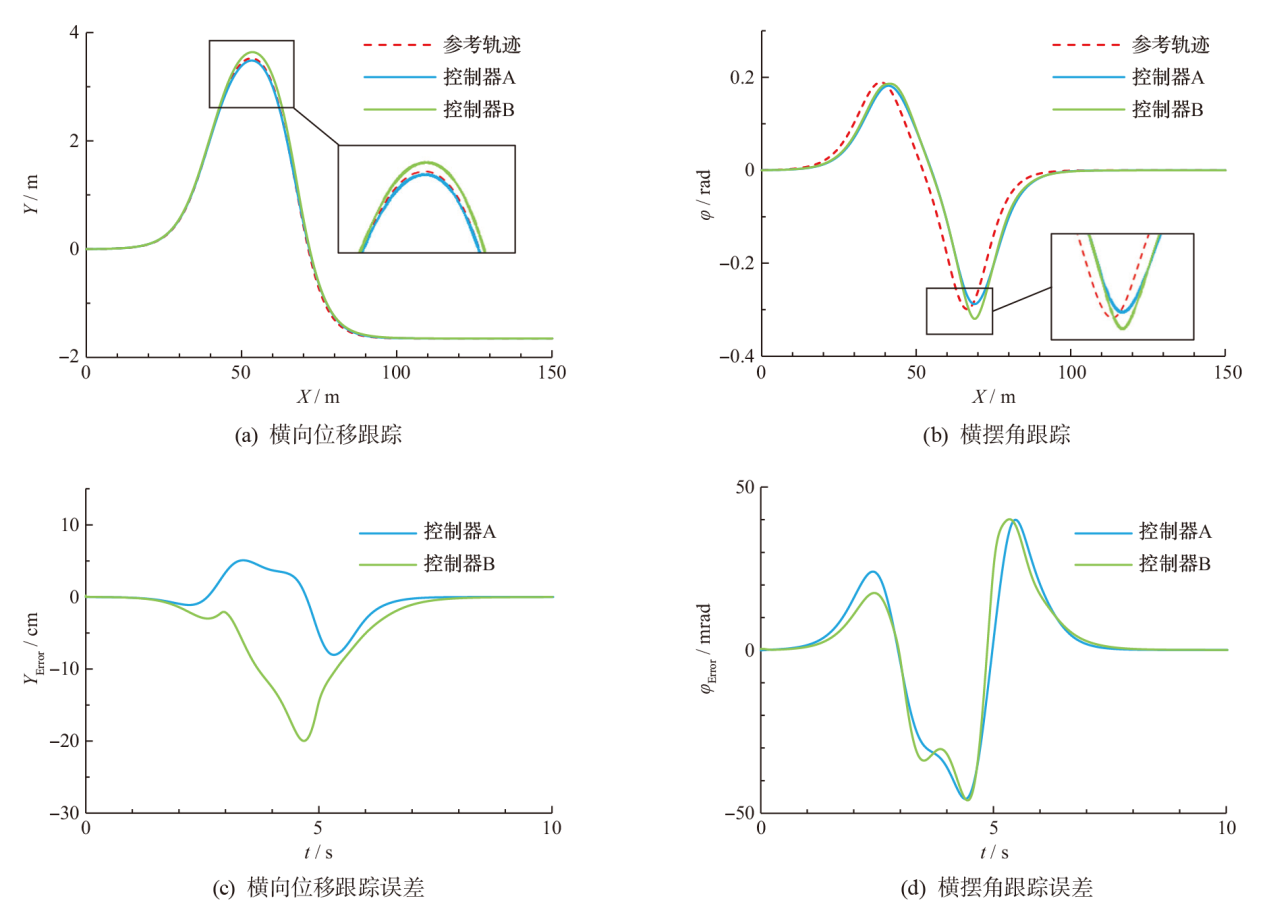
| 控制器 | μ | YRMSE mm | φRMSE mrad | YError_max mm | φError_max mrad |
|---|---|---|---|---|---|
| A | 1.00 | 23 | 18 | 73 | 46 |
| 0.75 | 26 | 18 | 81 | 45 | |
| 0.50 | 25 | 17 | 88 | 47 | |
| B | 1.00 | 60 | 21 | 169 | 53 |
| 0.75 | 156 | 29 | 199 | 46 | |
| 0.50 | 174 | 30 | 296 | 65 |
| 控制器 | μ | YRMSE mm | φRMSE mrad | YError_max mm | φError_max mrad |
|---|---|---|---|---|---|
| A | 1.00 | 23 | 18 | 73 | 46 |
| 0.75 | 26 | 18 | 81 | 45 | |
| 0.50 | 25 | 17 | 88 | 47 | |
| B | 1.00 | 60 | 21 | 169 | 53 |
| 0.75 | 156 | 29 | 199 | 46 | |
| 0.50 | 174 | 30 | 296 | 65 |
| [1] | 李克强, 罗禹贡, 郭景华. 先进车辆系统动力学与控制[M]. 武汉: 华中科技大学出版社, 2021: 11-18. |
| LI Keqiang, LUO Yugong, GUO Jinghua, Advanced Vehicle Dynamic and Control[M]. Wuhan: Huazhong Univ Sci Tech Pres, 2021: 11-18. (in Chinese) | |
| [2] | 郭景华, 李克强, 罗禹贡. 智能车辆运动控制研究综述[J]. 汽车安全与节能学报, 2016, 7(2): 151-159. |
| GUO Jinghua, LI Keqiang, LUO Yugong. Review on the research of motion control for intelligent vehicles[J]. J Autom Safe Energy, 2016, 7(2): 151-159. (in Chinese) | |
| [3] |
赵治国, 周良杰, 朱强. 无人驾驶车辆路径跟踪控制预瞄距离自适应优化[J]. 机械工程学报. 2018, 54(24): 166-173.
doi: 10.3901/JME.2018.24.166 |
| ZHAO Zhiguo, ZHOU Liangjie, ZHU Qiang. Preview distance adaptive optimization for the path tracking control of unmanned vehicle[J]. J Mech Engi, 2018, 54(24): 166-173. (in Chinese) | |
| [4] | GUO Jinghua, LUO Yugong, LI Keqiang. An adaptive hierarchical trajectory following control approach of autonomous four-wheel independent drive electric vehicles[J]. IEEE Trans Intel Transport Syst, 2017, 19(8): 2482-2492. |
| [5] | CHEN Yimin, Stout C, Joshi A, et al. Driver-assistance lateral motion control for in-wheel-motor-driven electric ground vehicles subject to small torque variation[J]. IEEE Trans Vehi Tech, 2018, 67(8): 6838-6850. |
| [6] | GUO Jinghua, LUO Yugong, WANG Jingyao, et al. An adaptive cascade trajectory tracking control for over-actuated autonomous electric vehicles with input saturation[J]. Sci Chin: Tech Sci, 2019, 62(12): 2153-2160. |
| [7] |
Taghavifar H, Rakheja S. Path-tracking of autonomous vehicles using a novel adaptive robust exponential-like-sliding-mode fuzzy type-2 neural network controller[J]. Mech Syst Sign Process, 2019, 130: 41-55.
doi: 10.1016/j.ymssp.2019.04.060 URL |
| [8] | YUE Ming, HOU Xiaoqiang, ZHAO Xudong, et al. Robust tube-based model predictive control for lane change maneuver of tractor-trailer vehicles based on a polynomial trajectory[J]. IEEE Trans Syst, Man, Cybern: Syst, 2018, 50(12): 5180-5188. |
| [9] | CHENG Shuo, LI Liang, CHEN Xiang, et al. Model predictive control based path tracking controller of autonomous vehicle considering parametric uncertainties and velocity-varying[J]. IEEE Trans Indu Electron, 2021, 68(9): 8698-8707. |
| [10] | WANG Xin, SUN Weichao. Trajectory tracking of autonomous vehicle: A differential flatness approach with disturbance-observer-based control[J]. IEEE Trans Intel Vehi, 2023, 8(2): 1368-1379. |
| [11] | CHU Duanfeng, LI Haoren, ZHAO Chengyang, et al. Trajectory tracking of autonomous vehicle based on model predictive control with PID feedback[J]. IEEE Trans Intel Transport Syst, 2023, 24(2): 2239-2250. |
| [12] | SONG Jiarui, TAO Gang, ZANG Zheng, et al. Isolating trajectory tracking from motion control: A model predictive control and robust control framework for unmanned ground vehicles[J]. IEEE Robot Autom Lett, 2023, 8(2): 1699-1706. |
| [13] |
Sekban H T, Basci A. Designing new model-based adaptive sliding mode controllers for trajectory tracking control of an unmanned ground vehicle[J]. IEEE Access, 2023, 11: 101387-101397.
doi: 10.1109/ACCESS.2023.3313942 URL |
| [14] | Pauca G S, Caruntu C F. Nonlinear model predictive control for vehicle dynamics with optimized velocity profile[C]// Int’l Conf Contr Syst Compu Sci (CSCS), Bucharest, Romania, 2025: 19-24. |
| [15] | ZHENG Xunjia, CAO Zeyi, CHEN Xing, et al. Research on trajectory tracking control based on adaptive prediction time-domain MPC[C]// Int’l Conf Autom-Intel-Safe (ICAIS), Xi'an, China, 2025: 1-6. |
| [16] | HAN Sangwon, SONG Yuho, Kim S, et al. A path tracking controller for heavy-duty buses based on robust model predictive control with a novel enhanced kinematic model[J]. IEEE Trans Intel Vehi, 2025, 10(2): 1273-1288. |
| [17] | GAO Zhenhai, WEN Wenhao, XING Yang, et al. An integrated framework for autonomous driving planning and tracking based on NNMPC considering road surface variations[J]. IEEE Trans Intel Vehi, 2025, 10(2): 848-862. |
| [18] | Thakur A, Mishra S K, Kumar A, et al. Optimizing lateral motion control of an autonomous ground vehicle using modified particle swarm optimization with model predictive controller[C]// Int’l Conf Comput, Electron-Elect-Eng (IC2E3), 2024: 1-6. |
| [19] | Diklić V, Novoselnik B. Comparison of linear and nonlinear Model Predictive Control for vehicle path following[C]// MIPRO ICT Electron Conv (MIPRO), 2024: 1794-1799. |
| [20] | XIE Zhaoxi, WU Yanfeng, GAO Jianping, et al. Emergency obstacle avoidance system of driverless vehicle based on model predictive control[C]// Int’l Conf Advan Mech Syst (ICAMechS), Tokyo, Japan, 2021: 22-27. |
| [21] |
LI Shengqin, ZHAO Qingqing. Research on the emergency obstacle avoidance strategy of intelligent vehicles based on a safety distance model[J]. IEEE Access, 2023, 11: 7124-7134.
doi: 10.1109/ACCESS.2023.3238056 URL |
| [22] | Domina Á, Tihanyi V. LTV-MPC approach for automated vehicle path following at the limit of handling[J]. Sensors, 2022, 22(15): No 5807. |
| [23] | 龚建伟, 姜岩, 徐威. 无人驾驶车辆模型预测控制[M]. 北京: 北京理工大学出版社, 2014: 86-88. |
| GONG Jianwei, JIANG Yan, XU Wei. Model Predictive Control for Autonomous Vehicles[M]. Beijing: Beijing Inst Tech Pre, 2014: 86-88. (in Chinese) | |
| [24] | 马思群, 王兆强, 韩博, 等. 改进的 LQR 横向路径跟踪控制器[J]. 机械科学与技术, 2024, 43(1): 130-140. |
| MA Siqun, WANG Zhaoqiang, HAN Bo, et al. Improved LQR lateral path tracking controller[J]. J Mech Sci Tech, 2024, 43(1): 130-140. (in Chinese) |
| [1] | ZHANG Rongyu, ZHAO Xuan, WANG Shu, LI Meiying. Robust model prediction based clamping force control for electro-mechanical braking systems [J]. Journal of Automotive Safety and Energy, 2025, 16(6): 832-842. |
| [2] | GUAN Yongxue, LIU Senhai, HAN Yong, XU Li, SHU Weibin, FAN Chenxu. A coupled decision-making and trajectory planning approach for vehicle emergency collision avoidance in multi-obstacle scenarios [J]. Journal of Automotive Safety and Energy, 2025, 16(6): 945-954. |
| [3] | ZHENG Xunjia, CAO Zeyi, CHEN Xing, LIU Hui, GAO Jianjie. Trajectory tracking control based on adaptive prediction time-domain MPC [J]. Journal of Automotive Safety and Energy, 2025, 16(5): 773-783. |
| [4] | PAN Yuheng, REN Chen, LU Weijia, LI Yang. DV-PointPillars 3D object detection model based on dual pooling attention mechanism and vertical feature fusion [J]. Journal of Automotive Safety and Energy, 2025, 16(5): 793-801. |
| [5] | ZONG Jianzhuang, WU Guangqiang, MAO Libo, GUI Yuhui. Lateral control for unmanned mining trucks based on fuzzy MPC [J]. Journal of Automotive Safety and Energy, 2025, 16(4): 598-609. |
| [6] | OUYANG Delin, QIU Yifan, WANG Yingchen, YANG Liang, MIN Haigen, WANG Wenjun, LI Guofa. End-to-end decision-making model for multi-task autonomous driving [J]. Journal of Automotive Safety and Energy, 2025, 16(4): 610-619. |
| [7] | GAO Chaojun, LI Yicheng, CAI Yingfeng, WANG Hai, JIANG Jin. Research on AEB control of autonomous vehicles based on sensor fusion perception [J]. Journal of Automotive Safety and Energy, 2025, 16(4): 629-637. |
| [8] | WANG Lin, CHEN Qinghua, YE Hongling, WANG Pengfei, XU Chi, QIAN Aiwen. Simulation of intelligent vehicle trajectory tracking based on neural network adaptive MPC [J]. Journal of Automotive Safety and Energy, 2025, 16(4): 638-647. |
| [9] | LI Guofa, OUYANG Delin, CHEN Chen, NIE Binging, ZHANG Wei, YU Huili, Liu Bin, ZHANG Qiang, WANG Wenjun, CHENG Bo, LI Shengbo. Review on driving risk monitoring and intervention technologies [J]. Journal of Automotive Safety and Energy, 2025, 16(2): 181-196. |
| [10] | ZHANG Shuo, LI Xiao, CHEN Yisong, ZHAO Xuan, YU Qiang, YU Man. Research on adaptive trajectory tracking control method for intelligent vehicle [J]. Journal of Automotive Safety and Energy, 2025, 16(2): 303-314. |
| [11] | HU Zhilong, PEI Xiaofei, ZHOU Honglong, WEI Weiran. Risk-sensitive hierarchical reinforcement learning decision-making for autonomous vehicles [J]. Journal of Automotive Safety and Energy, 2025, 16(2): 326-333. |
| [12] | YANG Junru, ZHENG Sifa, XU Shucai, TIAN Ye, SUN Jian, SUN Chuan, LI Haoran. Design and research of an automated parking evaluation tool based on the OnSite platform [J]. Journal of Automotive Safety and Energy, 2025, 16(2): 334-343. |
| [13] | LI Yi, LIU Xiangui, TANG Yaohong, CHEN Lipei, CHEN Yangrui, YOU Mingxian. Safety stability and tracking control strategy for robobus under variable curvature roads [J]. Journal of Automotive Safety and Energy, 2025, 16(1): 136-147. |
| [14] | ZHANG Fuchun, YIN Yanli, MA Yongjuan, XIAO Hangyang, CHEN Haixin, YU Kai. Ecological driving and hierarchical control of energy management for networked hybrid electric vehicle queues [J]. Journal of Automotive Safety and Energy, 2025, 16(1): 159-169. |
| [15] | CAO Liling, LIU Junli, JIN Shengye, CAO Shouqi, ZHOU Guofeng. Design of a remote multidimensional information real time interaction system for autonomous driving [J]. Journal of Automotive Safety and Energy, 2024, 15(6): 934-942. |
| Viewed | ||||||
|
Full text |
|
|||||
|
Abstract |
|
|||||
