Welcome to Journal of Automotive Safety and Energy,

Journal of Automotive Safety and Energy ›› 2025, Vol. 16 ›› Issue (3): 376-385.DOI: 10.3969/j.issn.1674-8484.2025.03.003
• Automotive Safety • Previous Articles Next Articles
LIU Yu1( ), ZHANG Huida1, WU Xiaofan1, JIANG Han2, LI Guibing2,*()
Received:2024-09-23
Revised:2025-01-24
Online:2025-06-30
Published:2025-07-01
CLC Number:
LIU Yu, ZHANG Huida, WU Xiaofan, JIANG Han, LI Guibing. Comparative analysis of driver response between Chinese and western drivers under various collision conditions[J]. Journal of Automotive Safety and Energy, 2025, 16(3): 376-385.
Add to citation manager EndNote|Ris|BibTeX
URL: https://www.journalase.com/EN/10.3969/j.issn.1674-8484.2025.03.003
| 部位 | 缩放比例 | |
|---|---|---|
| 上半身 | 宽度 | 1.03 |
| 厚度 | 1.02 | |
| 高度 | 0.96 | |
| 大臂 | 长度 | 0.94 |
| 前后径 | 1.06 | |
| 左右径 | 0.99 | |
| 小臂 | 长度 | 0.92 |
| 前后径 | 0.92 | |
| 左右径 | 1.16 | |
| 大腿 | 长度 | 0.91 |
| 前后径 | 1.06 | |
| 左右径 | 1.06 | |
| 小腿 | 长度 | 0.89 |
| 前后径 | 0.95 | |
| 左右径 | 1.16 | |
| 部位 | 缩放比例 | |
|---|---|---|
| 上半身 | 宽度 | 1.03 |
| 厚度 | 1.02 | |
| 高度 | 0.96 | |
| 大臂 | 长度 | 0.94 |
| 前后径 | 1.06 | |
| 左右径 | 0.99 | |
| 小臂 | 长度 | 0.92 |
| 前后径 | 0.92 | |
| 左右径 | 1.16 | |
| 大腿 | 长度 | 0.91 |
| 前后径 | 1.06 | |
| 左右径 | 1.06 | |
| 小腿 | 长度 | 0.89 |
| 前后径 | 0.95 | |
| 左右径 | 1.16 | |
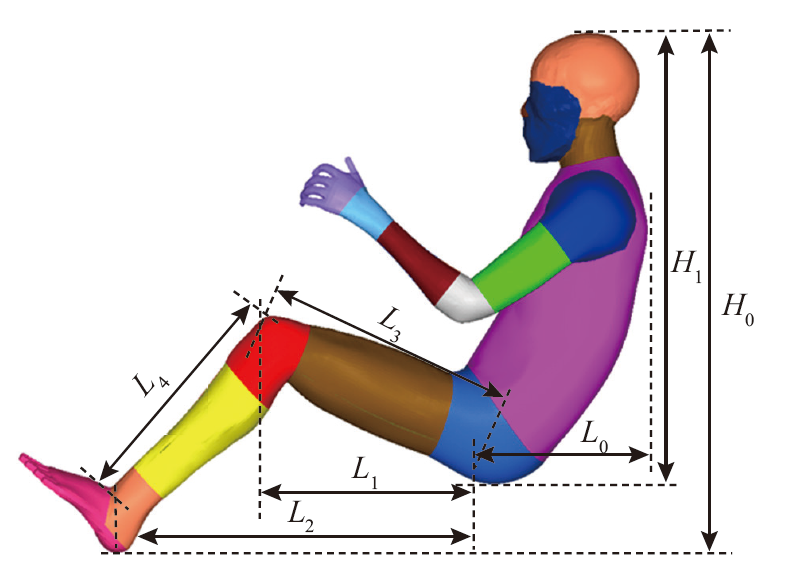
| 测量尺寸 | H0 / mm | H1 / mm | L0 / mm | L1 / mm | L2 / mm | L3 / mm | L4 / mm | m / kg |
|---|---|---|---|---|---|---|---|---|
| THUMS AM50 | 133 | 874 | 284 | 442 | 738 | 490 | 484 | 77.2 |
| THUMS CN50 | 124 | 851 | 283 | 413 | 654 | 459 | 442 | 70.8 |
| 相对差异/ % | -6.8 | -2.6 | -0.4 | -6.6 | -11.4 | -6.3 | -8.7 | -8.3 |
| 测量尺寸 | H0 / mm | H1 / mm | L0 / mm | L1 / mm | L2 / mm | L3 / mm | L4 / mm | m / kg |
|---|---|---|---|---|---|---|---|---|
| THUMS AM50 | 133 | 874 | 284 | 442 | 738 | 490 | 484 | 77.2 |
| THUMS CN50 | 124 | 851 | 283 | 413 | 654 | 459 | 442 | 70.8 |
| 相对差异/ % | -6.8 | -2.6 | -0.4 | -6.6 | -11.4 | -6.3 | -8.7 | -8.3 |
| 工况 | 模型 | 头部HIC | 头部BrIC | 颈部Fx / kN | 颈部Fz / kN | 胸廓压缩率/ % |
|---|---|---|---|---|---|---|
| SOB | THUMS AM50 | 252 | 0.62 | 0.13 | 1.04 | 23.5 |
| THUMS CN50 | 213 | 0.63 | 0.08 | 1.08 | 23.9 | |
| 相对误差 / % | -15.48 | 1.61 | -38.46 | 3.85 | 1.70 | |
| MPDB | THUMS AM50 | 232 | 0.89 | 0.3 | 1.86 | 27.4 |
| THUMS CN50 | 348 | 0.93 | 0.61 | 1.68 | 27.5 | |
| 相对误差/ % | 50 | 4.49 | 103.33 | -9.68 | 0.36 | |
| FRB | THUMS AM50 | 523 | 0.81 | 0.32 | 0.97 | 26.4 |
| THUMS CN50 | 386 | 0.6 | 0.15 | 0.82 | 18.1 | |
| 相对误差 / % | -26.2 | -25.93 | -53.13 | -15.46 | -31.44 | |
| FarSide | THUMS AM50 | 106 | 0.67 | 0.71 | 0.52 | 12.2 |
| THUMS CN50 | 129 | 0.62 | 0.45 | 0.38 | 9.7 | |
| 相对误差 / % | 21.7 | -7.46 | -36.62 | -26.92 | -20.49 |
| 工况 | 模型 | 头部HIC | 头部BrIC | 颈部Fx / kN | 颈部Fz / kN | 胸廓压缩率/ % |
|---|---|---|---|---|---|---|
| SOB | THUMS AM50 | 252 | 0.62 | 0.13 | 1.04 | 23.5 |
| THUMS CN50 | 213 | 0.63 | 0.08 | 1.08 | 23.9 | |
| 相对误差 / % | -15.48 | 1.61 | -38.46 | 3.85 | 1.70 | |
| MPDB | THUMS AM50 | 232 | 0.89 | 0.3 | 1.86 | 27.4 |
| THUMS CN50 | 348 | 0.93 | 0.61 | 1.68 | 27.5 | |
| 相对误差/ % | 50 | 4.49 | 103.33 | -9.68 | 0.36 | |
| FRB | THUMS AM50 | 523 | 0.81 | 0.32 | 0.97 | 26.4 |
| THUMS CN50 | 386 | 0.6 | 0.15 | 0.82 | 18.1 | |
| 相对误差 / % | -26.2 | -25.93 | -53.13 | -15.46 | -31.44 | |
| FarSide | THUMS AM50 | 106 | 0.67 | 0.71 | 0.52 | 12.2 |
| THUMS CN50 | 129 | 0.62 | 0.45 | 0.38 | 9.7 | |
| 相对误差 / % | 21.7 | -7.46 | -36.62 | -26.92 | -20.49 |
| [1] | 任立海, 罗志秦, 陈浩, 等. 假人与人体模型在 AEB 作用下的驾驶员离位响应对比[J]. 汽车安全与节能学报, 2023, 14(4): 448-456. |
| REN Lihai, LUO Zhiqin, CHEN Hao, et al. Comparison of driver’s out-of-position response of dummy and human models under AEB[J]. J Auto Safe Energ, 2023, 14(4): 448-456. (in Chinese) | |
| [2] | Devane K, Hsu F C, Koya B, et al. Assessment of finite element human body and ATD models in estimating injury risk in far-side impacts using field-based injury risk[J]. Accid Anal Preve, 2023, 192(3): Paper No 107274. |
| [3] | ZHAO Jay, Sabannavar D, Shkoukani M. Evaluation of Thor-50M, WorldSID-50M and GHBMC M50-O V6.0 models in far-side crashes[C]// 27 th Int’l Tech Conf Enha Safe Vehic (ESV), 2023:No. 23-0283. |
| [4] | Toyota Motor Corporation. Total Human Model for Safety (THUMS) AM50 occupant model version 6.1 user manual[SB/OL]. (2022-07-30) http://www.toyota.co.jp/thums/download. |
| [5] | Global Human Body Models Consortium. User manual: M50 occupant, version 4.3 for LS-Dyna[SB/OL]. (2011-04-01) https://www.elemance.com/resources. |
| [6] | 黄新刚. 基于中国人体的正面碰撞假人开发策略研究[D]. 长沙: 湖南大学, 2014. |
| HUANG Xingang. The research of the development of frontal crash dummy based on the Chinese human body[D]. Changsha: Hunan University, 2014. (in Chinese) | |
| [7] |
CAO Libo, ZHANG Kai, LÜ Xin, et al. Comparison of current ATDs with Chinese adults in anthropometry[J]. Traffic Inj Prev, 2016, 17(4): 430-433.
doi: 10.1080/15389588.2015.1101077 pmid: 26508539 |
| [8] | WANG Fang, YIN Jiajie, HU Lin, et al. Should anthropometric differences between the commonly used pedestrian computational biomechanics models and Chinese population be taken into account when predicting pedestrian head kinematics and injury in vehicle collisions in China?[J]. Accid Anal Preve, 2022, 173(4): Paper No 106718. |
| [9] | 王玉龙. 基于体征的参数化乘员有限元模型建立方法及应用研究[D]. 长沙: 湖南大学, 2016. |
| WANG Yulong. Development and application of parametric human body models based on different vehicle occupant characteristics[D]. Changsha: Hunan University, 2016. (in Chinese) | |
| [10] | 李莉, 段大伟, 刘孙炼, 等. 基于不同身材乘员保护的约束系统优化研究[J]. 汽车工程, 2016, 38(11): 1312-1318. |
| LI Li, DUAN Dawei, LIU Sunlian, et al. A research on the optimization of restraint system for the protection of occupants with different statures[J]. Autom Engineering, 2016, 38(11): 1312-1318. (in Chinese) | |
| [11] | 张恺. 面向自适应约束系统的多体征乘员碰撞仿真与损伤分析[D]. 长沙: 湖南大学, 2017. |
| ZHANF Kai. Toward adaptive restraint system: a simulation and injury analysis study with consideration of population variation[D]. Changsha: Hunan University, 2017. (in Chinese) | |
| [12] | 黎和俊, 杨震, 周大永, 等. 混Ⅲ假人, GHBMC人体模型以及中国人体模型的正碰损伤差异[J]. 中国机械工程, 2021, 32(15): 1836-1843. |
| LI Hejun, YANG Zhen, ZHOU Dayong, et al. Differences of injury response among Hybrid III dummy, GHBMC model and Chinese human body model in frontal crash[J]. Chin Mech Engi, 2021, 32(15): 1836-1843. (in Chinese) | |
| [13] | 杨洁. 基于THUMS 的东西方5百分位女性碰撞响应差异分析[D]. 北京: 清华大学, 2016. |
| YANG Jie. Study of differences of dynamic responses between eastern and western 5th percentile female based on THUMS[D]. Beijing: Tsinghua University, 2016. (in Chinese) | |
| [14] | 国家市场监督管理总局, 国家标准化管理委员会. GB/T 10000-2023中国成年人人体尺寸[S]. (2022-07-30). https://openstd.samr.gov.cn/bzgk/gb. |
| State Administration for Market Regulation, Standardization Administration. GB/T 10000-2023 human dimensions of Chinese adults[S]. (2022-07-30). https://openstd.samr.gov.cn/bzgk/gb. (in Chinese) | |
| [15] | National Highway Traffic Safety Administration. Vehicle interior and restraints modeling development of full vehicle finite element model including vehicle interior and occupant restraints systems for occupant safety analysis using Thor dummies[EB/OL]. [2022-04-06] https://www.nhtsa.gov/research-data/crashworthiness. |
| [16] |
QIU Jinlong, LI Kui, XIANG Hongyi, et al. Biomechanical analysis of thorax-abdomen response of vehicle occupant under seat belt load considering different frontal crash pulses[J]. Acta Bioeng Biomech, 2022, 24(4): 31-38.
pmid: 37341047 |
| [17] |
Perez-Rapela D, Donlon J, Forman J, et al. PMHS and WorldSID kinematic and injury response in far-side events in a vehicle-based test environment[J]. Stapp Car Crash J, 2019, 63: 83-126.
pmid: 32311053 |
| [18] | Hertz E. A note on the head injury criterion (HIC) as a predictor of the risk of skull fracture[C]// Proc: Asso Adva Automotive Medi Annu Conf, 1993, 37: 303-312. |
| [19] |
Takhounts E, Craig J, Moorhouse K, et al. Development of brain injury criteria (BrIC)[J]. Stapp Car Crash J, 2013, 57: 243-266.
pmid: 24435734 |
| [20] | 刘金明, 马华星, 李奎, 等. 行人头部与车辆碰撞中旋转速度对颅脑组织响应影响[J]. 汽车安全与节能学报, 2021, 12(1): 70-78. |
| LIU Jinming, MA Huaxing, LI Kui, et al. Effect of rotation speed on craniocerebral tissue response in pedestrian head-to-vehicle collision[J]. J Autom Safe Energ, 2021, 12(1): 70-78. (in Chinese) |
| [1] | HUANG Zhishan, PAN Di, HAN Yong, XIAO Zonghan, LIU Hui, QIN Zhenyuan. Effects of occupant anthropometry on thoracolumbar injury risk in reclined postures during frontal collisions [J]. Journal of Automotive Safety and Energy, 2026, 17(1): 50-58. |
| [2] | WANG Hanying, PAN Di, LI Zhuo, LIU Hui, HAN Yong. Distribution of body regions of multiple injuries in vulnerable road users based on real collisions accidents [J]. Journal of Automotive Safety and Energy, 2025, 16(6): 843-850. |
| [3] | DENG Gongxun, CAI Yani, LEI Feibing, LIU Hengjin, QI Lulin, FAN Yubo. Effect of vehicle crash severity and advanced restraint system parameters on occupant injuries [J]. Journal of Automotive Safety and Energy, 2025, 16(5): 698-706. |
| [4] | GAO Chaojun, LI Yicheng, CAI Yingfeng, WANG Hai, JIANG Jin. Research on AEB control of autonomous vehicles based on sensor fusion perception [J]. Journal of Automotive Safety and Energy, 2025, 16(4): 629-637. |
| [5] | FANG Xibo, NING Yigao, ZHAO Xuan, ZHOU Meng. Adaptive identification of dynamic parameters for commercial buses based on SQP and GRNN [J]. Journal of Automotive Safety and Energy, 2025, 16(4): 648-656. |
| [6] | ZHANG Xu, TAN Huiying, WU Weihai, XIE Zongfa. Two-stroke braking performance of diesel engine equipped with variable valve mechanism [J]. Journal of Automotive Safety and Energy, 2025, 16(2): 243-251. |
| [7] | HAN Yong, XU Guochao, LI Mingwang, PAN Di, ZHANG Haiyang. Near and far end occupant injury risk in non-regulatory side impact conditions [J]. Journal of Automotive Safety and Energy, 2025, 16(1): 57-65. |
| [8] | ZOU Tiefang, JIANG Die, ZHOU Jing, YUAN Xiangting. Effect of the parameter disturbance on a vehicle brake control and protection method proposed earlier [J]. Journal of Automotive Safety and Energy, 2024, 15(4): 477-483. |
| [9] | JIANG Jian, WANG Ping. Diagnosis of residual bidirectional LSTM automotive motor bearings with attention mechanism [J]. Journal of Automotive Safety and Energy, 2024, 15(4): 511-519. |
| [10] | HOU Zhiping, ZHU Haitao, LIU Cancan, YANG Jialin. Dimensionality reduction and reconstruction method of dummy biomechanics response based on adaptive autoencode [J]. Journal of Automotive Safety and Energy, 2024, 15(3): 337-343. |
| [11] | ZHANG Daowen, LEI Yi, REN Yao, TANG Kaiwen, DONG Xinchi, LUO Jing, HU Wenhao. Pedestrian lower limb dynamic response and injury biomechanical analysis based on pedestrian-vehicle collision accident reconstruction [J]. Journal of Automotive Safety and Energy, 2023, 14(6): 671-680. |
| [12] | HAN Yong, LUO Jinrong, HE Yong, WU He, LIN Xujie, CAI Hongyu. Prediction of pedestrian head injury in vehicle-pedestrian collisions based on a CART decision tree [J]. Journal of Automotive Safety and Energy, 2023, 14(5): 536-543. |
| [13] | GAO Wenbo, LV Xiaojiang, XIAO Zhi, MO Fuhao, LI Guibing. Boundary-condition characteristics-analysis of the pedestrian thorax-vehicle contacts considering accident scenarios [J]. Journal of Automotive Safety and Energy, 2023, 14(5): 555-562. |
| [14] | XIA Huaicheng, HAN Xiangyang, HU Kuanda. Influence of the speed and load on the tire-pressure monitoring- system performances by frequency method [J]. Journal of Automotive Safety and Energy, 2022, 13(3): 429-437. |
| [15] | LIU Tao, CHI Ting, WANG Di, WU Zhenxin, ZHANG Zhenglong. Brake model updating of automatic emergency braking system simulation test [J]. Journal of Automotive Safety and Energy, 2022, 13(3): 502-508. |
| Viewed | ||||||
|
Full text |
|
|||||
|
Abstract |
|
|||||
