Welcome to Journal of Automotive Safety and Energy,

Journal of Automotive Safety and Energy ›› 2025, Vol. 16 ›› Issue (1): 57-65.DOI: 10.3969/j.issn.1674-8484.2025.01.006
• Automotive Safety • Previous Articles Next Articles
HAN Yong1,2( ), XU Guochao1, LI Mingwang1, PAN Di1,2, ZHANG Haiyang3,*()
Received:2024-07-12
Revised:2024-08-29
Online:2025-02-28
Published:2025-03-04
CLC Number:
HAN Yong, XU Guochao, LI Mingwang, PAN Di, ZHANG Haiyang. Near and far end occupant injury risk in non-regulatory side impact conditions[J]. Journal of Automotive Safety and Energy, 2025, 16(1): 57-65.
Add to citation manager EndNote|Ris|BibTeX
URL: https://www.journalase.com/EN/10.3969/j.issn.1674-8484.2025.01.006
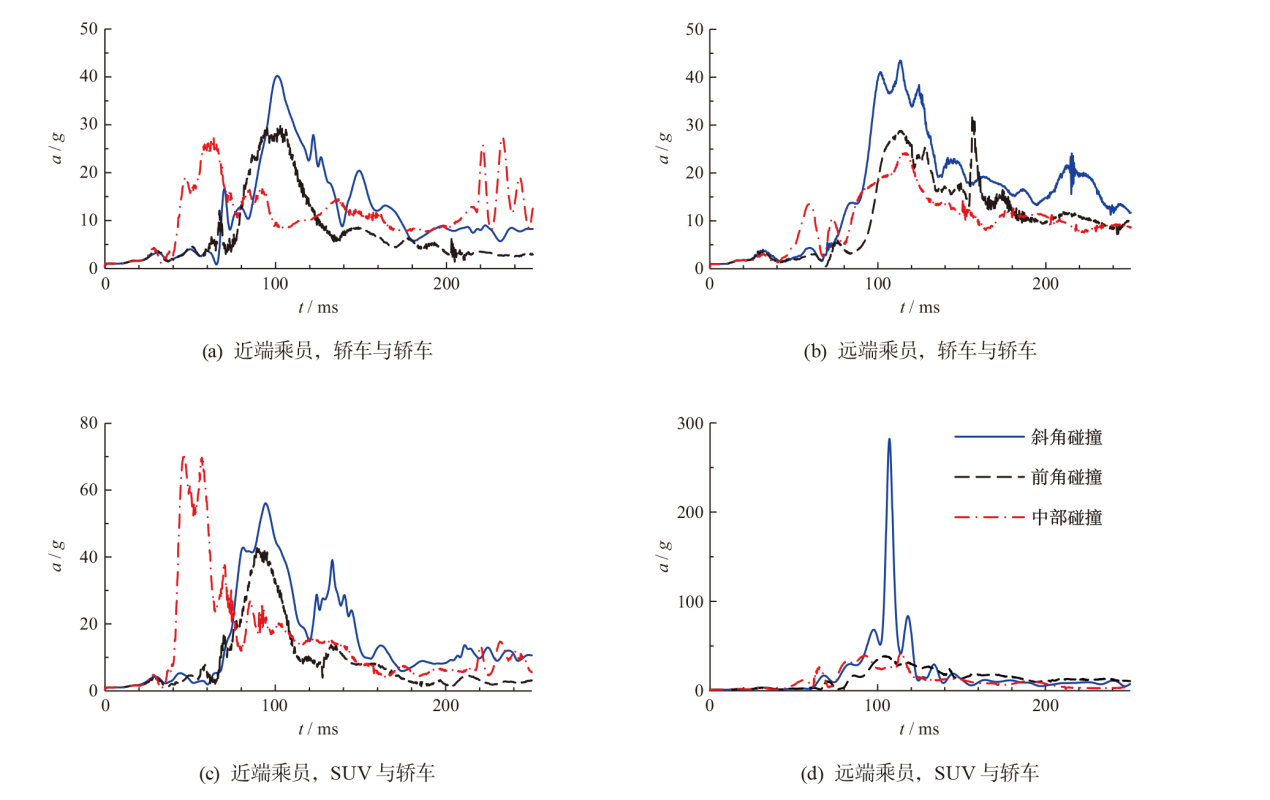
| 碰撞工况 | 头部3 ms合成加速度 / g | HIC15 | |||
|---|---|---|---|---|---|
| 近端乘员 | 远端乘员 | 近端乘员 | 远端乘员 | ||
| 阈值 | 高性能限72; | 低性能限80 [ | 高性能限500; | 低性能限700 [ | |
| 轿车-轿车-斜角碰撞 | 39.4 | 41.3 | 115.8 | 147.4 | |
| 轿车-轿车-前角碰撞 | 27.9 | 28.3 | 61.4 | 58.1 | |
| 轿车-轿车-中部碰撞 | 25.2 | 23.9 | 41.3 | 34.4 | |
| SUV-轿车-斜角碰撞 | 54.0 | 194.0 | 417.7 | 3011.0 | |
| SUV-轿车-前角碰撞 | 40.6 | 38.0 | 134.7 | 108.6 | |
| SUV-轿车-中部碰撞 | 65.1 | 38.3 | 453.7 | 198.5 | |
| 碰撞工况 | 头部3 ms合成加速度 / g | HIC15 | |||
|---|---|---|---|---|---|
| 近端乘员 | 远端乘员 | 近端乘员 | 远端乘员 | ||
| 阈值 | 高性能限72; | 低性能限80 [ | 高性能限500; | 低性能限700 [ | |
| 轿车-轿车-斜角碰撞 | 39.4 | 41.3 | 115.8 | 147.4 | |
| 轿车-轿车-前角碰撞 | 27.9 | 28.3 | 61.4 | 58.1 | |
| 轿车-轿车-中部碰撞 | 25.2 | 23.9 | 41.3 | 34.4 | |
| SUV-轿车-斜角碰撞 | 54.0 | 194.0 | 417.7 | 3011.0 | |
| SUV-轿车-前角碰撞 | 40.6 | 38.0 | 134.7 | 108.6 | |
| SUV-轿车-中部碰撞 | 65.1 | 38.3 | 453.7 | 198.5 | |
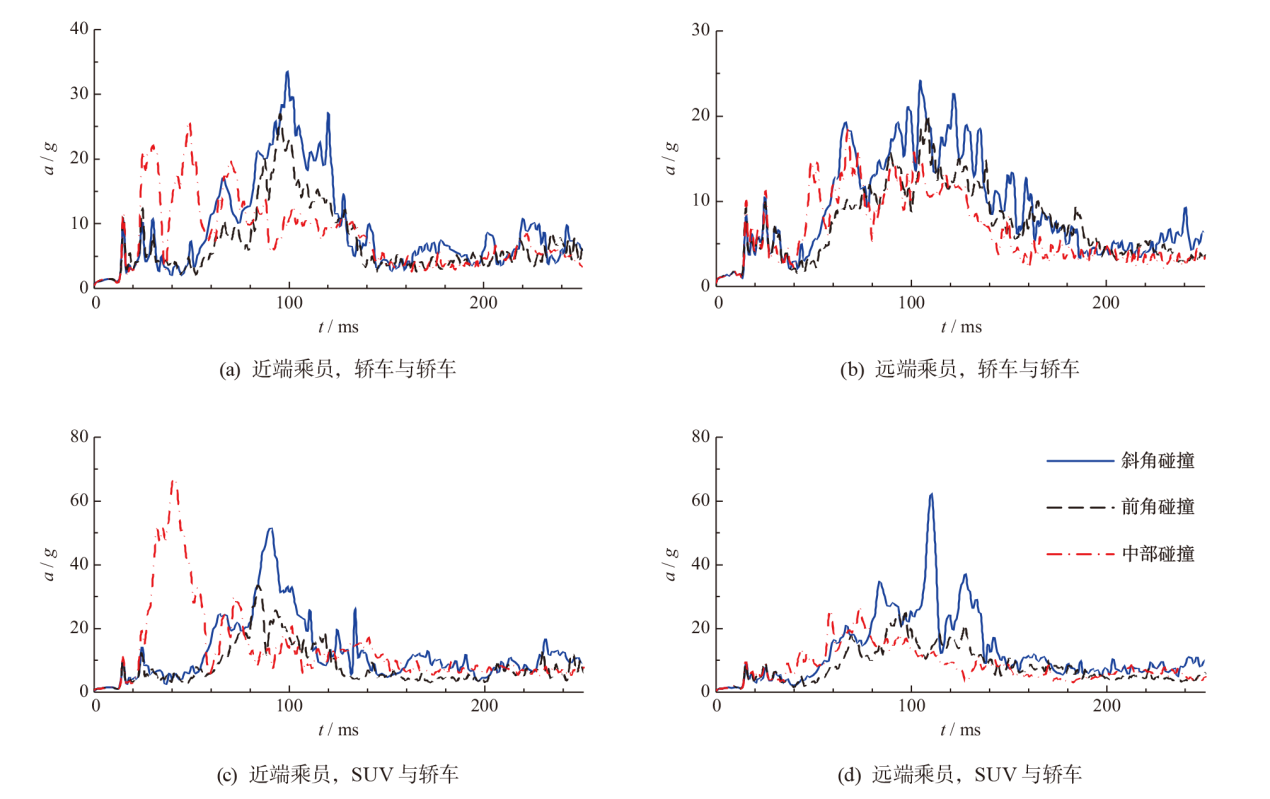
| 碰撞工况 | 近端乘员胸部肋骨最大压缩量 / mm | 远端乘员胸部肋骨最大压缩量/ mm | |||||
|---|---|---|---|---|---|---|---|
| 上肋骨 | 中肋骨 | 下肋骨 | 上肋骨 | 中肋骨 | 下肋骨 | ||
| 阈值 | 高性能限值28; 低性能限值50 | ||||||
| 轿车-轿车-斜角碰撞 | 2.7 | 3.7 | 7.0 | 4.8 | 6.0 | 1.5 | |
| 轿车-轿车-前角碰撞 | 8.1 | 4.3 | 7.5 | 14.4 | 1.3 | 1.5 | |
| 轿车-轿车-中部碰撞 | 12.7 | 14.5 | 19.6 | 11.8 | 1.6 | 3.0 | |
| SUV-轿车-斜角碰撞 | 2.8 | 3.5 | 6.9 | 5.6 | 1.9 | 6.0 | |
| SUV-轿车-前角碰撞 | 17.0 | 9.4 | 9.3 | 6.2 | 1.4 | 1.4 | |
| SUV-轿车-中部碰撞 | 54.8 | 51.4 | 57.5 | 14.2 | 4.9 | 3.9 | |
| 碰撞工况 | 近端乘员胸部肋骨最大压缩量 / mm | 远端乘员胸部肋骨最大压缩量/ mm | |||||
|---|---|---|---|---|---|---|---|
| 上肋骨 | 中肋骨 | 下肋骨 | 上肋骨 | 中肋骨 | 下肋骨 | ||
| 阈值 | 高性能限值28; 低性能限值50 | ||||||
| 轿车-轿车-斜角碰撞 | 2.7 | 3.7 | 7.0 | 4.8 | 6.0 | 1.5 | |
| 轿车-轿车-前角碰撞 | 8.1 | 4.3 | 7.5 | 14.4 | 1.3 | 1.5 | |
| 轿车-轿车-中部碰撞 | 12.7 | 14.5 | 19.6 | 11.8 | 1.6 | 3.0 | |
| SUV-轿车-斜角碰撞 | 2.8 | 3.5 | 6.9 | 5.6 | 1.9 | 6.0 | |
| SUV-轿车-前角碰撞 | 17.0 | 9.4 | 9.3 | 6.2 | 1.4 | 1.4 | |
| SUV-轿车-中部碰撞 | 54.8 | 51.4 | 57.5 | 14.2 | 4.9 | 3.9 | |
| 碰撞工况 | 近端乘员腹部肋骨最大压缩量/ mm | 远端乘员腹部肋骨最大压缩量/ mm | |||
|---|---|---|---|---|---|
| 上肋骨 | 下肋骨 | 上肋骨 | 下肋骨 | ||
| 阈值 | 高性能限值47; 低性能限值65 | ||||
| 轿车-轿车-斜角碰撞 | 10.5 | 10.6 | 2.9 | 2.4 | |
| 轿车-轿车-前角碰撞 | 10.9 | 10.4 | 3.4 | 2.9 | |
| 轿车-轿车-中部碰撞 | 20.8 | 24.7 | 6.1 | 5.1 | |
| SUV-轿车-斜角碰撞 | 9.8 | 10.0 | 2.6 | 2.3 | |
| SUV-轿车-前角碰撞 | 12.4 | 10.8 | 3.1 | 3.0 | |
| SUV-轿车-中部碰撞 | 67.7 | 88.7 | 10.3 | 20.9 | |
| 碰撞工况 | 近端乘员腹部肋骨最大压缩量/ mm | 远端乘员腹部肋骨最大压缩量/ mm | |||
|---|---|---|---|---|---|
| 上肋骨 | 下肋骨 | 上肋骨 | 下肋骨 | ||
| 阈值 | 高性能限值47; 低性能限值65 | ||||
| 轿车-轿车-斜角碰撞 | 10.5 | 10.6 | 2.9 | 2.4 | |
| 轿车-轿车-前角碰撞 | 10.9 | 10.4 | 3.4 | 2.9 | |
| 轿车-轿车-中部碰撞 | 20.8 | 24.7 | 6.1 | 5.1 | |
| SUV-轿车-斜角碰撞 | 9.8 | 10.0 | 2.6 | 2.3 | |
| SUV-轿车-前角碰撞 | 12.4 | 10.8 | 3.1 | 3.0 | |
| SUV-轿车-中部碰撞 | 67.7 | 88.7 | 10.3 | 20.9 | |
| [1] | World Health Organization, Global status report on road safety 2023[R]. Swtizerland: World Health Organization, ISBN 978-92-4-008651-7, 2023. |
| [2] | 公安部交通管理局. 2020年中华人民共和国道路交通事故统计年报[M]. 北京: 公安部交通管理局, 2021: 64-67. |
| Ministry of Public Security Traffic Management Bureau. 2020 Statistical Annual Report on Road Traffic Accidents in the People's Republic of China[M]. Beijing: Ministry of Public Security Traffic Management Bureau, 2021: 64-67. (in Chinese) | |
| [3] | GB20071-2006. 汽车侧面碰撞的乘员保护[S]. 北京: 中国标准出版社, 2006. |
| GB20071-2006. The protection of the occupants in the event of a lateral collision[S]. Beijing: China Zhijian Publishing House, 2006. (in Chinese) | |
| [4] | 邱少波. 汽车碰撞安全工程[M]. 北京: 北京理工大学出版社, 2016: 472-510. |
| QIU Shaobuo. Vehicle Crash Safety Engineering[M]. Beijing: Beijing Institute of Technology Press, 2016: 472-510. (in Chinese) | |
| [5] | Viano D, Parenteau C. Difference in dummy responses in matched side impact tests of vehicles with and without side airbags[J]. Traf Injury Pre, 2016, 17(5): 524-9 |
| [6] | Gierczycka D, Cronin D S. Occupant thorax response variations due to arm position and restraint systems in side impact crash scenarios[J]. Acci Ana Pre, 2017, 106: 173-180. |
| [7] | Diez M, Abajo J, de Prada J V, et al. Sitting posture influence in autonomous vehicles for the evaluation of occupant safety in side impact[J]. Safety Scienc, 2023, 159: 106002. |
| [8] | Brumbelow M L, Mueller B C, Arbelaez R A. Occurrence of serious injury in real-world side impacts of vehicles with good side-impact protection ratings[J]. Traf Injury Pre, 2015, 16: S125-S132. |
| [9] | Golman A J, Danelson K A, Stitzel J D. Robust human body model injury prediction in simulated side impact crashes[J]. Compu Meth Biomech Biomed En, 2016, 19(7): 717-732. |
| [10] | 王方, 韩勇, 李桂兵, 等. 基于有限元模拟的人体胸部材料参数对其碰撞响应影响分析[J]. 振动与冲击, 2016, 35(8): 90-96. |
| WANG Fang, HAN Yong, LI Guibing, et al. Finite element analysis of the effect of material properties on human thoracic impact response[J]. J Vibr Shoc, 2016, 35(8): 90-96. (in Chinese) | |
| [11] | Boyle K, Fanta A, Reed MP, et al. Restraint systems considering occupant diversity and pre-crash posture[J]. Traff Injury Pre, 2020, 21: S31-S36. |
| [12] | Gierczycka D, Cronin D. Importance of impact boundary conditions and pre-crash arm position for the prediction of thoracic response to pendulum, side sled, and near side vehicle impacts[J]. Compu Meth Biomech Biomed Engi, 2021, 24(14): 1531-1544. |
| [13] | 杨明俊, 卜晓兵, 郭庆祥. 基于某车型的不同乘员性别远端保护响应差异分析[J]. 汽车安全与节能学报, 2022, 13(4): 634-642. |
| YANG Mingjun, BU Xiaobing, GUO Qingxiang. Analysis of differences in far side protection responses of different occupant genders based on a certain vehicle[J]. J Autom Safe Ener, 2022, 13(4): 634-642. (in Chinese) | |
| [14] | Koya B, Devane K.S, Fuentes D.A, et al. Preliminary validation of the GHBMC average male occupant models and 70YO aged model in far-side impact[J]. Acci Ana Pre, 2023, 193: Paper No 107283. |
| [15] | Umale S, Yoganandan N, Pintar F A, et al. Factors influencing the effectiveness of occupant retention under far-side impacts: A parametric study[J]. J Mech Beha Biomed Mat, 2018, 84: 235-248. |
| [16] | Devane K, Hsu FC, Koya B, et al. Assessment of finite element human body and ATD models in estimating injury risk in far-side impacts using field-based injury risk[J]. Acci Ana Pre, 2023, 192: Paper No 107274. |
| [17] | Abdel-Aty M, Abdelwahab H. Analysis and prediction of traffic fatalities resulting from angle collisions including the effect of vehicles’ configuration and compatibility[J]. Acci Ana Pre, 2004, 36(3): 457-469. |
| [18] | LAI Xinghua, MA Chunsheng, HU Jingwen, et al. Impact direction effect on serious-to-fatal injuries among drivers in near-side collisions according to impact location: Focus on thoracic injuries[J]. Acci Ana Pre, 2004, 2012, 48: 442-450. |
| [19] | National Center for Statistics and Analysis. Traffic safety facts 2020:A compilation of motor vehicle crash data (Report No. DOT HS 813 375)[R]. National Highway Traffic Safety Administratio, 2022, October. |
| [20] | Singh, Harry. Mass reduction for light-duty vehicles for model years 2017-2025[R]. DOT HS 811 666. National Highway Traffic Safety Administration, 2012-08. |
| [21] | 朱鸿旭. 自动紧急制动介入时侧碰离位乘员防护仿真分析[D]. 重庆: 重庆理工大学, 2020. |
| ZHU Hongxu. Simulation analysis of out-of-position occupant protection in side impact with automatic emergency braking introduction[D]. Chongqing: Chongqing University of Technology, 2020. (in Chinese) | |
| [22] | NCAC National Crash Analysis Center.Development and validation of a finite element model for a 2002 ford explorer [S]. NCAC 2008-T-004, prepared for FHW, 2008-12. |
| [23] | Dhafer M, Randa R S, Fadi T, et al. Extended validation of the finite element model for the 2002 ford explorer sport utility vehicle [S]. Working paper, National Crash Analysis Cente, NCAC 2012-W-002, 2012. |
| [24] | Cui Y, Yamaguchi M, Mizuno K, et al. FE analysis of child occupant kinematics in CRS in side oblique impact[J]. Int’l J Crashworthines, 2012, 17(3): 233-242. |
| [25] | Singh H, Ganesan V, Davies J, et al. Vehicle interior and restraints modeling the development of full vehicle finite element model including vehicle interior and occupant restraints systems for occupant safety analysis using THOR dummies (Report No. DOT HS 812 545)[R]. Washingto, DC: National Highway Traffic Safety Administration, 2018. |
| [26] | Rattenbury S J, Gloyns P F, Nolan J M. Vehicle deformation in real-world side impact crashes and regulatory crash tests[C]// Proc 17th Int’l Tech Conf ES, 2001:No. 2001*06-02482001-06-04. |
| [27] | Euro NCAP Commission.Euro NCAP 2024 [S/OL]. The official site of European new car assessment programme (2023-12-05). . |
| [28] | 刘婷婷. 车—车侧碰事故中副驾驶乘员动力学响应研究[D]. 重庆: 重庆交通大学, 2019. |
| LIU Tingting. Study on the dynamic response of copilot crew in the side collision accident[D]. Chongqing: Chongqing Jiaotong University, 2019. (in Chinese) | |
| [29] | 水野幸治, 韩勇. 汽车碰撞安全[M]. 北京: 人民交通出版社股份有限公司, 2016: 1-30. |
| Koji MIZUNO, HAN Yong. Automotive Crash Safety[M]. Beijing: People's Transportation Press, 2016: 1-30. (in Chinese) | |
| [30] | XU Lei, Aoshima Y, Korenaga D, et al. Evaluation of rib deformation of THOR dummy in seat belt loadings[J]. Trans SAE, 2021, 52(2): 486-491. |
| [31] | DU Tianya, CHEN Jiqing, LAN Fengchong. Analysis of liver impact responses through a Chinese human body finite element model[J]. J Mech Med Bi, 2016, 16(8): Paper No 1640024. |
| [1] | YI Wentao, TANG Ying, LEI Feibing, ZENG Dong, CAI Yani, LUO Binyin. Effects of head kinematic characteristics on diffuse brain injury in side pole impact [J]. Journal of Automotive Safety and Energy, 2025, 16(1): 66-76. |
| [2] | WU Hequan, LI Yihui, LIU Jin, ZHANG Shenao. Simulation experiments for the passenger injuries with different sitting positions in autonomous vehicle collisions [J]. Journal of Automotive Safety and Energy, 2024, 15(4): 484-491. |
| [3] | JIANG Jian, WANG Ping. Diagnosis of residual bidirectional LSTM automotive motor bearings with attention mechanism [J]. Journal of Automotive Safety and Energy, 2024, 15(4): 511-519. |
| [4] | HOU Zhiping, ZHU Haitao, LIU Cancan, YANG Jialin. Dimensionality reduction and reconstruction method of dummy biomechanics response based on adaptive autoencode [J]. Journal of Automotive Safety and Energy, 2024, 15(3): 337-343. |
| [5] | HAN Yong, LUO Jinrong, HE Yong, WU He, LIN Xujie, CAI Hongyu. Prediction of pedestrian head injury in vehicle-pedestrian collisions based on a CART decision tree [J]. Journal of Automotive Safety and Energy, 2023, 14(5): 536-543. |
| [6] | GAO Wenbo, LV Xiaojiang, XIAO Zhi, MO Fuhao, LI Guibing. Boundary-condition characteristics-analysis of the pedestrian thorax-vehicle contacts considering accident scenarios [J]. Journal of Automotive Safety and Energy, 2023, 14(5): 555-562. |
| [7] | TANG Youming, XIE Xiangjian, SUN Guibin, WANG Ping, ZHANG Yi, SUN Guanyu. Effect of increasing age on injury risk in elderly male occupant [J]. Journal of Automotive Safety and Energy, 2023, 14(4): 413-420. |
| [8] | XU Zhe, GAO Guanyu, LIU Cancan, LOU Lei. Multi-point intrusion side impact method for the child restraint system and dummy injury [J]. Journal of Automotive Safety and Energy, 2023, 14(1): 38-45. |
| [9] | YANG Mingjun, BU Xiaobing, GUO Qingxiang. Analysis of differences in far side protection responses of different occupant genders based on a certain vehicle [J]. Journal of Automotive Safety and Energy, 2022, 13(4): 634-642. |
| [10] | XIA Huaicheng, HAN Xiangyang, HU Kuanda. Influence of the speed and load on the tire-pressure monitoring- system performances by frequency method [J]. Journal of Automotive Safety and Energy, 2022, 13(3): 429-437. |
| [11] | LIU Tao, CHI Ting, WANG Di, WU Zhenxin, ZHANG Zhenglong. Brake model updating of automatic emergency braking system simulation test [J]. Journal of Automotive Safety and Energy, 2022, 13(3): 502-508. |
| [12] | SHAN Chunxian, XIA Dengfu, LIU Zhaoyang, TANG Aikun. Experimental study on power battery thermal managment system based on thermoelectric-coupling liquid-cooling [J]. Journal of Automotive Safety and Energy, 2022, 13(3): 535-540. |
| [13] | WEI Meng, WANG Qiao, YE Min, LIAN Gaoqi, XU Xinxin. Remaining useful life prediction of lithium-ion batteries based on dropout Monte Carlo recurrent neural network [J]. Journal of Automotive Safety and Energy, 2022, 13(3): 541-549. |
| [14] | YONG Jiawang, LI Yansong, FENG Nenglian, LIU Yahui. Adaptive automatic emergency braking control strategy based on an ESHB system [J]. Journal of Automotive Safety and Energy, 2022, 13(2): 300-308. |
| [15] | WANG Donglin, HU Zichen, ZHAO Liang, JIN Pengfei, TANG Liang. Submarining injury mechanism and its protect measures for rear seat occupant under frontal impact [J]. Journal of Automotive Safety and Energy, 2021, 12(4): 467-474. |
| Viewed | ||||||
|
Full text |
|
|||||
|
Abstract |
|
|||||
