Welcome to Journal of Automotive Safety and Energy,

Journal of Automotive Safety and Energy ›› 2024, Vol. 15 ›› Issue (5): 774-782.DOI: 10.3969/j.issn.1674-8484.2024.05.015
• Intelligent Driving and Intelligent Transportation • Previous Articles Next Articles
ZHENG Xunjia1( ), JIANG Junhao1, LI Huilan2, CHEN Xing1, LIU Hui1, WANG Jianqiang3, GAO Jianjie4,*()
Received:2024-05-10
Revised:2024-06-04
Online:2024-10-31
Published:2024-11-07
CLC Number:
ZHENG Xunjia, JIANG Junhao, LI Huilan, CHEN Xing, LIU Hui, WANG Jianqiang, GAO Jianjie. Research on transient driving risk vector modeling method under strong constraints of traffic regulations[J]. Journal of Automotive Safety and Energy, 2024, 15(5): 774-782.
Add to citation manager EndNote|Ris|BibTeX
URL: https://www.journalase.com/EN/10.3969/j.issn.1674-8484.2024.05.015
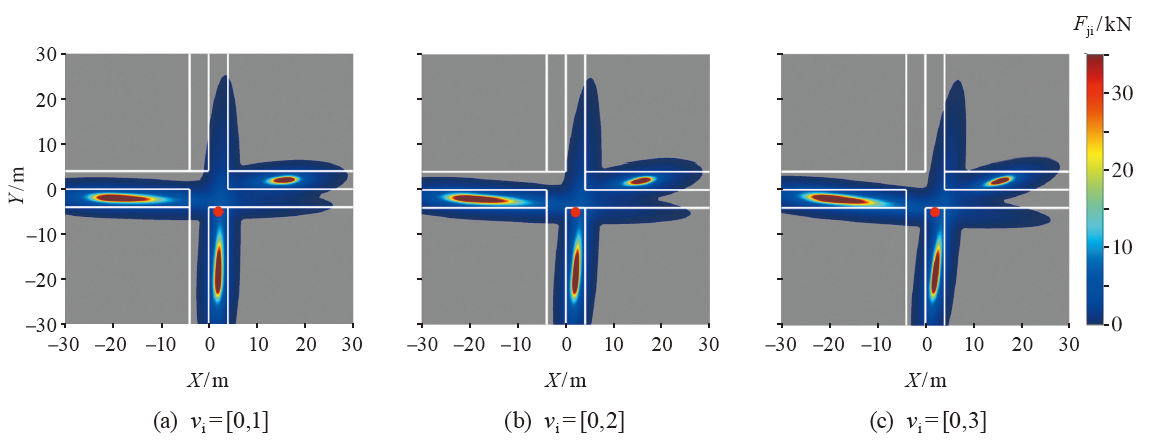
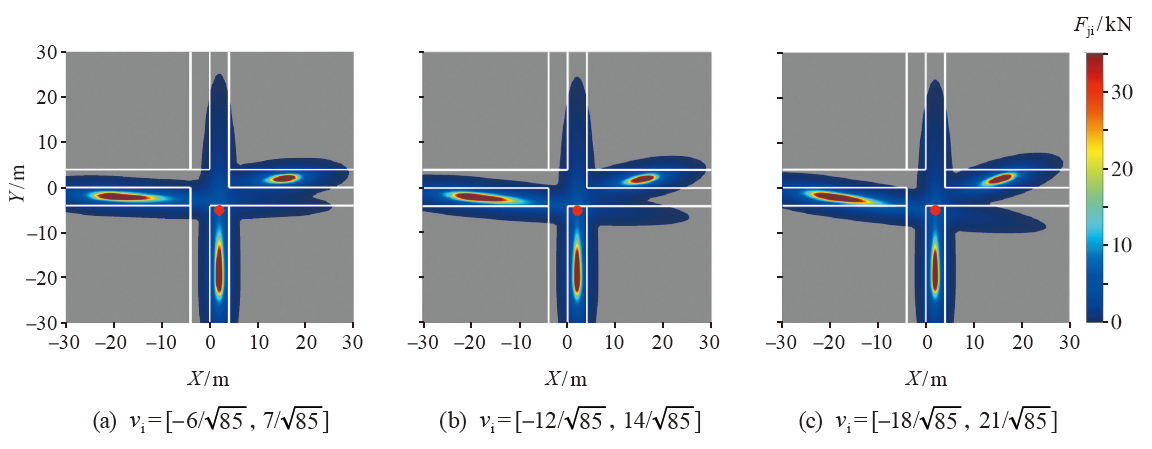
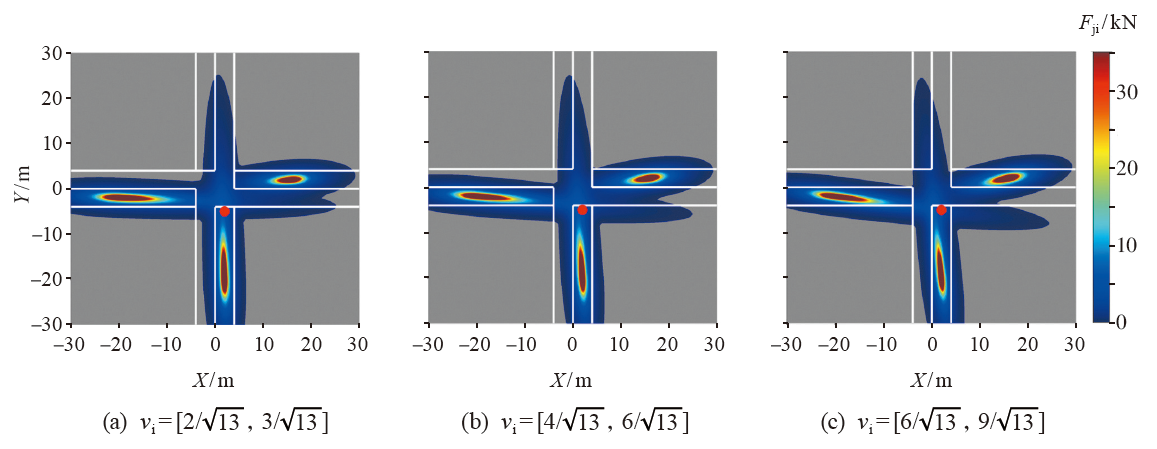
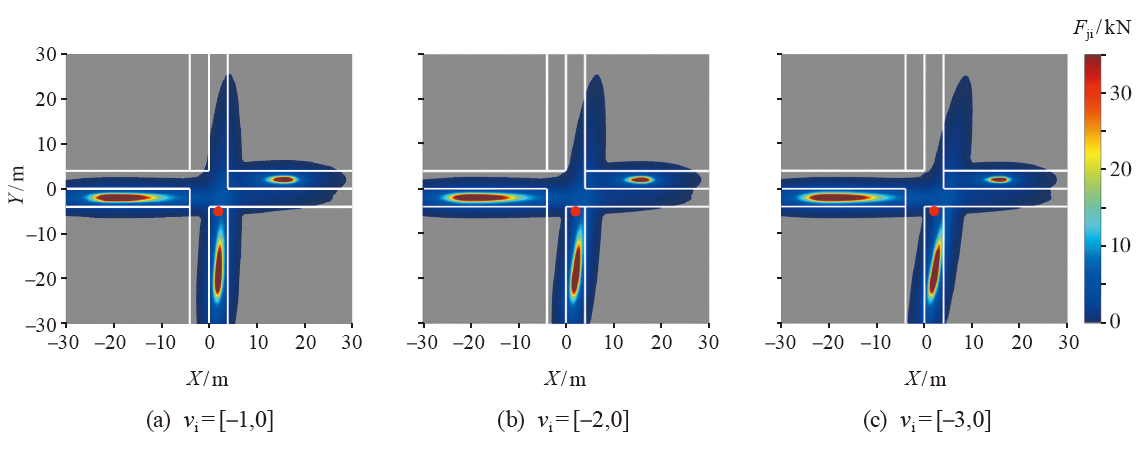
| 序号 | 场景 | vi / (m·s-1) | Fji / kN | Fj1i / kN | Fj2i / kN | Fj3i / kN | 风险降低率/ % |
|---|---|---|---|---|---|---|---|
| 1 | 初始 | [0,0] | 6.411 | 0.469 | 0 | 5.942 | — |
| 2 | 直行 | [0,1] | 6.499 | 1.236 | 0 | 5.363 | -1.37 |
| 3 | [0,2] | 6.892 | 2.079 | 0 | 4.813 | -7.50 | |
| 4 | [0,3] | 6.823 | 2.403 | 0.125 | 4.293 | -6.40 | |
| 5 | 左转 | [-6/,7/] | 5.860 | 0.984 | 0 | 4.875 | 8.60 |
| 6 | [-12/,14/] | 4.960 | 1.734 | 0 | 3.227 | 22.63 | |
| 7 | [-18/,21/] | 4.511 | 2.581 | 0.055 | 1.874 | 29.65 | |
| 8 | 右转 | [2/,3/] | 5.953 | 0.962 | 0 | 4.991 | 7.15 |
| 9 | [4/,6/] | 5.280 | 1.658 | 0 | 3.522 | 19.21 | |
| 10 | [6/,9/] | 4.246 | 2.057 | 0 | 2.188 | 33.78 | |
| 11 | 掉头 | [-1,0] | 5.149 | 0.517 | 0 | 4.632 | 19.68 |
| 12 | [-2,0] | 3.263 | 0.568 | 0 | 2.695 | 49.11 | |
| 13 | [-3,0] | 2.089 | 0.620 | 0 | 1.469 | 67.41 |
| 序号 | 场景 | vi / (m·s-1) | Fji / kN | Fj1i / kN | Fj2i / kN | Fj3i / kN | 风险降低率/ % |
|---|---|---|---|---|---|---|---|
| 1 | 初始 | [0,0] | 6.411 | 0.469 | 0 | 5.942 | — |
| 2 | 直行 | [0,1] | 6.499 | 1.236 | 0 | 5.363 | -1.37 |
| 3 | [0,2] | 6.892 | 2.079 | 0 | 4.813 | -7.50 | |
| 4 | [0,3] | 6.823 | 2.403 | 0.125 | 4.293 | -6.40 | |
| 5 | 左转 | [-6/,7/] | 5.860 | 0.984 | 0 | 4.875 | 8.60 |
| 6 | [-12/,14/] | 4.960 | 1.734 | 0 | 3.227 | 22.63 | |
| 7 | [-18/,21/] | 4.511 | 2.581 | 0.055 | 1.874 | 29.65 | |
| 8 | 右转 | [2/,3/] | 5.953 | 0.962 | 0 | 4.991 | 7.15 |
| 9 | [4/,6/] | 5.280 | 1.658 | 0 | 3.522 | 19.21 | |
| 10 | [6/,9/] | 4.246 | 2.057 | 0 | 2.188 | 33.78 | |
| 11 | 掉头 | [-1,0] | 5.149 | 0.517 | 0 | 4.632 | 19.68 |
| 12 | [-2,0] | 3.263 | 0.568 | 0 | 2.695 | 49.11 | |
| 13 | [-3,0] | 2.089 | 0.620 | 0 | 1.469 | 67.41 |
| [1] | 王云鹏, 王学平, 王翀, 等. 自动驾驶汽车交通安全白皮书[R/OL]. 中国汽车技术研究中心有限公司,同济大学,百度Apollo, 2021. [2023-09-08]. https://max.book118.com/html/2023/0905/5111234322010322.shtm. |
| WANG Yunpeng, WANG Xueping, WANG Chong, et al. White paper on traffic safety of autonomous vehicle[R/OL]. China Automotive Technology and Research center Co. Ltd, Tongji University, Baidu Apollo, 2021. [2023-09-08]. https://max.book118.com/html/2023/0905/5111234322010322.shtm. (in Chinese) | |
| [2] | Kirovskii O M, Gorelov V A. Driver assistance systems: Analysis, tests and the safety case. ISO 26262 and ISO PAS 21448[C]// IOP Conf Ser: Mater Sci Engi. IOP Publishing Ltd, 534: 012019. |
| [3] | Chia W M D, Keoh S L, Goh C, et al. Risk assessment methodologies for autonomous driving: A survey[J]. IEEE Trans Intel Transport Syst, 2022, 23(10): 16923-16939. |
| [4] | Ericson C A. Hazard Analysis Techniques for System Safety[M]. John Wiley & Sons, Hoboken, New Jersey,2015:69-92. |
| [5] | Khaiyum S, Pal B, Kumaraswamy Y S. An approach to utilize FMEA for autonomous vehicles to forecast decision outcome[C]// Proc 3rd Int'l Conf Front Intel Comput: Theor Appl (FICTA)2014. 1: 701-709. Springer International Publishing, Switzerland, 2015, 1: 701-709. |
| [6] | Ro J W, Roop P S, Malik A. A new safety distance calculation for rear-end collision avoidance[J]. IEEE Trans Intel Transport Syst, 2021, 22(3): 1742-1747. |
| [7] | 兰凤崇, 余蒙, 李诗成, 等. 考虑预碰撞时间的自动紧急制动系统分层控制策略研究[J]. 汽车工程, 2020, 42(2): 206-214. |
| LAN Fengchong, YU Meng, LI Shicheng, et al. Research on hierarchical control strategy for automatic emergency braking system with consideration of time-to-collision[J]. Autom Engineering, 2020, 42(2): 206-214. (in Chinese) | |
| [8] | Altendorfer R, Wilkmann C. A new approach to estimate the collision probability for automotive applications[J]. Automatica, 2021, 127: 109497. |
| [9] | Winkelbauer M, Donabauer M, Pommer A, et al. Naturalistic data on time headway behind motorcycles and other vehicles[J]. Safe Sci, 2019, 119: 162-173. |
| [10] | Seppelt B D, Lee J D. Keeping the driver in the loop: Dynamic feedback to support appropriate use of imperfect vehicle control automation[J]. Int'l J Human-Comput Stud, 2019, 125: 66-80. |
| [11] | Fahmy H M, Ghany M A A E, Baumann G. Vehicle risk assessment and control for lane-keeping and collision avoidance at low-speed and high-speed scenarios[J]. IEEE Trans Vehi Tech, 2018, 67(6): 4806-4818. |
| [12] | Katrakazas C, Quddus M, Chen W-H. A new integrated collision risk assessment methodology for autonomous vehicles[J]. Accid Anal Prevent, 2019, 127: 61-79. |
| [13] | Ledent P, Paigwar A, Renzaglia A, et al. Formal validation of probabilistic collision risk estimation for autonomous driving[C]// 2019 IEEE Int'l Conf Cybern Intel Syst (CIS) and IEEE Conf Robot, Auto Mechatron (RAM). Bangkok, Thailand, 2019: 433-438. |
| [14] | Ni Daiheng. A unified perspective on traffic flow theory, part I: The field theory[J]. Appl Math Sci, 2013, 7(39): 1929-1946. |
| [15] | Ni Daiheng, Leonard J D, Jia Chaoqun, et al. Vehicle longitudinal control and traffic stream modeling[J]. Transport Sci, 2015, 50(3): 1016-1031. |
| [16] | 王建强, 吴剑, 李洋. 基于人-车-路协同的行车风险场概念、原理及建模[J]. 中国公路学报, 2016, 29(1): 105-114. |
| WANG Jianqiang, WU Jian, LI Yang. Concept, principle and modeling of driving risk field based on driver-vehicle-road interaction[J]. Chin J Highw Transport, 2016, 29(1): 105-114. (in Chinese) | |
| [17] | WANG Jianqiang, WU Jian, ZHENG Xunjia, et al. Driving safety field theory modeling and its application in pre-collision warning system[J]. Transport Res Part C: Emerg Tech, 2016, 72: 306-324. |
| [18] | 郑讯佳, 李会兰, 胡孟夏, 等. 基于能量转移理论的行车风险量化建模方法研究[J]. 汽车工程学报, 2023, 13(5): 615-622. |
| ZHENG Xunjia, LI Huilan, HU Mengxia, et al. Quantitative modeling of driving risk based on energy transfer theory[J]. Chin J Autom Engi, 2023, 13(5): 615-622. (in Chinese) | |
| [19] | ZHENG Xunjia, ZHANG Di, GAO Hongbo, et al. A novel framework for road traffic risk assessment with hmm-based prediction model[J]. Sensors, 2018, 18(12): No 4313. |
| [20] | ZHENG Xunjia, WANG Jiawei, WANG Jianqiang. A novel road traffic risk modeling approach based on the traffic safety field concept[C]// 18th COTA Int'l Conf Transport Profession. Reston, VA: American Society of Civil Engineers, Beijing, 2018: 263-274. |
| [21] | 郑讯佳, 蒋骏皓, 黄荷叶, 等. 行车风险量化新方法及其防控策略仿真研究[J]. 机械工程学报, 2024, 60(10): 207-221. |
| ZHNEG Xunjia, JIANG Junhan, HUANG Heye, et al. Novel quantitative approach for assessing driving risks and simulation study of its prevention and control strategies[J]. J Mech Engineering, 60(10): 207-221. (in Chinese) |
| [1] | WU Hangzhe, JIAO Yizhou, LIU Yang, ZHONG Wei, WANG Shuihe, GUO Jinghua, ZHAO Jian. Predictive trajectory tracking control by a linear time-varying model for emergency collision avoidance of autonomous vehicles [J]. Journal of Automotive Safety and Energy, 2025, 16(6): 934-944. |
| [2] | ZHENG Xunjia, CAO Zeyi, CHEN Xing, LIU Hui, GAO Jianjie. Trajectory tracking control based on adaptive prediction time-domain MPC [J]. Journal of Automotive Safety and Energy, 2025, 16(5): 773-783. |
| [3] | PAN Yuheng, REN Chen, LU Weijia, LI Yang. DV-PointPillars 3D object detection model based on dual pooling attention mechanism and vertical feature fusion [J]. Journal of Automotive Safety and Energy, 2025, 16(5): 793-801. |
| [4] | OUYANG Delin, QIU Yifan, WANG Yingchen, YANG Liang, MIN Haigen, WANG Wenjun, LI Guofa. End-to-end decision-making model for multi-task autonomous driving [J]. Journal of Automotive Safety and Energy, 2025, 16(4): 610-619. |
| [5] | LI Guofa, OUYANG Delin, CHEN Chen, NIE Binging, ZHANG Wei, YU Huili, Liu Bin, ZHANG Qiang, WANG Wenjun, CHENG Bo, LI Shengbo. Review on driving risk monitoring and intervention technologies [J]. Journal of Automotive Safety and Energy, 2025, 16(2): 181-196. |
| [6] | HU Zhilong, PEI Xiaofei, ZHOU Honglong, WEI Weiran. Risk-sensitive hierarchical reinforcement learning decision-making for autonomous vehicles [J]. Journal of Automotive Safety and Energy, 2025, 16(2): 326-333. |
| [7] | YANG Junru, ZHENG Sifa, XU Shucai, TIAN Ye, SUN Jian, SUN Chuan, LI Haoran. Design and research of an automated parking evaluation tool based on the OnSite platform [J]. Journal of Automotive Safety and Energy, 2025, 16(2): 334-343. |
| [8] | QIN Yaqin, DONG Shuai, XIE Jiming, CHEN Liang, LIU Yonghua, GUO Miao. Methods for predicting vehicle trajectories in motorway weaving zones based on driving risk fields [J]. Journal of Automotive Safety and Energy, 2024, 15(6): 952-961. |
| [9] | CAO Liling, LIU Junli, JIN Shengye, CAO Shouqi, ZHOU Guofeng. Design of a remote multidimensional information real time interaction system for autonomous driving [J]. Journal of Automotive Safety and Energy, 2024, 15(6): 934-942. |
| [10] | LIU Yang, ZHAN Jiahao, LI Shen, LI Xiaopeng, CHEN Jun. Future of autonomous driving: Single autonomous driving and intelligent vehicle-infrastructure collaboration systems [J]. Journal of Automotive Safety and Energy, 2024, 15(5): 611-633. |
| [11] | QU Guangyue, YANG Lan, YUAN Meng, FANG Shan, LIU Songyan. A multimodal trajectory prediction method of pedestrians at signalized intersections for autonomous vehicles [J]. Journal of Automotive Safety and Energy, 2024, 15(5): 689-701. |
| [12] | LIU Peng, ZHAO Kegang, LIANG Zhihao, YE Jie. Vehicle longitudinal speed planning based on deep reinforcement learning CLPER-DDPG [J]. Journal of Automotive Safety and Energy, 2024, 15(5): 702-710. |
| [13] | GAO Kai, LIU Jian, LIU Linhong, LIU Xinyu, ZHANG Jinlai, DU Ronghua. Explainable lane change intention prediction based on LSTM-multi-head mixed attention [J]. Journal of Automotive Safety and Energy, 2024, 15(5): 763-773. |
| [14] | XIE Zhen, ZHOU Guofeng, WU Mingyu, CAO Shouqi. Research on dynamic modeling of port autonomous driving truck [J]. Journal of Automotive Safety and Energy, 2024, 15(5): 783-794. |
| [15] | ZHANG Yongsheng, LI Yizhou, WANG Liang, XU Zhigang. Development status and challenges of vehicle terminals in intelligent and connected environments [J]. Journal of Automotive Safety and Energy, 2024, 15(3): 295-308. |
| Viewed | ||||||
|
Full text |
|
|||||
|
Abstract |
|
|||||
