欢迎访问《汽车安全与节能学报》,

汽车安全与节能学报 ›› 2024, Vol. 15 ›› Issue (3): 269-294.DOI: 10.3969/j.issn.1674-8484.2024.03.001
• 综述与展望 • 下一篇
许敏( ), 张亦嘉()
收稿日期:2024-05-20
修回日期:2024-06-16
出版日期:2024-06-30
发布日期:2024-07-01
作者简介:许敏(1962—),男(汉),安徽,教授。E-mail:mxu@sjtu.edu.cn。
XU Min(), ZHANG Yijia()
Received:2024-05-20
Revised:2024-06-16
Online:2024-06-30
Published:2024-07-01
摘要:
在国家政策与市场需求的双重驱动下,2021年以来,中国品牌混合动力汽车动力总成技术实现突破,围绕中国市场特点与消费者用车习惯推出一批具有中国特色、世界范围内领先的混合动力汽车产品。近期混合动力汽车市场销量呈爆发式增长,2023年中国市场混合动力乘用车销售超300万辆,同比增长83%。然而,受近年来汽车领域电动化浪潮影响,行业内尚存关于混合动力汽车仅为过渡性技术的观点,部分消费者对国产混动汽车技术产品力仍存质疑。为纠正对混合动力汽车的片面性、偏见性认识,该文围绕中国混合动力汽车动力总成技术路线展开,聚焦多样化的混动架构与专用化的核心部件,提出新的混合度定义作为动力总成电气化程度的统一评价标准,探讨国内外主流混动技术异同,剖析当下中国最前沿的混动技术特点与发展趋势,厘清中国混动汽车动力总成的发展脉络。研究表明:中国式混动汽车以大容量动力电池与插电式混合动力为技术特色,实现发动机、电机两大驱动动力源以及动力电池、增程系统两大动力能量源的灵活混合与优势互补。与纯内燃机车相比,得益于电驱动技术辅助,混合动力汽车聚焦提高发动机热效率、发动机高效区利用率以及整车燃油经济性。与纯电动车相比,混合动力汽车则基于发动机的增程发电,以高性价比和高便利度解决纯电动车的补能焦虑;并通过结合发动机直驱、变速器动力放大等机械驱动技术,以更低的硬件成本实现更稳定的强劲动力输出。混合动力汽车的独特优势使其作为长期性技术路线,将成为带动汽车产业向碳中和方向转型升级的关键,该文对当下市场的深度分析和未来趋势的理性推测将为中国混动技术的进一步发展提供有益参考。
中图分类号:
许敏, 张亦嘉. 中国混合动力汽车动力总成技术进展[J]. 汽车安全与节能学报, 2024, 15(3): 269-294.
XU Min, ZHANG Yijia. Advancements in the powertrain technology of hybrid electric vehicles in China[J]. Journal of Automotive Safety and Energy, 2024, 15(3): 269-294.
| 串联 | 并联 | 串并联 | 功率分流 | |||
|---|---|---|---|---|---|---|
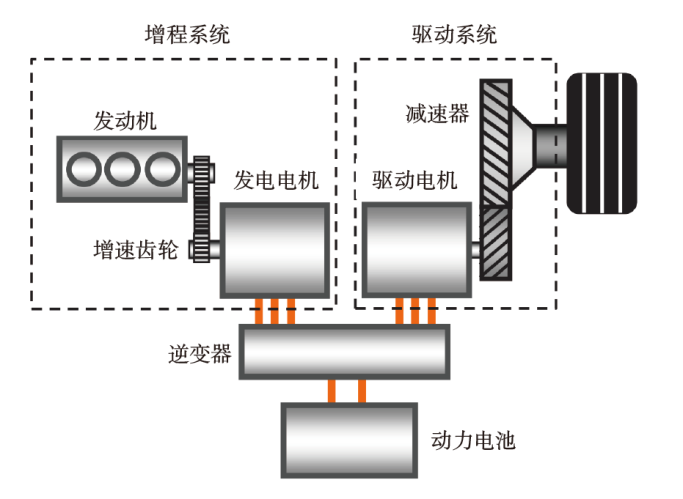
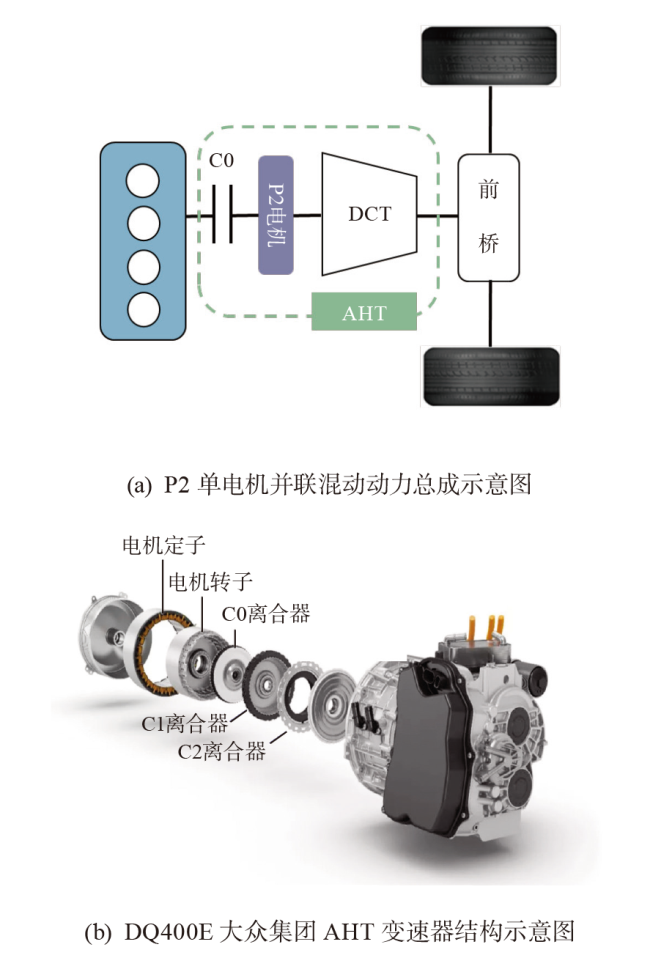
| 代表技术 | 日产e-POWER | 48 V轻混 | P2单电机并联 | 本田i-MMD | 本田THS | 通用VOLTEC |
| 代表车型 | 日产轩逸 | 奥迪A8 | 大众途观 | 本田思域 | 丰田卡罗拉 | 雪佛兰沃蓝达 |
| 系统架构 | | | | | | |
| 变速器 | 单速减速器 | AT/DCT/AMT | AHT | MMT-DHT | PS-DHT | PS-DHT |
| 节油潜力/ % | 20~40 | 5~10 | 15~30 | 25~50 | 25~50 | 25~50 |
| 发动机调节 | √ | √ | √ | √ | √ | √ |
| 制动能量回收 | √ | √ | √ | √ | √ | √ |
| 纯电驱动 | √ | × | √ | √ | √ | √ |
| 串联增程 | √ | × | √(充电) | √ | √ | √ |
| 并联混动 | × | × | √ | √ | √ | √ |
| 串联混动 | √ | × | × | √ | √ | √ |
| 发动机直驱 | × | √ | √ | √(高速) | √ | √ |
| 串联 | 并联 | 串并联 | 功率分流 | |||
|---|---|---|---|---|---|---|
| 代表技术 | 日产e-POWER | 48 V轻混 | P2单电机并联 | 本田i-MMD | 本田THS | 通用VOLTEC |
| 代表车型 | 日产轩逸 | 奥迪A8 | 大众途观 | 本田思域 | 丰田卡罗拉 | 雪佛兰沃蓝达 |
| 系统架构 | | | | | | |
| 变速器 | 单速减速器 | AT/DCT/AMT | AHT | MMT-DHT | PS-DHT | PS-DHT |
| 节油潜力/ % | 20~40 | 5~10 | 15~30 | 25~50 | 25~50 | 25~50 |
| 发动机调节 | √ | √ | √ | √ | √ | √ |
| 制动能量回收 | √ | √ | √ | √ | √ | √ |
| 纯电驱动 | √ | × | √ | √ | √ | √ |
| 串联增程 | √ | × | √(充电) | √ | √ | √ |
| 并联混动 | × | × | √ | √ | √ | √ |
| 串联混动 | √ | × | × | √ | √ | √ |
| 发动机直驱 | × | √ | √ | √(高速) | √ | √ |
| 微混 (12 V) | 轻混 (48 V) | 强混 | |
|---|---|---|---|
| 混合度/ % | <10 | 10~20 | >50 |
| 发动机启停管理 | √ | √ | √ |
| 制动能量回收 | × | √ | √ |
| 电机辅助驱动 | × | √ | √ |
| 纯电驱动 | × | × | √ |
| 发动机直驱 | √ | √ | √(除串联) |
| 节油效果/ % | 3 | 5~10 | 25~50 |
| 系统成本/元 | 2 000 | 4 000 | 15 000 |
| 单位节油成本 / (元/ %) | 667 | 533 | 400 |
| 微混 (12 V) | 轻混 (48 V) | 强混 | |
|---|---|---|---|
| 混合度/ % | <10 | 10~20 | >50 |
| 发动机启停管理 | √ | √ | √ |
| 制动能量回收 | × | √ | √ |
| 电机辅助驱动 | × | √ | √ |
| 纯电驱动 | × | × | √ |
| 发动机直驱 | √ | √ | √(除串联) |
| 节油效果/ % | 3 | 5~10 | 25~50 |
| 系统成本/元 | 2 000 | 4 000 | 15 000 |
| 单位节油成本 / (元/ %) | 667 | 533 | 400 |
| 参数 | 新势力车企 | 老牌车企 | |||||
|---|---|---|---|---|---|---|---|
| 问界M7 | 理想L7 | 零跑C11 | 长安深蓝S7 | 东风岚图FREE | |||
| 尺寸 | 轴距/ mm | 2 820 | 3 005 | 2 930 | 2 900 | 2 960 | |
| 续航性 | CLTC综合续航/ km | 1 250 | 1421 | 1 210 | 1 120 | 1 201 | |
| CLTC纯电续航/ km | 210 | 286 | 300 | 200 | 210 | ||
| 电池容量/ kWh | 40 | 52.3 | 43.74 | 31.73 | 39.2 | ||
| 油箱容积/ L | 60 | 65 | 47 | 45 | 56 | ||
| 节能性 | 发动机 | 1.5T四缸 | 1.5T四缸 | 1.5L四缸 | 1.5L四缸 | 1.5T四缸 | |
| 发动机最高有效热效率/ % | 41 | 40.5 | 40 | NA | 42 | ||
| 油电转换率/ (kWh·L-1) | 3.44 | NA | NA | 3.3 | 3.3 | ||
| 100 km电耗/ kWh | 22.3 | 22.8 | 19.5 | 14.2 | 21 | ||
| 100 km电能当量油耗/ L | 2.52 | 2.58 | 2.21 | 1.61 | 2.38 | ||
| 100 km亏电油耗/ L | 7.4 | 7.4 | 5.2 | 5.6 | 6.69 | ||
| 动力性 | 最高车速/ (km·h-1) | 190 | 180 | 170 | 180 | 200 | |
| 0~100 km / h加速时间/ s | 4.8 | 5.3 | 8.3 | 7.7 | 4.8 | ||
| 发动机功率/ kW | 112 | 113 | 70 | 70 | 110 | ||
| 驱动形式 | 双电机四驱 | 双电机四驱 | 单电机后驱 | 单电机后驱 | 双电机四驱 | ||
| 后驱电机功率/ kW | 200 | 200 | 200 | 175 | 200 | ||
| 前驱电机功率/ kW | 130 | 130 | 无 | 无 | 160 | ||
| 参数 | 新势力车企 | 老牌车企 | |||||
|---|---|---|---|---|---|---|---|
| 问界M7 | 理想L7 | 零跑C11 | 长安深蓝S7 | 东风岚图FREE | |||
| 尺寸 | 轴距/ mm | 2 820 | 3 005 | 2 930 | 2 900 | 2 960 | |
| 续航性 | CLTC综合续航/ km | 1 250 | 1421 | 1 210 | 1 120 | 1 201 | |
| CLTC纯电续航/ km | 210 | 286 | 300 | 200 | 210 | ||
| 电池容量/ kWh | 40 | 52.3 | 43.74 | 31.73 | 39.2 | ||
| 油箱容积/ L | 60 | 65 | 47 | 45 | 56 | ||
| 节能性 | 发动机 | 1.5T四缸 | 1.5T四缸 | 1.5L四缸 | 1.5L四缸 | 1.5T四缸 | |
| 发动机最高有效热效率/ % | 41 | 40.5 | 40 | NA | 42 | ||
| 油电转换率/ (kWh·L-1) | 3.44 | NA | NA | 3.3 | 3.3 | ||
| 100 km电耗/ kWh | 22.3 | 22.8 | 19.5 | 14.2 | 21 | ||
| 100 km电能当量油耗/ L | 2.52 | 2.58 | 2.21 | 1.61 | 2.38 | ||
| 100 km亏电油耗/ L | 7.4 | 7.4 | 5.2 | 5.6 | 6.69 | ||
| 动力性 | 最高车速/ (km·h-1) | 190 | 180 | 170 | 180 | 200 | |
| 0~100 km / h加速时间/ s | 4.8 | 5.3 | 8.3 | 7.7 | 4.8 | ||
| 发动机功率/ kW | 112 | 113 | 70 | 70 | 110 | ||
| 驱动形式 | 双电机四驱 | 双电机四驱 | 单电机后驱 | 单电机后驱 | 双电机四驱 | ||
| 后驱电机功率/ kW | 200 | 200 | 200 | 175 | 200 | ||
| 前驱电机功率/ kW | 130 | 130 | 无 | 无 | 160 | ||
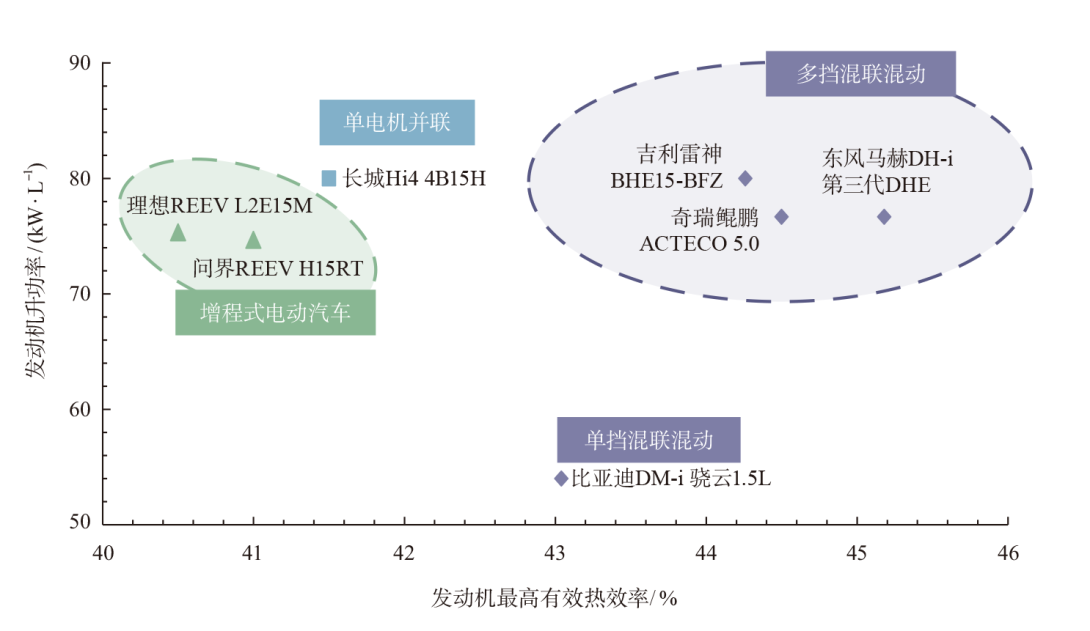
| 增程专用发动机 | 混动专用发动机 | |||||||
|---|---|---|---|---|---|---|---|---|
| 理想(新晨) L2E15M | 问界(赛力斯) H15RT | 长城Hi4 GW4B15H | 比亚迪DM-i 骁云BYD472QA | 奇瑞鲲鹏 SQRE4T15C | 东风马赫DH-i DFMC15TE3 | |||
| 发动机 性能特点 | 混动技术路线 | 增程式 电动汽车 | 增程式 电动汽车 | P2单电机 并联混动 | P1 + P3 单挡串并联 | P1 + P3 三挡串并联 | 四挡串并联+ 双模功率分流 | |
| 排量及缸数 | 1.5 L横置4缸 | 1.5 L横置4缸 | 1.5 L横置4缸 | 1.5 L横置4缸 | 1.5 L横置4缸 | 1.5 L横置4缸 | ||
| 最高有效热效率 | 40.50% | 41.00% | 41.50% | 43.04% | 44.50% | 45.18% | ||
| 最大输出功率 | 113 kW | 112 kW | 85 kW | 81 kW | 115 kW | 118 kW | ||
| 最大输出扭矩 | 240 N·m | 205 N·m | 140 N·m | 135 N·m | 220 N·m | 240 N·m | ||
| 燃油标号 | 95# | 95# | 92# | 92# | 92# | 92# | ||
| 减小燃烧热能转换损失 | 行径比 | 1.15 | ≥1.2 | 1.28 | 1.28 | 1.28 | 1.23 | |
| 压缩比 | 12.5 | 15 | 16 | 15.5 | 14.5 | 14 | ||
| 燃油雾化 | 35 MPa GDI | 多点电喷 PFI | 35 MPa GDI | 多点电喷 PFI | 35 MPa GDI | 35 MPa GDI | ||
| 先进燃烧技术 | 高滚流比气道 | 高能点火 高滚流比气道 | 高能点火 | 高能点火 高滚流比气道 | 高能点火 高滚流比气道 高湍动能 | 高能点火 高滚流比气道 高湍动能 | ||
| 减小泵气损失 | 循环形式 | Miller | 深度 Miller | Atkinson | Atkinson | 深度 Miller | 深度 Miller | |
| 进气形式 | 涡轮增压 | 涡轮增压 | 自然吸气 | 自然吸气 | 涡轮增压 | 涡轮增压 | ||
| 废气再循环EGR | × | √(25%) | √(28%) | √(25%) | √(27%) | √(30%) | ||
| 先进配气技术 | √ | √ | √ | √ | √ | √ | ||
| 减小传热损失 | 智能热管理技术 | √ | √ | √ | √ | √ | √ | |
| 减小机械损失 | 先进减摩技术 | √ | √ | √ | √ | √ | √ | |
| 增程专用发动机 | 混动专用发动机 | |||||||
|---|---|---|---|---|---|---|---|---|
| 理想(新晨) L2E15M | 问界(赛力斯) H15RT | 长城Hi4 GW4B15H | 比亚迪DM-i 骁云BYD472QA | 奇瑞鲲鹏 SQRE4T15C | 东风马赫DH-i DFMC15TE3 | |||
| 发动机 性能特点 | 混动技术路线 | 增程式 电动汽车 | 增程式 电动汽车 | P2单电机 并联混动 | P1 + P3 单挡串并联 | P1 + P3 三挡串并联 | 四挡串并联+ 双模功率分流 | |
| 排量及缸数 | 1.5 L横置4缸 | 1.5 L横置4缸 | 1.5 L横置4缸 | 1.5 L横置4缸 | 1.5 L横置4缸 | 1.5 L横置4缸 | ||
| 最高有效热效率 | 40.50% | 41.00% | 41.50% | 43.04% | 44.50% | 45.18% | ||
| 最大输出功率 | 113 kW | 112 kW | 85 kW | 81 kW | 115 kW | 118 kW | ||
| 最大输出扭矩 | 240 N·m | 205 N·m | 140 N·m | 135 N·m | 220 N·m | 240 N·m | ||
| 燃油标号 | 95# | 95# | 92# | 92# | 92# | 92# | ||
| 减小燃烧热能转换损失 | 行径比 | 1.15 | ≥1.2 | 1.28 | 1.28 | 1.28 | 1.23 | |
| 压缩比 | 12.5 | 15 | 16 | 15.5 | 14.5 | 14 | ||
| 燃油雾化 | 35 MPa GDI | 多点电喷 PFI | 35 MPa GDI | 多点电喷 PFI | 35 MPa GDI | 35 MPa GDI | ||
| 先进燃烧技术 | 高滚流比气道 | 高能点火 高滚流比气道 | 高能点火 | 高能点火 高滚流比气道 | 高能点火 高滚流比气道 高湍动能 | 高能点火 高滚流比气道 高湍动能 | ||
| 减小泵气损失 | 循环形式 | Miller | 深度 Miller | Atkinson | Atkinson | 深度 Miller | 深度 Miller | |
| 进气形式 | 涡轮增压 | 涡轮增压 | 自然吸气 | 自然吸气 | 涡轮增压 | 涡轮增压 | ||
| 废气再循环EGR | × | √(25%) | √(28%) | √(25%) | √(27%) | √(30%) | ||
| 先进配气技术 | √ | √ | √ | √ | √ | √ | ||
| 减小传热损失 | 智能热管理技术 | √ | √ | √ | √ | √ | √ | |
| 减小机械损失 | 先进减摩技术 | √ | √ | √ | √ | √ | √ | |
| S-winding | Hair-pin | I-pin | X-pin | |
|---|---|---|---|---|
| 最高满槽率/ % | 60 | 69 | 74 | 74 |
| 绕组端部高度/ mm | 54 | 64 | 74 | 50 |
| 焊点数/ 个 | 0 | Q×L / 2 | Q×L | Q×L |
| 典型应用 | 长安 蓝鲸iDD | 吉利雷神 DHT Evo | 长安 深蓝增程 | 奇瑞鲲鹏 |
| S-winding | Hair-pin | I-pin | X-pin | |
|---|---|---|---|---|
| 最高满槽率/ % | 60 | 69 | 74 | 74 |
| 绕组端部高度/ mm | 54 | 64 | 74 | 50 |
| 焊点数/ 个 | 0 | Q×L / 2 | Q×L | Q×L |
| 典型应用 | 长安 蓝鲸iDD | 吉利雷神 DHT Evo | 长安 深蓝增程 | 奇瑞鲲鹏 |
| 售价区间 | <10万元 | 10~15万元 | 15~25万元 | >25万元 |
|---|---|---|---|---|
| 动力电池 容量/ kWh | 8~20 | 18~22 | 20~40 | 35~60 |
| 纯电续航 里程/km | 50~100 | 85~120 | 100~200 | 180~400 |
| 快充 | 部分支持 | 支持 | 支持 | 支持 |
| 动力电池 正极材料 | 磷酸 铁锂 | 磷酸 铁锂 | 磷酸铁锂/三元锂 (以磷酸铁锂为主) | 三元锂/磷酸铁锂 (以三元锂为主) |
| 典型车型 | 比亚迪 秦系列 | 比亚迪 宋系列 | 吉利银河L7 | 理想L7 |
| 售价区间 | <10万元 | 10~15万元 | 15~25万元 | >25万元 |
|---|---|---|---|---|
| 动力电池 容量/ kWh | 8~20 | 18~22 | 20~40 | 35~60 |
| 纯电续航 里程/km | 50~100 | 85~120 | 100~200 | 180~400 |
| 快充 | 部分支持 | 支持 | 支持 | 支持 |
| 动力电池 正极材料 | 磷酸 铁锂 | 磷酸 铁锂 | 磷酸铁锂/三元锂 (以磷酸铁锂为主) | 三元锂/磷酸铁锂 (以三元锂为主) |
| 典型车型 | 比亚迪 秦系列 | 比亚迪 宋系列 | 吉利银河L7 | 理想L7 |
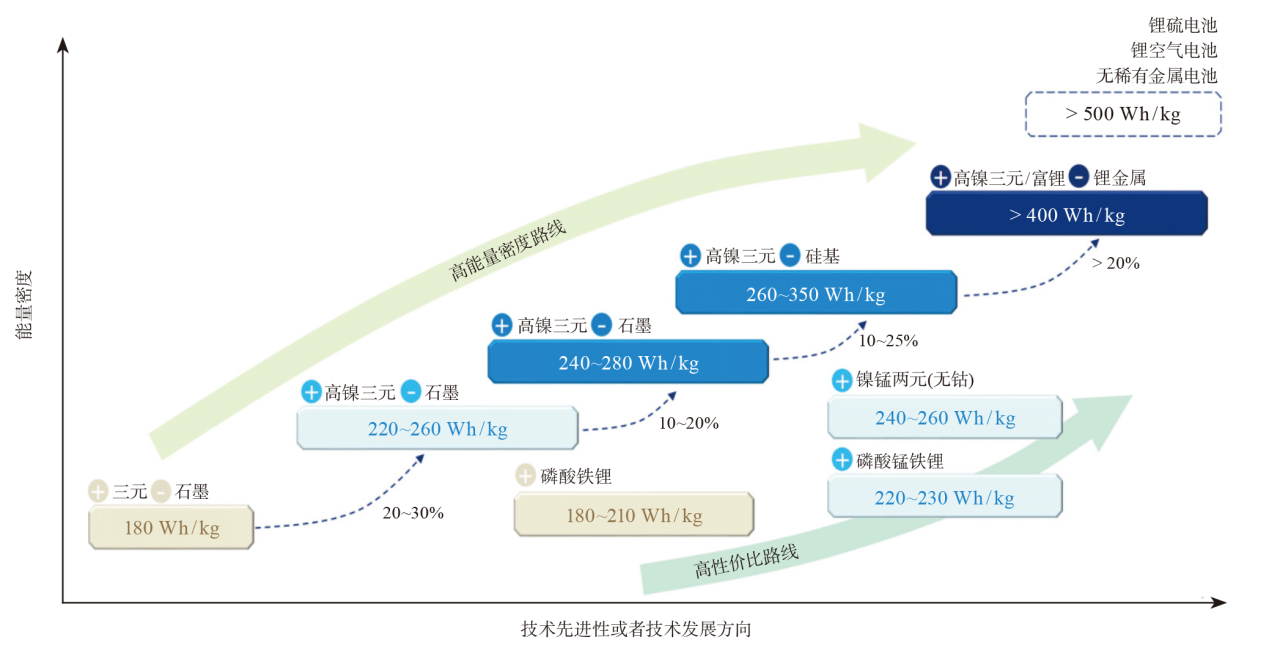
| [1] | 清华大学碳中和研究院. 2023全球碳中和年度进展报告[R/OL]. 2023. [2024-05-06]. http://portal.nstl.gov.cn/reportFront/getReportDetailFront.htm?serverId=210&uuid=8e91033757bbae55a9a0d27662823873&controlType=openhome&reportType=. |
| Tsinghua University Institute for Carbon Neutrality. 2023 global carbon neutrality annual progress report[R/OL]. 2023. [2024-05-06]. http://portal.nstl.gov.cn/reportFront/getReportDetailFront.htm?serverId=210&uuid=8e91033757bbae55a9a0d27662823873&controlType=openhome&reportType=. (in Chinese) | |
| [2] | International Energy Agency. CO2 emissions by sector[DB/OL]. 2021. [2024-05-06]. https://www.iea.org/data-and-statistics/data-tools/energy-statistics-data-browser. |
| [3] | 国务院. 新能源汽车产业发展规划(2021-2035年)[S/OL]. 2020. [2024-05-06]. https://wap.miit.gov.cn/jgsj/ghs/zlygh/art/2022/art_158cc63ebe76470cbff2458c4328ea22.html. |
| People's Republic of China State Council. Development plan for the new energy vehicle industry (2021-2035)[S/OL]. Ministry of Industry and Information Technology, 2020. [2024-05-06]. https://wap.miit.gov.cn/jgsj/ghs/zlygh/art/2022/art_158cc63ebe76470cbff2458c4328ea22.html. (in Chinese) | |
| [4] | 工业和信息化部. GB/T 19596-2017: 电动汽车术语[S/OL]. 2017. [2024-05-06]. https://openstd.samr.gov.cn/bzgk/gb/newGbInfo?hcno=08D415B288CB210FB05764E89EE793DB. |
| Ministry of Industry and Information Technology. GB/T 19596-2017: Terminology of electric vehicles[S/OL]. 2017. [2024-05-06]. https://openstd.samr.gov.cn/bzgk/gb/newGbInfo?hcno=08D415B288CB210FB05764E89EE793DB. (in Chinese) | |
| [5] | 国务院. 节能与新能源汽车产业发展规划(2012-2020年)[S/OL]. 2012. [2024-05-06]. https://www.gov.cn/zwgk/2012-07/09/content_2179032.htm. |
| People's Republic of China State Council. Development plan for energy-saving and new energy vehicle industry (2012-2020)[S/OL]. 2012. [2024-05-06]. https://www.gov.cn/zwgk/2012-07/09/content_2179032.htm. (in Chinese) | |
| [6] | 中国汽车工业协会. 2023年汽车工业产销情况[R]. 北京: 中国汽车工业协会, 2024. |
| China Association of Automobile Manufacturers. 2023 automobile industry sales and production report[R]. Beijing: China Association of Automobile Manufacturers, 2024. (in Chinese) | |
| [7] | 管鸣宇, 彭波, 方寅亮, 等. 2024麦肯锡中国汽车消费者洞察报告[R]. 麦肯锡大中华区, 2024. |
| GUAN Mingyu, PENG Bo, FANG Yinliang, et al. 2024 McKinsey China automotive consumer insights report[R]. McKinsey Greater China, 2024. (in Chinese) | |
| [8] | 中国汽车工程学会. 节能与新能源汽车技术路线图2.0[M]. 北京: 机械工业出版社, 2020. |
| China Society of Automotive Engineers. Technology Roadmap for Energy Saving and New Energy Vehicles 2.0[M]. Beijing: China Machine Press, 2020. (in Chinese) | |
| [9] | 吴晓飞, 周逸洲. 中国汽车行业出海2023年总结与2024年展望报告[R]. 国泰君安证券, 2024. |
| WU Xiaofei, ZHOU Yizhou. A summary and prospects report of China's automotive industry going global in 2023 and 2024[R]. Guotai Junan Securities, 2024. (in Chinese) | |
| [10] | International Energy Agency. Global EV Outlook 2024[R]. International Energy Agency, 2024. [2024-05-12]. https://www.iea.org/reports/global-ev-outlook-2024?ref=bambooweekly.com. |
| [11] | 徐宏明. 欧洲汽车动力系统多元化的发展趋势和展望[J]. 汽车安全与节能学报, 2024, 15(2): 137-153. |
| XU Hongming. Development trends and outlook of diversified powertrains in Europe[J]. J Autom Safe Energ, 2024, 15(2): 137-153. (in Chinese) | |
| [12] | Manthey N. Germany cuts the EV purchase premium Umweltbonus with immediate effect[EB/OL]. (2023-12-18). https://www.electrive.com/2023/12/18/germany-cuts-all-zero-emission-vehicle-subsidies-with-immediate-effect/. |
| [13] | US Environmental Protection Agency. Multi-pollutant emissions standards for model years 2027 and later light-duty and medium-duty vehicles[A/OL]. (2024-03-20). https://www.epa.gov/regulations-emissions-vehicles-and-engines/final-rule-multi-pollutant-emissions-standards-model. |
| [14] | 付洋, 王步宇, 帅石金. 基于中国能源和材料的乘用车全生命周期温室气体排放分析[J]. 汽车安全与节能学报, 2023, 14(6): 744-754. |
| FU Yang, WANG Buyu, SHUAI Shijin. Life cycle analysis of greenhouse gas emissions from passenger cars based on energy and materials in China[J]. J Autom Safe Energ, 2023, 14(6): 744-754. (in Chinese) | |
| [15] | XUE Qicheng, ZHANG Xin, TENG Teng, et al. A comprehensive review on classification, energy management strategy, and control algorithm for hybrid electric vehicles[J]. Energies, 2020, 13(20): 5355. |
| [16] | Maggetto G, Van Mierlo J. Electric vehicles, hybrid electric vehicles and fuel cell electric vehicles: State of the art and perspectives[J]. Anna Chim Sci des Matériaux, 2001, 26(4): 9-26. |
| [17] | 孙逢春, 何洪文. 混合动力车辆的归类方法研究[J]. 北京理工大学学报, 2002(1): 40-44. |
| SUN Fengchun, HE Hongwen. A study on the method of classification of hybrid vehicles[J]. J Beijing Instit Tech, 2002(1): 40-44. (in Chinese) | |
| [18] | 曾小华, 王庆年, 王伟华. 混合动力汽车混合度设计方法研究[J]. 农业机械学报, 2006(12): 8-12. |
| ZENG Xiaohua, WANG Qingnian, WANG Weihua. Study on design method for DOH of HEV[J]. Trans Chin Soc Agri Mach, 2006(12): 8-12. (in Chinese) | |
| [19] | GAO Siyu, WEI Yanjun, ZHANG Di, et al. Model-free hybrid parallel predictive speed control based on ultralocal model of PMSM for electric vehicles[J]. IEEE Trans Ind Elect, 2022, 69(10): 9739-9748. |
| [20] | 过铠煜. 电动汽车用扁线永磁同步电机设计与转矩性能优化分析[D]. 南昌: 南昌大学, 2024. |
| GUO Kaiyu. Design and torque performance optimization analysis of flat-wire permanent magnet synchronous motors for electric vehicles[D]. Nanchang: Nanchang University, 2024. (in Chinese) | |
| [21] | 工业和信息化部. GB/T 31486-2015: 电动汽车用动力蓄电池电性能要求及试验方法[S/OL]. 2015. [2024-05-06]. https://std.samr.gov.cn/gb/search/gbDetailed?id=71F772D80B93D3A7E05397BE0A0AB82A. |
| Ministry of Industry and Information Technology. GB/T 31486-2015: Electrical performance requirements and test methods for traction battery of electric vehicle[S]. 2015. [2024-05-06]. https://std.samr.gov.cn/gb/search/gbDetailed?id=71F772D80B93D3A7E05397BE0A0AB82A. (in Chinese) | |
| [22] | 朱新明, 陈历焘, 陆国祥, 等. 2022年全球混合动力乘用车及混合动力变速器市场分析[J]. 汽车工艺师, 2023(8): 26-29. |
| ZHU Xinming, CHEN Litao, LU Guoxiang, et al. Market analysis of global hybrid passenger cars and hybrid powertrains in 2022[J]. Auto Manufact Engineer, 2023(8): 26-29. (in Chinese) | |
| [23] | 王坤城, 朱新明. 功率分流与多模式混动专用变速器的对比分析[J]. 汽车工程师, 2020(4): 41-44. |
| WANG Kuncheng, ZHU Xinming. Comparative Analysis between PS-DHT and MMT-DHT[J]. Auto Manufacturing Engineer, 2020(4): 41-44. (in Chinese) | |
| [24] | 罗本进, 石照耀. 汽车专用混合动力变速器和电驱动系统及其变速器发展状况(上)[J]. 汽车工艺师, 2018(8): 23-30. |
| LUO Benjin, SHI Zhaoyao. Development status of automobile-dedicated hybrid powertrains and electric drive systems and their transmissions (Part I)[J]. Auto Manufact Engineer, 2018(8): 23-30. (in Chinese) | |
| [25] | PORSCHE. Reconstruction of the “Semper Vivus” hybrid car from 1900[EB/OL]. 2019. [2024-05-29]. https://presskit.porsche.de/museum/en/2019/topic/exhibitions/cars/reconstruction-of-the-semper-vivus-hybrid-car-from-1900.html. |
| [26] | PORSCHE. The technology of the Semper Vivus[EB/OL]. 2019. [2024-05-29]. https://presskit.porsche.de/museum/en/2019/topic/exhibitions/cars/the-technology-of-the-semper-vivus.html. |
| [27] | 董团结, 杨亚联, 尚明. 高温高负荷下Miller发动机扭矩提升的控制策略[J]. 汽车安全与节能学报, 2024, 15(1): 92-98. |
| DONG Tuanjie, YANG Yalian, SHANG Ming. Control strategy for torque enhancement in miller engines under high-temperature and high-load conditions[J]. J Autom Safe Energ, 2024, 15(1): 92-98. (in Chinese) | |
| [28] | 陈虎, 贾宁, 刘小平, 等. 深度Miller循环在增压直喷汽油机上的仿真和试验[J]. 汽车安全与节能学报, 2019, 10(3): 366-373. |
| CHEN Hu, JIA Ning, LIU Xiaoping, et al. Simulations and experiments of effect of deep miller cycle on a turbocharged gasoline direct injection engine[J]. J Autom Safe Energ, 2019, 10(3): 366-373. (in Chinese) | |
| [29] | NISSAN. NISSAN Technical Review: No.87[R/OL]. (2021)[2024-05-29]. https://www.nissan-global.com/EN/TECHNICALREVIEW/PDF/NISSAN_TECHINICAL_REVIEW_87_En_ALL.pdf. |
| [30] | 汽车之家. 日产轩逸车型参数配置[EB/OL]. 2024. [2024-05-05]. https://car.autohome.com.cn/config/series/448.html#pvareaid=3454437. |
| Auto Home. Nissan Sylphy model parameter configuration[EB/OL]. 2024. [2024-05-05]. https://car.autohome.com.cn/config/series/448.html#pvareaid=3454437. (in Chinese) | |
| [31] | NISSAN. e-POWER’s internal combustion engine achieves 50% thermal efficiency[EB/OL]. [2024-05-05]. https://www.nissan-global.com/EN/INNOVATION/TECHNOLOGY/ARCHIVE/E_POWER50/. |
| [32] | 史天泽, 赵福全, 郝瀚, 等. 汽车48 V系统的节能效果、应用成本与实施策略[J]. 汽车技术, 2018(7): 5-11. |
| SHI Tianze, ZHAO Fuquan, HAO Han, et al. Effectiveness, Cost and application strategy of 48 V system in vehicles[J]. Autom Tech, 2018(7): 5-11. (in Chinese) | |
| [33] | 甘良松. 48V轻混汽车总布置设计及控制策略研究[D]. 合肥: 合肥工业大学, 2021. |
| GAN Liangsong. Study on general layout design and control strategy of 48V mild hybrid eehicle[D]. Hefei: Hefei University of Technology, 2021. (in Chinese) | |
| [34] | 刘桂彬, 刘志超, 陆春, 等. 48 V车型燃料消耗量标准分析及试验研究[J]. 汽车工程, 2019, 41(7): 757-762. |
| LIU Guibin, LIU Zhichao, LU Chun, et al. Standard analysis and experimental study on energy consumption of 48 V vehicle[J]. Autom Engineering, 2019, 41(7): 757-762. (in Chinese) | |
| [35] | 汪善进, 程远. 欧洲新能源汽车现状与发展趋势[J]. 汽车安全与节能学报, 2021, 12(2): 135-149. |
| WANG Shanjin, CHENG Yuan. Current status and development trends of european new energy vehicles[J]. J Autom Safe Energ, 2021, 12(2): 135-149. (in Chinese) | |
| [36] | HONDA. VTEC[EB/OL]. (2022-02-07). http://hondanews.com/en-US/honda-automobiles/releases/vtec. |
| [37] | HONDA. Honda two-motor hybrid-electric system[EB/OL]. (2023-01-31). http://hondanews.com/en-US/honda-automobiles/releases/honda-two-motor-hybrid-electric-system. |
| [38] | 马雪瑞. 基于双排行星齿轮机构的多模式混合动力机电耦合方案设计与优化控制研究[D]. 上海: 上海交通大学, 2019. |
| MA Xuerui. Research on design methodology and optimal control of the electromechanical coupling system in hybrid powertrain based on two planetary gearsets configuration[D]. Shanghai: Shanghai Jiaotong Univ, 2019. (in Chinese) | |
| [39] | 李琳. 功率分流式混动系统-输入式功率分流[EB/OL]. (2018-01-07). http://obasic.net/2018/story-of-powersplit-hybrid-2/. |
| LI Lin. Power split hybrid system - input power split[EB/OL]. (2018-01-07). http://obasic.net/2018/story-of-powersplit-hybrid-2/. (in Chinese) | |
| [40] | 王元祺. 混动汽车百科[EB/OL]. [2024-05-06]. https://www.zhihu.com/column/c_1425497145570525184. |
| WANG Yuanqi. Hybrid vehicle encyclopedia[EB/OL]. [2024-05-06]. https://www.zhihu.com/column/c_1425497145570525184. (in Chinese) | |
| [41] | 赵江灵, 尚阳, 祖国强, 等. 单行星排式功率分流机电耦合传动方案[J]. 重庆理工大学学报(自然科学), 2019, 33(12): 38-44. |
| ZHAO Jiangling, SHANG Yang, ZU Guoqiang, et al. Single planetary gear set type of power split transmission concept analysis[J]. J Chongqing Univ Tech (Natu Sci), 2019, 33(12): 38-44. (in Chinese) | |
| [42] | TOYOTA. Toyota hybrid: fifth generation system launched[EB/OL]. (2022-12-19). https://mag.toyota.co.uk/toyota-hybrid/. |
| [43] | 郑昌舜. 主流E-CVT动力分流混动变速器简析[J]. 传动技术, 2016, 30(4): 18-28. |
| ZHENG Changshun. Analysis of mainstream E-CVT power-split hybrid transmission[J]. Transmission Techn, 2016, 30(4): 18-28. (in Chinese) | |
| [44] | 李琳. 功率分流式混动系统-复合式功率分流[EB/OL]. (2020-06-22). http://obasic.net/2020/story-of-powersplit-hybrid-4/. |
| LI Lin. Power split hybrid system-compound power split[EB/OL]. (2020-06-22). http://obasic.net/2020/story-of-powersplit-hybrid-4/. (in Chinese) | |
| [45] | 许英博, 李景涛, 高飞翔, 等. 智能电动浪潮下的汽车产业格局重塑[J]. 汽车安全与节能学报, 2023, 14(6): 651-663. |
| XU Yingbo, LI Jingtao, GAO Feixiang, et al. Reshaping of automotive industry pattern under the wave of electrification and intelligence[J]. J Autom Safe Energ, 2023, 14(6): 651-663. (in Chinese) | |
| [46] | 李敏清, 冯坚, 韩志玉. 串联式和增程式混合动力轻型商用车的性能对比[J]. 汽车安全与节能学报, 2022, 13(3): 550-559. |
| LI Minqing, FENG Jian, HAN Zhiyu. Performance comparation of the series type and the range-extender type of the hybrid light commercial vehicles[J]. J Autom Safe Energ, 2022, 13(3): 550-559. (in Chinese) | |
| [47] | 姚春德, 姚安仁. 甲醇燃料的应用现状及其展望[J]. 汽车安全与节能学报, 2023, 14(5): 521-535. |
| YAO Chunde, YAO Anren. Review on methanol as fuel for engines and its future prospect[J]. J Autom Safe Energ, 2023, 14(5): 521-535. (in Chinese) | |
| [48] | 蔡开源, 王志, 刘奕, 等. 氨柴双燃料高压缩比发动机柴油喷射策略优化[J]. 汽车安全与节能学报, 2023, 14(6): 783-789. |
| CAI Kaiyuan, WANG Zhi, LIU Yi, et al. Optimization of diesel injection strategy for ammonia-diesel dual-fuel engines with high compression ratio[J]. J Autom Safe Energ, 2023, 14(6): 783-789. (in Chinese) | |
| [49] | 帅石金, 王志, 马骁, 等. 碳中和背景下内燃机低碳和零碳技术路径及关键技术[J]. 汽车安全与节能学报, 2021, 12(4): 417-439. |
| SHUAI Shijin, WANG Zhi, MA Xiao, et al. Low carbon and zero carbon technology paths and key technologies of ICEs under the background of carbon neutrality[J]. J Autom Safe Energ, 2021, 12(4): 417-439. (in Chinese) | |
| [50] | 王贺武, 欧阳明高, 李建秋, 等. 中国氢燃料电池汽车技术路线选择与实践进展[J]. 汽车安全与节能学报, 2022, 13(2): 211-224. |
| WANG Hewu, OUYANG Minggao, LI Jianqiu, et al. Hydrogen fuel cell vehicle technology roadmap and progress in China[J]. J Autom Safe Energ, 2022, 13(2): 211-224. (in Chinese) | |
| [51] | 长城汽车. 长城新能源Hi4-T[EB/OL]. [2024-05-09]. https://www.gwm.com.cn/hi4-t.html. |
| Great Wall Motors. Greatgy Hi4-T[EB/OL]. [2024-05-09]. https://www.gwm.com.cn/hi4-t.html. (in Chinese) | |
| [52] | 战金程. 长城Hi4插混技术创新,使用户价值最大化[C]// 第3届车用动力系统国际高峰论坛. 长城汽车, 宁波, 2023. |
| ZHAN Jincheng. Great Wall Hi4 plug-in hybrid technology innovation to maximize user value[C]// 3rd Int’l Summit Autom Propul Syst. Great Wall Motors, Ningbo, 2023. (in Chinese) | |
| [53] | 陆国祥. DM-i超级混动系统及其专用高效发动机方案[C]// 第3届车用动力系统国际高峰论坛.比亚迪汽车, 宁波, 2023. |
| LU Guoxiang. DM-i super hybrid system and its dedicated high-efficiency engine solution[C]// The 3rd Int’l Summit Autom Propul Syst. BYD Auto, Ningbo, 2023. (in Chinese) | |
| [54] | 张志福. 奇瑞鲲鹏超能混动C-DM开发[C]// 第3届车用动力系统国际高峰论坛. 奇瑞汽车, 宁波, 2023. |
| ZHANG Zhifu. Chery Kunpeng super hybrid C-DM development[C]// 3rd Int’l Summit Autom Propul Syst. Chery Automobile, Ningbo, 2023. (in Chinese) | |
| [55] | 刘国庆. 吉利全域高性能多挡混动系统[C]// 第3届车用动力系统国际高峰论坛. 吉利汽车, 宁波, 2023. |
| LIU Guoqing. Geely full-range high-performance multi-gear hybrid system[C]// 3rd Int’l Summit Autom Propul Syst. Greely Automobile, Ningbo, 2023. (in Chinese) | |
| [56] | 赵福成. 极光湾动力技术路线全球布局[C]// 第4动力系统国际高峰论坛. 吉利汽车, 宁波, 2024. |
| ZHAO Fucheng. Aurora Bay power technology roadmap global Layout[C]// 4th Int’l Summit Autom Propul Syst. Geely Automobile, Ningbo, 2024. (in Chinese) | |
| [57] | 余秋石. 马赫DH-i混动技术[C]// 第3届车用动力系统国际高峰论坛.东风汽车, 宁波, 2023. |
| YU Qiushi. Mach DH-i hybrid technology[C]// 3rd Int’l Summit Autom Propul Syst. Dongfeng Motor Co., Ningbo, 2023. (in Chinese) | |
| [58] | 徐传康. 中国乘用车用发动机技术特征的现状及趋势研究[J]. 内燃机与配件, 2024(7): 131-133. |
| XU Chuankang. Research on the current status and trends of engine technology characteristics for passenger cars in China[J]. Inter Combust Engi Parts, 2024(7): 131-133. (in Chinese) | |
| [59] | LI Xuesong, WANG Shangning, YANG Shangze, et al. A review on the recent advances of flash boiling atomization and combustion applications[J]. Prog Energ Combust Sci, 2024, 100: 101119. |
| [60] | 兰鹏宇. 新能源汽车扁线电机技术分析[J]. 内燃机与配件, 2022(6): 212-214. |
| LAN Pengyu. Technical analysis of bar-wound motor for new energy vehicles[J]. Inte Combust Engi Parts, 2022(6): 212-214. (in Chinese) | |
| [61] | 鞠孝伟, 张凤阁, 程远, 等. 车用驱动电机扁线绕组关键问题研究综述[J]. 中国电机工程学报, 1-18. |
| JU Xiaowei, ZHANG Fengge, CHENG Yuan, et al. Overview of key issues of flat wire winding of traction motor for electric vehicles[J]. Proceed CSEE, 1-18. (in Chinese) | |
| [62] | 匡柯, 任东生, 韩雪冰, 等. 车用大尺寸锂离子动力电池性能的仿真与分析[J]. 汽车安全与节能学报, 2021, 12(1): 116-124. |
| KUANG Ke, REN Dongsheng, HAN Xuebing, et al. Simulation and analysis of large-format iithium-ion power batteries[J]. J Autom Safe Energ, 2021, 12(1): 116-124. (in Chinese) | |
| [63] | 丁鹏, 邹晔, 张美娟, 等. 混合动力发动机与动力电池冷却余热双向循环预热[J]. 汽车安全与节能学报, 2021, 12(1): 125-132. |
| DING Peng, ZOU Ye, ZHANG Meijuan, et al. Bi-directional circulating preheating method based on waste heat reuse of engine and battery for hybrid electric vehicle[J]. J Autom Safe Energ, 2021, 12(1): 125-132. (in Chinese) | |
| [64] | 段伟. 技术创新引领变革-用户思维定义增程系统[C]// 第3届车用动力系统国际高峰论坛. 赛力斯汽车, 宁波, 2023. |
| DUA Wei. Technology innovation leads change-user thinking defines range extending system[C]// 3rd Int’l Summit Autom Propul Systems. Seres Automobile, Ningbo, 2023. (in Chinese) | |
| [65] | 郭峰. PHEV市场展望及电池发展趋势[C]// 第4届车用动力系统国际高峰论坛. 宁德时代, 宁波, 2024. |
| GO Feng. PHEV market outlook and battery development trends[C]// 4th Int’l Summit Autom Propul Syst. CATL, Ningbo, 2024. (in Chinese) | |
| [66] | 中国内燃机工业协会乘用车动力总成专业委员会; 中国汽车工程学会汽车先进动力系统分会. 汽车先进动力系统行业发展报告 (2023)[R]. 乘用车动力总成专业委员会, 2023. |
| SCP; APS. Report on the development of the advanced automotive powertrain (2023)[R]. SCP, 2023. (in Chinese) | |
| [67] | 肖成伟. 动力电池发展现状及趋势[C]// 第3届车用动力系统国际高峰论坛. 中电科十八所, 宁波, 2023. |
| XIAO Chengwei. Current status and trends in the development of power batteries[C]// 3rd Int’l Summit Autom Propul Syst. CETC, Ningbo, 2023. (in Chinese) | |
| [68] | 王亚楠, 韩雪冰, 卢兰光, 等. 电动汽车动力电池研究展望:智能电池、智能管理与智慧能源[J]. 汽车工程, 2022, 44(4): 617-637. |
| WANG Yanan, HAN Xuebing, LU Languang, et al. Prospects of research on traction batteries for electric vehicles: Intelligent battery, wise management, and smart energy[J]. Autom Engineering, 2022, 44(4): 617-637. (in Chinese) | |
| [69] | 刘继伟. 长安双电机数智电驱创新开发[C]// 第3届车用动力系统国际高峰论坛. 长安汽车, 宁波, 2023. |
| LIU Jiwei. Innovative development of Chang'an's dual-motor digital electric drive[C]// 3rd Int’l Summit Autom Propul Syst. Chang'an Automobile, Ningbo, 2023. (in Chinese) | |
| [70] | Jones N. The new car batteries that could power the electric vehicle revolution[J]. Nature, 2024, 626(7998): 248-251. |
| [1] | 杨建军, 柳东威, 李菁元, 柳邵辉, 张飞龙, 王梦渊. 混合动力汽车的道路预见性节能技术及一种测评方法[J]. 汽车安全与节能学报, 2025, 16(2): 268-276. |
| [2] | 张富椿, 尹燕莉, 马永娟, 肖杭洋, 陈海鑫, 余凯. 网联混合动力汽车队列的生态驾驶与能量管理分层控制[J]. 汽车安全与节能学报, 2025, 16(1): 159-169. |
| [3] | 尹燕莉, 王福振, 詹森, 黄学江, 张鑫新, 张富椿. 基于KL散度工况识别的混合动力汽车队列的分层控制[J]. 汽车安全与节能学报, 2024, 15(2): 242-252. |
| [4] | 罗闯, 许亮. 基于ISSA的燃料电池多电源模糊能量管理策略[J]. 汽车安全与节能学报, 2023, 14(4): 496-504. |
| [5] | 尹燕莉, 张鑫新, 潘小亮, 詹森, 黄学江, 王福振. 基于等效因子的Q学习燃料电池汽车能量管理策略[J]. 汽车安全与节能学报, 2022, 13(4): 785-795. |
| [6] | 周泉, 张策腾飞, 李雁飞, 帅斌, 徐宏明. 基于数字孪生和PSO算法的混动车辆能量管理策略鲁棒优化[J]. 汽车安全与节能学报, 2022, 13(3): 517-525. |
| [7] | 尹燕莉, 马永娟, 周亚伟, 王瑞鑫, 詹森, 马什鹏, 黄学江, 张鑫新. Markov 链与Q-Learning算法的超轻度混动汽车模型预测控制[J]. 汽车安全与节能学报, 2021, 12(4): 557-569. |
| [8] | 付雪青, 王宝森, 杨建军, 高海洋, 何邦全, 赵华, 郭文翠, 刘双喜. 基于双状态动态规划混动汽车坡道生态驾驶策略[J]. 汽车安全与节能学报, 2021, 12(3): 373-379. |
| [9] | 刘建辉, 姚方方, 张彦. 混合动力汽车参数的交叉—变异蜂群算法优化[J]. 汽车安全与节能学报, 2021, 12(2): 186-192. |
| [10] | 杨超, 杜雪龙, 王伟达, 项昌乐. 智能网联环境下的PHEV实时优化能量管理策略研究[J]. 汽车安全与节能学报, 2021, 12(2): 210-218. |
| [11] | 张学锋, 刘治文, 陈国栋, 杨云波, 李守魁. 改善乘用车低转速振动的动力总成控制优化策略[J]. 汽车安全与节能学报, 2021, 12(2): 193-200. |
| [12] | 童盛稳, 陈韬, 谢辉. 系统综合效率优化的插电式混合动力车辆的能量管理策略[J]. 汽车安全与节能学报, 2021, 12(1): 91-99. |
| [13] | 丁鹏, 邹晔, 张美娟, 蒋豪, 张鹏博. 混合动力发动机与动力电池冷却余热双向循环预热[J]. 汽车安全与节能学报, 2021, 12(1): 125-132. |
| [14] | 杜茂, 杨林, 金悦, 涂家毓. 基于交通时空特征的车辆全局路径规划算法[J]. 汽车安全与节能学报, 2021, 12(1): 52-61. |
| [15] | 胡浩然, 袁悦博, 安莉莎, 王贺武. 商用车动力总成最高系统效率的探讨[J]. 汽车安全与节能学报, 2020, 11(4): 428-443. |
| 阅读次数 | ||||||
|
全文 |
|
|||||
|
摘要 |
|
|||||
