Welcome to Journal of Automotive Safety and Energy,

Journal of Automotive Safety and Energy ›› 2022, Vol. 13 ›› Issue (4): 718-728.DOI: 10.3969/j.issn.1674-8484.2022.04.013
• Intelligent Driving and Intelligent Transportation • Previous Articles Next Articles
XU Jin1,2( ), ZHANG Yu1(), DAI Zhenhua1, LI Fei3, CHEN Jian1
Received:2021-12-27
Revised:2022-07-08
Online:2022-12-31
Published:2023-01-01
CLC Number:
XU Jin, ZHANG Yu, DAI Zhenhua, LI Fei, CHEN Jian. Vehicle trajectory oscillation characteristics and lane width control under human natural driving conditions[J]. Journal of Automotive Safety and Energy, 2022, 13(4): 718-728.
Add to citation manager EndNote|Ris|BibTeX
URL: https://www.journalase.com/EN/10.3969/j.issn.1674-8484.2022.04.013
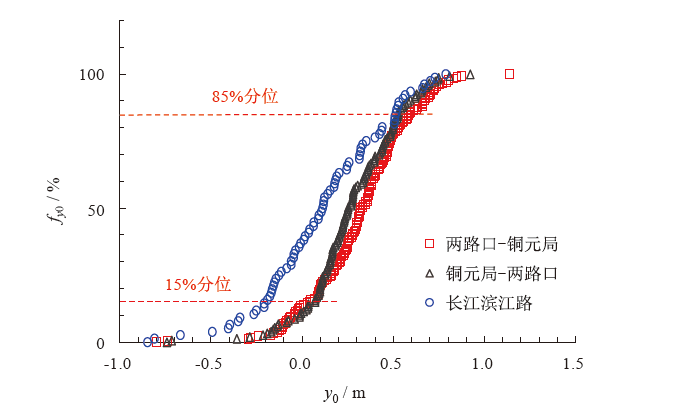
| 试验路段 | 平均值 | 中位数 | 标准差 | 方差 | 偏差 | 峰度 | 15分位数 | 85分位数 |
|---|---|---|---|---|---|---|---|---|
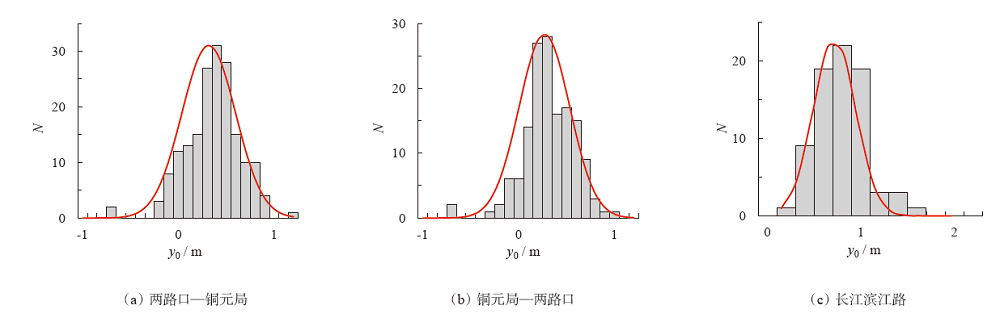
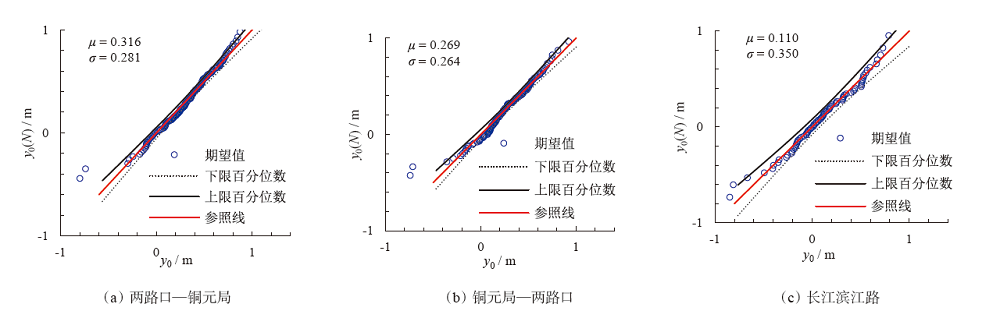
| 两路口—铜元局 | 0.316 | 0.320 | 0.281 | 0.079 | -0.545 | 1.599 | 0.036 | 0.588 |
| 铜元局—两路口 | 0.267 | 0.252 | 0.264 | 0.069 | -0.613 | 1.799 | 0.071 | 0.527 |
| 长江滨江路 | 0.110 | 0.113 | 0.349 | 0.124 | -0.348 | 0.092 | -0.200 | 0.513 |
| 试验路段 | 平均值 | 中位数 | 标准差 | 方差 | 偏差 | 峰度 | 15分位数 | 85分位数 |
|---|---|---|---|---|---|---|---|---|
| 两路口—铜元局 | 0.316 | 0.320 | 0.281 | 0.079 | -0.545 | 1.599 | 0.036 | 0.588 |
| 铜元局—两路口 | 0.267 | 0.252 | 0.264 | 0.069 | -0.613 | 1.799 | 0.071 | 0.527 |
| 长江滨江路 | 0.110 | 0.113 | 0.349 | 0.124 | -0.348 | 0.092 | -0.200 | 0.513 |
| 检验对象 | 假设 | Levene方差等同性检验 | 平均值等同性T检验 | 差值95%置信区间 | ||||||||
|---|---|---|---|---|---|---|---|---|---|---|---|---|
| F | 显著性 | t | 自由度 | sig. | 平均值差值 | 标准误差差值 | 下限 | 上限 | ||||
| 桥梁路段 往返方向 | 假定等方差 | 0.447 | 0.504 | 1.541 | 325.0 | 0.124 | 0.468 | 0.030 | -0.013 | 0.106 | ||
| 不假定等方差 | — | — | 1.550 | 319.9 | 0.122 | 0.468 | 0.030 | -0.013 | 0.106 | |||
| 桥梁路段与 地面路段 | 假定等方差 | 8.398 | 0.040 | 4.993 | 402.0 | 0.000 | 0.184 | 0.037 | 0.111 | 0.256 | ||
| 不假定等方差 | — | — | 4.287 | 98.8 | 0.000 | 0.184 | 0.043 | 0.099 | 0.269 | |||
| 检验对象 | 假设 | Levene方差等同性检验 | 平均值等同性T检验 | 差值95%置信区间 | ||||||||
|---|---|---|---|---|---|---|---|---|---|---|---|---|
| F | 显著性 | t | 自由度 | sig. | 平均值差值 | 标准误差差值 | 下限 | 上限 | ||||
| 桥梁路段 往返方向 | 假定等方差 | 0.447 | 0.504 | 1.541 | 325.0 | 0.124 | 0.468 | 0.030 | -0.013 | 0.106 | ||
| 不假定等方差 | — | — | 1.550 | 319.9 | 0.122 | 0.468 | 0.030 | -0.013 | 0.106 | |||
| 桥梁路段与 地面路段 | 假定等方差 | 8.398 | 0.040 | 4.993 | 402.0 | 0.000 | 0.184 | 0.037 | 0.111 | 0.256 | ||
| 不假定等方差 | — | — | 4.287 | 98.8 | 0.000 | 0.184 | 0.043 | 0.099 | 0.269 | |||
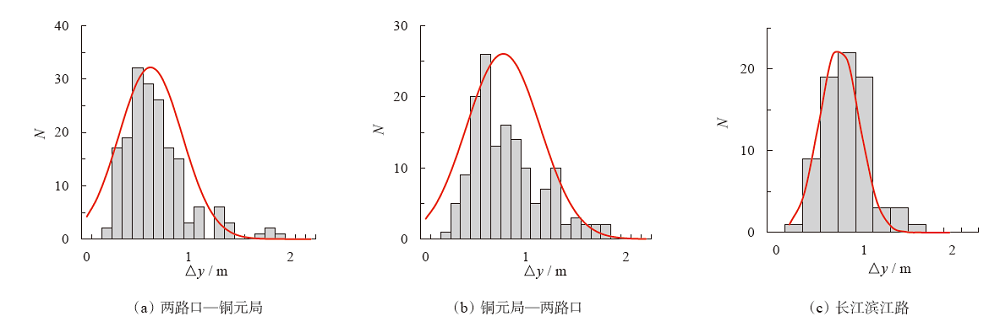
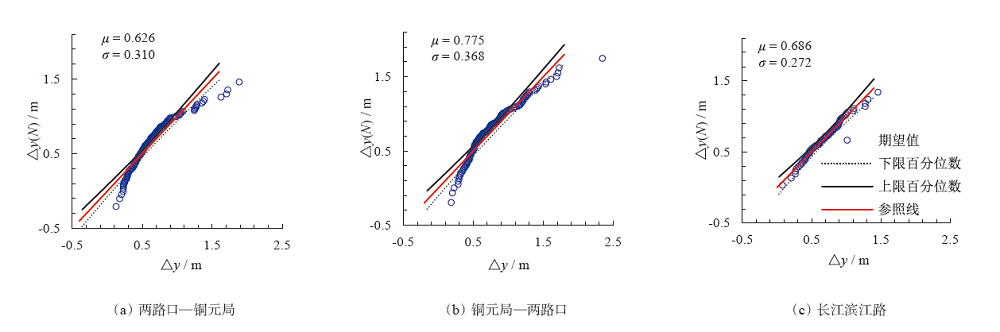
| 试验路段 | 平均值 | 平均值标准差 | 中位数 | 方差 | 偏差 | 峰度 | 15分位数 | 85分位数 |
|---|---|---|---|---|---|---|---|---|
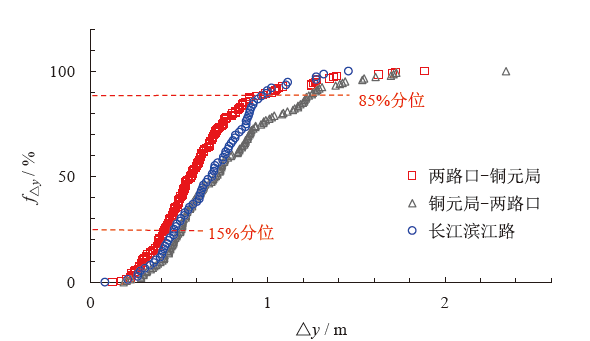
| 两路口—铜元局 | 0.626 | 0.231 | 0.566 | 0.095 | 1.455 | 2.788 | 0.352 | 0.877 |
| 铜元局—两路口 | 0.775 | 0.303 | 0.704 | 0.136 | 1.099 | 1.596 | 0.442 | 1.203 |
| 长江滨江路 | 0.686 | 0.310 | 0.686 | 0.074 | 0.399 | 0.152 | 0.407 | 0.929 |
| 试验路段 | 平均值 | 平均值标准差 | 中位数 | 方差 | 偏差 | 峰度 | 15分位数 | 85分位数 |
|---|---|---|---|---|---|---|---|---|
| 两路口—铜元局 | 0.626 | 0.231 | 0.566 | 0.095 | 1.455 | 2.788 | 0.352 | 0.877 |
| 铜元局—两路口 | 0.775 | 0.303 | 0.704 | 0.136 | 1.099 | 1.596 | 0.442 | 1.203 |
| 长江滨江路 | 0.686 | 0.310 | 0.686 | 0.074 | 0.399 | 0.152 | 0.407 | 0.929 |
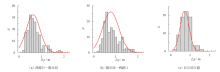
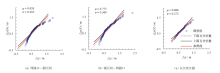
| [1] | YE Xinchen, WANG Xuesong, LIU Shuang, et al. Feasibility study of highway alignment design controls for autonomous vehicles[J]. Accid Anal Preve, 2021, 159: 1-12. |
| [2] | Fernandes P, Nunes U. Platooning with IVC-Enabled autonomous vehicles: strategies to mitigate communication delays[J]. Improve Safe Traffic Flow, 2012, 13(1): 91-106. |
| [3] | Manivasakan H, Kalra R, O’Hern S, et al. Infrastructure requirement for autonomous vehicle integration for future urban and suburban roads - Current practice and a case study of Melbourne, Australia[J]. Transp Res Part A: Policy Practice, 2021, 152: 36-53. |
| [4] | Chen N F, Small K A. Tradeoffs among free-flow speed, capacity, cost, and environmental footprint in highway design[J]. Transportation, 2012, 39(6): 1259-1280. |
| [5] | Nair G S, Bhat C R. Sharing the road with autonomous vehicles: Perceived safety and regulatory preferences[J]. Transp Res Part C: Emerging Tech, 2021, 122: 1-21. |
| [6] | 吴咪艺. 面向无人驾驶的道路交通关键参数优化研究[D]. 南京: 东南大学, 2020. |
| WU Miyi. Study on optimizationg of key road and traffic parameters in driverless conditions[D]. Nanjing: Southeast University, 2020. (in Chinese) | |
| [7] | 刘凯, 常四铁. 面向自动驾驶的城市街道设计研究[C]// 品质交通与协同共治——2019年中国城市交通规划年会论文集, 2019: 1-8. |
| LIU Kai, CHANG Sitie. Research on urban street design for autonomous driving[C]// 2019: 1-8. (in Chinese) | |
| [8] | 戴琪, 刘军, 孙腾. 城市道路机动车道宽度取值研究[J]. 交通科技, 2014(3): 91-92+95. |
| DAI Qi, LIU Jun, SUN Teng. Study on the value of vehicle lane width in urban Road[J]. Traffic Sci Tech, 2014(3): 91-92+95. (in Chinese) | |
| [9] | 滕生强, 杨晓光, 姚占春. 关于城市道路交通设计若干问题的探讨[J]. 中国市政工程, 2000(3): 2-6. |
| TENG Shengqiang, YANG Xiaoguang, YAO Zhanchun. Problems in urban road traffic design[J]. China Municipal Eng, 2000(3): 2-6. (in Chinese) | |
| [10] | 李朝阳, 徐循初. 城市道路横断面规划设计研究[J]. 城市规划汇刊, 2001(2): 47-52+ 80. |
| LI Chaoyang, XU Xunchu. Study on cross-sectional planning and design of urban road[J]. Urban Planning Forum, 2001(2): 47-52+ 80. (in Chinese) | |
| [11] | 常鑫. 城市道路信号交叉口车道宽度设计研究[D]. 北京: 北京工业大学, 2017. |
| CHANG Xin. Research on the lane width of urban signalized intersection[D]. Beijing: Beijing University of Technology, 2017. (in Chinese) | |
| [12] | 王维礼, 郑莘荑, 朱杰. 无人驾驶环境下城市交通空间优化设计探讨[J]. 天津建设科技, 2020, 30(5): 75-80. |
| WANG Weili, ZHENG Xinyi, ZHU Jie. Discussion on spatial optimization design of urban traffic under unmanned driving environment[J]. Tianjin Constr Sci Tech, 2020, 30(5): 75-80. (in Chinese) | |
| [13] | 周孝波. 基于视觉边缘率的高速公路弯道转向诱导设计方法及应用[D]. 武汉: 武汉理工大学, 2010. |
| ZHOU Xiaobo. Approach and application of steering on freeway curve based oon visual edge rate[D]. Wuhan: Wuhan University of Technology, 2010. (in Chinese) | |
| [14] | 魏文海. 多因素交互作用下缩减车道对驾驶行为的影响[J]. 长安大学学报(自然科学版), 2020, 40(4): 117-126. |
| WEI Wenhai. Influnce of lane reduction on driving behavior characteristics under multi- factor interaction[J]. J Chang᾽an Univ (Nat Sci Ed), 2020, 40(4): 117-126. (in Chinese) | |
| [15] | 曲大义, 韩乐潍, 贾彦峰, 等. 考虑横向偏移的车辆行为特性及全速度差拓展模型[J]. 吉林大学学报(工学版), 2020, 50(3): 963-969. |
| QU Dayi, HAN Lewei, JIA Yanfeng, et al. Vehicle behavior characteristics considering lateral offset and its full velocity difference expansion model[J]. J Jilin Univ (Eng Tech Ed), 2020, 50(3): 963-969. (in Chinese) | |
| [16] | 马栋栋, 吴玉涛, 郭宏伟. 小客车交通条件下车道宽度对通行能力的影响[J]. 公路, 2011(11): 130-132. |
| MA Dongdong, WU Yutao, GUO Hongwei. Influence of lane width on capacity of small bus traffic[J]. Highway, 2011(11): 130-132. (in Chinese) | |
| [17] | 中交第一公路勘察设计研究院有限公司. 公路路线设计规范(JTG D20-2017)[S]. 中华人民共和国交通运输部, 2017. |
| China Communications First Highway Survey and Design Institute Co. LTD. Design specification for highway alignment (JTG D20-2017)[S]. Ministry of Transport, PRC, 2017. (in Chinese) | |
| [18] | 徐进, 陈钦, 陈正委, 等. 适应无人驾驶汽车的道路设施设计综述[J/OL]. 西南交通大学学报. [2022-07-03], http://kns.cnki.net/kcms/detail/51.1277.U.20220520.1908.012.html. |
| XU Jin, CHEN Qin, CHEN Zhengwei, et al. Review of roadway infrastructure design for self-driving cars[J/OL]. J Southwest Jiaotong Univ. [2022-07-03], http://kns.cnki.net/kcms/detail/51.1277.U.20220520.1908.012.htm (in press) | |
| [19] | Gopalakrishna D, Carlson P, Sweatman P, et al. Impacts of automated vehicles on highway infrastructure[R]. FHWA-HRT-21-015. USA Department of Transportation Federal Highway Administration, Washington DC, 2021. |
| [1] | WEN Jiayan, ZOU Haifeng, ZHONG Wei, GAO Bolin, LU Yanbo. Vehicle speed planning method with the vehicle-road-cloud integration system and incorporating human-vehicle game theory [J]. Journal of Automotive Safety and Energy, 2026, 17(2): 261-269. |
| [2] | XUE Qingyuan, QU Jue, WANG Wei, NIU Tianlin, LI Xing. Human-machine interface design methods in autonomous driving takeover scenarios based on the Trust Theory [J]. Journal of Automotive Safety and Energy, 2026, 17(2): 270-277. |
| [3] | YANG Zongru, HU Yunze, LIU Shiqi, GUAN Yang, WU Wei, LIU Chang. Distributed active perception path planning for the estimation of parking occupancy status [J]. Journal of Automotive Safety and Energy, 2026, 17(1): 140-148. |
| [4] | CHEN Xiaofeng, WANG Lanwen, MA Guo, ZHANG Lei, BAO Jiading, JING Hui. Energy and stability aware path planning for autonomous vehicles in off road environments [J]. Journal of Automotive Safety and Energy, 2025, 16(3): 496-503. |
| [5] | YANG Lan, ZHAO Xiangmo, WANG Runmin, WANG Zhen, FANG Shan, QU Guangyue. Review on testing and evaluation of cognitive abilities for autonomous vehicles [J]. Journal of Automotive Safety and Energy, 2025, 16(1): 1-15. |
| [6] | LIU Qingchao, WANG Ruihai, CAI Yingfeng, WANG Hai, CHEN Long. Unintended stopping conflict risk prediction for high-level autonomous vehicles based on CatBoost and SHAP [J]. Journal of Automotive Safety and Energy, 2025, 16(1): 170-180. |
| [7] | WU Hequan, LI Yihui, LIU Jin, ZHANG Shenao. Simulation experiments for the passenger injuries with different sitting positions in autonomous vehicle collisions [J]. Journal of Automotive Safety and Energy, 2024, 15(4): 484-491. |
| [8] | CHEN Qitong, ZHAO Dong, LIU Congzhi, LI Liang. Real-time human-like speed planning method for curve entry considering experienced driving behaviors [J]. Journal of Automotive Safety and Energy, 2024, 15(3): 309-320. |
| [9] | LIU Yanwei, HUANG Zhiming, GAO Bolin, ZHONG Wei, CHEN Jiaxing, LIU Jiaxi. Recognition of front vehicle behavior based on visual information from vehicle perspective [J]. Journal of Automotive Safety and Energy, 2023, 14(6): 707-714. |
| [10] | HUANG Xinchao, ZHANG Yi. Prediction of future driving conditions for electrical vehicles based on Baidu maps API [J]. Journal of Automotive Safety and Energy, 2023, 14(6): 715-722. |
| [11] | WEI Wenming, LIU Weiping, FAN Zhipeng, BAI Chuang. Differential algorithm with variable step-sizes to calculate accelerations in autonomous vehicle tests [J]. Journal of Automotive Safety and Energy, 2023, 14(4): 457-462. |
| [12] | XIU Guotao, XIE Hui, SONG Kang, BI Fengrong. Parallel parking operation model for driverless vehicles based on driver experiences [J]. Journal of Automotive Safety and Energy, 2023, 14(2): 191-201. |
| [13] | ZHU Bo, ZHANG Jiwei, TAN Dongkui, HU Xudong. End-to-end autonomous driving method based on multi-source sensor and navigation map [J]. Journal of Automotive Safety and Energy, 2022, 13(4): 738-749. |
| [14] | HU Yuanzhi, JIANG Tao, LIU Xi, SHI Youning. Pedestrian-crossing intention-recognition based on dual-stream adaptive graph-convolutional neural-network [J]. Journal of Automotive Safety and Energy, 2022, 13(2): 325-332. |
| [15] | WU Yimin, ZHENG Kaiyuan, GAO Bolin, CHEN Ming, WANG Yifeng. Roadside multi-sensor fusion based on adaptive extended Kalman filter [J]. Journal of Automotive Safety and Energy, 2021, 12(4): 522-527. |
| Viewed | ||||||
|
Full text |
|
|||||
|
Abstract |
|
|||||
