Welcome to Journal of Automotive Safety and Energy,

Journal of Automotive Safety and Energy ›› 2023, Vol. 14 ›› Issue (4): 421-430.DOI: 10.3969/j.issn.1674-8484.2023.04.003
• Automotive Safety • Previous Articles Next Articles
LI Haiyan( ), HU Jing, HE Lijuan*(), LV Wenle, CUI Shihai, RUAN Shijie
Received:2022-12-08
Revised:2023-06-04
Online:2023-08-31
Published:2023-08-31
CLC Number:
LI Haiyan, HU Jing, HE Lijuan, LV Wenle, CUI Shihai, RUAN Shijie. Analysis on the rear passenger injuries of the 5th percentile Chinese female occupant in 100% frontal impact[J]. Journal of Automotive Safety and Energy, 2023, 14(4): 421-430.
Add to citation manager EndNote|Ris|BibTeX
URL: https://www.journalase.com/EN/10.3969/j.issn.1674-8484.2023.04.003
| 损伤指标 | TUST IBMs F05-O | Hybrid III 5th | 损伤阈值 | |
|---|---|---|---|---|
| 运动学 | HIC15 | 2 518 | 508 | 高性能:500,低性能:700 |
| a3-ms | 174.2 g | 70 g | 高性能:72 g,低性能:80 g | |
| BrIC | 1.33 | — | BrIC = 1,AIS4级脑损伤概率为45%。 | |
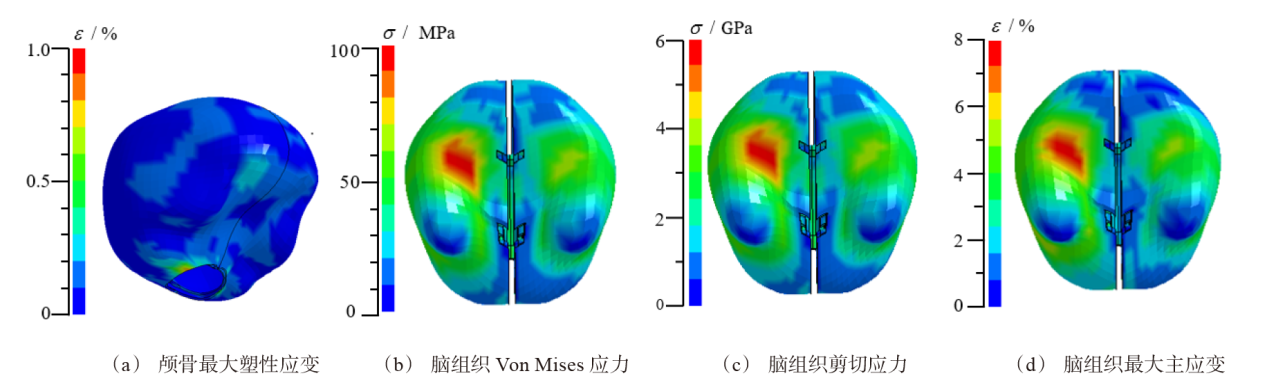
| 生物力学 | 颅骨最大塑性应变 | 1.1 % | — | 1.5%,颅骨骨折。 |
| 脑组织Von Mises应力 | 13.8 kPa | — | 6~11 kPa脑挫伤,15 kPa轻微脑震荡, 38 kPa重度脑损伤[ | |
| 脑组织剪切应力 | 7.96 kPa | — | 6 kPa,25%出现轻度脑损伤;7.8 kPa,50%出现轻度脑损伤;10 kPa,80%出现轻度脑损伤;25 kPa,100%出现中度脑损伤[ | |
| 最大主应变 | 8.18 % | — | 10%,可逆伤害;20%,大脑神经系统功能缺陷[ 25%脑组织神经系统结构失效[ | |
| 损伤指标 | TUST IBMs F05-O | Hybrid III 5th | 损伤阈值 | |
|---|---|---|---|---|
| 运动学 | HIC15 | 2 518 | 508 | 高性能:500,低性能:700 |
| a3-ms | 174.2 g | 70 g | 高性能:72 g,低性能:80 g | |
| BrIC | 1.33 | — | BrIC = 1,AIS4级脑损伤概率为45%。 | |
| 生物力学 | 颅骨最大塑性应变 | 1.1 % | — | 1.5%,颅骨骨折。 |
| 脑组织Von Mises应力 | 13.8 kPa | — | 6~11 kPa脑挫伤,15 kPa轻微脑震荡, 38 kPa重度脑损伤[ | |
| 脑组织剪切应力 | 7.96 kPa | — | 6 kPa,25%出现轻度脑损伤;7.8 kPa,50%出现轻度脑损伤;10 kPa,80%出现轻度脑损伤;25 kPa,100%出现中度脑损伤[ | |
| 最大主应变 | 8.18 % | — | 10%,可逆伤害;20%,大脑神经系统功能缺陷[ 25%脑组织神经系统结构失效[ | |
| 损伤指标 | TUST IBMs F05-O | Hybrid III 5th | 损伤阈值 | |
|---|---|---|---|---|
| 运动学 | Fx / kN | 2.36 | 1.07 | 高性能:1.2;低性能:1.95 |
| Fz / kN | 2.15 | 2.18 | 高性能:1.7 ;低性能:2.62 | |
| My / Nm | 49.0 | 73.8 | 高性能:36 ;低性能:49 | |
| Nij | 0.94 | 1.1 | 1 | |
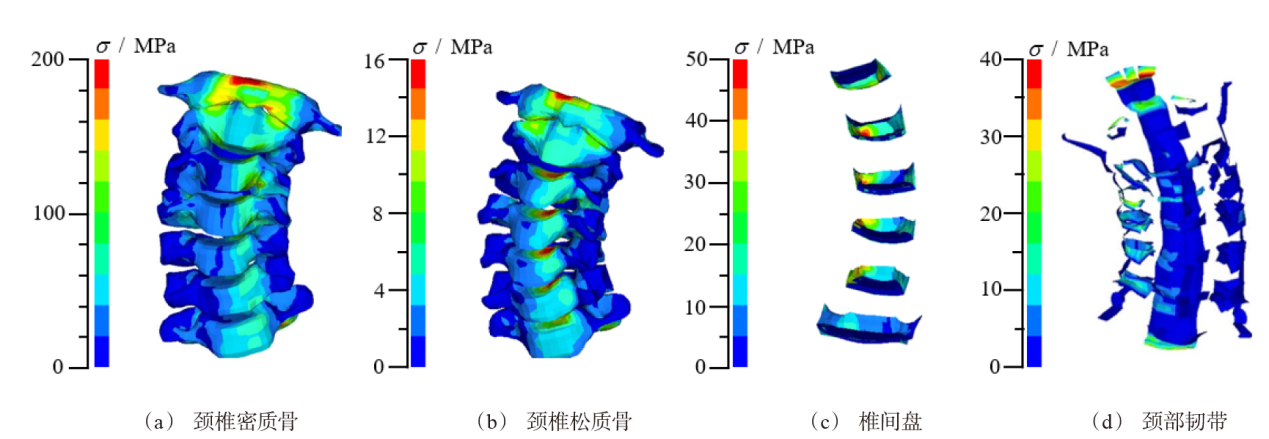
| 生物力学 | 颈椎Von Mises应力 | 密质骨201 MPa,松质骨16 MPa。 | — | 密质骨236 MPa,松质骨59 MPa[ |
| 椎间盘Von Mises应力 | 51 MPa。 | — | 30 MPa[ | |
| 颈部韧带伸长失效值 | 棘间韧带1.12倍,后纵韧带1.09倍,黄韧带1.16倍,前纵韧带1.03倍,囊韧带1.08倍。 | — | 棘间韧带1.87倍,后纵韧带1.55倍,黄韧带2.05倍,前纵韧带1.57倍,囊韧带2.5倍[ | |
| 损伤指标 | TUST IBMs F05-O | Hybrid III 5th | 损伤阈值 | |
|---|---|---|---|---|
| 运动学 | Fx / kN | 2.36 | 1.07 | 高性能:1.2;低性能:1.95 |
| Fz / kN | 2.15 | 2.18 | 高性能:1.7 ;低性能:2.62 | |
| My / Nm | 49.0 | 73.8 | 高性能:36 ;低性能:49 | |
| Nij | 0.94 | 1.1 | 1 | |
| 生物力学 | 颈椎Von Mises应力 | 密质骨201 MPa,松质骨16 MPa。 | — | 密质骨236 MPa,松质骨59 MPa[ |
| 椎间盘Von Mises应力 | 51 MPa。 | — | 30 MPa[ | |
| 颈部韧带伸长失效值 | 棘间韧带1.12倍,后纵韧带1.09倍,黄韧带1.16倍,前纵韧带1.03倍,囊韧带1.08倍。 | — | 棘间韧带1.87倍,后纵韧带1.55倍,黄韧带2.05倍,前纵韧带1.57倍,囊韧带2.5倍[ | |
| 损伤指标 | TUST IBMs F05-O | Hybrid III 5th | 损伤阈值 | |
|---|---|---|---|---|
| 运动学 | 胸部压缩量 / mm | 32 mm | 30 | 高性能限值18,低性能限值42 |
| 胸部VC值 / (m·s-1) | 0.34 | 0.2 | 高性能限值0.5 ,低性能限值1 | |
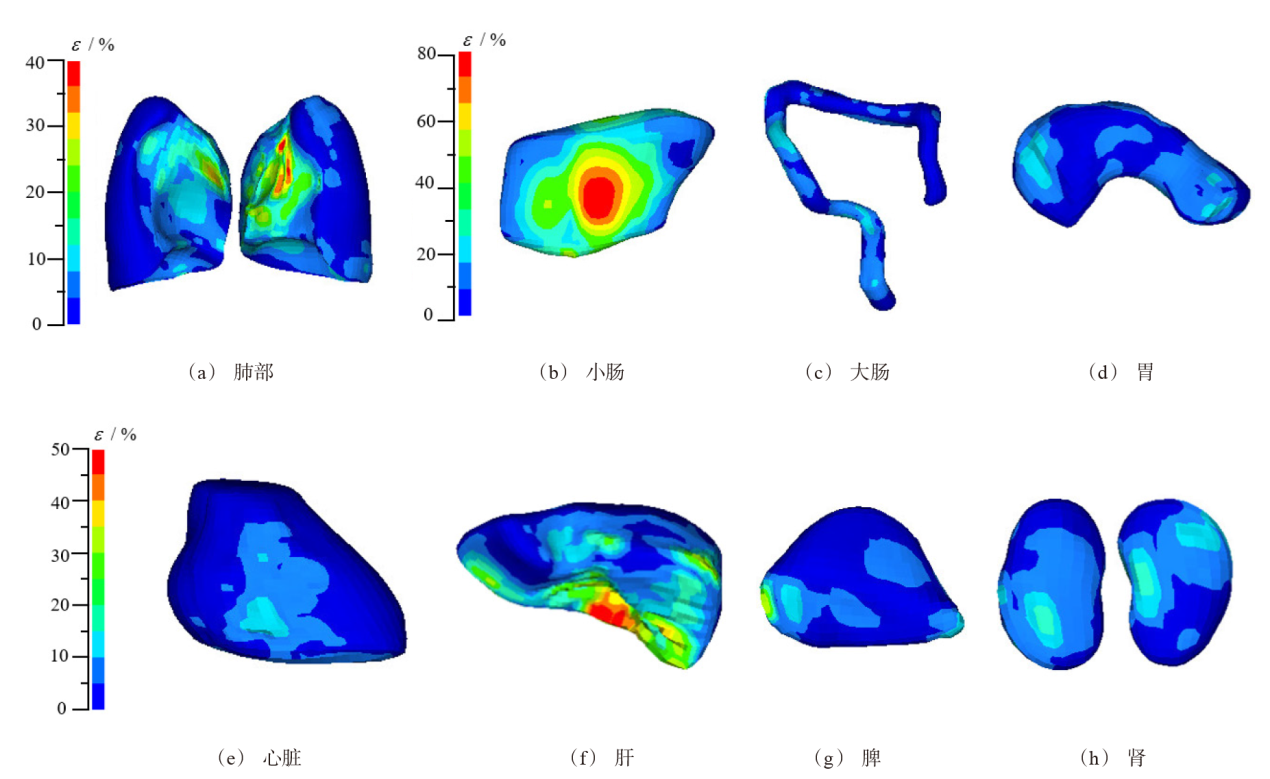
| 肺部第一主应变/ % | 左肺30.7,右肺40.0 | ― | 28.4 [ | |
| 生物力学 | 心脏、肝、脾、肾脏 第一主应变 / % | 心脏18.1,肝46.1,左肾8.4,脾29.6,右肾23.4 | ― | 30[ |
| 大肠、小肠、胃第一主应变 / % | 大肠75.2,小肠40.6,胃58.3 | ― | 130[ | |
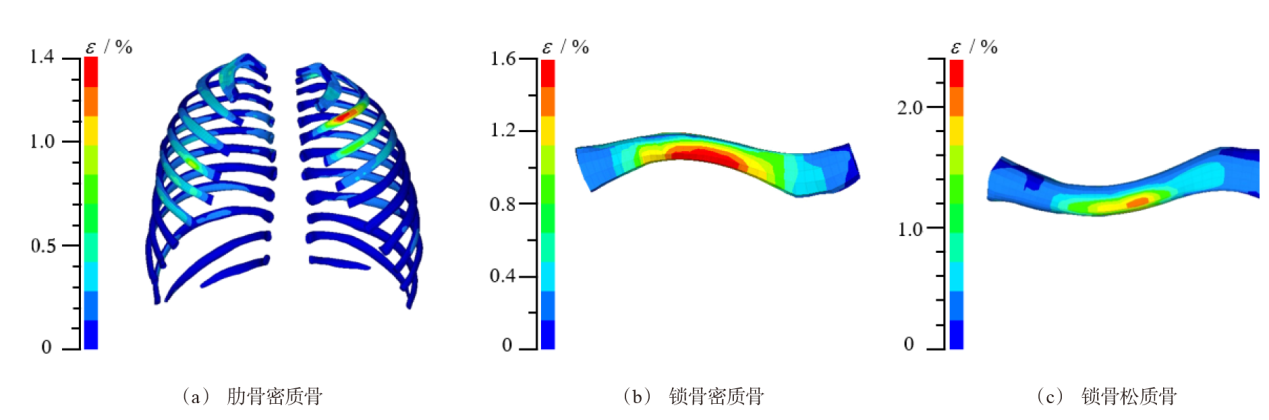
| 肋骨密质骨最大塑性应变 / % | 1.3 | ― | 2[ | |
| 锁骨失效应变 / % | 锁骨密质骨1.6,锁骨松质骨2.2 | ― | 锁骨密质骨2~3,骨折;锁骨松质骨8~15[ | |
| 锁骨失效力、力矩 | 失效载荷530 N;失效力矩14.42 Nm | ― | 平均失效载荷为(732±175) N,骨折;平均失效力矩为(28.3±7.8) Nm[ | |
| 损伤指标 | TUST IBMs F05-O | Hybrid III 5th | 损伤阈值 | |
|---|---|---|---|---|
| 运动学 | 胸部压缩量 / mm | 32 mm | 30 | 高性能限值18,低性能限值42 |
| 胸部VC值 / (m·s-1) | 0.34 | 0.2 | 高性能限值0.5 ,低性能限值1 | |
| 肺部第一主应变/ % | 左肺30.7,右肺40.0 | ― | 28.4 [ | |
| 生物力学 | 心脏、肝、脾、肾脏 第一主应变 / % | 心脏18.1,肝46.1,左肾8.4,脾29.6,右肾23.4 | ― | 30[ |
| 大肠、小肠、胃第一主应变 / % | 大肠75.2,小肠40.6,胃58.3 | ― | 130[ | |
| 肋骨密质骨最大塑性应变 / % | 1.3 | ― | 2[ | |
| 锁骨失效应变 / % | 锁骨密质骨1.6,锁骨松质骨2.2 | ― | 锁骨密质骨2~3,骨折;锁骨松质骨8~15[ | |
| 锁骨失效力、力矩 | 失效载荷530 N;失效力矩14.42 Nm | ― | 平均失效载荷为(732±175) N,骨折;平均失效力矩为(28.3±7.8) Nm[ | |
| L1 | L2 | L3 | L4 | L5 | |
|---|---|---|---|---|---|
| 轴向力,Fz / kN | 1.94 | 1.87 | 1.62 | 1.34 | 1.14 |
| 弯曲力矩,Mx / Nm | 9.29 | 6.89 | 7.44 | 7.61 | 8.05 |
| 弯曲力矩,My / Nm | 24.9 | 26.8 | 28.0 | 26.2 | 25.8 |
| 合成力矩,Mr / Nm | 26.5 | 27.67 | 28.97 | 27.28 | 27.02 |
| 椎体截面积,CSA / mm2 | 1 311 | 1 435 | 1 577 | 1 622 | 1 779 |
| 腰椎损伤指标,LSI | 2.26 | 2.23 | 2.08 | 1.82 | 1.65 |
| 腰椎骨折风险, Lfx/ (N·m-2) | 1.32 | 1.16 | 0.91 | 0.74 | 0.57 |
| L1 | L2 | L3 | L4 | L5 | |
|---|---|---|---|---|---|
| 轴向力,Fz / kN | 1.94 | 1.87 | 1.62 | 1.34 | 1.14 |
| 弯曲力矩,Mx / Nm | 9.29 | 6.89 | 7.44 | 7.61 | 8.05 |
| 弯曲力矩,My / Nm | 24.9 | 26.8 | 28.0 | 26.2 | 25.8 |
| 合成力矩,Mr / Nm | 26.5 | 27.67 | 28.97 | 27.28 | 27.02 |
| 椎体截面积,CSA / mm2 | 1 311 | 1 435 | 1 577 | 1 622 | 1 779 |
| 腰椎损伤指标,LSI | 2.26 | 2.23 | 2.08 | 1.82 | 1.65 |
| 腰椎骨折风险, Lfx/ (N·m-2) | 1.32 | 1.16 | 0.91 | 0.74 | 0.57 |
| [1] | Brumbelow M L, Jermakian J S. Injury risks and crashworthiness benefits for females and males: Which differences are physiological?[J]. Traf Inju Prev, 2022, 23(1): 11-16. |
| [2] | Forman J, Poplin G S, Shaw C G, et al. Automobile injury trends in the contemporary fleet Belted occupants in frontal collisions[J]. Traf Inju Prev, 2019, 20(3): 1-6. |
| [3] | ZHANG Yaohui, JU Chunxian, YUE Guohui, et al. Simulation analysis of the rear seat female in front impact[C]// 3rd Int’l Conf Digit Manufact Autom. IEEE, 2012. |
| [4] |
周华, 彭一峻, 刘卓异, 等. 约束系统对不同体型女性驾驶人的保护研究[J]. 中国安全科学学报, 2019, 29(4): 76-82.
doi: 10.16265/j.cnki.issn1003-3033.2019.04.013 |
| ZHOU Hua, PENG Yijun, LIU Zhuoyi, et al. A study on protection of restraint system on female drivers with different body types[J]. Chin Safe Sci J, 2019, 29(4): 76-82. (in Chinese) | |
| [5] | 张雄, 韩为铎, 赵佳庆. 正面碰撞波形对后排女性乘员伤害影响研究[C]// 2021中国汽车工程学会年会论文集(4), 2021: 677-682. |
| ZHANG Xiong, HAN Weiduo, ZHAO Jiaqing. Research on the influence of frontal crash waveform on the rear female occupant injury[C]// 2021 SAE China Congress (4), 2021: 677-682. (in Chinese) | |
| [6] | Kurano Y, Hikida K, Hibara S, et al. Two-dimensional degenerated model of next-generation crash test dummy THOR 5F[J]. Int’l J Autom Engi, 2020, 11(3): 94-100. |
| [7] | XU Tao, SHNEG Xiaoming, ZHANG Tianyi, et al. Development and validation of dummies and human models used in crash test[J]. Appl Bionics Biomech, 2018, Pt.2: 1-12. |
| [8] | Ghosh P, Gyanadutta S, Ravi K C, et al. Deriving anthropometrically-correct 5th percentile female from subject-specific female CAD model[C]// Int’l Res Counl Biomech Inju Conf, 2014: 477-478. |
| [9] | 杨洁. 基于THUMS的东西方5百分位女性碰撞响应差异分析[D]. 北京: 清华大学, 2016. |
| YANG Jie. Study of differences of dynamic responses between eastern and western 5th percentile female based on THUMS[D]. Beijing: Tsinghua University, 2016. (in Chinese) | |
| [10] | 黎和俊, 杨震, 周大永, 等. 混Ⅲ假人、GHBMC人体模型以及中国人体模型的正碰损伤差异[J]. 中国机械工程, 2021, 32(15): 1836-1843. |
| LI Hejun, YANG Zhen, ZHOU Dayong, et al. Differences of injury response among hybrid III dummy,GHBMC model and Chinese human body model in frontal crash[J]. Chin Mech Engi, 2021, 32(15): 1836-1843. (in Chinese) | |
| [11] | 阮世捷, 李超, 崔世海, 等. 颅骨厚度对颅内生物力学响应的影响[J]. 医用生物力学, 2021, 36(4): 560-567. |
| RUAN Shijie, LI Chao, CUI Shihai, et al. The influence of skull thickness on intracranial biomechanical response[J]. J Biomech, 2021, 36(4): 560-567. (in Chinese) | |
| [12] | 李海岩, 孙孝海, 贺丽娟, 等. 具有详实解剖学结构的国人第5百分位女性胸腹部有限元模型开发及验证[J]. 医用生物力学, 2022, 37(1): 91-97. |
| LI Haiyan, SUN Xiaohai, HE Lijuan, et al. Development and validation for thoracic-abdominal finite element model of Chinese 5th percentile female with detailed anatomical structure[J]. J Medi Biomech, 2022, 37(1): 91-97. (in Chinese) | |
| [13] | 李海岩, 李广明, 贺丽娟, 等. 汽车追尾碰撞中颈部姿态对生物力学响应的影响[J]. 汽车安全与节能学报, 2022, 13(1): 55-62. |
| LI Haiyan, LI Guangming, HE Lijuan, et al. Effect of neck posture on biomechanical response in rear end collision[J]. Autom Safe Energ, 2022, 13(1): 55-62. (in Chinese) | |
| [14] | 阮世捷, 梁亚妮, 李海岩, 等. 国人第5百分位女性行人下肢生物力学计算模型开发及应用[J]. 医用生物力学, 2022, 37(6): 1056-1063. |
| RUAN Shijie, LIANG Yani, LI Haiyan, et al. Development and application for biomechanical computational model of lower extremity of 5th percentile Chinese female pedestrian[J]. J Medi Biomech, 2022, 37(6): 1056-1063. (in Chinese) | |
| [15] | Takhounts E G, Craig M J, Moorhouse K, et al. Development of brain injury criteria (BrIC)[J]. Stap Car Crash J, 2013, 57: 243-266. |
| [16] | Baumgartner D, Willinger R, Shewchenko N, et al. Tolerance limits for mild traumatic brain injury derived from numerical head impact replication[C]// Int’l IRCOBI Conf Biomechan Impacts. Isle of Man, UK: IRCOBI, 2001: 353-355. |
| [17] | ZHANG Liying, YANG Kaihui, King A I, et al. A proposed injury threshold for mild traumatic brain injury[J]. Biomech Engi, 2004, 126(2): 226-236. |
| [18] | Galbraith J A, Thibault L E, Matteson D R, et al. Mechanical and electrical responses of the squid giant axon to simple elongation[J]. J Biomech Engi, 1993, 115(1): 13-22. |
| [19] | Morrison B, Cater H L, Wang C, et al. A tissue level tolerance criterion for living brain developed with an in vitro model of traumatic mechanical loading[J]. Stap Car Crash J, 2003, 47: 93-105. |
| [20] | Mizuno K, HAN Yong, CHEN Yiwei. Automobile Crash Safety[M]. Beijing: China Communications Press, 2016: 18-19. |
| [21] | Carter D R, Hayes W C. The compressive behavior of bone as a two-phase porous structure[J]. J Bone Joint Surg, 1977, 59-A (7): 954-962. |
| [22] | Kasra M, Parnianpour M, Shirazi-Adl A, et al. Effect of strain rate on tensile properties of sheep disc annulus fibrosus[J]. Tech Health Care:Offi J Euro Soc Engi Medi, 2004, 12(4): 333-342. |
| [23] |
Chazal J, Tanguy A, Bourges M, et al. Biomechanical properties of spinal ligaments and a histological study of the supraspinal ligament in traction[J]. J Biomech, 1985, 18(3): 167-176.
pmid: 3997901 |
| [24] | Gayzik F S. Development of a finite element based injury metric for pulmonary contusion[D]. Winston-Salem: Wake Forest University, 2008. |
| [25] | Shigeta K, Kitagawa Y, Yasuki T, et al. Development of next generation human FE model capable of organ injury prediction[C]// The 21st Int’l Tech Conf Enhan Safe Vehi. Germany: Stuttgart, 2009: 1-20. |
| [26] |
Melvin J W, Stalnaker R L, Roberts V L, et al. Impact injury mechanisms in abdominal organs[J]. Endocrinology, 1973, 138(12): 5231-5237.
doi: 10.1210/endo.138.12.5602 URL |
| [27] | Yamada H, Evans G F. Strength of Biological Materials[M]. Philadelphia: Baltimore Williams & Wilkins, 1970, 108(3): 582. |
| [28] | Kemper A R, Stitzel J D, Mcnally C, et al. Biomechanical response of the human clavicle: the effects of loading direction on bending properties[J]. Appl Biomechan, 2009, 25(2): 165-174. |
| [29] | ZHANG Qi, Kerrigan J, Kindig M, et al. Axial injury tolerance of the clavicle and the effect of age and gender[C]// Injur Biomechan Symp. America: Columbus, 2013: 1-17. |
| [30] | LI Zhuoping, Kindig M W, Kerrigan J R, et al. Development and validation of a subject-specific finite element model of a human clavicle[J]. Comput Method Biomech Biomed Engi, 2013, 16(7-9): 819-829. |
| [31] | YE Xin, Gaewsky J P, Jones D A, et al. Computational modeling and analysis of thoracolumbar spine fractures in frontal crash reconstruction[J]. Traf Inju Prev, 2018, 19(Suppla2): 1-25. |
| [32] | Tushak S K, Gepner B D, Forman J L, et al. Human lumbar spine injury risk in high-rate combined compression and flexion loading[J]. Anna Biomed Engi, 2023, 51: 1216-1225. |
| [1] | WANG Meijun, MENG Yu, ZHENG Chao, PENG Xiaorui, XU Yan. Research on pedestrian collision injury assessment based on monocular pose estimation [J]. Journal of Automotive Safety and Energy, 2026, 17(1): 33-39. |
| Viewed | ||||||
|
Full text |
|
|||||
|
Abstract |
|
|||||
