Welcome to Journal of Automotive Safety and Energy,

Journal of Automotive Safety and Energy ›› 2026, Vol. 17 ›› Issue (3): 397-408.DOI: 10.3969/j.issn.1674-8484.2026.03.012
• Intelligent Driving and Intelligent Transportation • Previous Articles Next Articles
CAO Shouqi1( ), JIANG Jiasheng1, ZHOU Guofeng1,*(), CHEN Jianwei2
Received:2025-12-11
Revised:2026-05-14
Online:2026-06-30
Published:2026-07-02
CLC Number:
CAO Shouqi, JIANG Jiasheng, ZHOU Guofeng, CHEN Jianwei. Path tracking and roll stability control for distributed drive autonomous vehicles based on LTV-MPC[J]. Journal of Automotive Safety and Energy, 2026, 17(3): 397-408.
Add to citation manager EndNote|Ris|BibTeX
URL: https://www.journalase.com/EN/10.3969/j.issn.1674-8484.2026.03.012
| 整车质量,m / kg | 1 860 |
|---|---|
| 簧上质量,ms / kg | 1 590 |
| 车辆轮距,W / m | 1.575 |
| 质心到前轴的距离,a / m | 1.18 |
| 质心到后轴的距离,b / m | 1.77 |
| 车辆轴距,l / m | 2.95 |
| 绕x轴的转动惯量,Ixx / (kg·m2) | 894.4 |
| 绕z轴的转动惯量,Izz / (kg·m2) | 2 687.1 |
| 质心到侧倾中心的距离,hs / m | 0.57 |
| 侧倾中心到地面的距离,hr / m | 0.15 |
| 轮胎有效半径,Rm / m | 0.393 |
| 侧倾刚度系数,kφ / (Nm·rad-1) | 189 506 |
| 侧倾阻尼系数,cφ / (Nm·s·rad-1) | 6 364 |
| 整车质量,m / kg | 1 860 |
|---|---|
| 簧上质量,ms / kg | 1 590 |
| 车辆轮距,W / m | 1.575 |
| 质心到前轴的距离,a / m | 1.18 |
| 质心到后轴的距离,b / m | 1.77 |
| 车辆轴距,l / m | 2.95 |
| 绕x轴的转动惯量,Ixx / (kg·m2) | 894.4 |
| 绕z轴的转动惯量,Izz / (kg·m2) | 2 687.1 |
| 质心到侧倾中心的距离,hs / m | 0.57 |
| 侧倾中心到地面的距离,hr / m | 0.15 |
| 轮胎有效半径,Rm / m | 0.393 |
| 侧倾刚度系数,kφ / (Nm·rad-1) | 189 506 |
| 侧倾阻尼系数,cφ / (Nm·s·rad-1) | 6 364 |
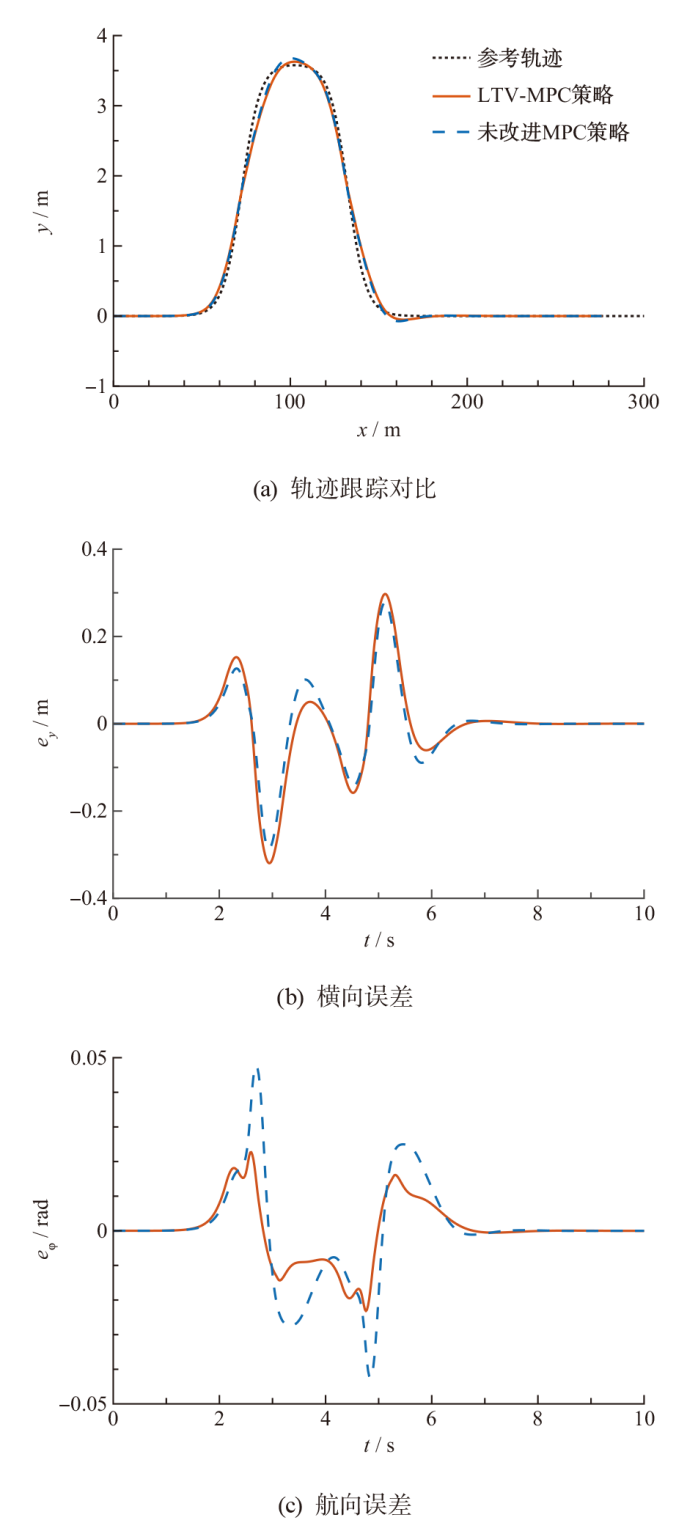
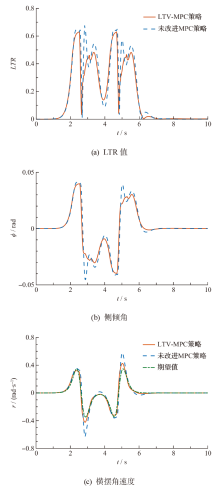
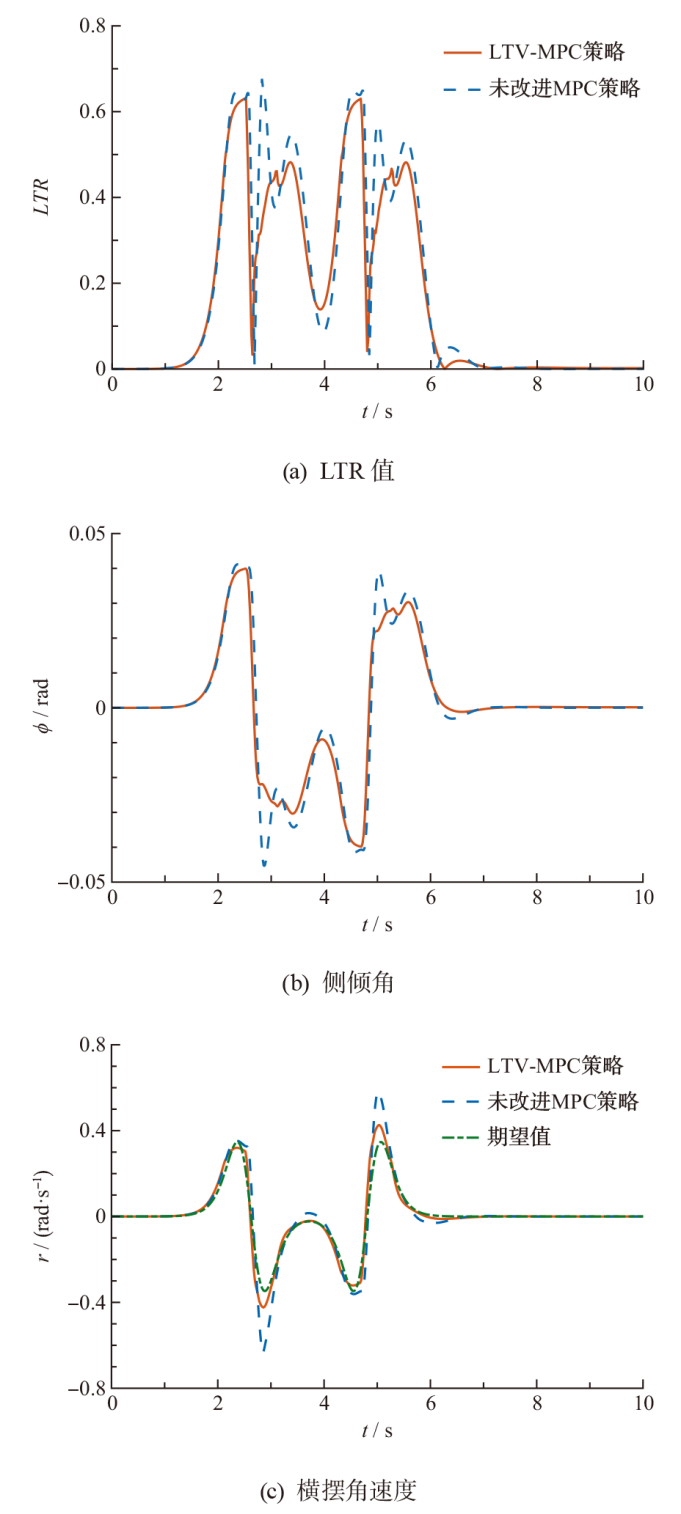
| 方法 | 指标 | ey / m | e? / rad | LTR | φ / rad | r / (rad·s-1) |
|---|---|---|---|---|---|---|
| 未改进 MPC策略 | 峰值 | 0.286 9 | 0.047 5 | 0.676 6 | 0.045 3 | 0.632 4 |
| RMSE | 0.083 2 | 0.014 2 | 0.292 9 | 0.018 8 | 0.059 6 | |
| LTV-MPC 策略 | 峰值 | 0.316 7 | 0.023 2 | 0.632 1 | 0.039 9 | 0.425 9 |
| RMSE | 0.090 4 | 0.008 4 | 0.266 2 | 0.016 9 | 0.031 8 |
| 方法 | 指标 | ey / m | e? / rad | LTR | φ / rad | r / (rad·s-1) |
|---|---|---|---|---|---|---|
| 未改进 MPC策略 | 峰值 | 0.286 9 | 0.047 5 | 0.676 6 | 0.045 3 | 0.632 4 |
| RMSE | 0.083 2 | 0.014 2 | 0.292 9 | 0.018 8 | 0.059 6 | |
| LTV-MPC 策略 | 峰值 | 0.316 7 | 0.023 2 | 0.632 1 | 0.039 9 | 0.425 9 |
| RMSE | 0.090 4 | 0.008 4 | 0.266 2 | 0.016 9 | 0.031 8 |
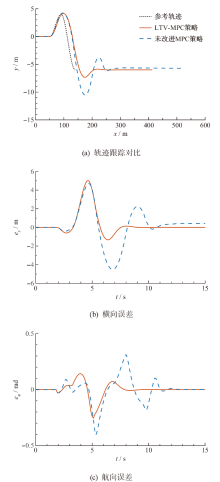
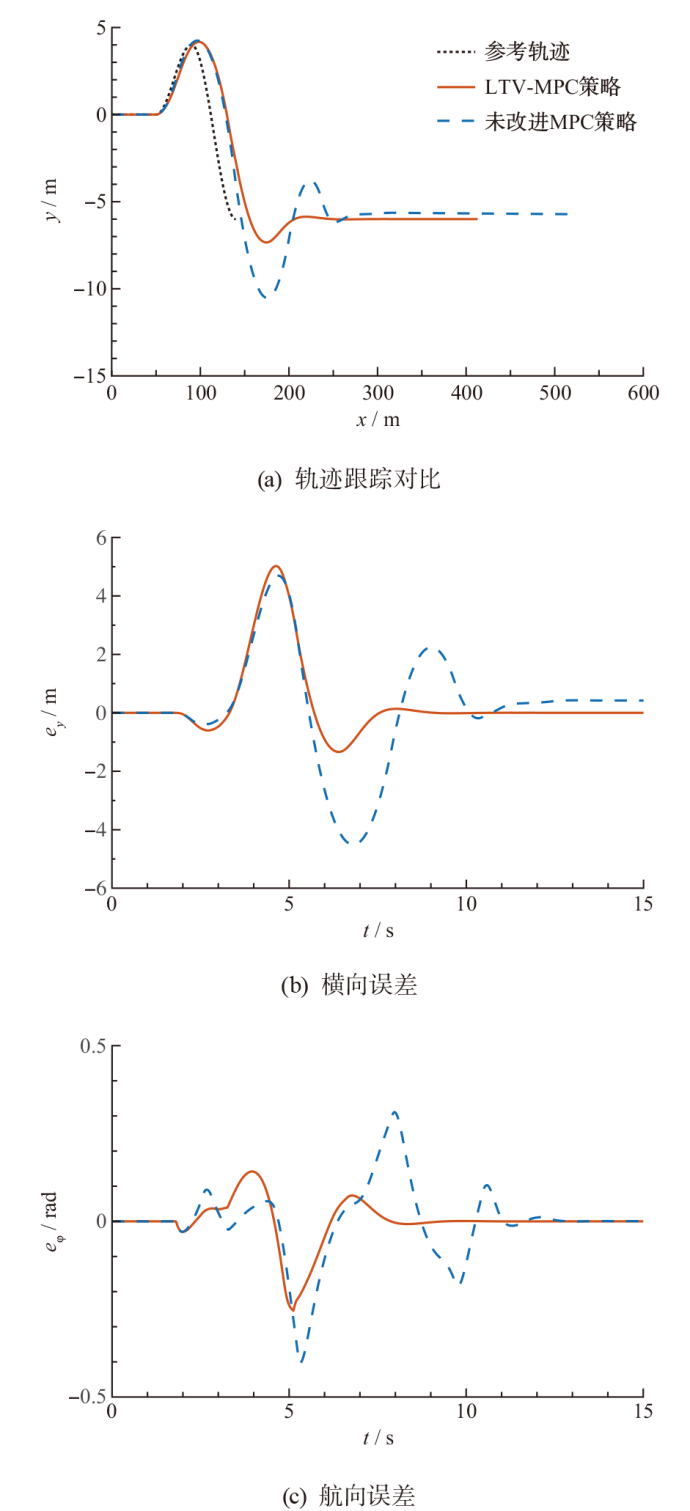
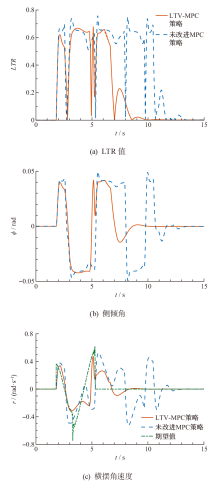
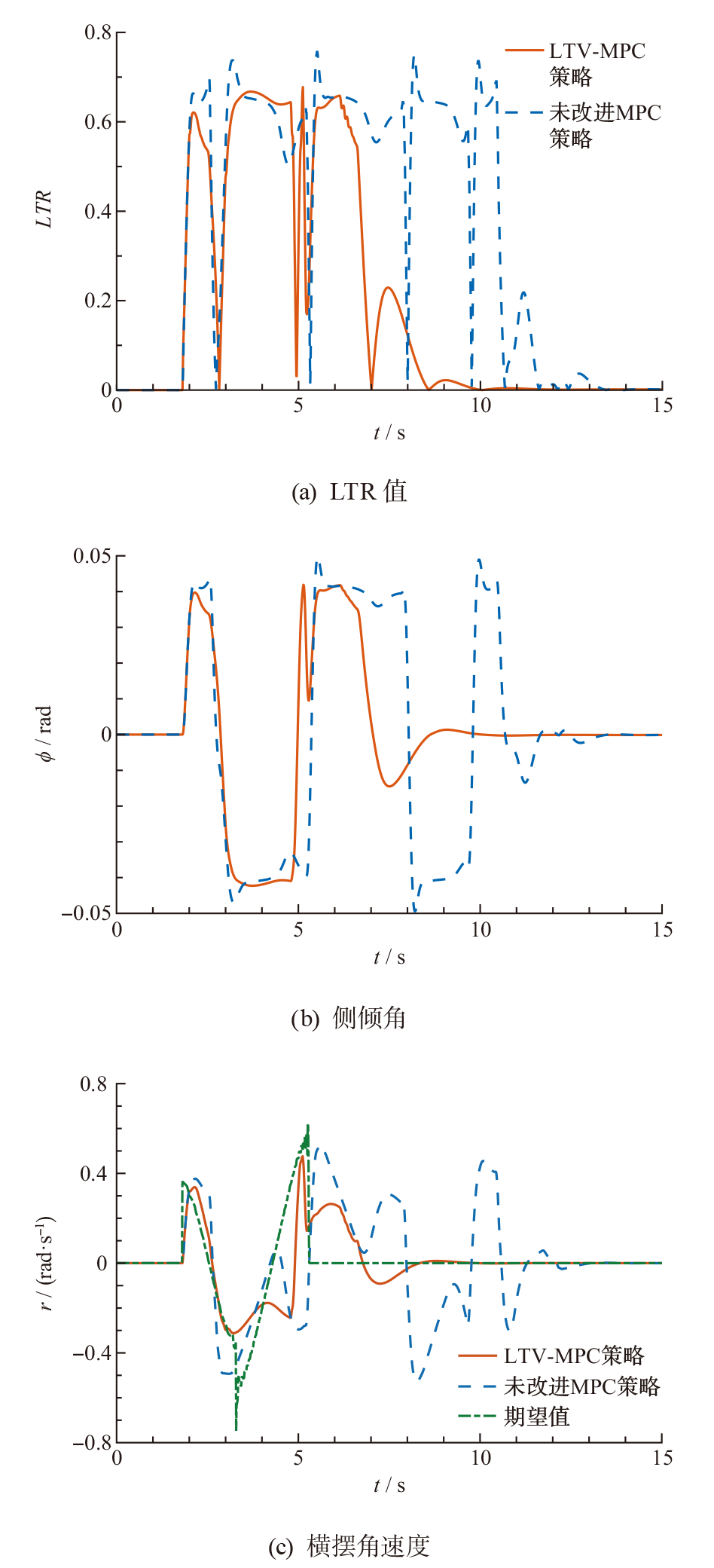
| 方法 | 指标 | ey / m | e? / rad | LTR | φ / rad | r / (rad·s-1) |
|---|---|---|---|---|---|---|
| 未改进MPC策略 | 峰值 | 4.691 3 | 0.404 0 | 0.758 3 | 0.049 7 | 0.527 4 |
| RMSE | 1.871 8 | 0.107 6 | 0.399 7 | 0.025 5 | 0.219 7 | |
| LTV-MPC 策略 | 峰值 | 5.024 1 | 0.254 4 | 0.677 6 | 0.042 3 | 0.476 3 |
| RMSE | 1.335 5 | 0.063 4 | 0.330 5 | 0.021 0 | 0.145 7 |
| 方法 | 指标 | ey / m | e? / rad | LTR | φ / rad | r / (rad·s-1) |
|---|---|---|---|---|---|---|
| 未改进MPC策略 | 峰值 | 4.691 3 | 0.404 0 | 0.758 3 | 0.049 7 | 0.527 4 |
| RMSE | 1.871 8 | 0.107 6 | 0.399 7 | 0.025 5 | 0.219 7 | |
| LTV-MPC 策略 | 峰值 | 5.024 1 | 0.254 4 | 0.677 6 | 0.042 3 | 0.476 3 |
| RMSE | 1.335 5 | 0.063 4 | 0.330 5 | 0.021 0 | 0.145 7 |
| [1] | ZHA Yunfei, DENG Jianxian, QIU Yinyuan, et al. A survey of intelligent driving vehicle trajectory tracking based on vehicle dynamics[J]. SAE Int’l J Vehi Dyna Stab NVH, 2023, 7(2): 221-248. |
| [2] |
熊璐, 杨兴, 卓桂荣, 等. 无人驾驶车辆的运动控制发展现状综述[J]. 机械工程学报, 2020, 56(10): 127-143.
doi: 10.3901/JME.2020.10.127 |
| XIONG Lu, YANG Xing, ZHUO Guirong, et al. A review of the development of motion control for autonomous vehicles[J]. J Mech Engi, 2020(10): 127-143. (in Chinese). | |
| [3] |
LI Lei, LI Jun, ZHANG Shiyi. Review article: state-of-the-art trajectory tracking of autonomous vehicles[J]. Mech Sci, 2021, 12(1): 419-432.
doi: 10.5194/ms-12-419-2021 |
| [4] | WANG Lihui, CHEN Zongliang, ZHU Wenxing. An improved pure pursuit path tracking control method based on heading error rate[J]. Indu Robot: Int’l J Robo Res Appl, 2022, 49(5): 973-980. |
| [5] | GU Jingming, FANG Dianjun. Genetic algorithm based LQR control for AGV path tracking problem[J]. J Phys Conf Seri IOP Publ, 2021, 1952(3): 12-32. |
| [6] | LU Ao, LU Ziwang, LI Runfeng, et al.Adaptive LQR path tracking control for 4WS electric vehicles based on genetic algorithm [C]// 2022 6th CAA Int’l Conf Vehi Cont Intel (CVCI). IEEE, 2022: 1-6. |
| [7] | ZHANG Lin, JIANG Lianbo, LIU Hanghang, et al. Cooperative strategy of trajectory tracking and stability control for 4WID autonomous vehicles under extreme conditions[J]. IEEE Trans Vehi Tech, 2023, 72(3): 3105-3118. |
| [8] | TIAN Yang, MA He, MA Lei, et al. Path tracking control of commercial vehicle emergency obstacle avoidance based on MPC and active disturbance rejection control[J]. IEEE Trans Transport Elect, 2025, 11(3): 7162-7170. |
| [9] |
LIU Hebing, SUN Jinghong, CHENG Kawaieric. A two-layer model predictive path-tracking control with curvature adaptive method for high-speed autonomous driving[J]. IEEE Access, 2023, 11: 89228-89239.
doi: 10.1109/ACCESS.2023.3306239 URL |
| [10] | CHEN Jie, WANG Ruochen, LIU Wei, et al. A review of recent advances in roll stability control in on-road and off-road vehicles[J]. Appl Sci, 2025, 15(10): 54-91. |
| [11] |
Júnior Z R M, Murilo A, Lopes R V. Vehicle stability upper-level-controller based on parameterized model predictive control[J]. IEEE Access, 2022, 10: 21048-21065.
doi: 10.1109/ACCESS.2022.3147452 URL |
| [12] | CHEN Shuping, XIONG Guangming, CHEN Huiyan, et al. MPC-based path tracking with PID speed control for high-speed autonomous vehicles considering time-optimal travel[J]. J Cent South Univ, 2020, 27(12): 3702-3720. |
| [13] | 王康, 李琼琼, 王子洋, 等. 考虑侧倾的无人车NMPC轨迹跟踪控制[J]. 控制与决策, 2022, 37(10): 2535-2542. |
| WANG Kang, LI Qiongqiong, WANG Ziyang, et al. Trajectory tracking control for automated vehicle based on NMPC considering vehicle rolling motion[J]. Contr Deci, 2022, 37(10): 2535-2542. (in Chinese). | |
| [14] | 江和耀, 王永海, 吴幼冬, 等. 四轮毂驱动电动车辆横向稳定与侧倾预防协同控制策略[J]. 吉林大学学报(工学版), 2024, 54(2): 540-549. |
| JIANG Heyao, WANG Yonghai, WU Youdong, et al. Coordinated lateral stability and rollover prevention control for four-wheel independent motor drive electric vehicles[J]. J Jilin Univ (Engi Tech Edit), 2024, 54(2): 540-549. (in Chinese). | |
| [15] | Ataei M, Khajepour A, Jeon S. Model predictive rollover prevention for steer-by-wire vehicles with a new rollover index[J]. Int’l J Contr, 2020, 93(1): 140-155. |
| [16] | Ghazali M, Durali M, Salarieh H. Vehicle trajectory challenge in predictive active steering rollover prevention[J]. Int’l J Autom Tech, 2017, 18(3): 511-521. |
| [17] | 朱绍鹏, 吕超. 轮毂电机分布式驱动控制技术[M]. 北京: 机械工业出版社, 2022: 231. |
| ZHU Shaopeng, LV Chao. In-Wheel Motor Distri-buted Drive Control Technology[M]. Beijing: China Machine Press, 2022: 231. (in Chinese). | |
| [18] | Ataei M, Khajepour A, Jeon S. Development of a novel general reconfigurable vehicle dynamics model[J]. Mech Mach Theor, 2021, 156: 104-147. |
| [19] | WANG Zhaoqiang, SUN Keyang, MA Siqun, et al. Improved linear quadratic regulator lateral path tracking approach based on a real-time updated algorithm with fuzzy control and cosine similarity for autonomous vehicles[J]. Elect, 2022, 11(22): 3703. |
| [1] | CAO Liling, LIU Wei, DAI Kunpeng, ZHOU Guofeng. Path tracking control of autonomous container trucks using angular compensation LQR [J]. Journal of Automotive Safety and Energy, 2024, 15(3): 413-423. |
| [2] | ZHOU Xing, LIU Fuyun, TANG Zhentian, DENG Jucai. Optimal lateral acceleration driver model based on trajectory prediction [J]. Journal of Automotive Safety and Energy, 2023, 14(3): 338-345. |
| [3] | ZHANG Xinrong, XU Quanning, GONG Xinle, LI Xueyun, HUANG Jin. Integrated control strategy for path tracking of human-machineco-driving vehicle [J]. Journal of Automotive Safety and Energy, 2022, 13(4): 686-696. |
| [4] | SUN Zhiwei, PEI Xiaofei, LIU Yiping, YONG Chenghao, CHEN Ci. Path tracking and remote control of driverless sweeper [J]. Journal of Automotive Safety and Energy, 2022, 13(4): 729-737. |
| [5] | LI Wenli, QIU Fanke, LIAO Daming, REN Yongpeng, YI Fan. Highway lane change decision control model based on deep reinforcement learning [J]. Journal of Automotive Safety and Energy, 2022, 13(4): 750-759. |
| [6] | LI Yaohua, FAN Jikang, LIU Yang, HE Jie, LI Zetian, PAN Shaofei. Path planning and path tracking control for autonomous vehicle based on MPC with adaptive dual-horizon-parameters [J]. Journal of Automotive Safety and Energy, 2021, 12(4): 528-539. |
| [7] | LI Yaohua, LIU Yang, FENG Qianlong, NAN Youfei, HE Jie, FAN Jikang. Path tracking control for an intelligent commercial vehicle based on optimal preview and model predictive [J]. Journal of Automotive Safety and Energy, 2020, 11(4): 462-469. |
| [8] | CHAI Xiaodong, XIA Huaicheng, WANG Zhanchao, QU Zijun. Active braking hierarchical control algorithm of electric power-assisted brake system [J]. Journal of Automotive Safety and Energy, 2020, 11(2): 205-211. |
| [9] | YANG Echuan, XIE Chuanren, WANG Jiang, CHEN Ruinan, OU Jian . Active anti-roll control method for a semi-trailer based on MPC theory [J]. Journal Of Automotive Safety And Energy, 2020, 11(1): 61-70. |
| [10] | ZHAO Shu’en,ZHANG Xiong,TANG Juntao. Multilevel hierarchical control of anti-rollover for heavy-duty tractor-semitrailer [J]. Journal Of Automotive Safety And Energy, 2019, 10(4): 474-482. |
| [11] | HE Xiangkun, YANG Kaiming, JI Xuewu﹡. Vehicle stability control based on integrated-electro- hydraulic brake system [J]. Journal Of Automotive Safety And Energy, 2017, 08(02): 170-177. |
| Viewed | ||||||
|
Full text |
|
|||||
|
Abstract |
|
|||||
