欢迎访问《汽车安全与节能学报》,

汽车安全与节能学报 ›› 2026, Vol. 17 ›› Issue (2): 149-169.DOI: 10.3969/j.issn.1674-8484.2026.02.001
• 综述与展望 • 下一篇
刘杨1( ), 官苏琳1, 秦子威2, 邵勤思1, 倪昀3, 赵玉峰1, 张久俊1,*()
收稿日期:2026-03-01
修回日期:2026-03-14
出版日期:2026-04-30
发布日期:2026-04-30
通讯作者:
张久俊,教授,中国工程院外籍院士。E-mail:jiujun.zhang@fzu.edu.cn。加拿大皇家科学院院士、加拿大工程院院士、加拿大工程研究院院士,国际电化学能源科学院(IAOEES)主席,中国内燃机学会常务理事兼燃料电池发动机分会主任委员。曾任加拿大联邦政府国家研究院首席科学家,现任上海大学理学院及可持续能源研究院院长、福州大学材料与工程学院院长及新能源材料与工程研究院院长。至今已发表学术论文1 000余篇、著作31本、书章47篇、学术专刊6期、工业研发技术报告90余篇,以及获批70余项国内外专利。论文被引用114 000多次(H-Index为149),有100余篇论文均被引用100次以上。主要研究领域为电化学能源存储和转换的科学基础研究和产业化的应用开发,包括燃料电池、高比能二次电池、超级电容器、CO2电化学还原和水电解等。
作者简介:刘杨(1985—),男(汉),山东,副研究员。E-mail:yangliu8651@shu.edu.cn。
基金资助:
LIU Yang1(), GUAN Sulin1, QIN Ziwei2, SHAO Qinsi1, NI Yun3, ZHAO Yufeng1, ZHANG Jiujun1,*()
Received:2026-03-01
Revised:2026-03-14
Online:2026-04-30
Published:2026-04-30
Contact:
Prof. ZHANG Jiujun He is a Foreign Member of the 摘要:
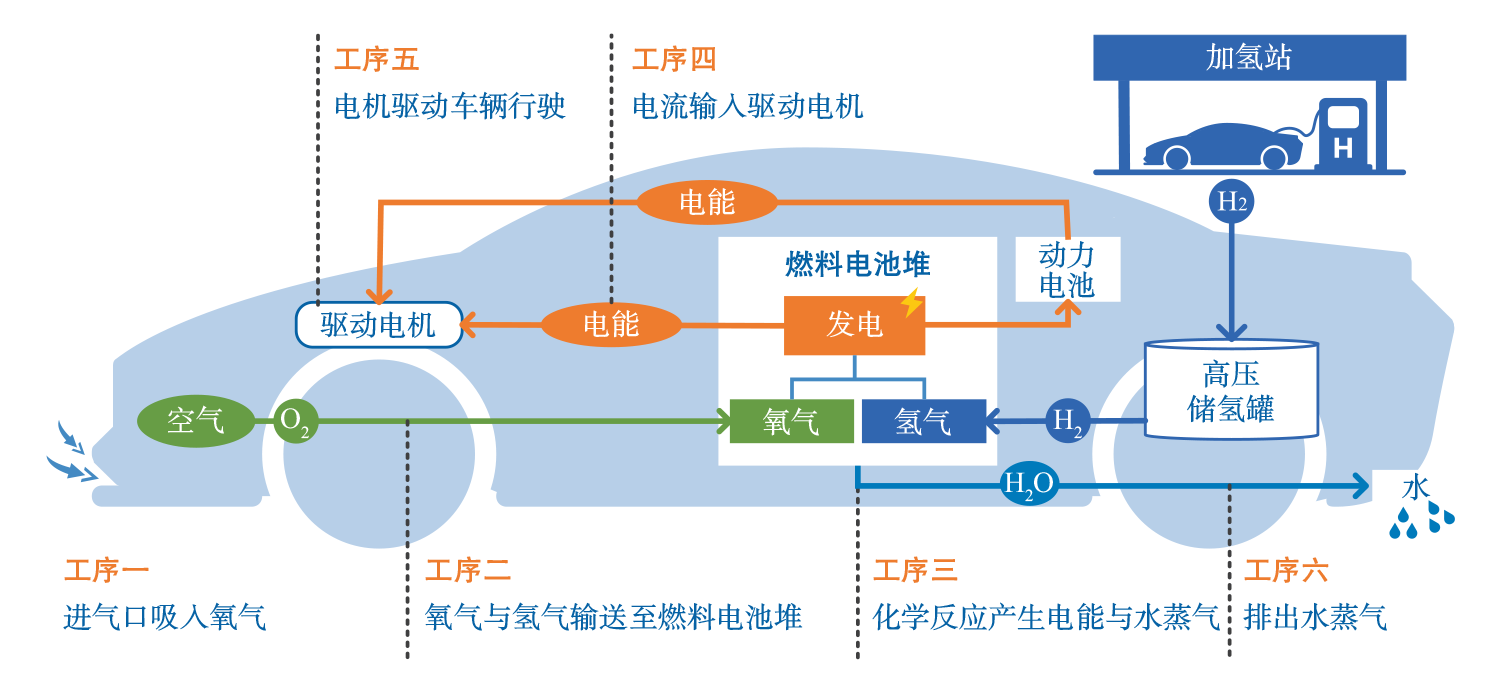
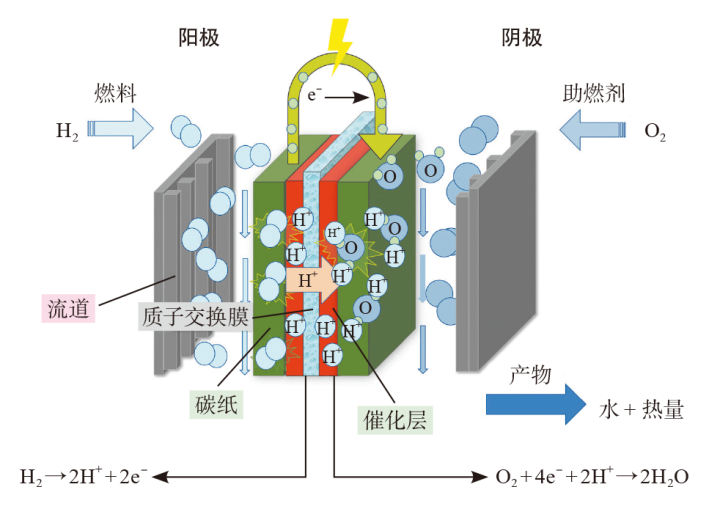
在“双碳”战略目标引领下,中国能源结构转型进入关键阶段,氢能作为清洁低碳且来源丰富的二次能源成为国家能源体系的重要组成部分。交通运输领域是实现碳减排的关键场景,氢燃料电池汽车(HFCV)凭借零排放、高效率、快加注等优势,被视为运输领域电动化转型的终极方案。该文综述了氢能燃料电池,主要是质子交换膜燃料电池(PEMFC)的工作原理及核心部件(膜电极、催化剂、质子交换膜等)及性能,分析了商业化过程中燃料电池所面临的科学技术问题;对 Pt 催化剂降解、碳载体腐蚀对催化剂活性损失的影响进行了分析与梳理,讨论了提高催化剂活性与降低成本的发展趋势;总结了影响质子交换膜(PEM)耐久性的因素,提出了化学改性与物理强化等改善措施;探讨了工况下气体扩散层(GDL)的机械衰减与化学衰减对耐久性和寿命的影响,归纳了 GDL 的微观结构与水/热管理的优化策略。针对政策与市场环境,分析了中国与部分先进国家的氢能政策动向,阐述了中国“车-站-源”闭环与全链条集成 2 类商业模式的演化路径以及世界主要经济体国家氢能PEMFC与氢能的商业化发展进程。最后对中国氢能燃料电池汽车产业提出建议,指出突破关键材料的国产化“卡脖子”瓶颈,完善标准体系,构建“技术研发-中试验证-商业应用”全链条创新生态,是推动车用质子交换膜燃料电池产业高质量发展的核心任务。
中图分类号:
刘杨, 官苏琳, 秦子威, 邵勤思, 倪昀, 赵玉峰, 张久俊. 车用氢能质子交换膜燃料电池关键材料与技术现状和前景解析[J]. 汽车安全与节能学报, 2026, 17(2): 149-169.
LIU Yang, GUAN Sulin, QIN Ziwei, SHAO Qinsi, NI Yun, ZHAO Yufeng, ZHANG Jiujun. Key materials, technology status, and prospect analysis of proton exchange membrane fuel cells for hydrogen-based electric vehicles[J]. Journal of Automotive Safety and Energy, 2026, 17(2): 149-169.
| 项目 | 电解质 | 燃料 | 催化剂 | 电堆功率/ kW | 电效率 | 工作温度/ ℃ | 应用 |
|---|---|---|---|---|---|---|---|
| AFC | KOH | H2 | Ni/Ag | 5~150 | 60%~70% | < 100 | 军事航天、固定式发电、交通运输 |
| PAFC | 磷酸浸渍多孔基质 | H2 | Pt、PtRu/Pt | 50~1万 | 35%~40%、85%(热电联产) | 160~220 | 分布式发电 |
| MCFC | 碳酸盐混合物 | H2、CH4、煤气、天然气 | Ni-5Cr/NiO(Li) | 100~2000 | 约60% | 600~800 | 电力系统 |
| SOFC | 钇稳定氧化锆(YSZ)等 | H2、CO、CH4煤气、天然气 | Ni-YSZ/锶掺杂锰酸镧(LSM) | 100~250 | > 60%、> 80% (热量回收) | 800~1 000 | 与热力学循环集成、热电联产 |
| DMFC | 质子交换膜 | CH3OH | Pt、Pt/Ru、Pt/过渡金属合金、非Pt催化剂 | < 5 | < 35% | < 120 | 便携式电子设备 |
| PEMFC | 质子交换膜 | H2 | Pt、Pt/Ru、Pt/过渡金属合金、非Pt催化剂 | 5~250 | 60%(直接氢气)、 40%(重整燃料) | 70~200 | 备用电源、便携电源、固定电站、分布式发电、交通运输等 |
| 项目 | 电解质 | 燃料 | 催化剂 | 电堆功率/ kW | 电效率 | 工作温度/ ℃ | 应用 |
|---|---|---|---|---|---|---|---|
| AFC | KOH | H2 | Ni/Ag | 5~150 | 60%~70% | < 100 | 军事航天、固定式发电、交通运输 |
| PAFC | 磷酸浸渍多孔基质 | H2 | Pt、PtRu/Pt | 50~1万 | 35%~40%、85%(热电联产) | 160~220 | 分布式发电 |
| MCFC | 碳酸盐混合物 | H2、CH4、煤气、天然气 | Ni-5Cr/NiO(Li) | 100~2000 | 约60% | 600~800 | 电力系统 |
| SOFC | 钇稳定氧化锆(YSZ)等 | H2、CO、CH4煤气、天然气 | Ni-YSZ/锶掺杂锰酸镧(LSM) | 100~250 | > 60%、> 80% (热量回收) | 800~1 000 | 与热力学循环集成、热电联产 |
| DMFC | 质子交换膜 | CH3OH | Pt、Pt/Ru、Pt/过渡金属合金、非Pt催化剂 | < 5 | < 35% | < 120 | 便携式电子设备 |
| PEMFC | 质子交换膜 | H2 | Pt、Pt/Ru、Pt/过渡金属合金、非Pt催化剂 | 5~250 | 60%(直接氢气)、 40%(重整燃料) | 70~200 | 备用电源、便携电源、固定电站、分布式发电、交通运输等 |
| 年份 | 名称 | 内容 |
|---|---|---|
| 2021 | 《中华人民共和国国民经济和社会发展第十四个五年规划和2035年远景目标纲要》 | 将氢能作为前瞻产业写入文件,在氢能与储能等前沿科技和产业变革领域组织实施未来产业孵化与加速计划 |
| GB/T40045-2021《氢能汽车用燃料液氢》 | 规定了氢动力汽车燃料液氢的技术指标、测试方法及储存运输要求,填补液氢民用标准空白 | |
| 2022 | 《氢能产业发展中长期规划(2021-2035年)》 | 明确了氢能的战略定位,提出“清洁低碳”的基本原则,定位为未来国家能源体系重要组成部分;提出到2025年基本掌握核心技术和制造工艺,初步建立较为完整的供应链和产业体系 |
| 2023 | 《氢能产业标准体系建设指南(2023版)》 | 系统构建氢能制、储、输、用全产业链标准体系,加强氢能标准化工作顶层设计 |
| 2024 | 《推动铁路行业低碳发展实施方案》 | 推动氢燃料电池在站场调车作业及短途低运量城际、市域客运牵引场景的示范应用 |
| 《中华人民共和国能源法(草案)》 | 首次将氢能明确纳入能源管理体系,明确国家积极有序推进氢能开发利用(2025年1月1日正式施行) | |
| 《关于大力实施可再生能源替代行动的指导意见》 | 积极有序发展可再生能源制氢;鼓励低碳氢规模化替代高碳氢;加强加氢站建设;开展氢冶金和氢基化工技术推广应用 | |
| 《加快工业领域清洁低碳氢应用实施方案》 | 加快工业副产氢和可再生能源制氢等清洁低碳氢应用;推动可再生能源弱并网、离网制氢新模式发展;探索海上风电制氢等新途径 | |
| 2025 | 《关于调整享受车船税优惠的节能新能源汽车产品技术要求的公告》 | 调整燃料电池商用车技术要求:系统额定功率不小于50 kW、启动温度不高于-30 ℃、电堆额定功率密度不低于2.5 kW/L、纯氢续驶里程不低于300 km (2026年1月1日起实施) |
| 《2025年能源工作指导意见》 | 明确将氢能与绿色液体燃料列为能源转型的核心方向,提出通过技术创新、场景拓展和国际合作加速产业规模化发展 | |
| 《关于组织开展能源领域氢能试点工作的通知》 | 提出4个领域11项试点任务,支持氢能“制储输用”全链条发展,推动创新氢能管理模式 | |
| 2026 | 《关于开展氢能综合应用试点工作的通知》 | 部署氢能综合应用试点,将应用场景由燃料电池汽车向交通、工业等多元领域拓展;提出到2030年城市群终端用氢平均价格降至25元/kg以下,全国燃料电池汽车保有量力争达到10万辆;采取“以奖代补”方式,单个城市群试点期奖励上限16亿元 |
| 年份 | 名称 | 内容 |
|---|---|---|
| 2021 | 《中华人民共和国国民经济和社会发展第十四个五年规划和2035年远景目标纲要》 | 将氢能作为前瞻产业写入文件,在氢能与储能等前沿科技和产业变革领域组织实施未来产业孵化与加速计划 |
| GB/T40045-2021《氢能汽车用燃料液氢》 | 规定了氢动力汽车燃料液氢的技术指标、测试方法及储存运输要求,填补液氢民用标准空白 | |
| 2022 | 《氢能产业发展中长期规划(2021-2035年)》 | 明确了氢能的战略定位,提出“清洁低碳”的基本原则,定位为未来国家能源体系重要组成部分;提出到2025年基本掌握核心技术和制造工艺,初步建立较为完整的供应链和产业体系 |
| 2023 | 《氢能产业标准体系建设指南(2023版)》 | 系统构建氢能制、储、输、用全产业链标准体系,加强氢能标准化工作顶层设计 |
| 2024 | 《推动铁路行业低碳发展实施方案》 | 推动氢燃料电池在站场调车作业及短途低运量城际、市域客运牵引场景的示范应用 |
| 《中华人民共和国能源法(草案)》 | 首次将氢能明确纳入能源管理体系,明确国家积极有序推进氢能开发利用(2025年1月1日正式施行) | |
| 《关于大力实施可再生能源替代行动的指导意见》 | 积极有序发展可再生能源制氢;鼓励低碳氢规模化替代高碳氢;加强加氢站建设;开展氢冶金和氢基化工技术推广应用 | |
| 《加快工业领域清洁低碳氢应用实施方案》 | 加快工业副产氢和可再生能源制氢等清洁低碳氢应用;推动可再生能源弱并网、离网制氢新模式发展;探索海上风电制氢等新途径 | |
| 2025 | 《关于调整享受车船税优惠的节能新能源汽车产品技术要求的公告》 | 调整燃料电池商用车技术要求:系统额定功率不小于50 kW、启动温度不高于-30 ℃、电堆额定功率密度不低于2.5 kW/L、纯氢续驶里程不低于300 km (2026年1月1日起实施) |
| 《2025年能源工作指导意见》 | 明确将氢能与绿色液体燃料列为能源转型的核心方向,提出通过技术创新、场景拓展和国际合作加速产业规模化发展 | |
| 《关于组织开展能源领域氢能试点工作的通知》 | 提出4个领域11项试点任务,支持氢能“制储输用”全链条发展,推动创新氢能管理模式 | |
| 2026 | 《关于开展氢能综合应用试点工作的通知》 | 部署氢能综合应用试点,将应用场景由燃料电池汽车向交通、工业等多元领域拓展;提出到2030年城市群终端用氢平均价格降至25元/kg以下,全国燃料电池汽车保有量力争达到10万辆;采取“以奖代补”方式,单个城市群试点期奖励上限16亿元 |
| [1] |
侯明, 邵志刚, 俞红梅, 等. 2019年氢燃料电池研发热点回眸[J]. 科技导报, 2020, 38(1): 137-150.
doi: 10.3981/j.issn.1000-7857.2020.01.012 |
| HOU Ming, SHAO Zhigang, YU Hongmei, et al. Review of hot topics on hydrogen fuel cells in 2019[J]. Sci Tech Rev, 2020, 38(1): 137-150. (in Chinese) | |
| [2] | 许德超, 赵子亮, 赵洪辉, 等. 国内燃料电池电堆技术进展综述[J]. 汽车文摘, 2020(1): 8-13. |
| XU Dechao, ZHAO Ziliang, ZHAO Honghui, et al. Progress review of fuel cell stack technologies in China[J]. Autom Dige, 2020(1): 8-13. (in Chinese) | |
| [3] |
朱明原, 刘文博, 刘杨, 等. 氢能与燃料电池关键科学技术:挑战与前景[J]. 上海大学学报(自然科学版), 2021, 27: 411-443.
doi: 10.12066/j.issn.1007-2861.2300 |
| ZHU Mingyuan, LIU Wenbo, LIU Yang, et al. Key scientific and technological principles of hydrogen energy and fuel cells: challenges and prospects[J]. J Shanghai Univ (Nat Sci Edit), 2021, 27: 411-443. (in Chinese) | |
| [4] |
WU Yunna, LIU Fangtong, HE Jiaming, et al. Obstacle identification, analysis and solutions of hydrogen fuel cell vehicles for application in China under the carbon neutrality target[J]. Energy Policy, 2021, 159: 112643.
doi: 10.1016/j.enpol.2021.112643 URL |
| [5] | Brouzgou A, Podias A, Tsiakaras P. PEMFCs and AEMFCs directly fed with ethanol: A current status comparative review[J]. J Appl Electrochem, 2012, 43(2): 119-136. |
| [6] |
YOU Jiabin, HU Jing, ZHENG Zhifeng, et al. Porous carbon supports for low-Pt proton-exchange membrane fuel cells[J]. Electrochem Energ Rev, 2025, 8: 22-57.
doi: 10.1007/s41918-025-00259-8 |
| [7] | 姚昊天, 董珊芝, 郝杨, 等. 固体氧化物电解池材料和结构优化的研究进展[J]. 储能科学与技术, 2026, 15(1): 4878-4903. |
| YAO Haotian, DONG Shanzhi, HAO Yang, et al. Key scientific and technological principles of hydrogen energy and fuel cells: Challenges and prospects[J]. Energ Stor Sci Tech, 2026, 15(1): 4878-4903. (in Chinese) | |
| [8] | TANG Hongying, GENG Kang, WU Lei, et al. Fuel cells with an operational range of -20 ℃ to 200 ℃ enabled by phosphoric acid-doped intrinsically ultramicroporous membranes[J]. Nature Energy, 2022, 7(2): 153-162. |
| [9] | Qasem N, Abdulrahman G Q. A recent comprehensive review of fuel cells: History, types, and applications[J]. Int’l J Energ Res, 2024(1): 7271748. |
| [10] |
HONG Jichao, YANG Jingsong, WENG Zhipeng, et al. Review on proton exchange membrane fuel cells: Safety analysis and fault diagnosis[J]. J Power Sources, 2024, 617: 235118.
doi: 10.1016/j.jpowsour.2024.235118 URL |
| [11] |
ZHU Xinning, LIU Rongkang, SU Liang, et al. Synergistic mass transfer and performance stability of a proton exchange membrane fuel cell with traveling wave flow channels[J]. Energy, 2023, 285: 129360.
doi: 10.1016/j.energy.2023.129360 URL |
| [12] | 张永明, 唐军柯, 袁望章. 燃料电池全氟磺酸质子交换膜研究进展[J]. 膜科学与技术, 2011, 31: 76-85. |
| ZHANG Yongming, TANG Junke, YUAN Wangzhang. Research progress in perfluorosulfonic acid proton exchange membranes for fuel cells[J]. Memb Sci Tech, 2011, 31: 76-85. (in Chinese) | |
| [13] | 刘义鹤, 江洪. 燃料电池质子交换膜技术发展现状[J]. 新材料产业, 2018, 5: 27-30. |
| LIU Yihe, JIANG Hong. Development status of proton exchange membrane technology for fuel cells[J]. Advan Mater Ind, 2018, 5: 27-30. (in Chinese) | |
| [14] | Hussain A, LU Yushien, YU Mingchi, et al. Rational design of proton exchange membranes with superior conductivity for advanced fuel cell applications[J]. Int’l J Energ Res, 2026, 197: 152523. |
| [15] | ZHAI Heng, CHEN Jianuo, MENG Chen, et al. Nanofiber membranes for enhanced performance and optimization of proton exchange membrane fuel cells[J]. Sci Advan, 2010, 11(38): eadw5747. |
| [16] | Mohan D B, Padmanaban R, Mahalingam A, et al. Short-side-chain composite membranes with polyaminobenzene sulfonic acid-enriched single-walled carbon nanotubes for polymer electrolyte fuel cells[J]. RSC Appl Polym, 2025, 3(5): 1376-1384. |
| [17] | 蔡鑫, 林瑞. 车用质子交换膜燃料电池低铂化展望及应用[J]. 汽车工程学报, 2024, 14: 553-565. |
| CAI Xin, LIN Rui. Prospects and applications of low-platinum PEMFCs for vehicles[J]. Chin J Autom Engi, 2024, 14: 553-565. (in Chinese) | |
| [18] |
LIN Rui, JI Weichen, LU Ying, et al. Control strategy design and dynamic characteristic analysis of a photovoltaic powered water electrolysis system[J]. J Power Sources, 2025, 633: 236423.
doi: 10.1016/j.jpowsour.2025.236423 URL |
| [19] |
CAI Xin, ZHENG Tong, HUA Shiyang, et al. Gram-scale synthesis of Pt-Co core-shell catalyst and its improved performance in proton exchange membrane fuel cells[J]. J Power Sources, 2023, 581: 233483.
doi: 10.1016/j.jpowsour.2023.233483 URL |
| [20] | ZHAO Yasong, WAN Jiawei, LING Chongyi, et al. Acidic oxygen reduction by single-atom Fe catalysts on curved supports[J]. Nature, 2025, 644(8077): 668-675. |
| [21] |
YIN Shuhu, CHENG Xiaoyang, HAN Yu, et al. Proximity-engineered Ru single-atom sites modulate Fe-N4 spatial distortion for enhanced acidic oxygen reduction reaction[J]. Chin J Catal, 2025, 78: 343-353.
doi: 10.1016/S1872-2067(25)64813-3 |
| [22] |
BI Zhexu, SHU Pan, LIU Shengchu, et al. Microstructural optimization of cathode catalyst layers: A pathway to achieve efficient low Pt-loaded PEMFCs under oxygen-constrained conditions[J]. Appl Surf Sci, 2026, 716: 164685.
doi: 10.1016/j.apsusc.2025.164685 URL |
| [23] | CHEN Tao, ZHANG Xinkai, WANG Hangchao, et al. Antisite defect unleashes catalytic potential in high-entropy intermetallics for oxygen reduction reaction[J]. Nat Commun, 2025, 16(1): 3308. |
| [24] | Singh S, Paul D, Nishad T. Development of a promising zeolitic imidazolate framework-based nanostructure cathode catalyst for low-temperature fuel cells[J]. J Nano-Elect Phys, 2025, 17(6):06027 |
| [25] | More K L, Borup R, Reeves K S. Identifying contributing degradation phenomena in PEM fuel cell membrane electrode assemblies via electron microscopy[J]. ECS Trans, 2006, 3(1): 717-733. |
| [26] |
CUI Chunhua, GAN Lin, Heggen Marc, et al. Compositional segregation in shaped Pt alloy nanoparticles and their structural behaviour during electrocatalysis[J]. Nat Mater, 2013, 12(8): 765-771.
doi: 10.1038/nmat3668 pmid: 23770725 |
| [27] | Kataro S, Hideo N, CAI Yun, et al. Core-protected platinum monolayer shell high-stability electrocatalysts for fuel-cell cathodes[J]. Angew Chem Int’l Edit Engl, 2010, 49(46): 8602-8607. |
| [28] |
Michel L, Eric P, Frederic J, et al. Iron-based catalysts with improved oxygen reduction activity in polymer electrolyte fuel cells[J]. Science, 2009, 324: 71-74.
doi: 10.1126/science.1170051 pmid: 19342583 |
| [29] | LI Dongguo, WANG Chao, Dusan S S, et al. Functional links between Pt single crystal morphology and nanopar- ticles with different size and shape: the oxygen reduction reaction case[J]. Energ Environ Sci, 2014, 7(12): 4061-4069. |
| [30] |
CHEN Chen, KANG Yijin, HUO Ziyang, et al. Highly crystalline multimetallic nanoframes with three-dimen-sional electrocatalytic surfaces[J]. Science, 2014, 343: 1339-1343.
doi: 10.1126/science.1249061 pmid: 24578531 |
| [31] | 陶金, 沈志刚, 昌志龙, 等. 质子交换膜燃料电池微孔层的研究进展[J]. 合成纤维工业, 2025, 48: 79-84. |
| TAO Jin, SHEN Zhigang, CHANG Zhilong, et al. Research progress on microporous layers for proton exchange membrane fuel cells[J]. Chin Synth Fibe Ind, 2025, 48: 79-84. (in Chinese) | |
| [32] | 刘永峰, 韩启沃, 张璐, 等. 车用质子交换膜燃料电池气体扩散层研究进展[J]. 节能与环保, 2025, 372: 72-78. |
| LIU Yongfeng, HAN Qiwo, ZHANG Lu, et al. The research progress of gas diffusion layer in automotive proton exchange membrane fuel cells[J]. Energ Conserv Environ Protect, 2025, 372: 72-78. (in Chinese) | |
| [33] | 余宾宴, 马建, 陈轶嵩, 等. 微孔间距和孔径对PEMFC气体扩散层表面液滴流动传输特性的影响[J]. 汽车工程, 2024, 46: 1025-1033. |
| YU Binyan, MA Jian, CHEN Yisong, et al. Analysis on influence of micropore spacing and size on droplet flow transport characteristics on gas diffusion layer in PEMFC[J]. Autom Engineering, 2024, 46: 1025-1033. (in Chinese) | |
| [34] | 王万腾, 李楠, 白雪宜, 等. 气体扩散层分层设计对PEMFC电堆性能影响研究[J]. 汽车工程, 2023, 45: 1720-1727. |
| WANG Wanteng, LI Nan, BAI Xueyi, et al. Research on effect of gas diffusion layer layered design on the performance of PEMFC stack[J]. Autom Engineering, 2023, 45: 1720-1727. (in Chinese) | |
| [35] |
王阳峰, 任博, 王红涛, 等. 质子交换膜燃料电池用碳纤维纸技术的关键及产业化研究进展[J]. 储能科学与技术, 2025, 14(3): 984-996.
doi: 10.19799/j.cnki.2095-4239.2024.1182 |
| WANG Yangfeng, REN Bo, WANG Hongtao, et al. Research progress on key technologies and industrialization of carbon fiber paper for proton exchange membrane fuel cells[J]. Energ Stor Sci Tech, 2025, 14(3): 984-996. (in Chinese) | |
| [36] | Choi H, Kim O-H, Kim M, et al. Next-generation polymer-electrolyte-membrane fuel cells using titanium foam as gas diffusion layer[J]. ACS Appl Mater Interf, 2014, 6(10): 7665-7671. |
| [37] | TANG Hao, WANG Lei, HE Peng, et al. Bulk hydrophobic gas diffusion layer with interpenetrating network for high-performance fuel cells[J]. Chem Engi J, 2024, 495: 152968. |
| [38] |
罗海文, 林雄, 刘高阳, 等. 燃料电池金属双极板的研究进展与展望[J]. 金属学报, 2026, 62(2): 263-274.
doi: 10.11900/0412.1961.2025.00142 |
| LUO Haiwen, LIN Xiong, LIU Gaoyang, et al. Progress and perspectives on metallic bipolar plates in fuel cells[J]. Acta Metal Sini, 2026, 62(2): 263-274. (in Chinese) | |
| [39] | 李飞宇, 焦道宽, 郝冬, 等. 运行工况对双极板腐蚀加速因子的量化研究[J]. 汽车工程, 2025, 47: 2346-2357. |
| LI Feiyu, JIAO Daokuan, HAO Dong, et al. Quantitative study on the corrosion acceleration factor of bipolar plates under various operating conditions[J]. Autom Engineering, 2025, 47: 2346-2357. (in Chinese) | |
| [40] | ZHANG Fan, ZU Bingfeng, WANG Bowen, et al. Develo- ping long-durability proton-exchange membrane fuel cells[J]. Joule, 2025, 9(3): 101853. |
| [41] |
孟翔宇, 顾阿伦, 曾静, 等. 中国氢能交通产业的现状、挑战与展望[J]. 科技导报, 2024, 42: 6-26.
doi: 10.3981/j.issn.1000-7857.2024.03.001 |
| MENG Xiangyu, GU Alun, ZENG Jing, et al. Status quo, challenges, and prospects of China's hydrogen transportation industry[J]. Sci Tech Rev, 2024, 42: 6-26. (in Chinese) | |
| [42] | 清能股份. 燃料电池单堆迈入400kW时代[EB/OL]. 清能股份官网, 2024. (2024-10-29) https://www.qingnengfc.com/news_1/8.html. |
| Qingneng Power. Fuel cell single stack enters the 400 kW era[EB/OL]. Qingneng Power Official Website, 2024. (2024-10-29) https://www.qingnengfc.com/news_1/8.html. (in Chinese) | |
| [43] | 清能股份. 清能股份全新240KW燃料电池系统震撼来袭![EB/OL]. 国际氢能网, 2025. (2025-10-27) https://h2.in-en.com/html/h2-2444078.shtml. |
| Qingneng Power. Qingneng power's new 240KW fuel cell system makes a powerful debut![EB/OL]. International Hydrogen Energy Network, 2025. (2025-10-27) https://h2.in-en.com/html/h2-2444078.shtml. (in Chinese) | |
| [44] | 证券之星企业. 雄韬股份获得发明专利授权: 一种燃料电池石墨金属复合双极板及其制备方法[EB/OL]. 证券之星, 2025. (2025-11-13) https://stock.stockstar.com/RB2025111300002129.shtml. |
| Stockstar Corporate News. Xiongtao Shares obtains invention patent authorization: A Fuel Cell Graphite-Metal Composite Bipolar Plate and Its Preparation Method[EB/OL]. Stockstar, 2025. (2025-11-13) https://stock.stockstar.com/RB2025111300002129.shtml. (in Chinese) | |
| [45] | Fraunhofer Institute for Environmental Saeta. Increasing the efficiency and long-term stability of fuel cells[EB/OL]. Fraunhofer UMSICHT, 2024. (2024-12-05) https://www.umsicht.fraunhofer.de/en/press-media/press-releases/2024/hybrid-compound-bipolarplates.html. |
| [46] | ZHANG Yan, WANG Renchao, ZOU Linhai, et al. Perfor- mance investigation on the new bionic leaf vein flow field for a proton exchange membrane fuel cell[J]. Appl Therm Engi, 2025, 272: 126359. |
| [47] | QIN Wenshan, DONG Fei, ZHANG Senhao, et al. Effect of multi-channel shape design on dynamic behavior of liquid water in PEMFC[J]. Int’l J Hydro Energ, 2024, 50: 1465-1483. |
| [48] | SHEN Jun, TU Zhengkai, CHAN Siewhwa. Performance enhancement in a proton exchange membrane fuel cell with a novel 3D flow field[J]. Appl Therm Engi, 2020, 164: 114464. |
| [49] |
WANG Bin, PAN Weitong, HU Zichao, et al. Adaptable design of parallel-leaf vein stratified flow field under different inlet and outlet arrangements in PEM fuel cells[J]. Electrochim Acta, 2025, 533: 146557.
doi: 10.1016/j.electacta.2025.146557 URL |
| [50] | ZHANG Jiangyun, HUANG Hongni, CHEN Kaichuang, et al. Effects of gradient porosity in the metal foam flow field on the performance of a proton exchange membrane fuel cell[J]. Appl Therm Engi, 2024, 252: 123638. |
| [51] | SUN Yun, LIN Yixiong, WAN Zhongmin, et al. Water management and performance enhancement in proton exchange membrane fuel cell through metal foam flow field with hierarchical pore structure[J]. Chem Engi J, 2024, 494: 152944. |
| [52] |
Siddiqa S, Chang K, Naqvi S B, et al. Leveraging transfer learning for data-driven proton exchange membrane fuel cells using surrogate models[J]. Fuel, 2025, 398: 135409.
doi: 10.1016/j.fuel.2025.135409 URL |
| [53] | 胡光明, 王睿迪, 郝冬, 等. 燃料电池膜电极耐久性试验技术的现状和展望[J]. 电源技术, 2024, 49: 82-91. |
| HU Guangming, WANG Ruidi, HAO Dong, et al. Current status and prospect of durability testing technology for membrane electrode assemblies in fuel cells[J]. Chin J Powe Sour, 2024, 49: 82-91. (in Chinese) | |
| [54] |
王睿迪, 张振, 王晓兵, 等. 基于中国汽车行驶工况的燃料电池单电池耐久性研究[J]. 电源技术, 2025, 49: 2358-2364.
doi: 10.3969/j.issn.1002-087X.2025.11.020 |
| WANG Ruidi, ZHANG Zhen, WANG Xiaobing, et al. Research on durability of fuel cell single cell based on China automotive test cycle condition[J]. Chin J Powe Sour, 2025, 49: 2358-2364. (in Chinese) | |
| [55] | YANG Yange, ZHOU Xiangyang, LI Bing, et al. Recent progress of the gas diffusion layer in proton exchange membrane fuel cells: Material and structure designs of microporous layer[J]. Int’l J Hydro Energ, 2021, 46(5): 4259-4282. |
| [56] | LI Zhen, LI Shang, CHENG Kuangwei, et al. Accelerated durability testing and partition analysis of gas diffusion layer for proton exchange membrane fuel cell[J]. Int’l J Electrochem Sci, 2022, 17(7): 220710. |
| [57] | Vijay R, Prathap H. Effect of cyclic compression on structure and properties of a gas diffusion layer used in PEM fuel cells[J]. Int’l J Hydro Energ, 2010, 35(20): 11107-11118. |
| [58] |
Thmas J M, Jason M, Tobias P N, et al. Effect of clamping pressure on ohmic resistance and compression of gas diffusion layers for polymer electrolyte fuel cells[J]. J Power Sources, 2012, 219: 52-59.
doi: 10.1016/j.jpowsour.2012.07.021 URL |
| [59] | FANG Xiang, SHEN Peikang, SONG Shuqin, et al. Degra- dation of perfluorinated sulfonic acid films: An in-situ infrared spectro-electrochemical study[J]. Polym Degrad Stab, 2009, 94(10): 1707-1713. |
| [60] | Lee S Y, CHO E A, Lee J, et al. Effects of purging on the degradation of PEMFCs operating with repetitive on/off cycles[J]. J Electrochem Soc, 2007, 154(2): B194. |
| [61] |
Mylene R, Assma E K, Perrin J C, et al. Time-resolved monitoring of composite NafionTM XL membrane degradation induced by Fenton's reaction[J]. J Memb Sci, 2021, 621: 118977.
doi: 10.1016/j.memsci.2020.118977 URL |
| [62] | Sadeghi A A, Khorasany M H R, Zachary N, et al. Micro-structural and mechanical characterization of catalyst coated membranes subjected to in situ hygrothermal fatigue[J]. J Electrochem Soc, 2015, 162(14): F1461-F1469. |
| [63] | Ahmet K, Weber A Z. Electrochemical/mechanical coupling in ion-cond-ucting soft matter[J]. J Phys Chem Lett, 2015, 6(22): 4547-4552. |
| [64] |
Khorasany R M H, Erik K, Wang G G, et al. Simulation of ionomer membrane fatigue under mechanical and hygrothermal loading conditions[J]. J Power Sources, 2015, 279: 55-63.
doi: 10.1016/j.jpowsour.2014.12.133 URL |
| [65] |
LIU Qingshan, LAN Fengchong, CHEN Jiqing, et al. A review of proton exchange membrane fuel cell water management: Membrane electrode assembly[J]. J Power Sources, 2022, 517: 230723.
doi: 10.1016/j.jpowsour.2021.230723 URL |
| [66] |
Krishan T, Pawel G, Andreas F K. Comparative investi-gation into the performance and durability of long and short side chain ionomers in polymer electrolyte membrane fuel cells[J]. J Power Sources, 2019, 439: 227078.
doi: 10.1016/j.jpowsour.2019.227078 URL |
| [67] | Silberstein M N, Boyce M C. Hygro-thermal mechanical behavior of Nafion during constrained swelling[J]. J Power Sources, 2011, 196(7): 3452-3460. |
| [68] | Sumit K, Simon L C, Michael F, et al. Mechanical properties of NafionTM electrolyte membranes under hydrated conditions[J]. Polymer, 2005, 46(25): 11707-11715. |
| [69] |
LIN Qiang, LIU Zheng, WANG Lei, et al. Fracture property of Nafion XL composite membrane determined by R-curve method[J]. J Power Sources, 2018, 398: 34-41.
doi: 10.1016/j.jpowsour.2018.07.052 URL |
| [70] | TANG Xingwang, SHI Lei, LI Ming, et al. Health state estimation and long-term durability prediction for vehicular PEM fuel cell stacks under dynamic operational conditions[J]. IEEE Trans Powe Electron, 2025, 40(3): 4498-4509. |
| [71] |
REN Peng, PEI Pucheng, LI Yuehua, et al. Degradation mechanisms of proton exchange membrane fuel cell under typical automotive operating conditions[J]. Prog Energ Combust Sci, 2020, 80: 100859.
doi: 10.1016/j.pecs.2020.100859 URL |
| [72] | CHENG Xuan, ZHANG Jianlu, TANG Yanghua, et al. Hydrogen crossover in high-temperature PEM fuel cells[J]. J Power Sources, 2007, 167(1): 25-31. |
| [73] |
SHAO Yuyan, YIN Geping, GAO Yunzhi. Understanding and approaches for the durability issues of Pt-based catalysts for PEM fuel cell[J]. J Power Sources, 2007, 171(2), 558-566.
doi: 10.1016/j.jpowsour.2007.07.004 URL |
| [74] | ZHAI Yunfeng, ZHANG Huamin, XING Danmin, et al. The stability of Pt/C catalyst in H3PO4/PBI PEMFC during high temperature life test[J]. J Power Sources, 2007, 164(1): 126-133. |
| [75] | ZHANG Jianlu, SONG Chaojie, ZHANG Jiujun. Accele-rated lifetime testing for proton exchange membrane fuel cells using extremely high temperature and unusually high load[J]. J Fuel Cell Sci Tech, 2011, 8(5): 051006. |
| [76] | Hegde S, Wörner R, Shabani B. Automotive PEM fuel cell catalyst layer degradation mechanisms and characterisation techniques, Part II: Platinum degradation[J]. Int’l J Hydro Energ, 2025, 143: 179-212. |
| [77] | LIANG Jiashun, YU Haoran, Zachman M J, et al. Creating favorable Pt/Co interfaces via a two-step approach for constructing highly durable PtCo intermetallic fuel cell catalysts[J]. Advan Mater, 2026, 38(7): e10847. |
| [78] | GUO Fei, GONG Manxi, LIU Longxia, et al. Harnessing controlled dealloying-support coupling for ultrastable PtNi catalysts in PEMFC applications[J]. Angew Chem Int’l Edit Engl, 2026, 65(12): e4524344. |
| [79] | Park Y, Manh H N, Park J H, et al. Inter-sublattice random Pt(Co,Ni) alloy nanoparticle catalysts for highly efficient oxygen reduction reaction[J]. Advan Energ Mater, 2025, 15(44): e03362. |
| [80] | DING Chen, MAO Zijie, LIANG Jiashun, et al. Aqueous phase approach to Au-modified Pt-Co/C toward efficient and durable cathode catalyst of PEMFCs[J]. J Phys Chem C, 2021, 125(43): 23821-23829. |
| [81] | SUN Qi, LI Xihao, WANG Kaixue, et al. Inorganic non-carbon supported Pt catalysts and synergetic effects for oxygen reduction reaction[J]. Energ Environ Sci, 2023, 16(5): 1838-1869. |
| [82] | HOU Junbo, YANG Min, K E Changchun, et al. Platinum-group-metal catalysts for proton exchange membrane fuel cells: From catalyst design to electrode structure optimization[J]. Energ Chem, 2020, 2(1): 100023. |
| [83] | CHI Bin, ZHANG Longhai, YANG Xiaoxuan, et al. Promoting ZIF-8-derived Fe-N-C oxygen reduction catalysts via Zr doping in proton exchange membrane fuel cells: Durability and activity enhancements[J]. ACS Catal, 2023, 13(7): 4221-4230. |
| [84] | Rodney B L, Ahmet K, Kenneth N C, et al. Recent developments in catalyst-related PEM fuel cell durability[J]. Curr Opin Electrochem, 2020, 21: 192-200. |
| [85] |
WANG Wang, JIA Qingying, Sanjeev M, et al. Recent insights into the oxygen-reduction electrocatalysis of Fe/N/C materials[J]. ACS Catal, 2019, 9(11): 10126-10141.
doi: 10.1021/acscatal.9b02583 |
| [86] |
李存璞, 陈嘉佳, 李莉, 魏子栋. 燃料电池关键材料与进展[J]. 科技导报, 2017, 35: 19-25.
doi: 10.3981/j.issn.1000-7857.2017.08.002 |
| LI Cunpu, CHEN Jiajia, LI Li, WEI Zidong. Key materials and progress of fuel cells[J]. Sci Tech Rev, 2017, 35: 19-25. (in Chinese) | |
| [87] | XIE Yujie, LIAN Bianyong, DENG Shuqi, et al. Advanced Ru/Ti4O7 catalyst for tolerating CO and H2S poisoning to hydrogen oxidation reaction[J]. Int’l J Hydro Energ, 2024, 65: 205-214. |
| [88] |
LIU Fang, ZHANG Xinquan, ZHANG Xiaolong, et al. Dual-template strategy for electrocatalyst of cobalt nano-particles encapsulated in nitrogen-doped carbon nanotubes for oxygen reduction reaction[J]. J Colloid Interf Sci, 2021, 581: 523-532.
doi: 10.1016/j.jcis.2020.07.008 pmid: 32818675 |
| [89] | LIAN Bianyong, CHEN Jinghong, LI Lingfei, et al. Bifunctional Pt/TiO2-Ov catalysts for enhanced electron transfer and CO tolerance in acidic HOR and ORR[J]. Front Energ, 2025, 19(5): 793-803. |
| [90] | WANG Yanjie, David W P, Vladimir N, et al. Ta and Nb co-doped TiO2 and its carbon-hybrid materials for supporting Pt-Pd alloy electrocatalysts for PEM fuel cell oxygen reduction reaction[J]. J Mater Chem A, 2014, 2(32): 12681-12685. |
| [91] | Reiser C A, Lawrence B, Patterson T W, et al. A reverse-current decay mechanism for fuel cells[J]. Electrochem Solid-State Lett, 2005, 8(6): A273. |
| [92] | Dusan S, Fairweather J D, Tommy R, et al. Characterization of carbon corrosion in a segmented PEM fuel cell[J]. ECS Trans, 2011, 41(1): 741-750. |
| [93] |
Chun J H, Jo D H, Kim S G, et al. Improvement of the mechanical durability of micro porous layer in a proton exchange membrane fuel cell by elimination of surface cracks[J]. Renew Energ, 2012, 48: 35-41.
doi: 10.1016/j.renene.2012.04.011 URL |
| [94] | Cho Junhyun, Taehun H, Jaeman P, et al. Analysis of transient response of a unit proton-exchange membrane fuel cell with a degraded gas diffusion layer[J]. Int’l J Hydro Energ, 2011, 36(10): 6090-6098. |
| [95] |
Adnan O, Samaneh S, LI Xiangguo, et al. A review of gas diffusion layers for proton exchange membrane fuel cells-with a focus on characteristics, characterization techniques, materials and designs[J]. Prog Energ Combust Sci, 2019, 74: 50-102.
doi: 10.1016/j.pecs.2019.05.002 URL |
| [96] | TANG Haojin, WANG Shenglong, PAN Mu, et al. Porosity-graded micro-porous layers for polymer electrolyte mem- brane fuel cells[J]. J Power Sources, 2007, 166(1): 41-46. |
| [97] | XU Linlin, Trogadas P, ZHOU Shangwei, et al. A scalable and robust water management strategy for PEMFCs: Operando electrothermal mapping and neutron imaging study[J]. Advan Sci, 2024, 11(36): 2404350. |
| [98] | Grigoria A, Arunkumar J, Kannan A M. Gas diffusion layers for PEM fuel cells: Materials, properties and manufacturing-A review[J]. Int’l J Hydro Energ, 2023, 48(6): 2294-2313. |
| [99] | ZHOU Jian, Stanier D, Putz A, et al. A mixed wettability pore size distribution based mathematical model for analyzing two-phase flow in porous electrodes[J]. J Electrochem Soc, 2017, 164(6): F540-F556. |
| [100] | GAO Jiangshan, DONG Xiaokun, TIAN Qingbin, et al. Carbon nanotubes reinforced proton exchange membranes in fuel cells: An overview[J]. Int’l J Hydro Energ, 2023, 48(8): 3216-3231. |
| [101] |
ZHOU Jian, Shukla S, Putz A, et al. Analysis of the role of the microporous layer in improving polymer electrolyte fuel cell performance[J]. Electrochim Acta, 2018, 268: 366-382.
doi: 10.1016/j.electacta.2018.02.100 URL |
| [102] | Donggun K, Seungwoo H, Hyunsun K, et al. The effect of through plane pore gradient GDL on the water distribution of PEMFC[J]. Int’l J Hydro Energ, 2018, 43(4): 2369-2380. |
| [103] |
王晓兵, 罗锡锋, 冀雪峰, 等. 燃料电池堆低温冷起动试验研究[J]. 电源技术, 2025, 49(11), 2288-2293.
doi: 10.3969/j.issn.1002-087X.2025.11.011 |
| WANG Xiaobing, LUO Xifeng, JI Xuefeng, et al. Research on low temperature cold start-up test of fuel cell stack[J]. Chin J Powe Sour, 2025, 49(11): 2288-2293. (in Chinese) | |
| [104] |
SONG Ruoyang, WEI Zhongbao, XU Yan, et al. Precheck and cold start of fuel cell engine: A system-level experi- mental investigation[J]. Energ Conv Manag, 2024, 302: 118094.
doi: 10.1016/j.enconman.2024.118094 URL |
| [105] | Martin A, Daniel V, Samuele C, et al. Conceptual analysis of cathode exhaust gas recirculation to reduce idling power and enable faster freeze starts in polymer electrolyte membrane fuel cell systems[J]. Int’l J Hydro Energ, 2024, 96: 474-484. |
| [106] |
YANG Liu, CAO Chenxi, GAN Quanquan, et al. Revealing failure modes and effect of catalyst layer properties for PEM fuel cell cold start using an agglomerate model[J]. Appl Energ, 2022, 312: 118792.
doi: 10.1016/j.apenergy.2022.118792 URL |
| [107] |
Sabawa J P, Bandarenka A S. Degradation mechanisms in polymer electrolyte membrane fuel cells caused by freeze-cycles: Investigation using electrochemical impedance spectroscopy[J]. Electrochim Acta, 2019, 311: 21-29.
doi: 10.1016/j.electacta.2019.04.102 |
| [108] |
LIN Yiwan, LIU Zhao, SONG Lidong, et al. Data-driven optimization of proton exchange membrane fuel cell cold start strategies for safe operating boundary[J]. J Power Sources, 2025, 659: 238408.
doi: 10.1016/j.jpowsour.2025.238408 URL |
| [109] |
HE Pu, ZHANG Qianxi, MU Yutong, et al. Temperature-dependent cathode starvation effects on cold start behavior of PEMFC stacks: An experimental investigation[J]. Appl Energ, 2026, 406: 127299.
doi: 10.1016/j.apenergy.2025.127299 URL |
| [110] |
LIU Guoqiu, LV Shuangyu, CHEN Lei, et al. Optimization of self-cold start for PEM fuel cell with serpentine flow field based on three-dimensional transient model: synergy of initial conditions and start-up strategies[J]. Renew Energ, 2026, 256: 124165.
doi: 10.1016/j.renene.2025.124165 URL |
| [111] |
LI Wenyu, LUO Xi, ZHOU Yongnan, et al. Advances in design and development of proton-exchange membranes for high-temperature polymer electrolyte fuel cells[J]. Proc Safe Environ Prot, 2025, 199: 107273.
doi: 10.1016/j.psep.2025.107273 URL |
| [112] | 叶银丹. 中国氢能产业链国际竞争力比较与政策建议[J]. 中国国情国力, 2025, 394: 75-79. |
| YE Yindan. Comparative analysis on international compe-titiveness of China's hydrogen energy industrial chain and policy suggestions[J]. Chin Nation Condit Stren, 2025, 394: 75-79. (in Chinese) | |
| [113] | 国家能源局能源节约和科技装备司, 国能氢创科技有限责任公司. 中国氢能发展报告2025[M]. 北京: 人民日报出版社, 2025: 1-35. |
| Energy Conservation, Science, Technology and Equipment Department, National Energy Administration, China Energy Hydrogen Innovation Technology Co., Ltd. China Hydrogen Energy Development Report 2025[M]. Beijing: People's Daily Press, 2025: 1-35. (in Chinese) | |
| [114] | John B. Larson announces $350,000 in new federal funding to grow connecticut’s hydrogen and fuel cell industry and invest in American-made, affordable clean energy image[EB/OL]. House of Representatives, 2026. (2026-3-13) https://larson.house.gov/media-center/press-releases/larson-announces-350000-new-federal-funding-grow-connecticuts-hydrogen. |
| [115] | U.S. Environmental Protection Agency. Rescission of the greenhouse gas endangerment finding and motor vehicle greenhouse gas emission standards under the Clean Air Act[EB/OL]. Federal Register, 2026. (2026-2-18) https://www.federalregister.gov/documents/2026/02/18/2026-03157/rescission-of-the-greenhouse-gas-endangerment-finding-and-motor-vehicle-greenhouse-gas-emission#page-7768. |
| [116] | 台北驻日经济文化代表处经济组. 日本经济产业省计划推动氢能补助政策以期普及应用范围[EB/OL]. 智慧機械海外推廣計畫(經濟部國際貿易署), 2025. [2026-4-21] https://industry.meettaiwan.com/smartmachinery/zh-tw/news/detail?id=51905&category_id=207. |
| Economic Division, Taipei Economic and Cultural Representative Office in Japan. Japan's Ministry of Economy, Trade and Industry plans hydrogen subsidy policy to promote widespread application[EB/OL]. Smart Machinery Overseas Promotion Program (Bureau of Foreign Trade, Ministry of Economic Affairs), 2025. [2026-4-21] https://industry.meettaiwan.com/smartmachinery/zh-tw/news/detail?id=51905&category_id=207 (in Chinese) | |
| [117] | 界面新闻. 日本官民会议敲定福岛氢能源商用化目标加速绿色转型[EB/OL]. 太阳能媒体网, 2025. [2026-4-21] https://www.solarmedia.com.cn/vip_doc/26700702.html. |
| Jiemian News. Japan's public-private meeting finalizes fukushima hydrogen energy commercialization targets to accelerate green transformation[EB/OL]. Solar Media Network, 2025. [2026-4-21] https://www.solarmedia.com.cn/vip_doc/26700702.html. | |
| [118] | Clean Hydrogen Joint Undertaking. Driving hydrogen innovation in Europe: Clean Hydrogen Partnership opens 2026 call with €105 million[EB/OL]. Clean Hydrogen Partnership (European Union), 2026. (2026-1-20) https://www.clean-hydrogen.europa.eu/media/news/driving-hydrogen-innovation-europe-clean-hydrogen-partnership-opens-2026-call-eu105-million-2026-01-20_en. |
| [119] | 盖世汽车综合. 氢能源汽车的思考[EB/OL]. 盖世汽车, 2026. (2026-02-06) https://i.gasgoo.com/news/70446037.html. |
| Gasgoo Comprehensive. Reflections on hydrogen energy vehicles[EB/OL]. Gasgoo, 2026. (2026-02-06) https://i.gasgoo.com/news/70446037.html. (in Chinese) | |
| [120] |
刘文质, 姜海, 王宇霖, 等. 中国氢能产业国际化发展机遇与挑战[J]. 现代化工, 2026, 46: 1-5.
doi: 10.16606/j.cnki.issn0253-4320.2026.01.001 |
| LIU Wenzhi, JIANG Hai, WANG Yulin, et al. Opportuni-ties and challenges for the international development of China's hydrogen energy industry[J]. Mode Chem Ind, 2026, 46: 1-5. (in Chinese) | |
| [121] | 顾婷婷. “氢”装上阵的嘉兴港区, 为中国氢能产业探路[EB/OL]. 21世纪经济报道, 2024. (2024-05-27) https://www.21jingji.com/article/20240527/herald/deb4ae4d83140d5fb01d34a63b43040b.html. |
| GU Tingting. Jiaxing Port Area embarks on hydrogen energy, pioneering China's hydrogen industry[EB/OL]. 21st Century Business Herald, 2024. (2024-05-27) https://www.21jingji.com/article/20240527/herald/deb4ae4d83140d5fb01d34a63b43040b.html. (in Chinese) | |
| [122] | 边万莉. 21世纪经济报道. 从氢能重卡到零碳船舶, 探访东方氢港“绿”变|活力中国调研行[EB/OL]. 21世纪经济报道, 2025. (2025-08-22) https://www.21jingji.com/article/20250822/herald/950128db73af78dfb7689cac56c4d81a.html. |
| BIAN Wanli. From hydrogen heavy trucks to zero-carbon ships: Exploring the Green Transformation of the Oriental Hydrogen Port|Vitality China Research Tour[EB/OL]. 21st Century Business Herald, 2025. (2025-08-22) https://www.21jingji.com/article/20250822/herald/950128db73af78df7689cac56c4d81a.html. (in Chinese) | |
| [123] | 康明斯中国. 60台康明斯Accelera氢燃料电池渣土车批量交付运营[EB/OL]. 国际氢能网, 2023. (2023-06-06) https://h2.in-en.com/html/h2-2425732.shtml. |
| Cummins China. 60 Cummins Accelera hydrogen fuel cell dump trucks delivered and put into operation[EB/OL]. International Hydrogen Energy Network, 2023. (2023-06-06) https://h2.in-en.com/html/h2-2425732.shtml. (in Chinese) | |
| [124] | 张小宝. 康明斯Accelera成功投运160台氢燃料电池渣土车[N/OL]. 中国改革报, 2024. [2026-04-21] http://www.cfgw.net.cn/epaper/content/202407/17/content_67397.htm. |
| ZHANG Xiaobao. Cummins Accelera successfully operates 160 hydrogen fuel cell dump trucks[N/OL]. China Reform Daily, 2024-07-17( 04). [2026-04-21] http://www.cfgw.net.cn/epaper/content/202407/17/content_67397.htm. (in Chinese) | |
| [125] | MarkNtel Advisors. Global fuel cell electric vehicle market to surge at 38.31% CAGR, surpassing USD 23.8 billion by 2032, says MarkNtel advisors[EB/OL]. TMCnet, 2026. (2026-03-13) https://www.tmcnet.com/usubmit/-global-fuel-cell-electric-vehicle-market-surge-3831-/2026/03/13/10347555.htm. |
| [126] | Research and Markets. Hydrogen fuel cell vehicle market report 2026[EB/OL]. Research and Markets, 2026. [2026-04-21] https://www.researchandmarkets.com/reports/5785493/hydrogen-fuel-cell-vehicle-market-report?utm_source=GNE&utm_medium=PressRelease&utm_code=rl_nhvr8h&utm_campaign=2092008+-+Hydrogen+T&utm_exec=chdomspi. |
| [127] | Charlie Currie. Escalating hydrogen disruption leaves just six stations online in California[EB/OL]. H2 View, 2026. (2026-04-07) https://www.h2-view.com/story/escalating-hydrogen-disruption-leaves-just-six-stations-online-in-california/2139009.article/. |
| [128] | Charlie Currie. Over 60% of California hydrogen stations offline after gaseous supply disruption[EB/OL]. H2 View, 2026. (2026-03-23) https://www.h2-view.com/story/over-60-of-california-hydrogen-stations-offline-after-gaseous-supply-disruption/2138679.article/. |
| [129] | Glpautogas. INFO. Hydrogen prices in USA: H2 prices in fuel stations in USA in April 2026[EB/OL]. Glpautogas, 2026. [2026-04-21] https://www.glpautogas.info/data/hydrogen-price-fuel-stations-united-states.html. |
| [130] | Ballard Power Systems. Ballard announces commercial agreement with New Flyer for 50 MW of fuel cell bus engines[EB/OL]. Ballard Power Systems, 2026. (2026-03-11) https://www.ballard.com/press-release/ballard-announces-commercial-agreement-with-new-flyer-for-50-mw-of-fuel-cell-bus-engines/. |
| [131] | Charlie Randall. Ballard Power unveils new fuel cell module for city buses[EB/OL]. electrive, 2025. (2025-09-23) https://www.electrive.com/2025/09/23/ballard-power-unveils-new-fuel-cell-module-for-city-buses/. |
| [132] | 巴拉德动力系统. 巴拉德:计划量产下一代双极板, 并将其成本降低70%[EB/OL]. 微信公众号, 2023. (2023-06-15) https://mp.weixin.qq.com/s/PersxOlBUm7Ds6l_4-rmHw. |
| Ballard Power Systems. Ballard:Plans to mass produce next-generation bipolar plates and reduce their cost by 70%[EB/OL]. WeChat Official Account, 2023. (2023-06-15) https://mp.weixin.qq.com/s/PersxOlBUm7Ds6l_4-rmHw. (in Chinese) | |
| [133] | IRU. Scaling hydrogen trucks across the EU[EB/OL]. IRU, 2026. (2026-02-10) https://www.iru.org/news-resources/newsroom/scaling-hydrogen-trucks-across-eu. |
| [134] | Gulf Oil & Gas. Federal Minister of Transport & Minister for the environment gain insights into hydrogen mobility[EB/OL]. Gulf Oil & Gas, 2026. [2026-04-21] https://gulfoilandgas.com/webpro1/main/mainnews.asp?id=1107891. |
| [1] | 徐建军, 乔文山, 刘瑛, 王之丰. 供氢策略对空冷型质子交换膜氢燃料电池堆性能影响[J]. 汽车安全与节能学报, 2026, 17(2): 253-260. |
| [2] | 朱蔡瀚, 李德威, 王宇楠. PEM燃料电池催化剂碳壳包覆技术[J]. 汽车安全与节能学报, 2026, 17(1): 79-87. |
| [3] | 郎冬余, 包钢, 张树, 于震宇, 孙嘉鸿, 谢华清. 质子交换膜燃料电池散热优化及废热—储氢系统耦合[J]. 汽车安全与节能学报, 2025, 16(6): 905-913. |
| [4] | 宋娇娇, 王晗, 张晓剑, 杨若曦, 曹博, 王誉霖, 张剑波. PEM燃料电池挡板型流道内扩散层表面结构对液滴流动特性的影响规律[J]. 汽车安全与节能学报, 2025, 16(2): 260-267. |
| [5] | 兰子剑, 代晓芳, 刘青山, 陈轶嵩, 付佩. 车用大功率质子交换膜燃料电池堆变负载电流下湿度控制[J]. 汽车安全与节能学报, 2025, 16(1): 127-135. |
| [6] | 丁玉杰, 甘全全, 邵扬斌, 徐梁飞, 李建秋, 欧阳明高. 各向异性膨胀石墨双极板对燃料电池性能的影响[J]. 汽车安全与节能学报, 2024, 15(4): 526-535. |
| [7] | 张硌, 蒲东义, 胡松, 樊芷君, 陈东方, 徐晓明. PEM燃料电池凸台流道性能三维仿真分析及结构参数优化[J]. 汽车安全与节能学报, 2024, 15(4): 545-552. |
| [8] | 朱鑫宁, 王茜, 刘荣康, 朱思明, 张剑波, 周伟. 质子交换膜燃料电池随行波流场设计与传质特性[J]. 汽车安全与节能学报, 2024, 15(3): 351-359. |
| [9] | 刘永峰, 张璐, 裴普成, 刘鑫桐, 禹永帅. 相对湿度对PEMFC加载过程中动态响应的影响分析[J]. 汽车安全与节能学报, 2023, 14(1): 89-97. |
| [10] | 史启通, 冯聪, 李冰, 张存满, 明平文. 气体扩散层变形模量与脊槽转角半径优化设计[J]. 汽车安全与节能学报, 2023, 14(1): 98-105. |
| [11] | 鲁大钢, 衣丰艳, 胡东海, 程善. 考虑PEMFC动态降载特性的FCV制动能量回收协调控制[J]. 汽车安全与节能学报, 2022, 13(2): 350-357. |
| [12] | 章俊良, 程明, 罗夏爽, 李慧媛, 罗柳轩, 程晓静, 闫晓晖, 沈水云. 车用燃料电池电堆关键技术研究现状[J]. 汽车安全与节能学报, 2022, 13(1): 1-28. |
| [13] | 黄福森, 汪尚尚, 李 哲, 等. 过冷水对质子交换膜燃料电池零下启动能力与特性的影响[J]. 汽车安全与节能学报, 2019, 10(1): 82-87. |
| [14] | 周 伟,俞 炜,裴普成,柯育智,刘阳旭. 渐变孔隙率纤维载体微反应器的甲醇重整制氢性能[J]. JASE, 2018, 9(01): 85-92. |
| [15] | 胡静, 胡准, 张俊, 帅石金. Si-Al 催化剂对碳烟氧化特性影响的XPS 分析[J]. 汽车安全与节能学报, 2016, 07(02): 236-240. |
| 阅读次数 | ||||||
|
全文 |
|
|||||
|
摘要 |
|
|||||
