欢迎访问《汽车安全与节能学报》,

汽车安全与节能学报 ›› 2024, Vol. 15 ›› Issue (2): 261-267.DOI: 10.3969/j.issn.1674-8484.2024.02.015
• 智能驾驶与智慧交通 • 上一篇
李彩虹1( ), 何晨阳1, 高锋1,2,*(), 陈佳欣1
收稿日期:2023-05-24
修回日期:2023-11-28
出版日期:2024-04-30
发布日期:2024-04-27
通讯作者:
* 高锋,教授。E-mail:gaofeng1@cqu.edu.cn。
作者简介:李彩虹(1993—),女(汉),山西,博士研究生。E-mail:licaihong@cqu.edu.cn。
基金资助:
LI Caihong1(), HE Chenyang1, GAO Feng1,2,*(), CHEN Jiaxin1
Received:2023-05-24
Revised:2023-11-28
Online:2024-04-30
Published:2024-04-27
摘要:
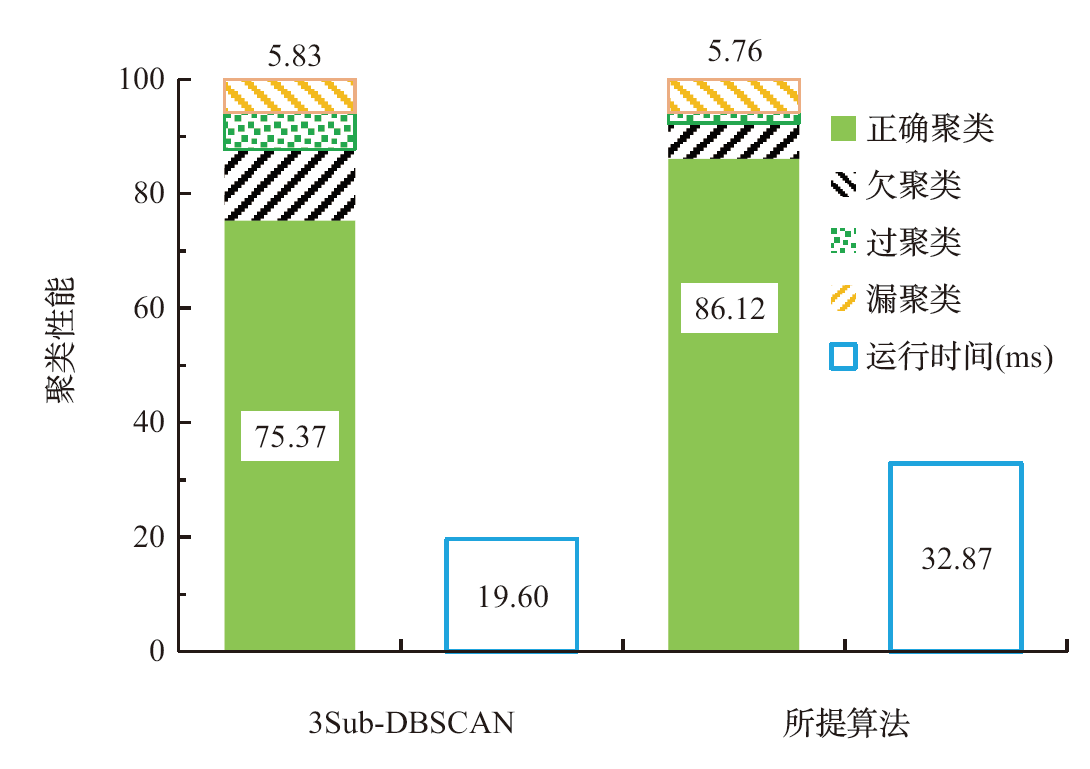
激光雷达在自动驾驶系统的目标检测任务中发挥着重要作用,但其扫描机理会使得点云分布不均匀,常规聚类算法由于参数固定会导致较多的错误聚类。为解决该问题,该文以椭圆形状作为邻域空间,设计基于采样点位置的邻域自适应调整策略,提出一种基于目标点云分布特性的动态聚类算法。通过正确聚类、过聚类等综合结果评估算法的性能,在KITTI数据集上进行了数值分析得到算法参数,并在校园环境中进行了实车对比实验。结果表明:所提算法能减少基于密度的噪声应用空间聚类(DBSCAN)中固定邻域所造成的70.60%过聚类、49.76%欠聚类等错误结果,从而有效提高算法的综合聚类性能。
中图分类号:
李彩虹, 何晨阳, 高锋, 陈佳欣. 一种基于目标点云分布特性的动态聚类算法[J]. 汽车安全与节能学报, 2024, 15(2): 261-267.
LI Caihong, HE Chenyang, GAO Feng, CHEN Jiaxin. A dynamic clustering algorithm based on the point clouds distribution characteristics of obstacle[J]. Journal of Automotive Safety and Energy, 2024, 15(2): 261-267.
| [1] | GAO Feng, HAN Yu, LI Shengbo, et al. Accurate pseudospectral optimization of nonlinear model predictive control for high-performance motion planning[J]. IEEE Trans Intel Vehi, 2023, 8(2): 1034-1045. |
| [2] |
Jebamikyous H H, Kashef R. Autonomous vehicles perception (AVP) using deep learning: modeling, assessment, and challenges[J]. IEEE Access, 2022, 10: 10523-10535.
doi: 10.1109/ACCESS.2022.3144407 URL |
| [3] |
Alaba S Y, Ball J E. A Survey on deep-learning-based LiDAR 3D object detection for autonomous driving[J]. Sensors, 2022, 22(24): 9577.
doi: 10.3390/s22249577 URL |
| [4] | LI You, Ibanez-guzman J. Lidar for autonomous driving: The principles, challenges, and trends for automotive lidar and perception systems[J]. IEEE Sign Proc Maga, 2020, 37(4): 50-61. |
| [5] | XIE Yuxing, TIAN Jiaojiao, ZHU Xiaoxiang. Linking points with labels in 3D: A review of point cloud semantic segmentation[J]. IEEE Geosci Remo Sens Maga, 2020, 8(4): 38-59. |
| [6] |
SUN Pengpeng, SUN Chenghao, WAN Lingfeng, et al. Objects detection with 3-D roadside LIDAR under snowy weather[J]. IEEE Sens J, 2022, 22(23): 23051-23063.
doi: 10.1109/JSEN.2022.3215768 URL |
| [7] | SU Hang, Maji S, Kalogerakis E, et al. Multi-view convolutional neural networks for 3D shape recognition[C]// 2015 IEEE Int’l Conf Comp Visi (ICCV). Santiago, Chile. 2015. |
| [8] | Lang A H, Vora S, Caesar H, et al. Pointpillars: Fast encoders for object detection from point clouds[C] // 2019 IEEE/CVF Conf Comp Visi Patt Recog (CVPR). California, USA. 2019. |
| [9] | DENG Jiajun, SHI Shaoshuai, LI Peiwei, et al. Voxel R-CNN: Towards high performance voxel-based 3D object detection[J]. Proceed AAAI Conf Artif Intel, 2021, 35(2): 1201-1209. |
| [10] |
YAN Yan, MAO Yuxing, LI Bo. SECOND: Sparsely embedded convolutional detection[J]. Sensors, 2018, 18(10): 3337.
doi: 10.3390/s18103337 URL |
| [11] | SHI Weijing, Ragunathan, Rajkumar. Point-GNN: Graph neural network for 3D object detection in a point cloud[C]// 2020 IEEE/CVF Conf Comp Visi Patt Recog (CVPR). Washington, USA. 2020. |
| [12] | YANG Honghui, LIU Zili, WU Xiaopei, et al. Graph R-CNN: Towards accurate 3D object detection with semantic-decorated local graph[C]// Comp Visi-ECCV 2022: 17th European Conf. Tel Aviv, Israel. 2022. |
| [13] | ZHENG Wu, TANG Weiliang, JIANG Li, et al. SE-SSD: Self-ensembling single-stage object detector from point cloud[C]// Proceed IEEE/CVF Conf Comp Visi Patt Recog. 2021: 14494-14503. |
| [14] | ZHANG Linfeng, DONG Runpei, TAI Hung-Shuo, et al. Pointdistiller: Structured knowledge distillation towards efficient and compact 3d detection[C]// Proceed IEEE/CVF Conf Comp Visi Patt Recog. Vancouver, BC, Canada, 2023. |
| [15] | Qi C R, SU Hao, MO Kaichun, et al. PointNet: Deep learning on point sets for 3D classification and segmentation[C]// 2017 IEEE Conf Comp Visi Patt Recog (CVPR), Hawaii, USA. 2017. |
| [16] | Rahman M M, TAN Yanhao, XUE Jian, et al. Notice of violation of IEEE publication principles: Recent advances in 3D object detection in the era of deep neural networks: A survey[J]. IEEE Trans Imag Proce, 2020, 29: 2947-2962. |
| [17] |
GUO Ente, CHEN Zhifeng, Rahardja S, et al. 3D Detection and pose estimation of vehicle in cooperative vehicle infrastructure system[J]. IEEE Sens J, 2021, 21(19): 21759-21771.
doi: 10.1109/JSEN.2021.3101497 URL |
| [18] | LI Xinggang, ZHANG Yaping, YANG Yuwei. Outlier detection for reconstructed point clouds based on image[C]// 2017 First Int’l Conf Elect Instrum Info Syst. Harbin, China. 2017. |
| [19] | ZHANG Zhengyu, JIN Mengdi. AOMC: An adaptive point cloud clustering approach for feature extraction[J]. Scientific Programming, 2022, 2022: e3744086. |
| [20] |
SONG Yanjie, ZHANG Han, LIU Yuanqiang, et al. Background filtering and object detection with a stationary LiDAR using a layer-based method[J]. IEEE Access, 2020, 8: 184426-184436.
doi: 10.1109/Access.6287639 URL |
| [21] | WU Jianqing, XU Hao, ZHENG Jianying, et al. Automatic vehicle detection with roadside LiDAR data under rainy and snowy conditions[J]. IEEE Intel Transport Syst Maga, 2021, 13(1): 197-209. |
| [22] |
ZHAO Junxuan, XU Hao, LIU Hongchao, et al. Detection and tracking of pedestrians and vehicles using roadside LiDAR sensors[J]. Transport Res Part C: Emerg Tech, 2019, 100: 68-87.
doi: 10.1016/j.trc.2019.01.007 URL |
| [23] | CHIANG Yenhung, HSU Chihming, Tsai A. Fast multi-resolution spatial clustering for 3D point cloud data[C]// 2019 IEEE Int’l Conf Syst, Man Cybe (SMC). Bari, Italy. 2019. |
| [24] |
JIANG Wuhua, SONG Chuanzheng, WANG Hai, et al. Obstacle detection by autonomous vehicles: An adaptive neighborhood search radius clustering approach[J]. Machines, 2023, 11(1): 54.
doi: 10.3390/machines11010054 URL |
| [25] |
CHEN Jingrong, XU Hao, WU Jianqing, et al. Deer crossing road detection with roadside LiDAR sensor[J]. IEEE Access, 2019, 7: 65944-65954.
doi: 10.1109/ACCESS.2019.2916718 |
| [26] |
CHEN Xiao, CHEN Zhuang, LIU Guoxiang, et al. Railway overhead contact system point cloud classification[J]. Sensors, 2021, 21(15): 4961.
doi: 10.3390/s21154961 URL |
| [27] | Athanesious J J, Vasuhi S, Vaidehi V, et al. Adaptive density based data mining technique for detection of abnormalities in traffic video surveillance[J]. J Intel Fuzz Syst, 2020, 39(3): 3737-3747. |
| [28] |
LIU Kaiqi, WANG Jianqiang. Fast dynamic vehicle detection in road scenarios based on pose estimation with convex-Hull model[J]. Sensors, 2019, 19(14): 3136.
doi: 10.3390/s19143136 URL |
| [29] | MENG Qinghao, WANG Wenguan, ZHOU Tianfei, et al. Towards a weakly supervised framework for 3D point cloud object detection and annotation[J]. IEEE Trans Patt Anal Mach Intel, 2022, 44(8): 4454-4468. |
| [30] | Geiger A, Lenz P, Stiller C, et al. Vision meets robotics: The KITTI dataset[J]. Int’l J Robot Res, 2013, 32(11): 1231-1237. |
| [31] |
JIN Xianjian, YANG Hang, LIAO Xin, et al. A robust gaussian process-based LiDAR ground segmentation algorithm for autonomous driving[J]. Machines, 2022, 10(7): 507.
doi: 10.3390/machines10070507 URL |
| [32] | Laghmara H, Laurain T, Cudel C, et al. 2.5D evidential grids for dynamic object detection[C]// 2019 22th Int’l Conf Info Fusion (FUSION). Ontario, Canada. 2019. |
| [33] | SONG Weilong, XIONG Guangming, CHEN Huiyan. Intention-aware autonomous driving decision-making in an uncontrolled intersection[J]. Math Prob Engi, 2016, 2016: 1-15. |
| [34] | Intempora. RTMaps [/OL]. 2023. [2023-01-03]. https://intempora.com/products/rtmaps/. |
| [1] | 潘玉恒, 任晨, 鲁维佳, 李洋. 基于双重池化注意力机制和竖直特征融合的DV-PointPillars三维目标检测模型[J]. 汽车安全与节能学报, 2025, 16(5): 793-801. |
| [2] | 高超俊, 李祎承, 蔡英凤, 王海, 蒋金. 基于融合感知的自动驾驶汽车AEB控制研究[J]. 汽车安全与节能学报, 2025, 16(4): 629-637. |
| [3] | 程瑞, 卢春成, 袁泉, 崔涛, 王涛. 基于自组织K-means的城市道路VRU事故场景复杂度评价[J]. 汽车安全与节能学报, 2025, 16(3): 386-395. |
| [4] | 邹铁方, 付玺郡, 李艳春. 基于投影警示的智能汽车分级预警制动系统[J]. 汽车安全与节能学报, 2025, 16(3): 405-413. |
| [5] | 石丽英, 周国峰, 李泽星, 曹莉凌. 基于3DSSD的差异路口自适应联邦学习算法[J]. 汽车安全与节能学报, 2024, 15(5): 732-741. |
| [6] | 黄晨, 贾丁鹏, 孙晓强, 许庆. 基于周边车辆轨迹预测的智能汽车路径规划[J]. 汽车安全与节能学报, 2024, 15(5): 753-762. |
| [7] | 张晨, 刘畅, 赵津, 王广玮, 许庆. 基于多尺度注意力机制的实时激光雷达点云语义的分割[J]. 汽车安全与节能学报, 2024, 15(4): 591-601. |
| [8] | 段京良, 陈良发, 王文轩, 焦春绚, 刘征宇, 马飞, 李升波. 智能汽车主动避撞工况的高实时预测控制[J]. 汽车安全与节能学报, 2023, 14(5): 580-590. |
| [9] | 朱波, 张纪伟, 谈东奎, 胡旭东. 基于多源传感器与导航地图的端到端自动驾驶方法[J]. 汽车安全与节能学报, 2022, 13(4): 738-749. |
| [10] | 李文礼, 肖凯文, 任勇鹏, 李超, 易帆. 行人过街场景下车辆避障路径规划与控制方法[J]. 汽车安全与节能学报, 2022, 13(3): 489-501. |
| [11] | 赵树恩, 陈文斌, 邓召学, 刘伟. 基于扩张状态观测器的智能汽车弯道轨迹跟踪控制[J]. 汽车安全与节能学报, 2022, 13(1): 112-121. |
| [12] | 王海, 徐岩松, 蔡英凤, 陈龙. 基于多传感器融合的智能汽车多目标检测技术综述[J]. 汽车安全与节能学报, 2021, 12(4): 440-455. |
| [13] | 采国顺, 刘昊吉, 冯吉伟, 徐利伟, 殷国栋. 智能汽车的运动规划与控制研究综述[J]. 汽车安全与节能学报, 2021, 12(3): 279-297. |
| [14] | 李亮, 王翔宇, 程硕, 陈翔, 黄超, 平先尧, 魏凌涛. 汽车底盘线控与动力学域控制技术[J]. 汽车安全与节能学报, 2020, 11(2): 143-160. |
| [15] | 申恩恩,胡玉梅,陈光,罗攀,朱浩. 智能驾驶实时目标检测的深度卷积神经网络[J]. JASE, 2020, 11(1): 111-116. |
| 阅读次数 | ||||||
|
全文 |
|
|||||
|
摘要 |
|
|||||
