欢迎访问《汽车安全与节能学报》,

汽车安全与节能学报 ›› 2026, Vol. 17 ›› Issue (3): 359-368.DOI: 10.3969/j.issn.1674-8484.2026.03.008
王建强1( ), 操建中1, 童婷1, 王锋2
收稿日期:2026-01-07
修回日期:2026-04-05
出版日期:2026-06-30
发布日期:2026-07-02
作者简介:王建强(1980—),男(汉),山东,教授。E-mail:xinxiwjq@126.com。
基金资助:
WANG Jianqiang1(), CAO Jianzhong1, TONG Ting1, WANG Feng2
Received:2026-01-07
Revised:2026-04-05
Online:2026-06-30
Published:2026-07-02
摘要:
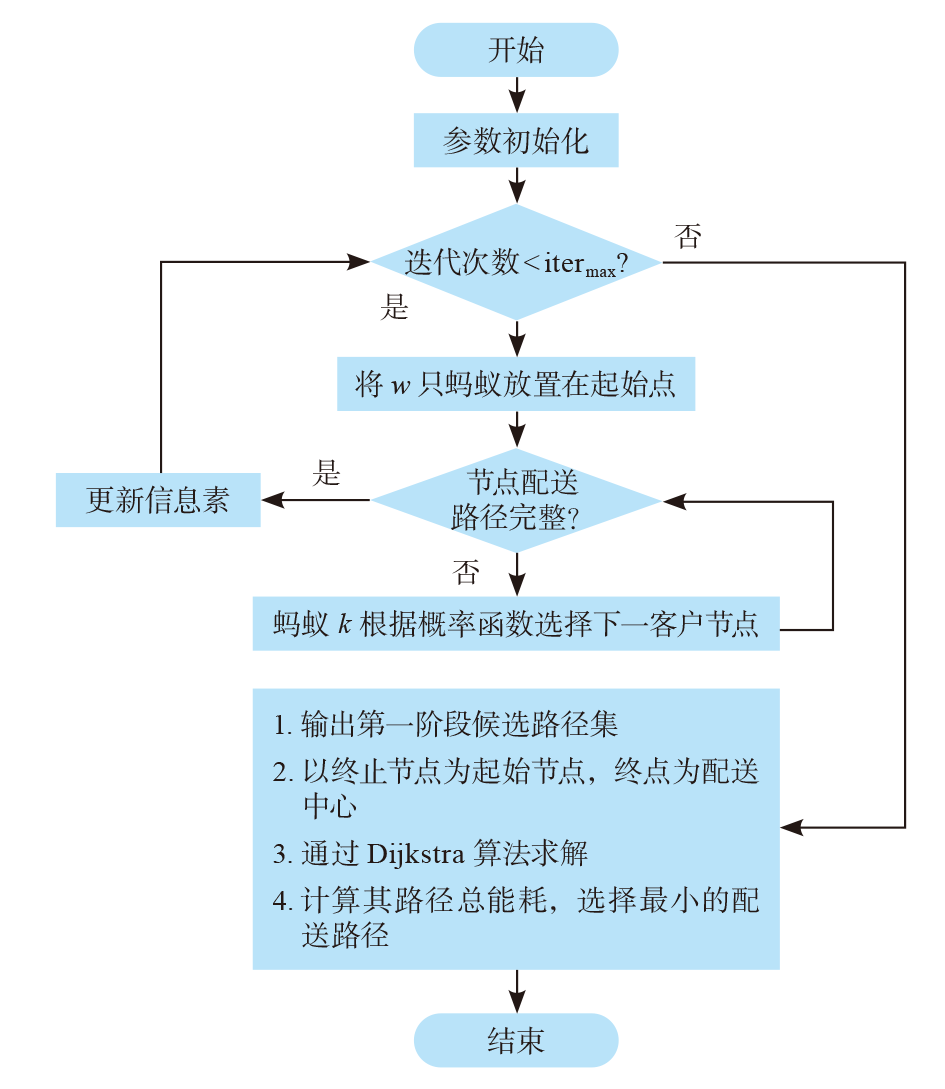
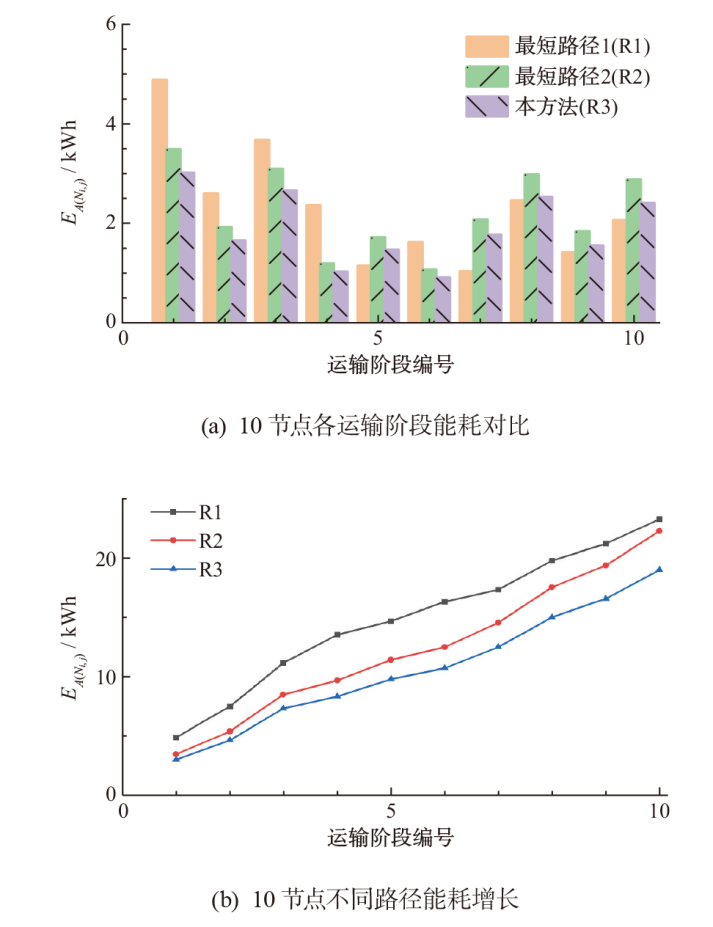
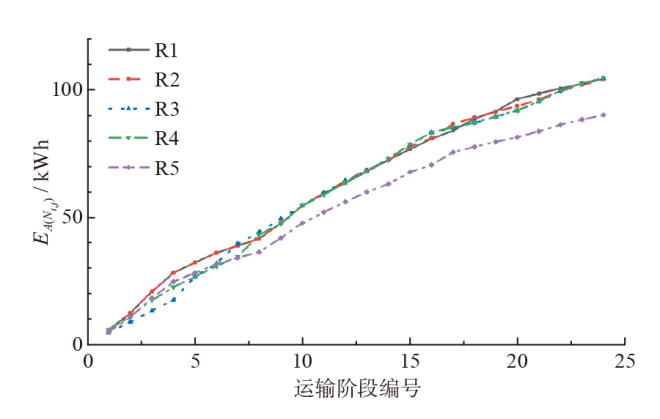
为优化物流配送电动车能耗问题,提出一种质量载荷—速度耦合驱动的节能时空路径规划方法。构建了载荷-空间-时间状态网络,来描述车辆配送时空路径;融合“综合功率能耗模型(CPEM)”建立弧段能耗,通过解析能耗与速度的函数关系,动态确定不同载荷下的最优经济车速。提出一种“蚁群搜索+ Dijkstra寻优”的 2 阶段分解路径搜索策略,解决复杂配送阶段的候选路径搜索与返程阶段的精确路径能耗寻优问题。在 10 节点及Sioux Falls 24 节点网络上展开仿真实验。结果表明:在等距条件下,相较于其他路径,本方法得出的路径能耗降低约 7%;与传统最短路径策略相比,整体配送能耗降幅达 13%~16%。
中图分类号:
王建强, 操建中, 童婷, 王锋. 载荷-车速耦合下物流配送电动车节能时空路径规划[J]. 汽车安全与节能学报, 2026, 17(3): 359-368.
WANG Jianqiang, CAO Jianzhong, TONG Ting, WANG Feng. Spatiotemporal path planning for energy saving of logistics delivery electric vehicles under load-speed coupling[J]. Journal of Automotive Safety and Energy, 2026, 17(3): 359-368.
| 车辆净质量,m0 | 1.8 t |
|---|---|
| 空气阻力因数,CD | 0.28 |
| 受风横截面积,Across | 2.332 m2 |
| 空气密度,ρa | 1.2 kg·m-3 |
| 滑动阻力因数,μ | 0.01 |
| 车况阻力因数,c1 | 0.0328 |
| 轮胎阻力因数,c2 | 4.575 |
| 电池效率,ηb | 92% |
| 最大迭代次数,itermax | 100 |
| 蚂蚁数量,w | 50 |
| 挥发因数,ψ | 0.3 |
| 信息素因子,α | 1 |
| 启发函数因子,β | 7 |
| 信息素强度,Q | 1 |
| 车辆净质量,m0 | 1.8 t |
|---|---|
| 空气阻力因数,CD | 0.28 |
| 受风横截面积,Across | 2.332 m2 |
| 空气密度,ρa | 1.2 kg·m-3 |
| 滑动阻力因数,μ | 0.01 |
| 车况阻力因数,c1 | 0.0328 |
| 轮胎阻力因数,c2 | 4.575 |
| 电池效率,ηb | 92% |
| 最大迭代次数,itermax | 100 |
| 蚂蚁数量,w | 50 |
| 挥发因数,ψ | 0.3 |
| 信息素因子,α | 1 |
| 启发函数因子,β | 7 |
| 信息素强度,Q | 1 |
| 实验组 | 权重参数ai取值(a1-a17) | 最低能耗路径(C0-C9) |
|---|---|---|
| 1 | 9-3-6-10-3-7-9-8-7-5-6-12-5-4-8-9-7 | C0-C3-C4-C5-C2-C1-C6-C7-C8-C9-C4-C3-C0 |
| 2 | 9-10-5-4-5-7-5-4-8-10-6-8-5-4-9-6-2 | C0-C3-C4-C9-C8-C5-C7-C6-C1-C2-C0 |
| 3 | 5-13-14-14-14-6-13-7-14-14-15-8-6-5-10-9-11 | C0-C1-C2-C3-C4-C9-C8-C7-C5-C6-C4-C0 |
| 4 | 20-18-18-17-20-12-16-9-10-20-10-10-13-7-8-18-10 | C0-C3-C4-C9-C8-C5-C7-C6-C1-C2-C0 |
| 5 | 19-10-16-8-14-10-11-18-13-10-11-9-15-12-13-16-12 | C0-C3-C2-C1-C6-C7-C8-C9-C4-C5-C2-C0 |
| 实验组 | 权重参数ai取值(a1-a17) | 最低能耗路径(C0-C9) |
|---|---|---|
| 1 | 9-3-6-10-3-7-9-8-7-5-6-12-5-4-8-9-7 | C0-C3-C4-C5-C2-C1-C6-C7-C8-C9-C4-C3-C0 |
| 2 | 9-10-5-4-5-7-5-4-8-10-6-8-5-4-9-6-2 | C0-C3-C4-C9-C8-C5-C7-C6-C1-C2-C0 |
| 3 | 5-13-14-14-14-6-13-7-14-14-15-8-6-5-10-9-11 | C0-C1-C2-C3-C4-C9-C8-C7-C5-C6-C4-C0 |
| 4 | 20-18-18-17-20-12-16-9-10-20-10-10-13-7-8-18-10 | C0-C3-C4-C9-C8-C5-C7-C6-C1-C2-C0 |
| 5 | 19-10-16-8-14-10-11-18-13-10-11-9-15-12-13-16-12 | C0-C3-C2-C1-C6-C7-C8-C9-C4-C5-C2-C0 |
| 客户编号 | 配送量/ kg | 寄取量/ kg | 客户编号 | 配送量/ kg | 寄取量/ kg |
|---|---|---|---|---|---|
| 0 | 0 | 0 | 12 | 180 | 24 |
| 1 | 234 | 20 | 13 | 100 | 8 |
| 2 | 120 | 0 | 14 | 167 | 30 |
| 3 | 265 | 25 | 15 | 210 | 14 |
| 4 | 239 | 10 | 16 | 177 | 0 |
| 5 | 160 | 30 | 17 | 193 | 12 |
| 6 | 150 | 5 | 18 | 134 | 20 |
| 7 | 210 | 5 | 19 | 289 | 18 |
| 8 | 130 | 35 | 20 | 204 | 6 |
| 9 | 140 | 15 | 21 | 137 | 25 |
| 10 | 200 | 26 | 22 | 275 | 8 |
| 11 | 150 | 19 | 23 | 169 | 0 |
| 客户编号 | 配送量/ kg | 寄取量/ kg | 客户编号 | 配送量/ kg | 寄取量/ kg |
|---|---|---|---|---|---|
| 0 | 0 | 0 | 12 | 180 | 24 |
| 1 | 234 | 20 | 13 | 100 | 8 |
| 2 | 120 | 0 | 14 | 167 | 30 |
| 3 | 265 | 25 | 15 | 210 | 14 |
| 4 | 239 | 10 | 16 | 177 | 0 |
| 5 | 160 | 30 | 17 | 193 | 12 |
| 6 | 150 | 5 | 18 | 134 | 20 |
| 7 | 210 | 5 | 19 | 289 | 18 |
| 8 | 130 | 35 | 20 | 204 | 6 |
| 9 | 140 | 15 | 21 | 137 | 25 |
| 10 | 200 | 26 | 22 | 275 | 8 |
| 11 | 150 | 19 | 23 | 169 | 0 |
| [1] | HAN Bing, YAN Yifan, CHI Tianze, et al. The electric vehicle routing problem with travel time and energy consumption uncertainty[J]. Transport Res Part E: Logist Transport Rev, 2025, 202: Paper No 104211. |
| [2] | 孙超, 刘波, 孙逢春. 新能源汽车节能规划与控制技术研究综述[J]. 汽车安全与节能学报, 2022, 13(4): 593-616. |
| SUN Chao, LIU Bo, SUN Fengchun. Review of energy-saving planning and control technology fornew energy vehicles[J]. J Autom Safe Energ, 2022, 13(4): 593-616. (in Chinese) | |
| [3] | CHEN Xirong, WANG Jinrun, DENG Haowei, et al. Shortest path planning in multimodal metropolitan transportation networks under timetable and label constraints[J]. J Advan Transport, 2025, 2025(1): 3365603. |
| [4] |
周鲜成, 周开军, 王莉, 等. 物流配送中的绿色车辆路径模型与求解算法研究综述[J]. 系统工程理论与实践, 2021, 41(1): 213-230.
doi: 10.12011/SETP2020-2300 |
| ZHOU Xiancheng, ZHOU Kaijun, WANG Li, et al. Review of green vehicle routing model and its algorithm in logistics distribution[J]. Syst Engi:Theo Pract, 2021, 41(1): 213-230. (in Chinese) | |
| [5] |
姜广田, 纪皎月, 董佳伟. 绿色物流配送下的多车型动态车辆路径优化[J]. 系统工程理论与实践, 2024, 44(7): 2362-2380.
doi: 10.12011/SETP2023-0524 |
| JIANG Guangtian, JI Jiaoyue, DONG Jiawei. Multi-vehicle dynamic vehicle routing optimization in green-logistics distribution[J]. Syst Engi-Theo Prac, 2024, 44(7): 2362-2380. (in Chinese) | |
| [6] | 陈晓峰, 王兰文, 马果, 等. 考虑能耗及稳定性的无人驾驶车辆越野环境路径规划[J]. 汽车安全与节能学报, 2025, 16(3): 496-503. |
| CHEN Xiaofeng, WANG Lanwen, MA Guo, et al. Energy and stability aware path planning for autonomousvehicles in off road environments[J]. J Autom Safe Energ, 2025, 16(3): 496-503. (in Chinese) | |
| [7] | Demir E, Bektaş T, Laporte G. An adaptive large neighbor-hood search heuristic for the pollution-routing problem[J]. Euro J Opera Res, 2012, 223(2): 346-359. |
| [8] | Kramer R, Subramanian A, Vidal T, et al. A matheuristic approach for the pollution-routing problem[J]. Europ J Opera Res, 2015, 243(2): 523-539. |
| [9] |
Franceschetti A, Honhon D, Van Woensel T, et al. The time-dependent pollution-routing problem[J]. Transport Res Part B:Meth, 2013, 56: 265-293.
doi: 10.1016/j.trb.2013.08.008 URL |
| [10] | Franceschetti A, Demir E, Honhon D, et al. A metaheuristic for the time-dependent pollution-routing problem[J]. Euro J Opera Res, 2017, 259(3): 972-991. |
| [11] | Ben A S, Rejeb L, Baati L. Route planning for electric vehicles[J]. IET Intel Transport Syst, 2022, 16(7): 875-889. |
| [12] | ZHANG Shuai, Gajpal Y, Appadoo S S, et al. Electric vehicle routing problem with recharging stations for minimizing energy consumption[J]. Int’l J Prod Econ, 2018, 203: 404-413. |
| [13] |
XIAO Yiyong, ZUO Xiaorong, Kaku I, et al. Development of energy consumption optimization model for the electric vehicle routing problem with time windows[J]. J Clean Prod, 2019, 225: 647-663.
doi: 10.1016/j.jclepro.2019.03.323 |
| [14] |
刘育良, 陈淮莉. 负载影响下纯电动汽车配送路径规划及充电策略[J]. 计算机应用, 2020, 40(10): 2831-2837.
doi: 10.11772/j.issn.1001-9081.2020020157 |
|
LIU Yuliang, CHEN Huaili. Distribution path planning and charging strategy for pure electric vehicles with load constraint[J]. J Comput Appl, 2020, 40(10): 2831-2837. (in Chinese)
doi: 10.11772/j.issn.1001-9081.2020020157 |
|
| [15] |
陈婉茹, 徐光明, 张得志, 等. 碳交易机制下多中心混合车队配送路径和速度优化研究[J]. 系统工程理论与实践, 2023, 43(11): 3320-3335.
doi: 10.12011/SETP2022-2971 |
| CHEN Wanru, XU Guangming, ZHANG Dezhi, et al. Multi-depot mixed fleet routing and speed optimization under acarbon trading mechanism[J]. Syst Engi-Theo Prac, 2023, 43(11): 3320-3335. (in Chinese) | |
| [16] | Cieslik W, Antczak W. Research of load impact on energy consumption in an electric delivery vehicle based on real driving conditions: guidance for electrification of light-duty vehicle fleet[J]. Energies, 2023, 16(2): 775-794. |
| [17] |
LIU Luying, Kotz A, Salapaka A, et al. Impact of time-varying passenger loading on conventional and electrified transit bus energy consumption[J]. Transport Res Rec, 2019, 2673(10): 632-640.
doi: 10.1177/0361198119852337 |
| [18] |
TONG Zheming, GUAN Sheng, ZHANG Qinguo, et al. Data-driven energy efficient speed planning for battery electric industrial vehicles: forklift as a case study[J]. J Clean Prod, 2024, 443: 140923.
doi: 10.1016/j.jclepro.2024.140923 URL |
| [19] |
郑李萍, 王建强, 张玉召, 等. 多时空配送任务驱动的无人车队车辆数优化方法[J]. 计算机应用, 2021, 41(5): 1406-1411.
doi: 10.11772/j.issn.1001-9081.2020081183 |
|
ZHENG Liping, WANG Jianqiang, ZHANG Yuzhao, et al. Vehicle number optimization approach of autonomous vehicle fleet driven by multi-spatio-temporal distribution task[J]. J Comput Appl, 2021, 41(5): 1406-1411. (in Chinese)
doi: 10.11772/j.issn.1001-9081.2020081183 |
|
| [20] |
Fiori C, Ahn K, Rkha H A. Power-based electric vehicle energy consumption model: model development and validation[J]. Appl Energ, 2016, 168: 257-268.
doi: 10.1016/j.apenergy.2016.01.097 URL |
| [21] | BAI Xiangen, LIU Di, XU Xiaofeng. A review of improved methods for ant colony optimization in path planning[J]. J Ship Res, 2024, 68(02): 77-92. |
| [22] | GAO Yucen, LI Zhuoran, HE Jingyu, et al. Algorithms for shortest path tour problem[J]. Theo Comput Sci, 2025: 115428. |
| [23] | ZHU Yazhen, SONG Qing, LI Meng. Multi-AGV multitask collaborative scheduling based on an improved ant colony algorithm[J]. Int’l J Advan Robo Syst, 2025, 22(1): 1312784. |
| [1] | 王越, 段宏伟, 钟薇, 杨路, 何雷, 柴福来, 石晓杨. 融合GoT-SAC的领航—跟随式多车编队路径规划方法[J]. 汽车安全与节能学报, 2026, 17(1): 122-129. |
| [2] | 杨宗儒, 胡韫泽, 刘士琪, 关阳, 吴伟, 刘畅. 停车占位状态估计的分布式主动感知的路径规划[J]. 汽车安全与节能学报, 2026, 17(1): 140-148. |
| [3] | 张炳力, 张智森, 张羊阳, 刘安, 许永华. 基于GA优化与路径扩展启发式采样的BI-RRT*路径规划方法[J]. 汽车安全与节能学报, 2025, 16(6): 923-933. |
| [4] | 代立宏, 金妮妮, 莫宗华, 胡鹏, 万文俊, 刘浩业, 王天友. 基于分段SOC轨迹预测的PHEV分层能量管理策略[J]. 汽车安全与节能学报, 2025, 16(5): 736-746. |
| [5] | 彭千龙, 金别树, 王建强, 王广玮. 考虑车道约束的骨架引导分层自主代客泊车路径规划方法[J]. 汽车安全与节能学报, 2025, 16(5): 784-792. |
| [6] | 李舜酩, 王昌荣, 史文贝. 光储充移动式充电机器人研发综述[J]. 汽车安全与节能学报, 2025, 16(4): 505-520. |
| [7] | 于谦, 郭圆圆, 杨鸣鹏, 张玉婷. 基于跟驰对的CO2排放特性的生态车辆跟驰策略[J]. 汽车安全与节能学报, 2025, 16(4): 577-586. |
| [8] | 陈晓峰, 王兰文, 马果, 张垒, 鲍家定, 景晖. 考虑能耗及稳定性的无人驾驶车辆越野环境路径规划[J]. 汽车安全与节能学报, 2025, 16(3): 496-503. |
| [9] | 匡兴红, 沈佳成. 改进北方苍鹰算法及其在智能汽车路径规划中的应用[J]. 汽车安全与节能学报, 2025, 16(1): 148-158. |
| [10] | 黄郑, 王红星, 杜彪, 高嵩, 高峰. 基于固定机巢的输变配无人机智能巡检方法[J]. 汽车安全与节能学报, 2024, 15(5): 670-679. |
| [11] | 黄晨, 贾丁鹏, 孙晓强, 许庆. 基于周边车辆轨迹预测的智能汽车路径规划[J]. 汽车安全与节能学报, 2024, 15(5): 753-762. |
| [12] | 李玉龙, 谢辉, 宋康. 无人驾驶公交车基于循迹误差观测和目标测量误差观测的避障路径规划算法[J]. 汽车安全与节能学报, 2024, 15(4): 579-590. |
| [13] | 李龙辉, 张甫仁, 黄郅凯, 李雪, 赵浩东, 史亚洲, 孙世政, 赵海波. 水轮型翅片组耦合均温板的多目标及拓扑优化[J]. 汽车安全与节能学报, 2024, 15(2): 208-217. |
| [14] | 孟庆京, 司俊德, 张新钰, 孙弘麟, 王小宇, 荣松松. 基于图搜索的陆空两栖平台3D路径规划算法[J]. 汽车安全与节能学报, 2024, 15(2): 253-260. |
| [15] | 宋泽华, 陈浩, 郭航, 叶芳, 张惟博. 基于蓄热装置辅助的燃料电池电动车供暖系统动态仿真[J]. 汽车安全与节能学报, 2024, 15(1): 54-62. |
| 阅读次数 | ||||||
|
全文 |
|
|||||
|
摘要 |
|
|||||
