Welcome to Journal of Automotive Safety and Energy,

Journal of Automotive Safety and Energy ›› 2026, Vol. 17 ›› Issue (4): 494-502.DOI: 10.3969/j.issn.1674-8484.2026.04.008
• Intelligent Driving and Intelligent Transportation • Previous Articles Next Articles
JIN Bieshu1( ), LIU Xiaobo1, XIAO Zhongkun1, XU Qing2, WANG Guangwei1,*()
Received:2026-05-01
Revised:2026-05-27
Online:2026-08-30
Published:2026-09-01
CLC Number:
JIN Bieshu, LIU Xiaobo, XIAO Zhongkun, XU Qing, WANG Guangwei. Dynamic obstacle avoidance parking trajectory planning method based on spatiotemporal search[J]. Journal of Automotive Safety and Energy, 2026, 17(4): 494-502.
Add to citation manager EndNote|Ris|BibTeX
URL: https://www.journalase.com/EN/10.3969/j.issn.1674-8484.2026.04.008
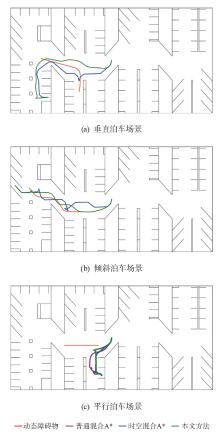
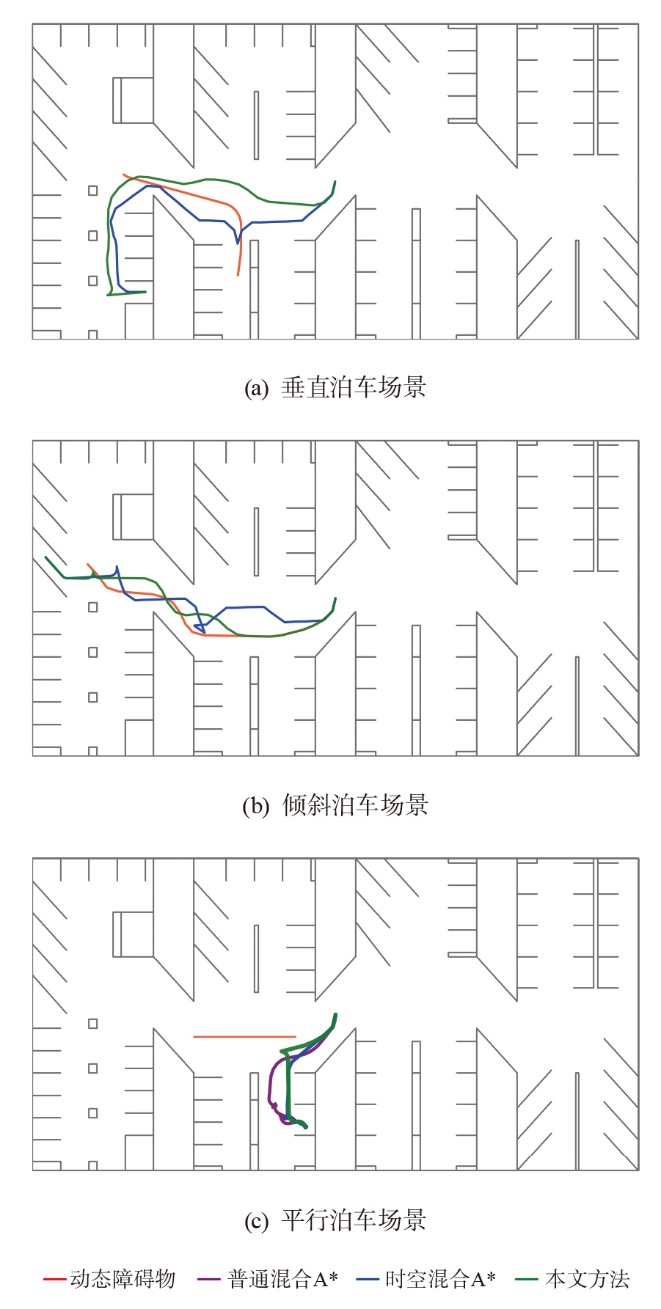
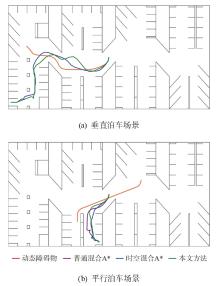
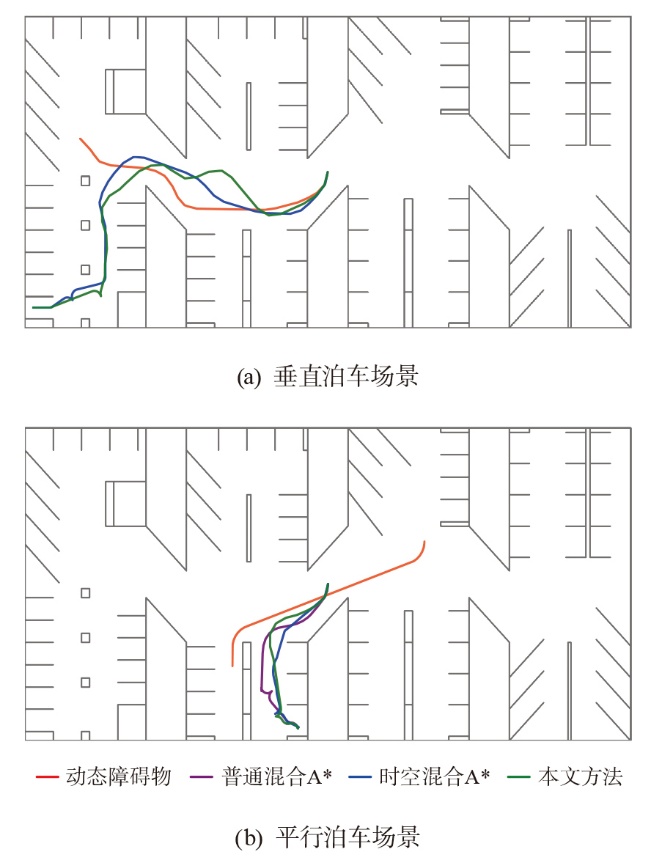
| 泊车 场景 | 方法 | 仿真时间/ s | 路径长度/ m | 换挡次数 |
|---|---|---|---|---|
| 垂直 | 普通混合A* | - | - | - |
| 时空混合A* | 4.03 | 95.69 | 1 | |
| 本文方法 | 1.86 | 92.77 | 1 | |
| 倾斜 | 普通混合A* | - | - | - |
| 时空混合A* | 3.32 | 87.59 | 1 | |
| 本文方法 | 1.43 | 83.79 | 1 | |
| 平行 | 普通混合A* | 6.33 | 49.94 | 8 |
| 时空混合A* | 4.47 | 43.97 | 4 | |
| 本文方法 | 0.61 | 37.71 | 2 |
| 泊车 场景 | 方法 | 仿真时间/ s | 路径长度/ m | 换挡次数 |
|---|---|---|---|---|
| 垂直 | 普通混合A* | - | - | - |
| 时空混合A* | 4.03 | 95.69 | 1 | |
| 本文方法 | 1.86 | 92.77 | 1 | |
| 倾斜 | 普通混合A* | - | - | - |
| 时空混合A* | 3.32 | 87.59 | 1 | |
| 本文方法 | 1.43 | 83.79 | 1 | |
| 平行 | 普通混合A* | 6.33 | 49.94 | 8 |
| 时空混合A* | 4.47 | 43.97 | 4 | |
| 本文方法 | 0.61 | 37.71 | 2 |
| [1] | 刘远志, 王松, 唐辰, 等. 自主泊车轨迹规划技术发展现状综述[J]. 汽车工程学报, 2024, 14(3): 321-335. |
| LIU Yuanzhi, WANG Song, TANG Chen, et al. Review on the development status of autonomous parking trajectory planning technology[J]. J Autom Engi, 2024, 14(3): 321-335. (in Chinese) | |
| [2] | 蒋强, 杨媛斌. 智能立体车库中改进A*算法的AGV路径规划[J]. 重庆理工大学学报(自然科学), 2025, 39(10): 102-108. |
| JIANG Qiang, YANG Yuanbin. AGV path planning in intelligent stereo garage based on improved A* algorithm[J]. J Chongqing Univ Tech (Nat Sci), 2025, 39(10): 102-108. (in Chinese) | |
| [3] | CUI Gaojian, YIN Yuxi, XU Qipei, et al. Efficient path planning for automated valet parking: Integrating hybrid A* search with geometric curves[J]. Int'l J Autom Tech, 2025, 26(1): 243-253. |
| [4] | ZHANG Runda, CHAI Runqi, CHAI Senchun, et al. Design and practical implementation of a high efficiency two-layer trajectory planning method for AGV[J]. IEEE Trans Ind Electron, 2024, 71(2): 1811-1822. |
| [5] | QIN Zhaobo, CHEN Xin, HU Manjiang, et al. A novel path planning methodology for automated valet parking based on directional graph search and geometry curve[J]. Rob Auto Syst, 2020, 132: 103597. |
| [6] | 张家旭, 王志伟, 郭崇, 等. 基于分层架构的自主代客泊车路径规划[J]. 东南大学学报(自然科学版), 2021, 51(5): 883-888. |
| ZHANG Jiaxu, WANG Zhiwei, GUO Chong, et al. Auto-nomous valet parking path planning based on hierarchical architecture[J]. J Southeast Univ (Nat Sci Ed), 2021, 51(5): 883-888. (in Chinese) | |
| [7] | 柏鉴, 徐元浩, 冀杰, 等. 基于图搜索和几何曲线的自主代客泊车路径规划[J]. 重庆理工大学学报(自然科学), 2022, 36(6): 115-125. |
| BAI Jian, XU Yuanhao, JI Jie, et al. Path planning for auto-mated valet parking based on graph search and geometry curves[J]. J Chongqing Univ Tech (Nat Sci), 2022, 36(6): 115-125. (in Chinese) | |
| [8] | 彭千龙, 金别树, 王建强, 等. 考虑车道约束的骨架引导分层自主代客泊车路径规划方法[J]. 汽车安全与节能学报, 2025, 16(5): 784-792. |
| PENG Qianlong, JIN Bieshu, WANG Jianqiang, et al. Skeleton guided hierarchical autonomous valet parking path planning method with lane constraints[J]. J Autom Safe Energ, 2025, 16(5): 784-792. (in Chinese) | |
| [9] | MENG Tianchuang, YANG Tianhong, HUANG Jin, et al. Improved hybrid A-star algorithm for path planning in auto-nomous parking system based on multi-stage dynamic opti-mization[J]. Int'l J Autom Tech, 2023, 24(2): 459-468. |
| [10] | 来飞, 刘俊博, 王清云, 等. 改进Hybrid A*自主泊车路径规划及MPC跟踪控制[J]. 重庆理工大学学报(自然科学), 2025, 39(12): 29-36. |
| LAI Fei, LIU Junbo, WANG Qingyun, et al. Improved hybrid A* autonomous parking path planning and MPC tracking control[J]. J Chongqing Univ Tech (Nat Sci), 2025, 39(12): 29-36. (in Chinese) | |
| [11] | 韩宇谦, 张勇, 李鹏飞, 等. 结合Visibility Graph的自动垂直泊车路径规划[J]. 重庆理工大学学报(自然科学), 2025, 39(10): 58-65. |
| HAN Yuqian, ZHANG Yong, LI Pengfei, et al. Automatic vertical parking path planning based on visibility graph[J]. J Chongqing Univ Tech (Nat Sci), 2025, 39(10): 58-65. (in Chinese) | |
| [12] | 张家旭, 王志伟, 郭崇, 等. 面向动态障碍物场景的自主代客泊车路径规划[J]. 东南大学学报(自然科学版), 2022, 52(2): 369-376. |
| ZHANG Jiaxu, WANG Zhiwei, GUO Chong, et al. Auto-nomous valet parking path planning for dynamic obstacle scene[J]. J Southeast Univ (Nat Sci Ed), 2022, 52(2): 369-376. (in Chinese) | |
| [13] | 谭光兴, 黄磊昌, 李明泽. 基于改进混合A*算法在动态环境中的快速路径规划[J]. 现代电子技术, 2025, 48(19): 136-142. |
| TAN Guangxing, HUANG Leichang, LI Mingze. Dynamic environmental fast path planning based on improved hybrid A* algorithm[J]. Mode Electron Tech, 2025, 48(19): 136-142. (in Chinese) | |
| [14] | 胡杰, 张志豪, 陈瑞楠, 等. 基于改进混合A*的智能汽车时空联合规划方法[J]. 汽车工程, 2023, 45(7): 1123-1133. |
| HU Jie, ZHANG Zhihao, CHEN Ruinan, et al. Spatio-temporal joint planning method for intelligent vehicles based on improved hybrid A*[J]. Autom Engineering, 2023, 45(7): 1123-1133. (in Chinese) | |
| [15] | GUO Jianhua, XIE Zhihao, LIU Ming, et al. Spatio-temporal joint optimization-based trajectory planning method for autonomous vehicles in complex urban environments[J]. Sensors, 2024, 24(14): 4685. |
| [16] | WANG Yebin, Hansen E, Ahn H. Hierarchical planning for autonomous parking in dynamic environments[J]. IEEE Trans Contr Syst Tech, 2024, 32(4): 1386-1398. |
| [17] | WEN Licheng, LIU Yong, LI Hongliang, et al. CL-MAPF: Multi-agent path finding for car-like robots with kinematic and spatiotemporal constraints[J]. Rob Auto Syst, 2022, 150: 103997. |
| [18] | 胡满江, 牟斌杰, 杨泽宇, 等. 基于DBSCAN与二分法的混合A*路径规划方法[J]. 汽车工程, 2023, 45(3): 341-349, 371. |
| HU Manjiang, MU Binjie, YANG Zeyu, et al. A hybrid A* path planning method based on DBSCAN and dichotomy[J]. Autom Engineering, 2023, 45(3): 341-349, 371. (in Chinese) | |
| [19] | Malayjerdi E, Sell R, Malayjerdi M, et al. Practical path planning techniques in overtaking for autonomous shuttles[J]. J Field Rob, 2022, 39(4): 410-425. |
| [1] | FAN Chenxu, GUAN Yongxue, HOU Wenbin, FU Kang, XU Li. Robust trajectory planning for vehicle emergency collision avoidance in spatially constrained scenarios considering perception uncertainty [J]. Journal of Automotive Safety and Energy, 2026, 17(4): 503-510. |
| [2] | CHEN Shi, ZHONG Shaopeng, WU Jianjun, JIANG Qihan, XU Hang, QIU Tianrun. Three-level collaborative optimization control of signal-route-speed for vehicle-road cooperation [J]. Journal of Automotive Safety and Energy, 2026, 17(3): 380-387. |
| [3] | GUAN Yongxue, LIU Senhai, HAN Yong, XU Li, SHU Weibin, FAN Chenxu. A coupled decision-making and trajectory planning approach for vehicle emergency collision avoidance in multi-obstacle scenarios [J]. Journal of Automotive Safety and Energy, 2025, 16(6): 945-954. |
| [4] | PENG Qianlong, JIN bieshu, WANG Jianqiang, WANG Guangwei. Skeleton guided hierarchical autonomous valet parking path planning method with lane constraints [J]. Journal of Automotive Safety and Energy, 2025, 16(5): 784-792. |
| [5] | QIN Yaqin, DONG Shuai, XIE Jiming, CHEN Liang, LIU Yonghua, GUO Miao. Methods for predicting vehicle trajectories in motorway weaving zones based on driving risk fields [J]. Journal of Automotive Safety and Energy, 2024, 15(6): 952-961. |
| [6] | LIU Yang, ZHAN Jiahao, LI Shen, LI Xiaopeng, CHEN Jun. Future of autonomous driving: Single autonomous driving and intelligent vehicle-infrastructure collaboration systems [J]. Journal of Automotive Safety and Energy, 2024, 15(5): 611-633. |
| [7] | SHI Liying, ZHOU Guofeng, LI Zexing, CAO Liling. Adaptive federated learning algorithm for differential intersection based on 3DSSD [J]. Journal of Automotive Safety and Energy, 2024, 15(5): 732-741. |
| [8] | HUANG Pengcheng, PEI Xiaofei, ZHOU Honglong, CHEN Ci. Trajectory planning algorithm of autonomous vehicle based on multi-index coupling [J]. Journal of Automotive Safety and Energy, 2023, 14(4): 480-487. |
| [9] | HONG Ying, SHA Yuchen, DING Fei, CHEN Zhu, ZHANG Dengyin. Resource allocation optimization and performance evaluation for 5G cellular vehicle-to-everything (C-V2X) [J]. Journal of Automotive Safety and Energy, 2023, 14(3): 346-354. |
| [10] | XIU Guotao, XIE Hui, SONG Kang, BI Fengrong. Parallel parking operation model for driverless vehicles based on driver experiences [J]. Journal of Automotive Safety and Energy, 2023, 14(2): 191-201. |
| [11] | HAN Ling, ZHANG Hui, FANG Ruoyu, LIU Guopeng, ZHU Changsheng, CHI Ruifeng. Global path planning strategy based on an improved deep reinforcement learning [J]. Journal of Automotive Safety and Energy, 2023, 14(2): 202-211. |
| [12] | ZHANG Hong, YU Hailiang, ZHENG Zan, YUAN Shengdong, XIONG Guoqiang. Modeling and application of road intersections based on digital twins [J]. Journal of Automotive Safety and Energy, 2023, 14(1): 55-61. |
| [13] | FENG Yao, JING Shoucai, HUI Fei, ZHAO Xiangmo, LIU Jianbei. Deep reinforcement learning-based lane-changing trajectory planning method of intelligent and connected vehicles [J]. Journal of Automotive Safety and Energy, 2022, 13(4): 705-717. |
| [14] | ZHANG Ping, CHEN Yifan, JIANG Shuzhen, HAN Yi. Trajectory planning and tracking control of automatic overtaking process on highway [J]. Journal of Automotive Safety and Energy, 2022, 13(3): 463-472. |
| [15] | ZHOU Qing, JI Peijun, HUANG Yi, et al. Challenges and opportunities of smart occupant protection against motor vehicle collision accidents in future traffic environment [J]. Journal Of Automotive Safety And Energy, 2017, 08(04): 333-350. |
| Viewed | ||||||
|
Full text |
|
|||||
|
Abstract |
|
|||||
