Welcome to Journal of Automotive Safety and Energy,

Journal of Automotive Safety and Energy ›› 2025, Vol. 16 ›› Issue (4): 610-619.DOI: 10.3969/j.issn.1674-8484.2025.04.011
• Intelligent Driving and Intelligent Transportation • Previous Articles Next Articles
OUYANG Delin1( ), QIU Yifan2, WANG Yingchen1, YANG Liang2, MIN Haigen3, WANG Wenjun4, LI Guofa1,*()
Received:2024-12-18
Revised:2025-02-04
Online:2025-08-30
Published:2025-08-27
CLC Number:
OUYANG Delin, QIU Yifan, WANG Yingchen, YANG Liang, MIN Haigen, WANG Wenjun, LI Guofa. End-to-end decision-making model for multi-task autonomous driving[J]. Journal of Automotive Safety and Energy, 2025, 16(4): 610-619.
Add to citation manager EndNote|Ris|BibTeX
URL: https://www.journalase.com/EN/10.3969/j.issn.1674-8484.2025.04.011
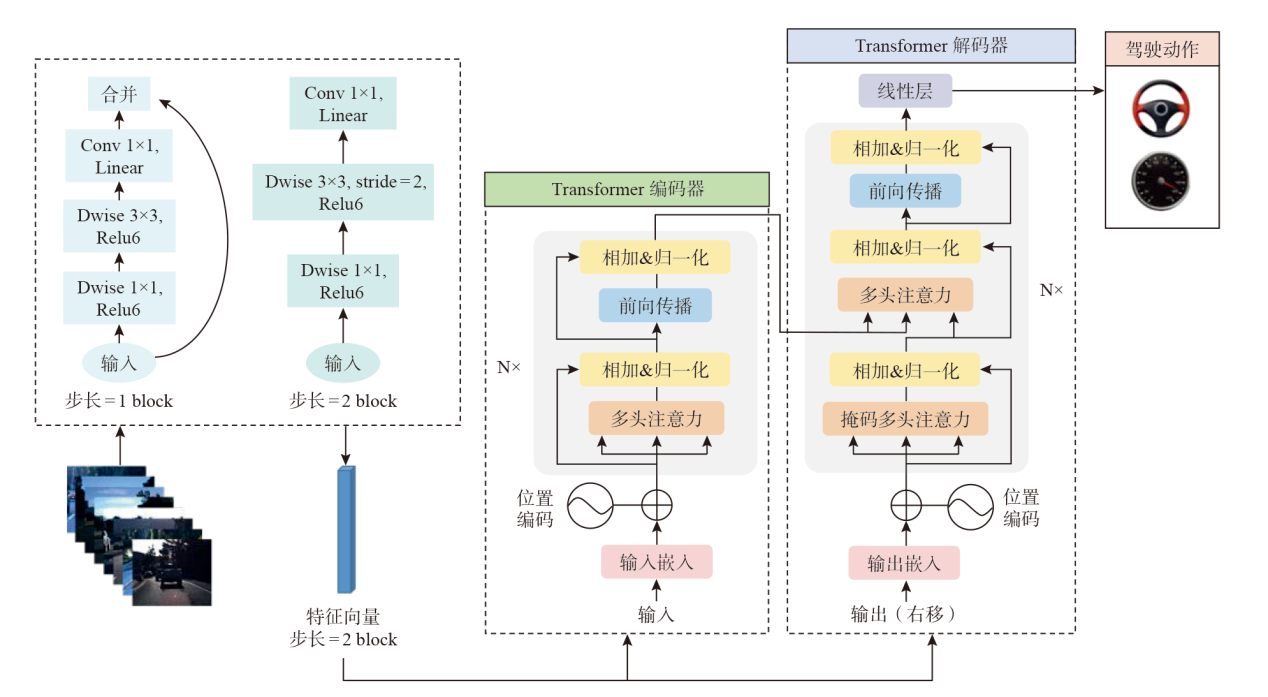
| Operator | t | c | n | s |
|---|---|---|---|---|
| Conv2d 3×3 | - | 16 | 1 | 2 |
| Bottlenecks | 6 | 8 | 1 | 2 |
| Bottlenecks | 6 | 8 | 2 | 2 |
| Bottlenecks | 6 | 16 | 3 | 2 |
| Bottlenecks | 6 | 24 | 4 | 2 |
| Bottlenecks | 6 | 31 | 3 | 1 |
| Bottlenecks | 6 | 56 | 3 | 1 |
| Conv2d 1×1 | 1280 | 1 | 1 | |
| Global Average Pooling | - | - | 1 | - |
| Linear | - | 512 | 1 | 1 |
| Operator | t | c | n | s |
|---|---|---|---|---|
| Conv2d 3×3 | - | 16 | 1 | 2 |
| Bottlenecks | 6 | 8 | 1 | 2 |
| Bottlenecks | 6 | 8 | 2 | 2 |
| Bottlenecks | 6 | 16 | 3 | 2 |
| Bottlenecks | 6 | 24 | 4 | 2 |
| Bottlenecks | 6 | 31 | 3 | 1 |
| Bottlenecks | 6 | 56 | 3 | 1 |
| Conv2d 1×1 | 1280 | 1 | 1 | |
| Global Average Pooling | - | - | 1 | - |
| Linear | - | 512 | 1 | 1 |
| 模型 | 车辆转向角 | 车辆行驶速度 | |||||||
|---|---|---|---|---|---|---|---|---|---|
| MAE / rad | RMSE / rad | AUC | Acc / % | MAE / (km·h-1) | RMSE / (km·h-1) | AUC | Acc / % | ||
| FMNet | 0.129 | 0.214 | 0.893 | 83.78 | - | - | - | - | |
| Swin-Transformer | 0.245 | 0.292 | 0.862 | 78.91 | 2.31 | 2.69 | 0.845 | 80.17 | |
| MobileT-DSM | 0.163 | 0.212 | 0.878 | 81.69 | 1.91 | 2.47 | 0.857 | 83.17 | |
| 3D ST-DSM | 0.119 | 0.148 | 0.897 | 86.32 | 1.77 | 2.38 | 0.868 | 85.36 | |
| 模型 | 车辆转向角 | 车辆行驶速度 | |||||||
|---|---|---|---|---|---|---|---|---|---|
| MAE / rad | RMSE / rad | AUC | Acc / % | MAE / (km·h-1) | RMSE / (km·h-1) | AUC | Acc / % | ||
| FMNet | 0.129 | 0.214 | 0.893 | 83.78 | - | - | - | - | |
| Swin-Transformer | 0.245 | 0.292 | 0.862 | 78.91 | 2.31 | 2.69 | 0.845 | 80.17 | |
| MobileT-DSM | 0.163 | 0.212 | 0.878 | 81.69 | 1.91 | 2.47 | 0.857 | 83.17 | |
| 3D ST-DSM | 0.119 | 0.148 | 0.897 | 86.32 | 1.77 | 2.38 | 0.868 | 85.36 | |
| [1] | Federal Highway Administration. How Do Weather Events Affect Roads? [EB/OL]. [2025-07-22] https://ops.fhwa.dot.gov/weather/roadimpact.htm. |
| [2] | Highway Traffic Safety Administration. Early estimate of motor vehicle traffic fatalities in 2024[R]. Washington DC. U.S. Department of Transportation, 2025, DOT HS 813 710. |
| [3] | Handiso A, Mekebo G G, Galdassa A. Trends and determinants of road traffic accident human death in Kembata Tembaro zone, SNNPR, Ethiopia[J]. Sci J Appl Math Statist, 2022, 10(5): 85-89. |
| [4] | Frédéric V. A rule-based support system for dissonance discovery and control applied to car driving[J]. Expert Syst Appl, 2016, 65(12): 361-371. |
| [5] | LI Liangzhi, OTA Kaoru, DONG Mianxiong. Humanlike driving: Empirical decision-making system for autonomous vehicles[J]. IEEE Trans Vehi Tech, 2018, 67(8): 6814-6823. |
| [6] | CHEN Li, WU Penghao, CHITTA Kashyap, et al. End-to-end autonomous driving: Challenges and frontiers[J]. IEEE Trans Patt Anal Mach Intel, 2024, 46(12): 10164-10183. |
| [7] | LI Guofa, YANG Yifan, QU Xingda, et al. A deep learning-based image enhancement approach for autonomous driving at night[J]. Know-Based Syst, 2021, 213: 106617. |
| [8] | Luca A, Paola B, Silvio B, et al. An end-to-end curriculum learning approach for autonomous driving scenarios[J]. IEEE Trans Intel Transport Syst, 2022, 23(10): 19817-19826. |
| [9] | YI Xianyong, Hakim G, Yehia M. End-to-end neural network for autonomous steering using lidar point cloud data [C]// 2022 IEEE 65th Int’l Midwest Symp Circ Syst (MWSCAS). Fukuoka, Japan, 2022: 1-4. |
| [10] | TENG Siyu, CHEN Long, AI Yunfeng, et al. Hierarchical interpretable imitation learning for end-to-end autonomous driving[J]. IEEE Trans Intel Vehi, 2022, 8(1): 673-683. |
| [11] | Song T-Taek-Jin, Jeong Jongoh, Kim Jong-Hwan. End-to-end real-time obstacle detection network for safe self-driving via multi-task learning[J]. IEEE Trans Intel Transport Syst, 2022, 23(9): 16318-16329. |
| [12] | Youssef M, Abdallah W, Abdel-Halim M, et al. Time fusion net for end-to-end self-driving cars[C]// 2023 5th Novel Intel Lead Emerg Sci Conf (NILES). Giza, Egypt, 2023: 42-47. |
| [13] | ZHOU Wujie, DONG Shaohua, LEI Jingsheng, et al. MTANet: Multitask-aware network with hierarchical multimodal fusion for RGB-T urban scene understanding[J]. IEEE Trans Intel Vehi, 2022, 8(1): 48-58. |
| [14] | LI Guofa, LIN Yongjie, QU Xingda. An infrared and visible image fusion method based on multi-scale transformation and norm optimization[J]. Info Fusion, 2021, 71: 109-129. |
| [15] | Andrew G H, ZHU Menglong, CHEN Bo, et al. Mobilenets: Efficient convolutional neural networks for mobile vision applications[J]. arXiv preprint arXiv: 170404861, 2017. |
| [16] | Maryam Z, Parham M K, Abbas K, et al. A survey of imitation learning: Algorithms, recent developments, and challenges[J]. IEEE Trans Cyber, 2024, 54(12): 7173-7186. |
| [17] | WU Weishang, DENG Xiaoheng, JIANG Ping, et al. Crossfuser: Multi-modal feature fusion for end-to-end autonomous driving under unseen weather conditions[J]. IEEE Trans Intel Transport Syst, 2023, 24(12): 14378-14392. |
| [18] | François C. Xception: Deep learning with depth wise separable convolutions[C]// Proc IEEE Conf Compu Visi Patt Recog. Honolulu, HI, USA, 2017: 1251-1258. |
| [19] | XIANG Qian, WANG Xiaodan, LAI Jie, et al. Quadruplet depth-wise separable fusion convolution neural network for ballistic target recognition with limited samples[J]. Expert Syst Appl, 2024, 235: No 121182. |
| [20] | Mark S, Andrew H, ZHU Menglong, et al. Mobilenetv2: Inverted residuals and linear bottlenecks[C]// Proc IEEE Conf Compu Visi Patt Recog. Salt Lake City, UT, USA, 2018: 4510-4520. |
| [21] | Alex K, Yarin G, Roberto C. Multi-task learning using uncertainty to weigh losses for scene geometry and semantics[C]// Proc IEEE Conf Compu Visi Patt Recog. Salt Lake City, UT, USA, 2018: 7482-7491. |
| [1] | WU Hangzhe, JIAO Yizhou, LIU Yang, ZHONG Wei, WANG Shuihe, GUO Jinghua, ZHAO Jian. Predictive trajectory tracking control by a linear time-varying model for emergency collision avoidance of autonomous vehicles [J]. Journal of Automotive Safety and Energy, 2025, 16(6): 934-944. |
| [2] | CHENG Zeyang, DUAN Yiyang, YANG Mengmeng, FENG Zhongxiang, WANG He, ZHU Xiaojun, BAO Lixia. Recognition of the dangerous driving behaviors and the driving styles in weaving areas based on a hybrid neural network [J]. Journal of Automotive Safety and Energy, 2025, 16(5): 688-697. |
| [3] | ZHENG Xunjia, CAO Zeyi, CHEN Xing, LIU Hui, GAO Jianjie. Trajectory tracking control based on adaptive prediction time-domain MPC [J]. Journal of Automotive Safety and Energy, 2025, 16(5): 773-783. |
| [4] | PAN Yuheng, REN Chen, LU Weijia, LI Yang. DV-PointPillars 3D object detection model based on dual pooling attention mechanism and vertical feature fusion [J]. Journal of Automotive Safety and Energy, 2025, 16(5): 793-801. |
| [5] | LIU Guosheng, SU Xiner, WANG Jianfeng, LIU Zhenwei. Night lane detection method based on deep generation network [J]. Journal of Automotive Safety and Energy, 2025, 16(3): 452-462. |
| [6] | YU Anjun, LI Yingdi, YANG Zheyi, FU Chongyu, TONG Weiping, YU Jia, LIU Yunhai, LIU Zhiyuan. Highway traffic flow prediction approach based on multi-dimensional attention mechanism [J]. Journal of Automotive Safety and Energy, 2025, 16(3): 463-469. |
| [7] | LI Guofa, OUYANG Delin, CHEN Chen, NIE Binging, ZHANG Wei, YU Huili, Liu Bin, ZHANG Qiang, WANG Wenjun, CHENG Bo, LI Shengbo. Review on driving risk monitoring and intervention technologies [J]. Journal of Automotive Safety and Energy, 2025, 16(2): 181-196. |
| [8] | HU Zhilong, PEI Xiaofei, ZHOU Honglong, WEI Weiran. Risk-sensitive hierarchical reinforcement learning decision-making for autonomous vehicles [J]. Journal of Automotive Safety and Energy, 2025, 16(2): 326-333. |
| [9] | YANG Junru, ZHENG Sifa, XU Shucai, TIAN Ye, SUN Jian, SUN Chuan, LI Haoran. Design and research of an automated parking evaluation tool based on the OnSite platform [J]. Journal of Automotive Safety and Energy, 2025, 16(2): 334-343. |
| [10] | LIU Yuqiu, TANG Liang, WANG Ningzhen. Physical adversarial attack on vehicle detection systems [J]. Journal of Automotive Safety and Energy, 2025, 16(1): 50-56. |
| [11] | CAO Liling, LIU Junli, JIN Shengye, CAO Shouqi, ZHOU Guofeng. Design of a remote multidimensional information real time interaction system for autonomous driving [J]. Journal of Automotive Safety and Energy, 2024, 15(6): 934-942. |
| [12] | LIU Yang, ZHAN Jiahao, LI Shen, LI Xiaopeng, CHEN Jun. Future of autonomous driving: Single autonomous driving and intelligent vehicle-infrastructure collaboration systems [J]. Journal of Automotive Safety and Energy, 2024, 15(5): 611-633. |
| [13] | SHI Tianjing, LI Xu. Traffic flow parameter prediction method based on dynamic graphs self-attention [J]. Journal of Automotive Safety and Energy, 2024, 15(5): 680-688. |
| [14] | QU Guangyue, YANG Lan, YUAN Meng, FANG Shan, LIU Songyan. A multimodal trajectory prediction method of pedestrians at signalized intersections for autonomous vehicles [J]. Journal of Automotive Safety and Energy, 2024, 15(5): 689-701. |
| [15] | LIU Peng, ZHAO Kegang, LIANG Zhihao, YE Jie. Vehicle longitudinal speed planning based on deep reinforcement learning CLPER-DDPG [J]. Journal of Automotive Safety and Energy, 2024, 15(5): 702-710. |
| Viewed | ||||||
|
Full text |
|
|||||
|
Abstract |
|
|||||
