Welcome to Journal of Automotive Safety and Energy,

Journal of Automotive Safety and Energy ›› 2024, Vol. 15 ›› Issue (3): 321-328.DOI: 10.3969/j.issn.1674-8484.2024.03.004
• Automotive Safety • Previous Articles Next Articles
CHEN Chun1( ), WANG Chenyu2(), ZHANG Daowen3,4,5,*()
Received:2023-10-27
Revised:2024-01-22
Online:2024-06-30
Published:2024-07-01
CLC Number:
CHEN Chun, WANG Chenyu, ZHANG Daowen. Black spot discrimination method for road traffic accidents based on spatiotemporal combination[J]. Journal of Automotive Safety and Energy, 2024, 15(3): 321-328.
Add to citation manager EndNote|Ris|BibTeX
URL: https://www.journalase.com/EN/10.3969/j.issn.1674-8484.2024.03.004
| 方法 | 优势 | 劣势 | 适用范围 |
|---|---|---|---|
| 事故 率法 | 计算简单;将交通量和道路长度考虑在内,能够判别出交通量小所以事故数小,但风险高的路段,防止将交通量大导致事故数高但风险低的路段错误地判别为事故黑点[ | 临界值的确定较为主观[ | 微观 |
| 质量 控制法 | 计算简单;既考虑交通量,又考虑相似路段的平均事故率。[ | 需要准确的交通量;未考虑事故严重程度;[ | 中观 |
| 核密度分析法 | 生动直观;当交通量数据缺失或质量不高时,有较好的辨识效果[ | 未考虑事故严重程度;未考虑事故在时间维度上的聚集性。 | 中观、微观 |
| 时空重叠率法 | 能够同时描述路段在时空维度上的危险程度。 | 未考虑事故严重程度。 | 中观、微观 |
| 方法 | 优势 | 劣势 | 适用范围 |
|---|---|---|---|
| 事故 率法 | 计算简单;将交通量和道路长度考虑在内,能够判别出交通量小所以事故数小,但风险高的路段,防止将交通量大导致事故数高但风险低的路段错误地判别为事故黑点[ | 临界值的确定较为主观[ | 微观 |
| 质量 控制法 | 计算简单;既考虑交通量,又考虑相似路段的平均事故率。[ | 需要准确的交通量;未考虑事故严重程度;[ | 中观 |
| 核密度分析法 | 生动直观;当交通量数据缺失或质量不高时,有较好的辨识效果[ | 未考虑事故严重程度;未考虑事故在时间维度上的聚集性。 | 中观、微观 |
| 时空重叠率法 | 能够同时描述路段在时空维度上的危险程度。 | 未考虑事故严重程度。 | 中观、微观 |
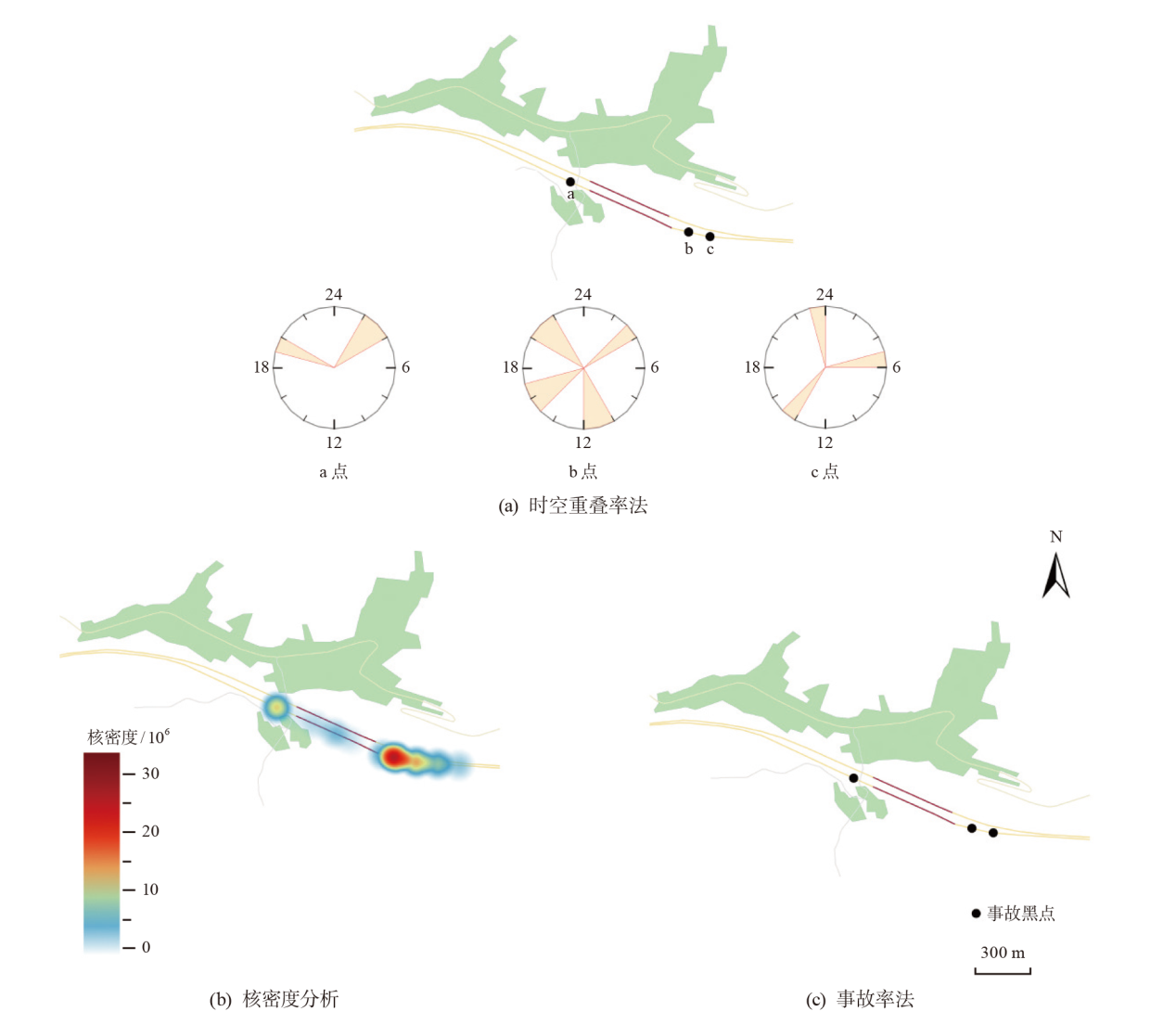
| 方法 | 空间事故黑点 / km | 时间事故黑点 (24 h 时制) | CPAI |
|---|---|---|---|
| 事故频率法 | 79.0~79.1,79.6~79.8 | 3—4、11—12、14—15、20—21、22—24 | 2.29 |
| 累积频率曲线法 | 79.0~79.1,79.6~79.9 | 3—4、11—12、14—15、20—21、22—24 | 2.03 |
| 核密度分析法 | 79.0~79.1,79.6~79.9 | — | 2.03 |
| 时空重叠率法 | 0K-3、0K-2、0K-19、7K-23、6K-15、7K-5、6K-10、 6K-16、6K-3、6K-20、6K-11、6K-21、7K-14 | 2.29 | |
| 方法 | 空间事故黑点 / km | 时间事故黑点 (24 h 时制) | CPAI |
|---|---|---|---|
| 事故频率法 | 79.0~79.1,79.6~79.8 | 3—4、11—12、14—15、20—21、22—24 | 2.29 |
| 累积频率曲线法 | 79.0~79.1,79.6~79.9 | 3—4、11—12、14—15、20—21、22—24 | 2.03 |
| 核密度分析法 | 79.0~79.1,79.6~79.9 | — | 2.03 |
| 时空重叠率法 | 0K-3、0K-2、0K-19、7K-23、6K-15、7K-5、6K-10、 6K-16、6K-3、6K-20、6K-11、6K-21、7K-14 | 2.29 | |
| [1] | 管满泉. 交通事故多发点鉴别方法的比较研究[J]. 公路, 2009(4): 191-195. |
| GUAN Manquan. Comparative study on identification methods of traffic accident-prone points[J]. Highway, 2009(4): 191-195. (in Chinese) | |
| [2] |
冯海霞, 宁二伟, 王琦, 等. 基于GIS的济南市交通事故成因分析[J]. 重庆交通大学学报(自然科学版), 2023, 42(5): 124-131.
doi: 10.3969/j.issn.1674-0696.2023.05.16 |
| FENG Haixia, NING Erwei, WANG Qi, et al. GIS-based analysis of causes of traffic accidents in Jinan[J]. J Chongqing Jiaotong Univ (Nat Sci), 2023, 42(5): 124-131. (in Chinese) | |
| [3] | 程国柱, 刚杰, 程瑞, 等. 公路货运通道路侧事故多发路段判别与线形设计[J]. 哈尔滨工业大学学报, 2022, 54(3): 131-138. |
| CHENG Guozhu, GANG Jie, CHENG Rui, et al. Identification and linear design of accident-prone sections on the roadside of highway freight corridors[J]. J Harbin Inst of Tech, 2022, 54(3): 131-138. (in Chinese) | |
| [4] | WANG Fu, WANG Jing, ZHANG Xianfeng, et al. Analysis of the causes of traffic accidents and identification of accident-prone points in long downhill tunnel of mountain expressways based on data mining[J]. Sustainability, 2022, 14(14): No 8460. |
| [5] | 耿超, 彭余华. 基于动态分段和DBSCAN算法的交通事故黑点路段鉴别方法[J]. 长安大学学报(自然科学版), 2018, 38(5): 131-138. |
| GENG Chao, PENG Yuhua. Traffic accident black spot roadway identification method based on dynamic segmentation and DBSCAN algorithm[J]. J Chang'an Univ (Nat Sci Ed), 2018, 38(5): 131-138. (in Chinese) | |
| [6] |
张云菲, 张泽旭, 朱芳琪. 利用时空密度聚类的高速公路交通事故黑点路段鉴别[J]. 测绘通报, 2022(10): 73-79.
doi: 10.13474/j.cnki.11-2246.2022.0297 |
|
ZHANG Yunfei, ZHANG Zexu, ZHU Fangqi. Identification of highway traffic accident black spot sections using spatio-temporal density clustering[J]. Bull Surv Map, 2022(10): 73-79. (in Chinese)
doi: 10.13474/j.cnki.11-2246.2022.0297 |
|
| [7] |
牛志鹏, 祁首铭, 吴东玲, 等. 考虑系统聚类的公路交通事故多发点鉴别研究[J]. 中国安全科学学报, 2018, 28(11): 104-109.
doi: 10.16265/j.cnki.issn1003-3033.2018.11.017 |
| NIU Zhipeng, QI Shouming, WU Dongling, et al. Research on identification of highway traffic accident-prone points considering systematic clustering[J]. Chin Safe Sci J, 2018, 28(11): 104-109. (in Chinese) | |
| [8] | 郭璘, 周继彪, 董升, 等. 基于改进K-means算法的城市道路交通事故分析[J]. 中国公路学报, 2018, 31(4): 270-279. |
| GUO Lin, ZHOU Jibiao, DONG Sheng, et al. Analysis of urban road traffic accidents based on improved K-means algorithm[J]. Chin J Highway Transp, 2018, 31(4): 270-279. (in Chinese) | |
| [9] | 任毅, 杨仁法, 周继彪, 等. 基于BiLSTM神经网络的交通事故黑点路段日均事故频次预测方法[J]. 交通信息与安全, 2023, 41(2): 36-49. |
| REN Yi, YANG Renfa, ZHOU Jibiao, et al. A daily average accident frequency prediction method for traffic accident black spot roadway based on BiLSTM neural network[J]. J Transp Info Safe, 2023, 41(2): 36-49. (in Chinese) | |
| [10] | 张琦, 陈红, 周继彪, 等. 道路开口对临近交叉口交通安全的影响[J]. 浙江大学学报(工学版), 2021, 55(4): 720-726. |
| ZHANG Qi, CHEN Hong, ZHOU Jibiao, et al. Impact of road openings on traffic safety at adjacent intersections[J]. J Zhejiang Univ (Eng Sci), 2021, 55(4): 720-726. (in Chinese) | |
| [11] | YUAN Tengfei, ZENG Xiaoqing, SHI Tongguang. Identifying urban road black spots with a novel method based on the firefly clustering algorithm and a geographic information system[J]. Sustainability, 2020, 12(5): No 2091. |
| [12] | WANG Dianhai, HUANG Yulang, CAI Zhengyi. A two-phase clustering approach for traffic accident black spots identification: integrated GIS-based processing and HDBSCAN model[J]. Int’l J Injur Contr Safe Prom, 2023, 30(2): 270-281. |
| [13] | 田准, 张生瑞. 优化经验贝叶斯事故黑点识别与排序方法[J]. 长安大学学报(自然科学版), 2019, 39(5): 115-126. |
| TIAN Zhun, ZHANG Shengrui. Optimization of empirical Bayesian accident black spot identification and ranking method[J]. J Chang'an Univ (Nat Sci Ed), 2019, 39(5): 115-126. (in Chinese) | |
| [14] | 曾强, 苏绮琪, 郑嘉仪, 等. 基于贝叶斯时空建模的高速公路事故黑点判别[J]. 交通信息与安全, 2020, 38(6): 87-94. |
| ZENG Qiang, SU Qiqi, ZHENG Jiayi, et al. Discrimination of highway accident black spots based on Bayesian spatio-temporal modeling[J]. J Transp Info Safe, 2020, 38(6): 87-94. (in Chinese) | |
| [15] | LIANG Guohua, SUN Xujiao, ZHANG Yidan, et al. Identifying expressway accident black spots based on the secondary division of road units[J]. Promet-Traff Transp, 2021, 33(5): 731-743. |
| [16] | WAN Yan, HE Wenqiang, ZHOU Jibiao. Urban road accident black spot identification and classification approach: a novel grey verhuls-empirical Bayesian combination method[J]. Sustainability, 2021, 13(20): No 11198. |
| [17] |
王颖志, 王立君. 基于网络时空核密度的交通事故多发点鉴别方法[J]. 地理科学, 2019, 39(8): 1238-1245.
doi: 10.13249/j.cnki.sgs.2019.08.005 |
| WANG Yingzhi, WANG Lijun. A method for identifying traffic accident-prone points based on network spatio-temporal kernel density[J]. Sci Geograph Sinica, 2019, 39(8): 1238-1245. (in Chinese) | |
| [18] |
吴佩洁, 孟祥海, 曹梦迪. 城市交通事故多发点鉴别与时空模式挖掘[J]. 中国安全科学学报, 2020, 30(11): 127-133.
doi: 10.16265/j.cnki.issn 1003-3033.2020.11.019 |
| WU Peijie, MENG Xianghai, CAO Mengdi. Identification and spatio-temporal pattern mining of urban traffic accident-prone points[J]. Chin Safe Sci J, 2020, 30(11): 127-133. (in Chinese) | |
| [19] | 刘戎阳, 郝妍熙, 胡华, 等. 基于泰森多边形的事故多发点识别方法[J]. 中国安全生产科学技术, 2022, 18(11): 26-31. |
| LIU Rongyang, HAO Yanxi, HU Hua, et al. An accident-prone point identification method based on Tyson polygon[J]. J Safe Sci Tech, 2022, 18(11): 26-31. (in Chinese) | |
| [20] | GE Huimin, DONG Lei, HUANG Mingyue, et al. Adaptive kernel density estimation for traffic accidents based on improved bandwidth research on black spot identification model[J]. Electronics, 2022, 11(21): No 3604. |
| [21] | Baranyai D, Sipos T. Black-spot analysis in Hungary based on kernel density estimation[J]. Sustainability, 2022, 14(14): No 8335. |
| [22] | WANG Zhuangzhuang, LU Yining, ZOU Zihao, et al. Applying OHSA to Detect Road Accident Blackspots[J]. Int’l J Envi Res Public Health, 2022, 19(24): No 16970. |
| [23] | Debrabant B, Halekoh U, Bonat W H, et al. Identifying traffic accident black spots with Poisson-Tweedie models[J]. Accid Anal Preve, 2018, 111: 147-154. |
| [24] | Tanprasert T, Siripanpornchana C, Surasvadi N, et al. Recognizing traffic black spots from street view images using environment-aware image processing and neural network[J]. IEEE Access, 2020, 8: 121469-121478. |
| [25] | 张道文. 冯店隧道交通事故特性研究[J]. 道路交通与安全, 2008(4): 46-49. |
| ZHANG Daowen. Traffic Accident Characteristics of Fengdian Tunnel[J]. Road Traff Safe, 2008(4): 46-49. (in Chinese) | |
| [26] | 杨轸, 唐莹, 方守恩. 双曲正切函数在事故黑点鉴别中的应用[J]. 哈尔滨工业大学学报, 2011, 43(10): 143-148. |
| YANG Zhen, TANG Ying, FANG Shouen. Application of hyperbolic tangent function in accident black spot identification[J]. J Harbin Inst Tech, 2011, 43(10): 143-148. (in Chinese) | |
| [27] | 张驰, 周郁茗, 翟艺阳, 等. 公路事故多发路段辨识方法研究综述[J]. 长安大学学报(自然科学版), 2023, 43(5): 72-87. |
| ZHANG Chi, ZHOU Yuming, ZHAI Yiyang, et al. A review of highway accident-prone roadway identification methods[J]. J Chang'an Univ (Nat Sci Ed), 2023, 43(5): 72-87. (in Chinese) | |
| [28] | CUI Hongjun, DONG Jianguo, ZHU Minqing, et al. Identifying accident black spots based on the accident spacing distribution[J]. J Traff Transp Engi (English Ed), 2022, 9(6): 1017-1026. |
| [1] | ZHOU Qianxi, WU Chengcheng, HU Zheng, SHI Liangliang. Strategy decision of man-machine co-driving switching in high-speed operation area based on combination game [J]. Journal of Automotive Safety and Energy, 2025, 16(3): 487-495. |
| [2] | HE Yongming, ZHAO Liyuan, WANG Fan. Aerodynamic characteristics of superhigh speed vehicles under different crosswind conditions superhighways [J]. Journal of Automotive Safety and Energy, 2025, 16(1): 77-85. |
| [3] | ZHANG Chen, WEI Wei, CHEN Jiaxing, MA Zhengwei. Design of pedestrian-safety-island height based on traffic accident reconstruction [J]. Journal of Automotive Safety and Energy, 2024, 15(2): 178-187. |
| [4] | ZHANG Daowen, LI Min, PANG Shaorong, LUO Qirui. Accident causes and its topological hierarchy analysis for heavy-duty trucks and two-wheelers [J]. Journal of Automotive Safety and Energy, 2023, 14(2): 157-164. |
| [5] | CHENG Yufeng, ZOU Tiefang, LI Pingfan. Core risk factors of major guardrail-type traffic accidents based on an integrated DEMATEL/ISM [J]. Journal of Automotive Safety and Energy, 2023, 14(2): 165-172. |
| [6] | XIAO Le, ZHOU Hua, WANG Chaojian, LIU Xin. Influencing factors of vehicle damage degree in vehicle-vehicle collision accident at intersection [J]. Journal of Automotive Safety and Energy, 2023, 14(1): 23-30. |
| [7] | ZHANG Daowen, WANG Chaojian, JIANG Jun, LI Huawei. Analysis of the severity of vehicle to vehicle accidents considering the interaction of factors [J]. Journal of Automotive Safety and Energy, 2022, 13(4): 643-650. |
| [8] | CHEN Jiayong, WU Xinye. Parameter calculation of traffic accidents based on the plastic deformation energy and the improved momentum method [J]. Journal of Automotive Safety and Energy, 2022, 13(3): 446-452. |
| [9] | YUAN Quan, QI Yuerui, YU Di, XU Xuecai. Contributing factors and risky scenario of cyclists’ smart phone using behavior [J]. Journal of Automotive Safety and Energy, 2022, 13(1): 48-54. |
| [10] | ZHANG Daowen, LIU Qi, QIU Jianbing, LIAO Wenjun, MU Yaoyao, JIN Siyu. Influence of pedestrian’s emergency posture on pedestrian injury in vehicle - pedestrian collision [J]. Journal of Automotive Safety and Energy, 2021, 12(4): 456-466. |
| [11] | YUAN Quan, YU Di, XIAO Ruixuan, SHI Yi, WANG Mingzhi. The influence characteristics of pedestrian mental risk image under the interaction of multiple factors [J]. Journal of Automotive Safety and Energy, 2020, 11(4): 511-517. |
| [12] | LI Zhenglei, CHU Duanfeng, HE Yi, LU Liping, WU Chaozhong. Longitudinal control method of cooperative autopilot vehicle platooning considering time delays [J]. Journal of Automotive Safety and Energy, 2020, 11(2): 182-188. |
| [13] | LIU Wenchao, HU Mengxia, WANG Yan, LI Yibing. Quick investigation system in vehicle based on binocular vision for traffic accident scenes [J]. Journal Of Automotive Safety And Energy, 2012, 3(3): 239-244. |
| [14] | YUE Guohui, CHEN Xianling, ZHANG Kai. Case analysis of US NHTSA 2010 version of new car assessment program [J]. Journal Of Automotive Safety And Energy, 2012, 3(2): 129-135. |
| [15] | Bing DENG, Zhentai WANG, Jikuang YANG, Chunyu KONG. Comparison of Pedestrian Accident Scenarios in a Chinese Urban City and in Sweden [J]. Journal of Automotive Safety and Energy, 2010, 1(3): 190-194. |
| Viewed | ||||||
|
Full text |
|
|||||
|
Abstract |
|
|||||
