Welcome to Journal of Automotive Safety and Energy,

Journal of Automotive Safety and Energy ›› 2022, Vol. 13 ›› Issue (4): 676-685.DOI: 10.3969/j.issn.1674-8484.2022.04.009
• Intelligent Driving and Intelligent Transportation • Previous Articles Next Articles
YANG Jinsong1( ), ZHAO Dezong1,3,*(), JIANG Jingjing2, LAN Jianglin1, LI Liang3
Received:2021-07-19
Revised:2022-07-27
Online:2022-12-31
Published:2023-01-01
Contact:
ZHAO Dezong
E-mail:2618741y@student.gla.ac.uk;dezong.zhao@glasgow.ac.uk
Supported by:CLC Number:
YANG Jinsong, ZHAO Dezong, JIANG Jingjing, LAN Jianglin, LI Liang. Two-stage eco-driving control strategy for heterogeneous connected and automated vehicle platoons[J]. Journal of Automotive Safety and Energy, 2022, 13(4): 676-685.
Add to citation manager EndNote|Ris|BibTeX
URL: https://www.journalase.com/EN/10.3969/j.issn.1674-8484.2022.04.009
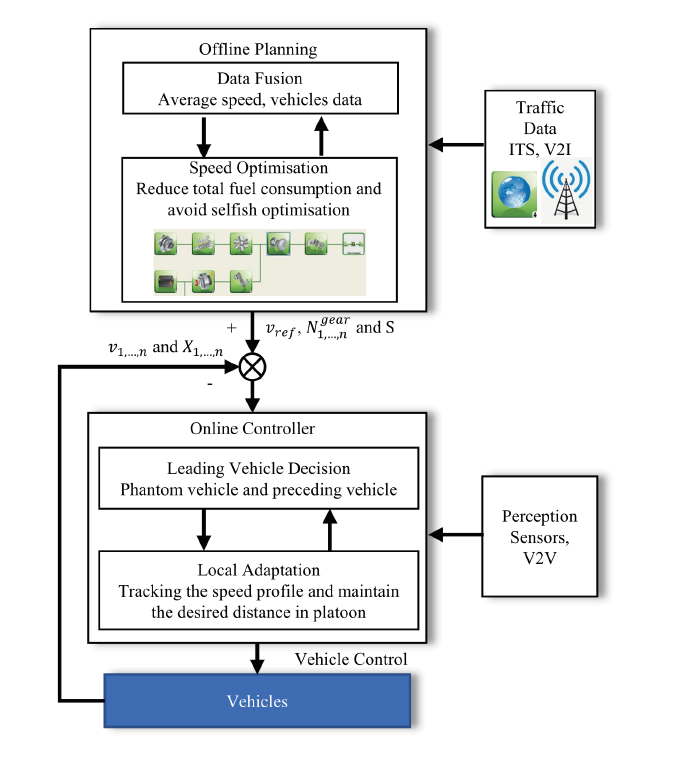
| Step 1: Initialisation 1 k∈{0, 1,…, N-1}, initialise iteration number. 2 xA←[vA, tA]T, generate the vehicle dynamic models (discrete distance-based) Eq. (1) for DP. 3 mf, establish vehicle powertrain models Eq. (4) in DP. 4 Inset each vehicle fuel efficiency map in DP. Step 2: Traffic data fusion 5 vmavg, obtain the future road segments average speed using the ITS. Step 3: Speed optimisation 6 x0A = [vA(0), tA(0)]T, set the initialise state (velocity and position) of the platoon. 7 $\boldsymbol{S}$←{Tω,imin, Tω,imax, amin, amax, vmin, vmax}, set the constraints (Eq. (7)) of the DP. 8 vref←DP(xA, mf, vmavg, x0A), obtain the solution of the minimum cost function (Eq. (6)) using DP and output the reference speed. |
| Step 1: Initialisation 1 k∈{0, 1,…, N-1}, initialise iteration number. 2 xA←[vA, tA]T, generate the vehicle dynamic models (discrete distance-based) Eq. (1) for DP. 3 mf, establish vehicle powertrain models Eq. (4) in DP. 4 Inset each vehicle fuel efficiency map in DP. Step 2: Traffic data fusion 5 vmavg, obtain the future road segments average speed using the ITS. Step 3: Speed optimisation 6 x0A = [vA(0), tA(0)]T, set the initialise state (velocity and position) of the platoon. 7 $\boldsymbol{S}$←{Tω,imin, Tω,imax, amin, amax, vmin, vmax}, set the constraints (Eq. (7)) of the DP. 8 vref←DP(xA, mf, vmavg, x0A), obtain the solution of the minimum cost function (Eq. (6)) using DP and output the reference speed. |
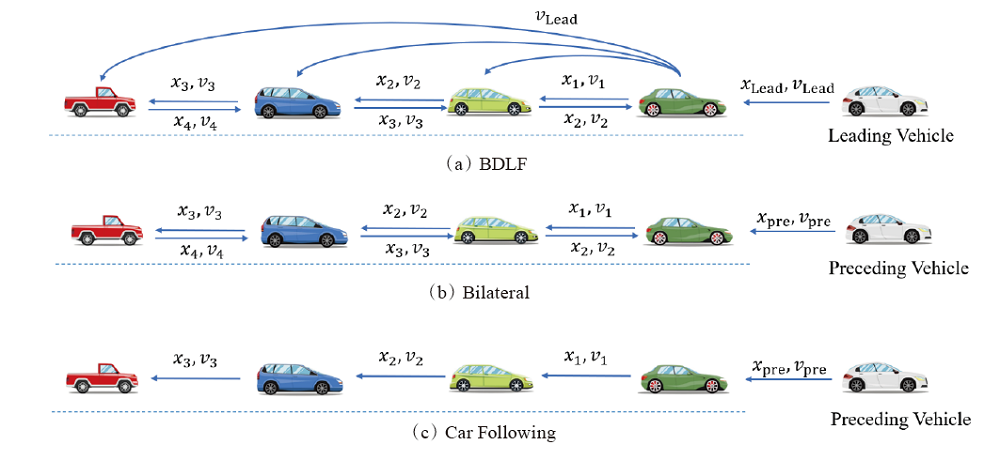
| Step 1: Initialisation 1 k = 0, initialise iteration number. 2 xi←[vi, ti]T, generate the vehicle dynamic models (point-mass model) Eq. (3) for online controller. 3 x0i = [vi(0), ti(0)]T, set the initialise state (velocity and position) of each vehicle. Step 2: Leading vehicle decision 4 Obtain the phantom vehicle state using Eq. (8) and longitudinal position of the first CAV. 5 vled←[vpha, vpre], decide the leading vehicle depended on Eq. (9) and (10). Step 3: Local adaptation 6 $\boldsymbol{S}$←[an(k)≤apreOVM(k), set the constraints (Eq. (13) and (14)) of the local adaptation. 7 Obtain the control input of CAVs i∈{0, 1,…, n-1} and CAV i∈{n} using BDLF (Eq. (11) and (12)). Step 4: Termination condition 8 If k ≥ N, k is equal or larger than the maximum iteration, stop the algorithm. Otherwise, k < N return to Step 2. |
| Step 1: Initialisation 1 k = 0, initialise iteration number. 2 xi←[vi, ti]T, generate the vehicle dynamic models (point-mass model) Eq. (3) for online controller. 3 x0i = [vi(0), ti(0)]T, set the initialise state (velocity and position) of each vehicle. Step 2: Leading vehicle decision 4 Obtain the phantom vehicle state using Eq. (8) and longitudinal position of the first CAV. 5 vled←[vpha, vpre], decide the leading vehicle depended on Eq. (9) and (10). Step 3: Local adaptation 6 $\boldsymbol{S}$←[an(k)≤apreOVM(k), set the constraints (Eq. (13) and (14)) of the local adaptation. 7 Obtain the control input of CAVs i∈{0, 1,…, n-1} and CAV i∈{n} using BDLF (Eq. (11) and (12)). Step 4: Termination condition 8 If k ≥ N, k is equal or larger than the maximum iteration, stop the algorithm. Otherwise, k < N return to Step 2. |
| [1] | Jollands N, Waide P, Ellis M, et al. The 25 IEA energy efficiency policy recommendations to the G8 gleneagles plan of action[J]. Energy Policy, 2010, 38(11): 6409-6418. |
| [2] | 孙万臣, 蒋梦奇. 煤基合成燃料及其在汽车发动机上的应用与技术进展[J]. 汽车安全与节能学报, 2021, 12(1): 1-17. |
| SUN Wanchen, JIANG Mengqi. Coal-based synthetic fuel and its application and technical progress in automobile engines[J]. J Autom Safe Energ, 2021, 12(1): 1-17. (in Chinese) | |
| [3] | HUANG Yuhan, Ng E C, ZHOU John, et al. Eco-driving technology for sustainable road transport: A review[J]. Renew Sustain Energy Rev, 2018, 93: 596-609. |
| [4] | DING Feng, JIN Hui. On the optimal speed profile for eco-driving on curved roads[J]. IEEE Trans Intell Transp Syst, 2018, 19(12): 4000-4010. |
| [5] | TIAN Danyang, WU Guoyuan, Boriboonsomsin K, et al. Performance measurement evaluation framework and co-benefit/tradeoff analysis for connected and automated vehicles (CAV) applications: A Survey[J]. IEEE Intell Transp Syst Mag, 2018, 10(3): 110-122. |
| [6] | Kuutti S, Fallah S, Katsaros K, et al. A survey of the state-of-the-art localization techniques and their potentials for autonomous vehicle applications[J]. IEEE Internet Things J, 2018, 5(2): 829-846. |
| [7] | WANG Ziran, WU Guoyuan, HAO Peng, et al. Developing a platoon-wide eco-cooperative adaptive cruise control (CACC) system[C]// 2017 IEEE Intell Vehi Symp Proc, (IV), 2017: 1256-1261. |
| [8] | LAN Jianglin, ZHAO Dezong. Min-max model predictive vehicle platooning with communication delay[J]. IEEE Trans Vehi Technol, 2020, 69(11): 12570-12584. |
| [9] | MA Fangwu, YANG Yu, WANG Jiawei, et al. Eco-driving-based cooperative adaptive cruise control of connected vehicles platoon at signalized intersections[J]. Transp Res Part D Transp Environ, 2021, 92: 102746. |
| [10] | SUN Chao, Guanetti J, Borrelli F, et al. Optimal eco-driving control of connected and autonomous vehicles through signalized intersections[J]. IEEE Internet Things J, 2020, 7(5): 3759-3773. |
| [11] | ZENG Weiliang, Miwa T, Morikawa T, et al. Eco-routing problem considering fuel consumption and probabilistic travel time budget[J]. Transp Res Part D Transp Environ, 2020, 78: 102219. |
| [12] | SUN Chao, Guanetti J, Borrelli F, et al. Robust eco-driving control of autonomous vehicles connected to traffic lights[R/OL]. arXiv preprint arXiv:1802.05815.201. |
| [13] | SHEN Daliang, Karbowski D, Rousseau A, et al. A minimum principle-based algorithm for energy-efficient eco-driving of electric vehicles in various traffic and road conditions[J]. IEEE Trans Intell Vehi, 2020, 5(4): 725-737. |
| [14] | Moser D, Schmied R, Waschl H, et al. Flexible spacing adaptive cruise control using stochastic model predictive control[J]. IEEE Trans Control Syst Technol, 2017, 26(1): 114-127. |
| [15] | Vajedi M, Azad N L. Ecological adaptive cruise controller for plug-in hybrid electric vehicles using nonlinear model predictive control[J]. IEEE Trans Intell Transp Syst, 2015, 17(1):113-122. |
| [16] | YANG Hao, Rakha H, Ala M V. Eco-cooperative adaptive cruise control at signalized intersections considering queue effects[J]. IEEE Trans Intell Transp Syst, 2016, 18(6): 1575-1585. |
| [17] | Lim H, Mi C C, SU Wencong. A distance-based two-stage ecological driving system using an estimation of distribution algorithm and model predictive control[J]. IEEE Trans Vehi Technol, 2017, 66(8): 6663-6675. |
| [18] | Dehkordi S G, Larue G S, Cholette M E, et al. Ecological and safe driving: A model predictive control approach considering spatial and temporal constraints[J]. Transp Res Part D Transp Environ, 2019, 67: 208-222. |
| [19] | Lim H, SU Wencong, Mi C C. Distance-based ecological driving scheme using a two-stage hierarchy for long-term optimization and short-term adaptation[J]. IEEE Trans Vehi Technol, 2016, 66(3): 1940-1949. |
| [20] | YANG Jingsong, ZHAO Dezong, LAN Jianglin, et al. A less-disturbed ecological driving strategy for connected and automated vehicles[J]. IEEE Trans Intell Vehi, 2021. |
| [21] | Halbach S, Sharer P, Pagerit S, et al. Model architecture, methods, and interfaces for efficient math-based design and simulation of automotive control systems[R]. SAE Tech Paper, 2010, 20100241. |
| [22] | Chehardoli H, Ghasemi A. Adaptive centralized/decentralized control and identification of 1-D heterogeneous vehicular platoons based on constant time headway policy[J]. IEEE Trans Intell Transp Syst, 2018, 19(10): 3376-3386. |
| [23] | Horn B K. Suppressing traffic flow instabilities[C]// IEEE (ITSC 2013) Conf Intell Transp Syst, 2013: 13-20. |
| [24] | Horn B K, WANG Liang. Wave equation of suppressed traffic flow instabilities[J]. IEEE Trans Intell Transp Syst, 2017, 19(9): 2955-2964. |
| [25] | ZHAO Weiming, Ngoduy D, Shepherd S, et al. A platoon based cooperative eco-driving model for mixed automated and human-driven vehicles at a signalised intersection[J]. Transp Res Part C Emerg Technol, 2018, 95: 802-821. |
| [26] | Asadi B, Vahidi A. Predictive cruise control: Utilizing upcoming traffic signal information for improving fuel economy and reducing trip time[J]. IEEE Trans Control Syst Technol 2010, 19(3): 707-714. |
| [27] | LIN Xiaohai, Görges D, Weißmann A. Simplified energy-efficient adaptive cruise control based on model predictive control[J]. IFAC (Int’l Fede Automatic Control)-PapersOnLine, 2017, 50(1): 4794-4799. |
| [28] |
HAN Jihun, Vahidi A, Sciarretta A. Fundamentals of energy efficient driving for combustion engine and electric vehicles: an optimal control perspective[J]. Automatica, 2019, 103: 558-572.
doi: 10.1016/j.automatica.2019.02.031 |
| [1] | ZHANG Licheng, YA Jingtian, PENG Kun, YANG Ran. Impact of Jerk on neural network based fuel consumption predicting models [J]. Journal of Automotive Safety and Energy, 2025, 16(1): 117-126. |
| [2] | ZHANG Fuchun, YIN Yanli, MA Yongjuan, XIAO Hangyang, CHEN Haixin, YU Kai. Ecological driving and hierarchical control of energy management for networked hybrid electric vehicle queues [J]. Journal of Automotive Safety and Energy, 2025, 16(1): 159-169. |
| [3] | LI Xinguang, SUN Chongxiao, QU Dayi, YU Wenchang, HU Han. Eco-driving strategy for mixed traffic flow of connected automated vehicles considering intersection start-stop wave [J]. Journal of Automotive Safety and Energy, 2024, 15(6): 895-904. |
| [4] | LIU Yi, GONG Xinle, TANG Yun, HU Man, MA Jie, QIN Yi, WU Fei, PU Huayan, LUO Jun. An iterative optimization-based predictive control method for eco-driving of unmanned vehicles [J]. Journal of Automotive Safety and Energy, 2023, 14(1): 80-88. |
| [5] | SUN Chao, LIU Bo, SUN Fengchun. Review of energy-saving planning and control technology for new energy vehicles [J]. Journal of Automotive Safety and Energy, 2022, 13(4): 593-616. |
| [6] | FU Xueqing, WANG Baosen, YANG Jianjun, GAO Haiyang, HE Bangquan, ZHAO Hua, GUO Wencui, LIU Shuangxi. Eco-driving strategy at ramp road for hybrid electric vehicles based on two-state dynamic programming [J]. Journal of Automotive Safety and Energy, 2021, 12(3): 373-379. |
| [7] | WANG Jianqiang, YU Qianwen, LI Shengbo, DUAN Ning, LI Keqiang. Eco speed optimization based on real-time information of road gradient [J]. Journal Of Automotive Safety And Energy, 2014, 5(03): 257-262. |
| Viewed | ||||||
|
Full text |
|
|||||
|
Abstract |
|
|||||
