Welcome to Journal of Automotive Safety and Energy,

Journal of Automotive Safety and Energy ›› 2022, Vol. 13 ›› Issue (3): 509-516.DOI: 10.3969/j.issn.1674-8484.2022.03.012
• Automotive Energy Efficiency and Environment Protection • Previous Articles Next Articles
MAO Jianshu( ), MA Xiao(), MA Yue, WANG Zhi, ZHANG Yixiao, SHUAI Shijin
Received:2022-07-04
Revised:2022-08-01
Online:2022-09-30
Published:2022-10-04
Contact:
MA Xiao
E-mail:mjs20@mails.tsinghua.edu.cn;max@tsinghua.edu.cn
CLC Number:
MAO Jianshu, MA Xiao, MA Yue, WANG Zhi, ZHANG Yixiao, SHUAI Shijin. Optical diagnostic on HCII combustion characteristics for NH3-PODE3 dual fuel engine[J]. Journal of Automotive Safety and Energy, 2022, 13(3): 509-516.
Add to citation manager EndNote|Ris|BibTeX
URL: https://www.journalase.com/EN/10.3969/j.issn.1674-8484.2022.03.012
| m (PODE3) mg | m (NH3) mg | α (PODE3) (°) | A % | φ |
|---|---|---|---|---|
| 6.3 | 0 | -20, -15, -10, -5 | 0 | 0.054 |
| 6.3 | 4.9 | -10 | 77 | 0.098 |
| 6.3 | 9.9 | -20, -15, -10, -5 | 154 | 0.142 |
| 6.3 | 14.8 | -10 | 231 | 0.188 |
| 6.3 | 19.8 | -10 | 308 | 0.235 |
| m (PODE3) mg | m (NH3) mg | α (PODE3) (°) | A % | φ |
|---|---|---|---|---|
| 6.3 | 0 | -20, -15, -10, -5 | 0 | 0.054 |
| 6.3 | 4.9 | -10 | 77 | 0.098 |
| 6.3 | 9.9 | -20, -15, -10, -5 | 154 | 0.142 |
| 6.3 | 14.8 | -10 | 231 | 0.188 |
| 6.3 | 19.8 | -10 | 308 | 0.235 |
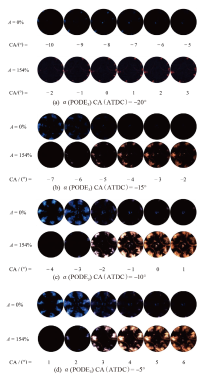
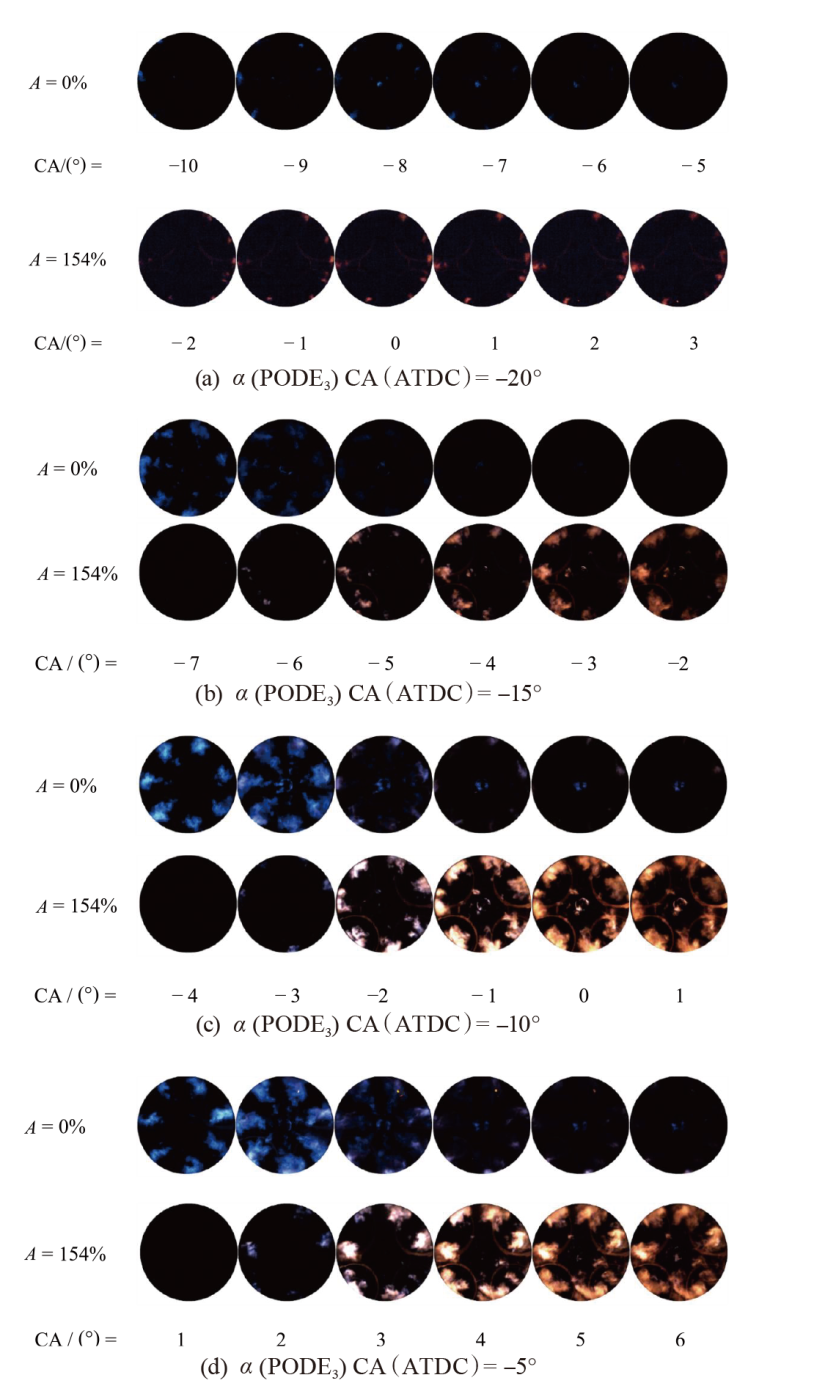
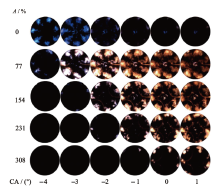
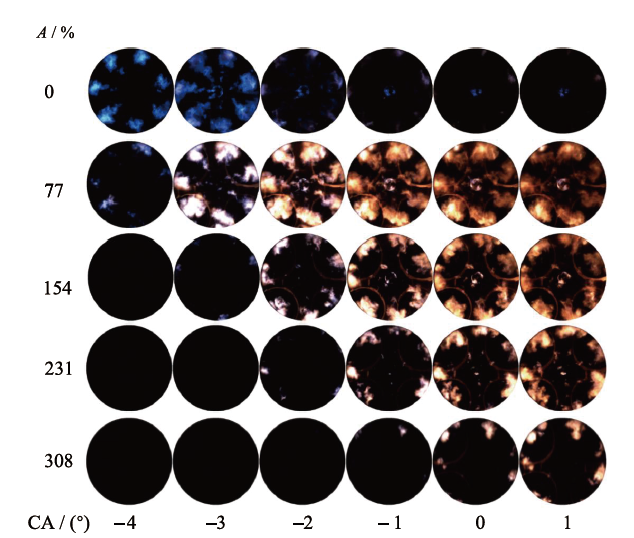
| [1] | 帅石金, 王志, 马骁, 等. 碳中和背景下内燃机低碳和零碳技术路径及关键技术[J]. 汽车安全与节能学报, 2021, 12(4): 417-439. |
| SHUAI Shijin, WANG Zhi, MA Xiao, et al. Low carbon and zero carbon technology paths and key technologies of ICEs under the background of carbon neutrality[J]. Autom Safe Energ, 2021, 12(4): 417-439. (in Chinese) | |
| [2] | Yapicioglu A, Dincer I. Performance assesment of hydrogen and ammonia combustion with various fuels for power generators[J]. Int’l Hydro Energ, 2018, 43(45): 21037-21048. |
| [3] |
Reiter A J, Kong S-C. Combustion and emissions characteristics of compression-ignition engine using dual ammonia-diesel fuel[J]. Fuel, 2011, 90(1): 87-97.
doi: 10.1016/j.fuel.2010.07.055 URL |
| [4] | 郭朋彦, 申方, 王丽君, 等. 氨燃料发动机研究现状及发展趋势[J]. 车用发动机, 2016(3): 1-5+13. |
| GUO Pengyan, SHEN Fang, WANG Lijun, et al. Research status and development trend of ammonia fuel engien[J]. Vehi Engine, 2016(3): 1-5+13. (in Chinese) | |
| [5] | 胡剑全, 谢珊, 吴一纯, 等. 低碳氨发动机的研究[J]. 可再生能源, 2014, 32(10): 1505-1509. |
| HU Jianquan, XIE Shan, WU Yichun, et al. Study on low carbon ammonia engine[J]. Rene Energ Resour, 2014, 32(10): 1505-1509. (in Chinese) | |
| [6] | Gray Jr Jt D E, Meckel Nt, Quillian Jr Rd. Ammonia fuel: Engine compatibility and combustion.[J]. SAE Trans, 1967: 785-807. |
| [7] |
Reiter A J, Kong S C. Demonstration of compression-ignition engine combustion using ammonia in reducing greenhouse gas emissions[J]. Energ Fuels, 2008, 22(5): 2963-2971.
doi: 10.1021/ef800140f URL |
| [8] | Niki Y, Yoo D H, Hirata K, et al. Effects of ammonia gas mixed into intake air on combustion and emissions characteristics in diesel engine[C]// ASME Inte Comb Engine Fall Tech Conf, Greenville, South Carolina, 2016. |
| [9] |
Yousefi A, Guo H, Dev S, et al. Effects of ammonia energy fraction and diesel injection timing on combustion and emissions of an ammonia/diesel dual-fuel engine[J]. Fuel, 2022, 314: 122723.
doi: 10.1016/j.fuel.2021.122723 URL |
| [10] |
LIU Haoye, WANG Zhi, LI Yanfei, et al. Recent progress in the application in compression ignition engines and the synthesis technologies of polyoxymethylene dimethyl ethers[J]. Appl Energ, 2019, 233: 599-611.
doi: 10.1016/j.apenergy.2018.10.064 |
| [11] |
REN Shuojin, WANG Zhi, LI Bowen, et al. Development of a reduced polyoxymethylene dimethyl ethers (PODEn) mechanism for engine applications[J]. Fuel, 2019, 238: 208-224.
doi: 10.1016/j.fuel.2018.10.111 |
| [12] |
MA Yue, CUI Longxi, MA Xiao, et al. Optical study on spray combustion characteristics of PODE/diesel blends in different ambient conditions[J]. Fuel, 2020, 272. Doi: 10.1016/j.fuel.2020.117691.
doi: 10.1016/j.fuel.2020.117691 |
| [13] |
TONG Laihui, WANG Hu, ZHENG Zunqing, et al. Experimental study of RCCI combustion and load extension in a compression ignition engine fueled with gasoline and PODE[J]. Fuel, 2016, 181: 878-886.
doi: 10.1016/j.fuel.2016.05.037 URL |
| [14] |
Burger J, Siegert M, Ströfer E, et al. Poly(oxymethylene) dimethyl ethers as components of tailored diesel fuel: Properties, synthesis and purification concepts[J]. Fuel, 2010, 89(11): 3315-3319.
doi: 10.1016/j.fuel.2010.05.014 URL |
| [15] | SUN Wenyu, WANG Guoqing, LI Shuang, et al. Speciation and the laminar burning velocities of poly(oxymethylene) dimethyl ether 3 (POMDME3) flames: An experimental and modeling study[J]. Proceed Combust Instit, 2017, 36(1): 1269-1278. |
| [16] | Hayakawa A, Goto T, Mimoto R, et al. NO formation/reduction mechanisms of ammonia/air premixed flames at various equivalence ratios and pressures[J]. Mech Engi J, 2015, 2(1): 14-00402. |
| [1] | LI Liguang, SHANG Quanbo, TANG Yongjian, DENG Jun. Review on the emission characteristics and near-zero emission control for ammonia-hydrogen internal combustion engines [J]. Journal of Automotive Safety and Energy, 2025, 16(3): 345-366. |
| [2] | YANG Yang, WANG Yichun, ZHANG Yi, YU Qian, ZHANG Tao. Characterization of ammonia emissions from urban motor vehicles in Taiyuan based on MOVES model [J]. Journal of Automotive Safety and Energy, 2025, 16(3): 425-433. |
| [3] | WANG Zhi, QI Yunliang, CHEN Qingchu, LI Jun. Overview of the combustion of ammonia-hydrogen internal combustion engines [J]. Journal of Automotive Safety and Energy, 2024, 15(4): 443-466. |
| [4] | LIU Xiao, YAO Xiaoxin, WANG Ze, TANG Chenglong. Microscopic characteristics of liquid ammonia spray at different ambient pressures and ambient temperatures [J]. Journal of Automotive Safety and Energy, 2024, 15(4): 520-525. |
| [5] | JIN Guangjie, LU Mingfei, LIU Xing, LONG Wuqiang, WANG Peng. Chemical mechanism and N2O generation analysis of ammonia-methanol combustion in low proportions of methanol blends [J]. Journal of Automotive Safety and Energy, 2024, 15(4): 536-544. |
| [6] | HU Shengqi, WANG Jie, CAI Yunkai, ZHU Neng. Digital simulation of the ammonia replacement rate on the combustion and emission performances of diesel engine [J]. Journal of Automotive Safety and Energy, 2024, 15(3): 395-401. |
| [7] | CAI Kaiyuan, WANG Zhi, LIU Yi, CHEN Qingchu, QI Yunliang, LIN Hao, LU Wenjian, ZHANG Shenhuan, YIN Yong. Optimization of diesel injection strategy for ammonia-diesel dual-fuel engines with high compression ratio [J]. Journal of Automotive Safety and Energy, 2023, 14(6): 783-789. |
| [8] | QIAN Weiwei, SHI Xiuyong, LI Song, SHUAI Shijin. Experimental study on the effect of ammonia on nanostructure of particulate matters in ethylene laminar diffusion flames [J]. Journal of Automotive Safety and Energy, 2023, 14(5): 618-627. |
| [9] | ZHANG Dingcheng, ZHANG Guangde, CHEN Shuzhi. Effects of fuel injection strategy on combustion characteristics of methanol/PODEn dual-fuel compression ignition mode [J]. Journal of Automotive Safety and Energy, 2023, 14(4): 513-520. |
| [10] | LIU Shang, CAI Kaiyuan, LIU Wei, WANG Wei, ZHAO Ziqing, ZHANG Ridong, ZHANG Qihang, MA Xiao, WANG Zhi. Experimental study on different combustion modes of ammonia blended engines [J]. Journal of Automotive Safety and Energy, 2022, 13(1): 142-148. |
| [11] | WANG Zhihao, ZHANG Xinhua, WU Huimin, LIU Chaohui, WANG Zhaowen, HUANG Ronghua, LI Dinggen, WANG Zhi. Effect of microwave assisted ignition on CO2 diluted methane combustion [J]. Journal of Automotive Safety and Energy, 2022, 13(1): 149-156. |
| [12] | ZHANG Zhiyong, GAO Dingwei, LAI Haipeng, ZHANG Bin, XING Huafeng. Optical diagnostics of charge stratification compression ignition in high compression ratio gasoline engine [J]. Journal of Automotive Safety and Energy, 2021, 12(3): 410-416. |
| [13] | REN Shuojin, ZHANG Ming, GUO Yong, YAN Yan, WANG Zhi, WANG Jianxin. Experimental and numerical investigation of effects of compression ratio on dual-fuel combustion at medium and high load [J]. Journal of Automotive Safety and Energy, 2020, 11(4): 518-528. |
| [14] | HE Ping, RUAN Haoda , MEI Jiahua , WANG Congyang , LI Zhaoyang. Cooling strategy of a dual fuel injector needle valve under micro pilot ignition condition [J]. Journal of Automotive Safety and Energy, 2020, 11(3): 406-412. |
| [15] | HAN Zhiyu, WU Zhenkuo, GAO Xiaojie . Development trend of internal combustion engines in the revolution of automotive powertrain [J]. Journal Of Automotive Safety And Energy, 2019, 10(2): 146-160. |
| Viewed | ||||||
|
Full text |
|
|||||
|
Abstract |
|
|||||
