Welcome to Journal of Automotive Safety and Energy,

Journal of Automotive Safety and Energy ›› 2021, Vol. 12 ›› Issue (4): 475-482.DOI: 10.3969/j.issn.1674-8484.2021.04.005
• Automotive Safety • Previous Articles Next Articles
LONG Yongcheng1,2( ), HAO Haizhou1,2, LI Fan3, FEI Jing1,2
Received:2021-04-13
Online:2021-12-31
Published:2022-01-10
CLC Number:
LONG Yongcheng, HAO Haizhou, LI Fan, FEI Jing. Biofidelity of current legform impactor in pedestrian safety test[J]. Journal of Automotive Safety and Energy, 2021, 12(4): 475-482.
Add to citation manager EndNote|Ris|BibTeX
URL: https://www.journalase.com/EN/10.3969/j.issn.1674-8484.2021.04.005
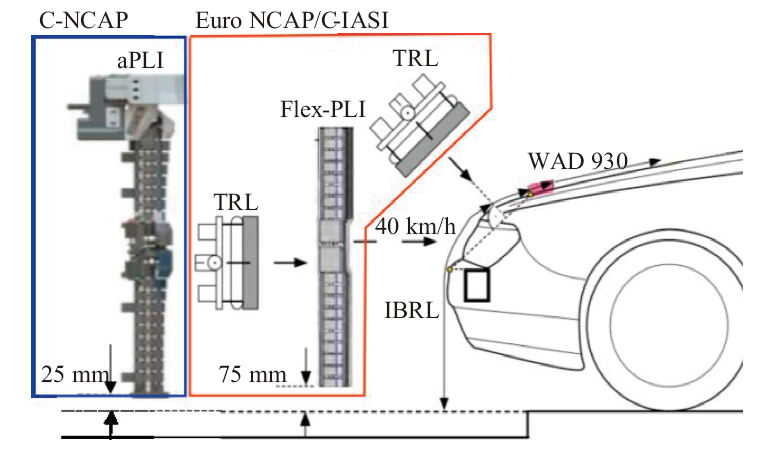
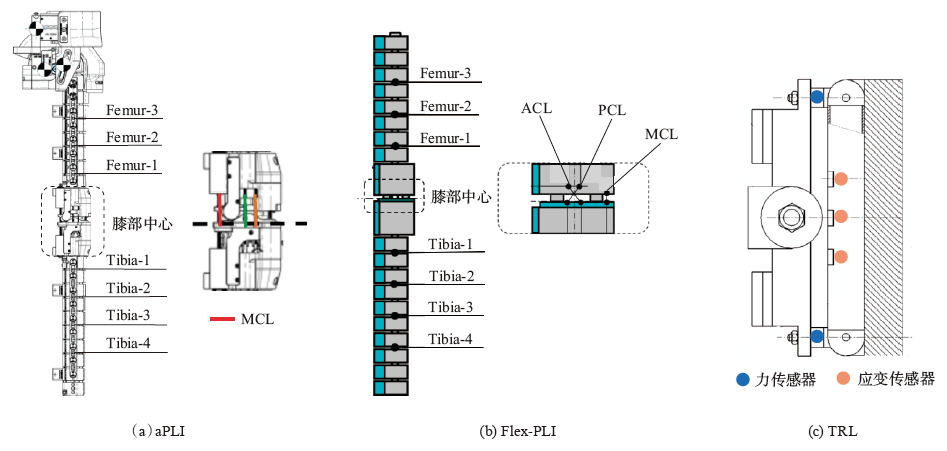
| 试验工况 | 参数 | Euro NCAP/C-IASI 2020版 | ECE R127/GTR 9 | |||
|---|---|---|---|---|---|---|
| 高性能值 | 低性能值 | 高性能值 | 低性能值 | |||
| TRL上腿型(水平冲击) | 碰撞位置 | 保险杠上、下基准线的中间位置 | 保险杠上、下基准线的中间位置 | |||
| 碰撞速度 / (km·h-1) | 40 | 40 | 40 | 40 | ||
| 合力 / kN | 5 | 6 | - | 7.5 | ||
| 弯矩 / Nm | 285 | 350 | - | 510 | ||
| Flex-PLI | 碰撞速度 / (km·h-1) | 40 | 40 | 40 | 40 | |
| 距地高度 / mm | 75 | 75 | - | 75 | ||
| 小腿弯矩 / Nm | 282 | 340 | - | 340 | ||
| MCL / mm | 19 | 22 | - | 22 | ||
| ACL/PCL / mm | 10 | 10 | - | 13 | ||
| 试验工况 | 参数 | Euro NCAP/C-IASI 2020版 | ECE R127/GTR 9 | |||
|---|---|---|---|---|---|---|
| 高性能值 | 低性能值 | 高性能值 | 低性能值 | |||
| TRL上腿型(水平冲击) | 碰撞位置 | 保险杠上、下基准线的中间位置 | 保险杠上、下基准线的中间位置 | |||
| 碰撞速度 / (km·h-1) | 40 | 40 | 40 | 40 | ||
| 合力 / kN | 5 | 6 | - | 7.5 | ||
| 弯矩 / Nm | 285 | 350 | - | 510 | ||
| Flex-PLI | 碰撞速度 / (km·h-1) | 40 | 40 | 40 | 40 | |
| 距地高度 / mm | 75 | 75 | - | 75 | ||
| 小腿弯矩 / Nm | 282 | 340 | - | 340 | ||
| MCL / mm | 19 | 22 | - | 22 | ||
| ACL/PCL / mm | 10 | 10 | - | 13 | ||
| [1] | 公安部交通管理局. 中华人民共和国道路交通事故统计年报(2018年度)[R]. 无锡:公安部交通管理科学研究所, 2019. |
| Traffic Administration of the Ministry of Public Security. Annual report of the People’s Republic of China on road traffic accidents (2018)[R]. Wuxi: Research Institute of Traffic Management, Ministry of Public Security, 2019. (in Chinese) | |
| [2] | European Enhanced Vehicle-Safety Committee Working Group 17. Improved test methods to evaluate pedestrian protection afforded by passenger cars[R]. Euro Enhan Vehicle-Safety Commi, Tech Report, 2006, PS/187/Rev.1. https://unece.org/fileadmin/DAM/trans/doc/2006/wp29grsp/ps-187r1e.pdf |
| [3] | Euro NCAP. Euro NCAP Pedestrian Test Protocol V8.0[S/OL]. [2014-06-12]. http://www.euroncap.com/files/Euro-NCAP-Pedestrian-Protocol-v8.0-June-2014---0-0ab54ac7-2de4-48b3-90a5-722410b1fd5c.pdf. |
| [4] | 中国汽车工程研究院股份有限公司, 中保研汽车技术研究院有限公司. 中国保险汽车安全指数:车外行人安全指数试验规程(2020版)[S/OL]. [2021-02-05]. https://www.ciasi.org.cn/Uploads/Download/2021-02-05/601c2a803e89a.pdf. |
| China Automotive Engineering Research Institute Co Ltd and CIRI Auto Technology Institute Co Ltd. China insurance automobile safety index:Pedestrian safety index test protocol(2020 Ver)[S/OL]. [2021-02-05]. https://www.ciasi.org.cn/Uploads/Download/2021-02-05/601c2a803e89a.pdf. (in Chinese) | |
| [5] | 中国汽车技术研究中心有限公司. C-NCAP管理规则(2021版)附录B: 行人保护试验方法[S/OL]. [2020-08-26]. http://www.c-ncap.org.cn/cms/picture/357309660978524160.pdf. |
| China Automotive Technology and Research Center Co. Ltd. C-NCAP management regulation(2021 ed)Appendix B:Pedestrian Protection testing methods[S/OL]. [2020-08-26]. http://www.c-ncap.org.cn/cms/picture/357309660978524160.pdf. (in Chinese) | |
| [6] | Isshiki T, Konosu A, Takahashi Y. Development of an appropriate pedestrian legform impact test method which can be used for all types of vehicles including high bumper vehicles: Development of a simplified upper body part (SUBP) FE model[C]// Proc Int’l Res Council on Biomech Injury (IRCOBI) Conf, 2014: 759-784. |
| [7] | Isshiki T, Konosu A, Takahashi Y. Analysis of the causes of differences in impact responses between a human lower limb and the flexible pedestrian legform impactor under low and high bumper vehicle impact situations[C]// Proc Int’l Res Council on Biomech Injury (IRCOBI) Conf, Lyons, France. 2015: 401-413. |
| [8] | Isshiki T, Konosu A, Takahashi Y. Development and evaluation of the advanced pedestrian legform impactor prototype which can be applicable to all types of vehicles regardless of bumper height-Part 1: finite element model[C]// Proc Int’l Res Council on Biomech Injury (IRCOBI) Conf, 2016: 770-785. |
| [9] | Isshiki T, Antona-Makoshi J, Konosu A, et al. Consolidated technical specifications for the advanced pedestrian legform impactor (aPLI)[C]// Proc Int’l Res Council on Biomech Injury (IRCOBI) Conf, 2018: 284-301. |
| [10] | Takahashi Y, Kikuchi Y, Mori F, et al. Advanced FE lower limb model for pedestrians[C]// 18th Proc Int’l Tech Conf Enha Safety Vehi. Nagoya, Japan, Paper No. 218, 2003. |
| [11] | Kikuchi Y, Takahashi Y, Mori F. Development of a finite element model for a pedestrian pelvis and lower limb[R]. SAE Tech Paper, 2006-01-0683. |
| [12] | Kikuchi Y, Takahashi Y, Mori F. Full-scale validation of a human FE model for the pelvis and lower limb of a pedestrian[R]. SAE Tech Paper, 2008-01-1243. |
| [13] | Takahashi Y, Matsuoka F, Okuyama H, et al. Development of injury probability functions for the flexible pedestrian legform impactor[J]. SAE Int’l J Passenger Cars-Mech Syst, 2012, 5:242-252. |
| [14] | Zander O, Wisch M, Ott J, et al. Development and evaluation of an upper body mass (UBM) for the flexible pedestrian legform impactor (FlexPLI) and for incorporation within improved test and assessment procedures-results from SENIORS[C]// Proc Int’l Res Council on Biomech Injury (IRCOBI) Conf, 2019: 397-415. |
| [15] | Mo F, Arnoux P J, Cesari D, et al. The failure modelling of knee ligaments in the finite element model[J]. Int’l J Crashworthiness, 2012, 17(6):630-636. |
| [16] | Matsui Y, Ishikawa H, Sasaki A. Validation of pedestrian upper legform impact test-reconstruction of pedestrian accidents[C]// 16th Int’l Tech Conf Expe Safety Vehi-Proce. 1998: 2152-2167. |
| [17] | Snedeker J G, Muser M H, Walz F H. Assessment of pelvis and upper leg injury risk in car-pedestrian collisions: comparison of accident statistics, impactor tests and a human body finite element model[R]. SAE Tech Paper. 2003-22-0019. |
| [18] | Snedeker J G, Walz F H, Muser M H, et al. Assessing femur and pelvis injury risk in car-pedestrian collisions: comparison of full body PMTO impacts, and a human body finite element model[C]// 19th Int’l Tech Conf Enha Safety of Vehi (ESV), 2005. (2005-06-09). https://www-esv.nhtsa.dot.gov/Proceedings/19/05-0103-O.pdf. |
| [1] | DENG Gongxun, CAI Yani, LEI Feibing, LIU Hengjin, QI Lulin, FAN Yubo. Effect of vehicle crash severity and advanced restraint system parameters on occupant injuries [J]. Journal of Automotive Safety and Energy, 2025, 16(5): 698-706. |
| [2] | GAO Chaojun, LI Yicheng, CAI Yingfeng, WANG Hai, JIANG Jin. Research on AEB control of autonomous vehicles based on sensor fusion perception [J]. Journal of Automotive Safety and Energy, 2025, 16(4): 629-637. |
| [3] | FANG Xibo, NING Yigao, ZHAO Xuan, ZHOU Meng. Adaptive identification of dynamic parameters for commercial buses based on SQP and GRNN [J]. Journal of Automotive Safety and Energy, 2025, 16(4): 648-656. |
| [4] | LIU Yu, ZHANG Huida, WU Xiaofan, JIANG Han, LI Guibing. Comparative analysis of driver response between Chinese and western drivers under various collision conditions [J]. Journal of Automotive Safety and Energy, 2025, 16(3): 376-385. |
| [5] | ZHANG Xu, TAN Huiying, WU Weihai, XIE Zongfa. Two-stroke braking performance of diesel engine equipped with variable valve mechanism [J]. Journal of Automotive Safety and Energy, 2025, 16(2): 243-251. |
| [6] | HAN Yong, XU Guochao, LI Mingwang, PAN Di, ZHANG Haiyang. Near and far end occupant injury risk in non-regulatory side impact conditions [J]. Journal of Automotive Safety and Energy, 2025, 16(1): 57-65. |
| [7] | YI Wentao, TANG Ying, LEI Feibing, ZENG Dong, CAI Yani, LUO Binyin. Effects of head kinematic characteristics on diffuse brain injury in side pole impact [J]. Journal of Automotive Safety and Energy, 2025, 16(1): 66-76. |
| [8] | JIANG Jian, WANG Ping. Diagnosis of residual bidirectional LSTM automotive motor bearings with attention mechanism [J]. Journal of Automotive Safety and Energy, 2024, 15(4): 511-519. |
| [9] | HOU Zhiping, ZHU Haitao, LIU Cancan, YANG Jialin. Dimensionality reduction and reconstruction method of dummy biomechanics response based on adaptive autoencode [J]. Journal of Automotive Safety and Energy, 2024, 15(3): 337-343. |
| [10] | HAN Yong, LUO Jinrong, HE Yong, WU He, LIN Xujie, CAI Hongyu. Prediction of pedestrian head injury in vehicle-pedestrian collisions based on a CART decision tree [J]. Journal of Automotive Safety and Energy, 2023, 14(5): 536-543. |
| [11] | GAO Wenbo, LV Xiaojiang, XIAO Zhi, MO Fuhao, LI Guibing. Boundary-condition characteristics-analysis of the pedestrian thorax-vehicle contacts considering accident scenarios [J]. Journal of Automotive Safety and Energy, 2023, 14(5): 555-562. |
| [12] | XIA Huaicheng, HAN Xiangyang, HU Kuanda. Influence of the speed and load on the tire-pressure monitoring- system performances by frequency method [J]. Journal of Automotive Safety and Energy, 2022, 13(3): 429-437. |
| [13] | LIU Tao, CHI Ting, WANG Di, WU Zhenxin, ZHANG Zhenglong. Brake model updating of automatic emergency braking system simulation test [J]. Journal of Automotive Safety and Energy, 2022, 13(3): 502-508. |
| [14] | SHAN Chunxian, XIA Dengfu, LIU Zhaoyang, TANG Aikun. Experimental study on power battery thermal managment system based on thermoelectric-coupling liquid-cooling [J]. Journal of Automotive Safety and Energy, 2022, 13(3): 535-540. |
| [15] | WEI Meng, WANG Qiao, YE Min, LIAN Gaoqi, XU Xinxin. Remaining useful life prediction of lithium-ion batteries based on dropout Monte Carlo recurrent neural network [J]. Journal of Automotive Safety and Energy, 2022, 13(3): 541-549. |
| Viewed | ||||||
|
Full text |
|
|||||
|
Abstract |
|
|||||
