Welcome to Journal of Automotive Safety and Energy,

Journal of Automotive Safety and Energy ›› 2025, Vol. 16 ›› Issue (3): 470-477.DOI: 10.3969/j.issn.1674-8484.2025.03.013
• Intelligent Driving and Intelligent Transportation • Previous Articles Next Articles
LI Ziyuan1( ), LIU Qiang1,*(), LI Dingli2, LI Zilong1
Received:2024-09-09
Revised:2025-01-16
Online:2025-06-30
Published:2025-07-01
CLC Number:
LI Ziyuan, LIU Qiang, LI Dingli, LI Zilong. Blind spot traffic strategy for intelligent connected vehicles based on deep reinforcement learning[J]. Journal of Automotive Safety and Energy, 2025, 16(3): 470-477.
Add to citation manager EndNote|Ris|BibTeX
URL: https://www.journalase.com/EN/10.3969/j.issn.1674-8484.2025.03.013
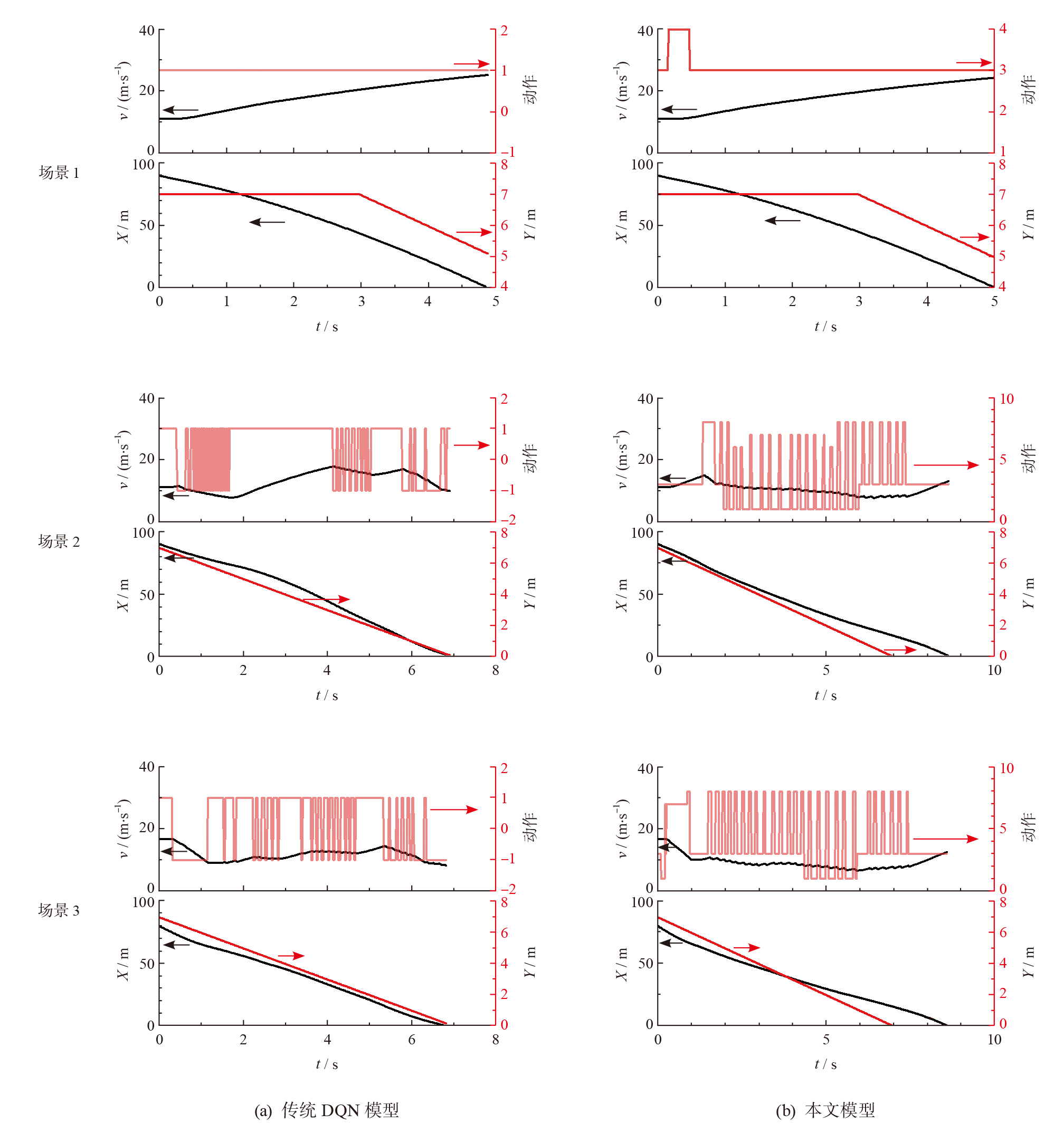
| 场景 | 模型 | t / s | 加速度超阈 值比例 / % | 加加速度超阈 值比例 / % |
|---|---|---|---|---|
| 场景1 | 传统DQN | 4.98 | 15.85 | 14.23 |
| 本文 | 5.02 | 8.33 | 10.30 | |
| 场景2 | 传统DQN | 7.02 | 43.65 | 16.28 |
| 本文 | 8.64 | 20.56 | 11.02 | |
| 场景3 | 传统DQN | 6.88* | 30.29 | 25.23 |
| 本文 | 8.38 | 37.33 | 38.60 |
| 场景 | 模型 | t / s | 加速度超阈 值比例 / % | 加加速度超阈 值比例 / % |
|---|---|---|---|---|
| 场景1 | 传统DQN | 4.98 | 15.85 | 14.23 |
| 本文 | 5.02 | 8.33 | 10.30 | |
| 场景2 | 传统DQN | 7.02 | 43.65 | 16.28 |
| 本文 | 8.64 | 20.56 | 11.02 | |
| 场景3 | 传统DQN | 6.88* | 30.29 | 25.23 |
| 本文 | 8.38 | 37.33 | 38.60 |
| [1] | 李克强, 戴一凡, 李升波, 等. 智能网联汽车 (ICV) 技术的发展现状及趋势[J]. 汽车安全与节能学报, 2017, 8(1): 1-14. |
| LI Keqiang, DAI Yifan, LI Shengbo, et al. State-of-theart and technical trends of intelligent and connected vehicles[J]. J Autom Safe Energ, 2017, 8(1): 1-14. (in Chinese) | |
| [2] |
李立, 徐志刚, 赵祥模, 等. 智能网联汽车运动规划方法研究综述[J]. 中国公路学报, 2019, 32(6): 20-33.
doi: 10.19721/j.cnki.1001-7372.2019.06.002 |
| LI Li, XU Zhigang, ZHAO Xiangmo, et al. Review of motion planning methods of intelligent connected vehicles[J]. Chin J High Transport, 2019, 32(6): 20-33. (in Chinese) | |
| [3] | 郭烈, 孙大川, 葛平淑, 等. 复杂工况下二阶碰撞时间自动紧急制动模型[J]. 机械设计与制造, 2022, 5(1): 127-131. |
| GUO Lie, SUN Dachuan, GE Pingshu, et al. Automatic emergency braking model using second-order time to collision for complex condition[J]. Mach Des Manuf, 2022, 5(1): 127-131. (in Chinese) | |
| [4] | 李霖, 朱西产. 智能汽车自动紧急控制策略[J]. 同济大学学报(自然科学版), 2015, 43(11): 1735-1742. |
| LI Lin, ZHU Xichan. Autonomous emergency control algorithm for intelligent vehicles[J]. J Tongji Univ (Nat Sci), 2015, 43(11): 1735-1742. (in Chinese) | |
| [5] | 肖宏伟, 周睿卓, 姜晴雯, 等. 商用车视野盲区测试方法[J]. 吉林大学学报(工学版), 2022, 52(5): 1009-1015. |
| XIAO Hongwei, ZHOU Ruizhuo, JIANG Qingwen, et al. Test method of commercial vehicle vision blind zone[J]. J Jilin Univ (Eng Tech Ed), 2022, 52(5): 1009-1015. (in Chinese) | |
| [6] | 刘洋, 占佳豪, 李深, 等. 自动驾驶技术的未来:单车智能和智能车路协同[J]. 汽车安全与节能学报, 2024, 15(5): 611-633. |
| LIU Yang, ZHAN Jiahao, LI Shen, et al. Future of autonomous driving: Single autonomous driving and intelligent vehicle-infrastructure collaboration systems[J]. J Autom Safe Energ, 2024, 15(5): 611-633. (in Chinese) | |
| [7] | 金立生, 韩广德, 谢宪毅, 等. 基于强化学习的自动驾驶决策研究综述[J]. 汽车工程, 2023, 45(4): 527-540. |
| JIN Lisheng, HAN Guangde, XIE Xianyi, et al. Review of autonomous driving decision-Making research based on reinforcement learning[J]. Autom Engineering, 2023, 45(4): 527-540. (in Chinese) | |
| [8] | Sallab A, Abdou M, Perot E, et al. Deep reinforcement learning framework for autonomous driving[J]. Electr Imag, 2017, 19: 70-76. |
| [9] | FU Yuchuan, LI Changle, YU Richard, et al. A decision making strategy for vehicle autonomous braking in emergency via deep reinforcement learning[J]. IEEE Trans Vehi Tech, 2020, 69(6): 5876-5888. |
| [10] | LI Junxiang, YAO Liang, XU Xin, et al. Deep reinforcement learning for pedestrian collision avoidance and human-machine cooperative driving[J]. Info Sci, 2020, 532: 110-124. |
| [11] | Rafiei A, Fasakhodi A O, Hajati F. Pedestrian collision avoidance using deep reinforcement learning[J]. Int’l J Autom Tech, 2022, 23(3): 613-622. |
| [12] | PENG Baiyu, SUN Qi, LI Shengbo E, et al. End-toend autonomous driving through dueling double deep Q-network[J]. Autom Inno, 2021, 4(3): 328-337. |
| [13] | LI Guofa, YANG Yifan, LI Shen, et al. Decision making of autonomous vehicles in lane change scenarios: Deep reinforcement learning approaches with risk awareness[J]. Transport Res Part C: Emerg Tech, 2021, 134: 1-18. |
| [14] | 柳鹏, 赵克刚, 梁志豪, 等. 基于深度强化学习CLPER-DDPG的车辆纵向速度规划[J]. 汽车安全与节能学报, 2024, 15(5): 702-710. |
| LIU Peng, ZHAO Kegang, LIANG Zhihao, et al. Vehicle longitudinal speed planning based on deep reinforcement learning CLPER-DDPG[J]. J Autom Safe Energ. 2024, 15(5): 702-710. (in Chinese) | |
| [15] | 周恒恒, 高松, 王鹏伟, 等. 基于深度强化学习的智能车辆行为决策研究[J]. 科学技术与工程, 2024, 24(12): 5194-5203. |
| ZHOU Hengheng, GAO Song, WANG Pengwei, et al. Intelligent vehicles behavior decision-making based on deep reinforcement learning[J]. Sci Tech Engi, 2024, 24(12): 5194-5203. (in Chinese) | |
| [16] | CAO Zhong, XU Shaobing, PENG Huei, et al. Confidence-aware reinforcement learning for self-driving cars[J]. IEEE Trans Intel Transport Syst, 2022, 23(7): 7419-7430. |
| [17] | FU Yuchuan, LI Chanle, LUAN Tomhao, et al. Graded warning for rear-end collision: An artificial intelligence-aided algorithm[J]. IEEE Trans Intel Transport Syst, 2019, 21(2): 565-579. |
| [1] | WANG Yue, DUAN Hongwei, ZHONG Wei, YANG Lu, HE Lei, CHAI Fulai, SHI Xiaoyang. Path planning method for leader-follower multi-vehicle formation with integrating GoT-SAC [J]. Journal of Automotive Safety and Energy, 2026, 17(1): 122-129. |
| [2] | ZHANG Fuchun, YIN Yanli, MA Yongjuan, XIAO Hangyang, CHEN Haixin, YU Kai. Ecological driving and hierarchical control of energy management for networked hybrid electric vehicle queues [J]. Journal of Automotive Safety and Energy, 2025, 16(1): 159-169. |
| [3] | HAN Yong, MENG Xin, PAN Di, WU He, SHI Jinming, ZHANG Yuecong. Characteristics and typical scenario analysis of electric two-wheeler accidents at intersections with visual obstacle [J]. Journal of Automotive Safety and Energy, 2023, 14(6): 664-670. |
| [4] | ZHANG Xinfeng, WU Lin. Behavior decision-making model for autonomous vehicles based on an ensemble deep reinforcement learning [J]. Journal of Automotive Safety and Energy, 2023, 14(4): 472-479. |
| [5] | HAN Ling, ZHANG Hui, FANG Ruoyu, LIU Guopeng, ZHU Changsheng, CHI Ruifeng. Global path planning strategy based on an improved deep reinforcement learning [J]. Journal of Automotive Safety and Energy, 2023, 14(2): 202-211. |
| [6] | FENG Yao, JING Shoucai, HUI Fei, ZHAO Xiangmo, LIU Jianbei. Deep reinforcement learning-based lane-changing trajectory planning method of intelligent and connected vehicles [J]. Journal of Automotive Safety and Energy, 2022, 13(4): 705-717. |
| [7] | LI Wenli, QIU Fanke, LIAO Daming, REN Yongpeng, YI Fan. Highway lane change decision control model based on deep reinforcement learning [J]. Journal of Automotive Safety and Energy, 2022, 13(4): 750-759. |
| [8] | ZHENG Yangjun, HE Shuai, SHUAI Zhibin, LI Jianqiu, GAI Jiangtao, LI Yong, ZHANG Ying, LI Guohui. Lateral velocity estimation for four-wheel-independent-drive electric vehicles based on deep reinforcement learning [J]. Journal of Automotive Safety and Energy, 2022, 13(2): 309-316. |
| [9] | YIN Xiaoqing, WANG Hao, MO Yudi, HU Panfeng . Optimized algorithm for vehicle forward collision pre-warning time considering road adhesion coefficient [J]. Journal Of Automotive Safety And Energy, 2019, 10(2): 178-183. |
| [10] | CAO Libo,LIU Zhongchen,WU Jun,Yao Yuan,Feng Xiexing. Development and tests of control strategy for four-in-one integrated automotive driver assistance systems [J]. Journal Of Automotive Safety And Energy, 2017, 08(02): 122-127. |
| [11] | HU Yuanzhi, LV Zhangjie, LIU Xi. Algorithm and simulation verification of longitudinal collision avoidance for autonomous emergency break (AEB) system based on PreScan [J]. Journal Of Automotive Safety And Energy, 2017, 08(02): 136-142. |
| [12] | ZHU Xichan, GAO Xuemin, XU Yuneng, LI Lin. Time to collision between vehicles estimation based on corner detection [J]. Journal Of Automotive Safety And Energy, 2014, 5(04): 331-335. |
| Viewed | ||||||
|
Full text |
|
|||||
|
Abstract |
|
|||||
