Welcome to Journal of Automotive Safety and Energy,

Journal of Automotive Safety and Energy ›› 2025, Vol. 16 ›› Issue (1): 43-49.DOI: 10.3969/j.issn.1674-8484.2025.01.004
• Automotive Safety • Previous Articles Next Articles
WU Qingfu1( ), YUAN Manrong1, HAO Shuaijie1, LIU Jiawei1, NIU Shifeng1,*(), LIU Jinfeng2
Received:2024-05-20
Revised:2024-07-02
Online:2025-02-28
Published:2025-03-04
CLC Number:
WU Qingfu, YUAN Manrong, HAO Shuaijie, LIU Jiawei, NIU Shifeng, LIU Jinfeng. Characteristic indicators of driver stress response in emergency situations[J]. Journal of Automotive Safety and Energy, 2025, 16(1): 43-49.
Add to citation manager EndNote|Ris|BibTeX
URL: https://www.journalase.com/EN/10.3969/j.issn.1674-8484.2025.01.004

| 序号 | 场景描述 | 复杂度 |
|---|---|---|
| 城市道路 | ||
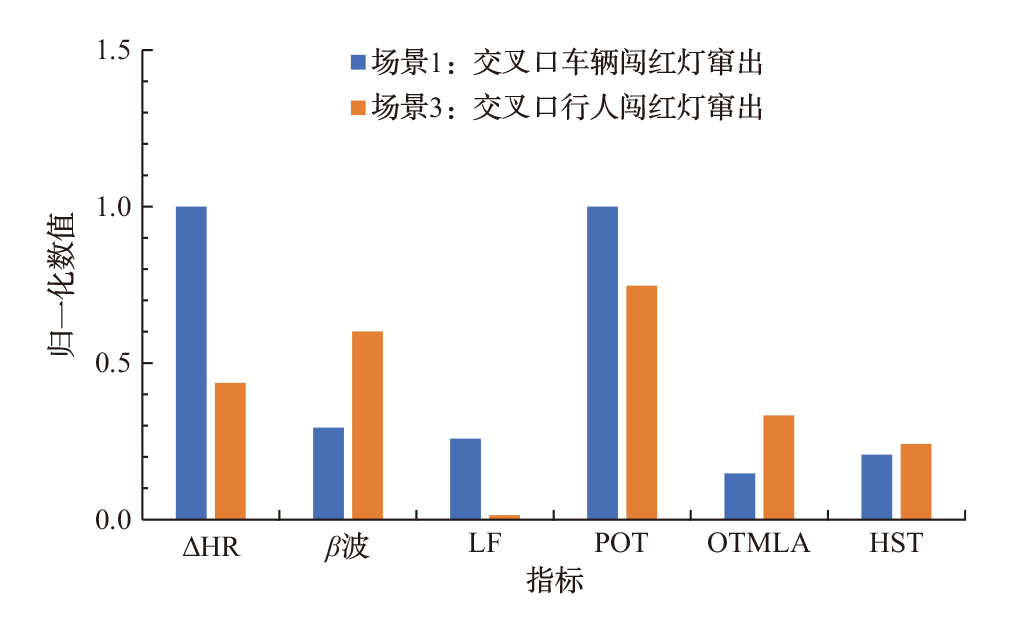
| 1 | 交叉口车辆闯红灯窜出 | 高 |
| 2 | 前方非机动车突然换道至自车前方 | 高 |
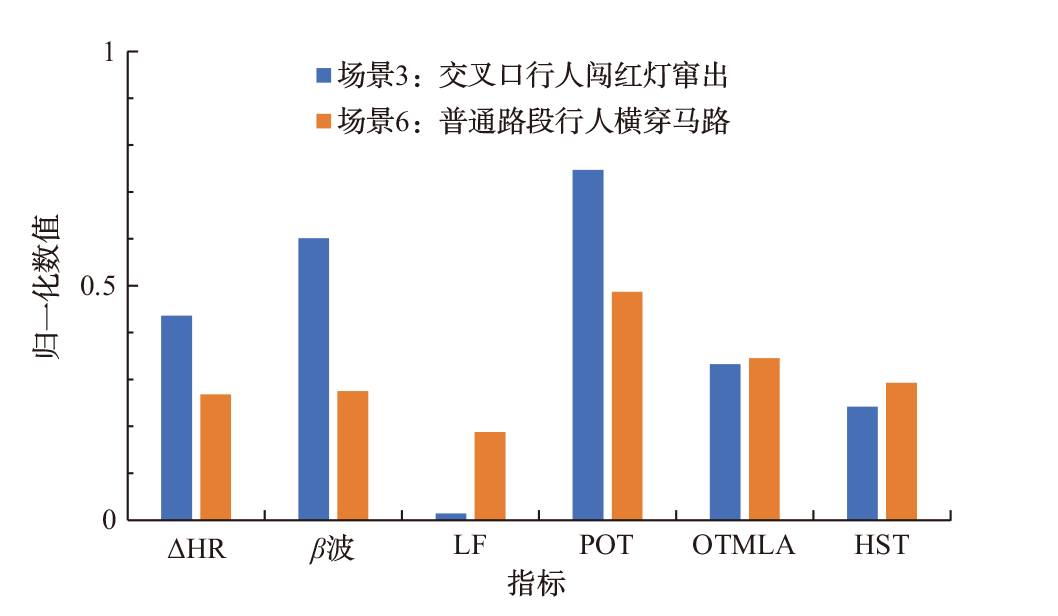
| 3 | 交叉口处行人突然从道路左侧闯红灯窜出 | 高 |
| 4 | 左后方车辆超车并换道至自车前方 | 高 |
| 5 | 机非混行路段前方非机动车紧急制动 | 高 |
| 6 | 道路右侧行人横穿马路 | 高 |
| 普通公路 | ||
| 7 | 后方车辆超车并不打转向灯换道至自车前方 | 中 |
| 8 | 路边停放车辆前方突然有行人窜出 | 中 |
| 9 | 跟车行驶过程中前车突然制动 | 中 |
| 10 | 对向车辆突然越过道路中心线行驶至自车前方 | 中 |
| 高速公路 | ||
| 11 | 前方车辆紧急制动 | 低 |
| 12 | 前方车辆不打转向灯突然换道至自车前方 | 低 |
| 序号 | 场景描述 | 复杂度 |
|---|---|---|
| 城市道路 | ||
| 1 | 交叉口车辆闯红灯窜出 | 高 |
| 2 | 前方非机动车突然换道至自车前方 | 高 |
| 3 | 交叉口处行人突然从道路左侧闯红灯窜出 | 高 |
| 4 | 左后方车辆超车并换道至自车前方 | 高 |
| 5 | 机非混行路段前方非机动车紧急制动 | 高 |
| 6 | 道路右侧行人横穿马路 | 高 |
| 普通公路 | ||
| 7 | 后方车辆超车并不打转向灯换道至自车前方 | 中 |
| 8 | 路边停放车辆前方突然有行人窜出 | 中 |
| 9 | 跟车行驶过程中前车突然制动 | 中 |
| 10 | 对向车辆突然越过道路中心线行驶至自车前方 | 中 |
| 高速公路 | ||
| 11 | 前方车辆紧急制动 | 低 |
| 12 | 前方车辆不打转向灯突然换道至自车前方 | 低 |
| [1] | 吴初娜. 驾驶人应激反应能力评估研究[D]. 西安: 长安大学, 2011. |
| WU Chuna. Research on the assessment of drivers'stress response ability[D]. Xi'an: Chang'an University, 2011. (in Chinese) | |
| [2] | 阎莹, 刘浩学, 郭忠印. 不同交通流状态下驾驶员心理生理特性研究[J]. 同济大学学报(自然科学版), 2008, 36(10): 13721377. |
| YAN Ying, LIU Haoxue, GUO Zhongyin. Research on drivers’ psychological and physiological characteristics in different traffic flow conditions[J]. J Tongji Univ (Nat Sci Ed), 2008, 36(10): 1372-1377. (in Chinese) | |
| [3] | 王海林, 刘仲国, 朱凯曼. 影响汽车驾驶员行车安全的内在因素分析[J]. 汽车研究与开发, 2002, 5: 32-42. |
| WANG Hailin, LIU Zhongguo, ZHU Kaiman. Analysis of intrinsic factors affecting automobile drivers' driving safety[J]. Autom Res Dev, 2002, 5: 32-42. (in Chinese) | |
| [4] | 宋长振. 基于心率变异的驾驶员生理负荷研究[D]. 呼和浩特: 内蒙古农业大学, 2007. |
| SONG Changzhen. Study on physiological load of drivers based on heart rate variability[D]. Hohhot: Inner Mongolia Agricultural University, 2007. (in Chinese) | |
| [5] | Healey J, Picard R. SmartCar: Detecting driver stress[C]// Proce 15th Int’l Conf Pattern Reco, ICPR - 2000. IEEE, 2000, 4: 218-221. |
| [6] | Ryu K, Myung R. Evaluation of mental workload with a combined measure based on physiological indices during a dual task of tracking and mental arithmetic[J]. Int’l J Indu Ergonomic, 2005, 35(11): 991-1009. |
| [7] | 李增勇, 焦昆, 陈铭, 等. 汽车驾驶员驾驶过程中的心率变异性功率谱分析[J]. 中国生物医学工程学报, 2003, 22(6): 574-576. |
| LI Zengyong, JIAO Kun, CHEN Ming, et al. Power spectral analysis of heart rate variability in automobile drivers during driving[J]. Chin J Biomed En, 2003, 22(6): 574-576. (in Chinese) | |
| [8] | 邹猛, 许述财, 张金换, 等. 驾乘人员受冲击或振动时的心律变异性分析[J]. 汽车安全与节能学报, 2010, 1(4): 283-287. |
| ZOU Meng, XU Shucai, ZHANG Jinhuan, et al. Analysis of heart rhythm variability in drivers and passengers subjected to shock or vibration[J]. J Autom Safe Ener, 2010, 1(4): 283-287. (in Chinese) | |
| [9] | 盛彬. 基于信息融合的驾驶危险场景分析识别研究[D]. 哈尔滨: 哈尔滨工业大学, 2019. |
| SHENG Bin. Research on analysis and identification of driving dangerous scenarios based on information fusion[D]. Harbin: Harbin Institute of Technology, 2019. (in Chinese) | |
| [10] | OU Yangkun, LIU Yongching. Effects of sign design features and training on comprehension of traffic signs in Taiwanese and Vietnamese user groups[J]. Int’l J Indu Ergonomic, 2012, 42(1): 1-7. |
| [11] | Lerner N D. Brake perception-reaction times of older and younger drivers[C]// Proc Human Factors Ergonomics Soc Annu Meeting. SAGECA, 1993, 37(2): 206-210. |
| [12] | Hankey J M, McGehee D V, Dingus T A, et al. Initial driver avoidance behavior and reaction time to an unalerted intersection incursion[C]// Proc Human Factors Ergonomics Soc Annu Meeting. SAGE CA, 1996, 40(18): 896-899. |
| [13] | 李晓梦. 基于驾驶模拟实验的驾驶员紧急避撞行为研究[D]. 北京: 北京交通大学, 2013. |
| LI Xiaomeng. Study of driver’s emergency collision avoidance behavior based on the driving simulator experiment[D]. Beijing: Beijing Jiaotong University, 2013. (in Chinese) | |
| [14] | 马彬涛. 公路事故数据驱动的驾驶人应激训练场景生成方法[D]. 西安: 长安大学. |
| MA Bintao. A data - driven approach to driver stress training scenario generation for highway accidents[D]. Xi'an: Chang'an University. (in Chinese) | |
| [15] | Eoh H J, Chung M K, Kim S H. Electroencephalographic study of drowsiness in simulated driving with sleep deprivation[J]. Int’l J Indu Ergonomic, 2005, 35(4): 307-320. |
| [16] | Kar S, Bhagat M, Routray A. EEG signal analysis for the assessment and quantification of driver’s fatigue[J]. Transp Res Part F: Traf Psychology Beha, 2010, 13(5): 297-306. |
| [17] | 贾丙硕. 基于驾驶模拟器的城市道路驾驶人应激反应特性试验研究[D]. 西安: 长安大学, 2019. |
| JIA Bingshuo. Experimental research on stress response characteristics of urban road drivers based on driving simulator[D]. Xi'an: Chang'an University, 2019. (in Chinese) | |
| [18] |
吴付威, 王鑫, 王畅. 城市道路驾驶人横向避险特性研究[J]. 中国安全科学学报, 2018, 28(8): 7-12.
doi: 10.16265/j.cnki.issn1003-3033.2018.08.02 |
| WU Fuwei, WANG Xin, WANG Chang. Research on lateral risk avoidance characteristics of drivers on urban roads[J]. China Safe Sci , 2018, 28(8): 7-12. (in Chinese) | |
| [19] | Foy H J, Chapman P. Mental workload is reflected in driver behaviour, physiology, eye movements and prefrontal cortex activation[J]. Appl Ergonomic, 2018, 73: 90-99. |
| [20] | Min B C, Chung S C, Min Y K, et al. Psychophysiological evaluation of simulator sickness evoked by a graphic simulator[J]. Appl Ergonomic, 2004, 35(6): 549-556. |
| [21] | Ryu K, Myung R. Evaluation of mental workload with a combined measure based on physiological indices during a dual task of tracking and mental arithmetic[J]. Int’l J Indu Ergonomic, 2005, 35(11): 991-1000. |
| [1] | LIANG Yuchen, DUAN Weijian, ZHANG Shi, ZHU Xinglin, XU Jin. Mental workload variations of drivers navigating over the differential types of interchange ramps [J]. Journal of Automotive Safety and Energy, 2025, 16(6): 851-858. |
| [2] | CHENG Zeyang, DUAN Yiyang, YANG Mengmeng, FENG Zhongxiang, WANG He, ZHU Xiaojun, BAO Lixia. Recognition of the dangerous driving behaviors and the driving styles in weaving areas based on a hybrid neural network [J]. Journal of Automotive Safety and Energy, 2025, 16(5): 688-697. |
| [3] | ZHANG Licheng, YA Jingtian, PENG Kun, YANG Ran. Impact of Jerk on neural network based fuel consumption predicting models [J]. Journal of Automotive Safety and Energy, 2025, 16(1): 117-126. |
| [4] | LI Xinguang, SUN Chongxiao, QU Dayi, YU Wenchang, HU Han. Eco-driving strategy for mixed traffic flow of connected automated vehicles considering intersection start-stop wave [J]. Journal of Automotive Safety and Energy, 2024, 15(6): 895-904. |
| [5] | YAO Ronghan, XU Wentao, LIN Zijing, WANG Libing. Multi-objective bi-level programming model for optimization design of bus-HOV lanes [J]. Journal of Automotive Safety and Energy, 2024, 15(5): 711-722. |
| [6] | CHEN Qitong, ZHAO Dong, LIU Congzhi, LI Liang. Real-time human-like speed planning method for curve entry considering experienced driving behaviors [J]. Journal of Automotive Safety and Energy, 2024, 15(3): 309-320. |
| [7] | XU Ting, CHEN Shuyi, PENG Chong, CHEN Yixin, LIANG Zekai, ZHAO Lei. Parameter relationship between exhaust emissions and driving behaviors for commercial heavy-duty vehicles [J]. Journal of Automotive Safety and Energy, 2023, 14(3): 365-374. |
| [8] | ZOU Tiefang, WU Liangwei, HU Lin, NIE Bingbing, WANG Fang. Influence of bicycle seat height on the back lean forward angle and head injury of cyclists [J]. Journal of Automotive Safety and Energy, 2022, 13(1): 95-103. |
| [9] | FANG Liang, GUAN Zhiwei, WANG Tao, GONG Jinfeng, DU Feng. Collision avoidance model and its validation for intelligent vehicles based on deep learning LSTM [J]. Journal of Automotive Safety and Energy, 2022, 13(1): 104-111. |
| [10] | ZHANG Rui, YAO Enjian, ZHANG Yongsheng. Multi-modal dynamic traffic assignment model with the addition of electric vehicles [J]. Journal of Automotive Safety and Energy, 2021, 12(4): 540-550. |
| [11] | LI Guofa,LAI Weijian,LIAO Yuan,WANG Wenjun,CHENG Bo . Driver reliance characteristics on forward collision warning systems in adjacent vehicle cut-in situations [J]. Journal Of Automotive Safety And Energy, 2020, 11(1): 36-43. |
| [12] | LI Guofa,CHEN Yaoyu,Lü Chen,TAO Da,CAO Dongpu,CHENG Bo. Key techniques of semantic analysis of driving behavior in decision making of autonomous vehicles [J]. Journal Of Automotive Safety And Energy, 2019, 10(4): 391-412. |
| [13] | ZHANG Chenyang, LI Shuguang, LI Yaohua, YAO Jin, ZHU Lei, WANG Min . Differences of the motion sickness associated brain activity regions based on the driving simulator and fNIRS [J]. Journal Of Automotive Safety And Energy, 2019, 10(4): 433-442. |
| [14] | LIU Rui, ZHU Xichan. Acceleration distribution characteristics of the driver and its application [J]. Journal Of Automotive Safety And Energy, 2019, 10(1): 37-45. |
| [15] | ZHU Xichan, LIU Zhichao, LI Lin. Open-loop model of drivers’ emergency lane-change behavior#br# based on the naturalistic driving data [J]. Journal Of Automotive Safety And Energy, 2015, 6(04): 328-332. |
| Viewed | ||||||
|
Full text |
|
|||||
|
Abstract |
|
|||||
