欢迎访问《汽车安全与节能学报》,

汽车安全与节能学报 ›› 2026, Vol. 17 ›› Issue (5): 538-546.DOI: 10.3969/j.issn.1674-8484.2026.05.003
叶彬( ), 杨睿, 谢静思*(), 常意, 赵恒平, 杨佩龙
收稿日期:2026-05-28
修回日期:2026-08-17
出版日期:2026-10-31
发布日期:2026-11-08
通讯作者:
*谢静思,工程师。E-mail:xiejingsi@caeri.com.cn。
作者简介:叶彬(1995—),女(汉),重庆市,工程师。E-mail:yebin@caeri.com.cn。
基金资助:
YE Bin(), YANG Rui, XIE Jingsi*(), CHANG Yi, ZHAO Hengping, YANG Peilong
Received:2026-05-28
Revised:2026-08-17
Online:2026-10-31
Published:2026-11-08
摘要:
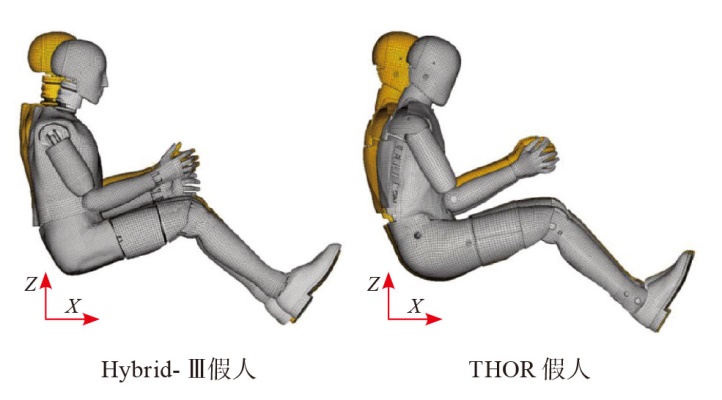
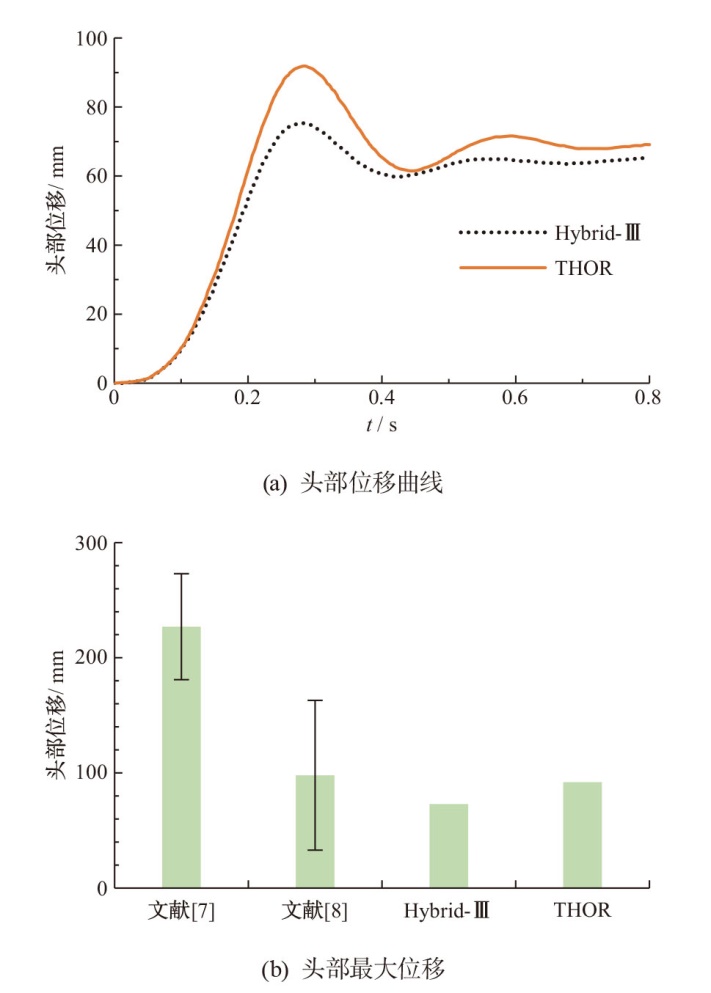
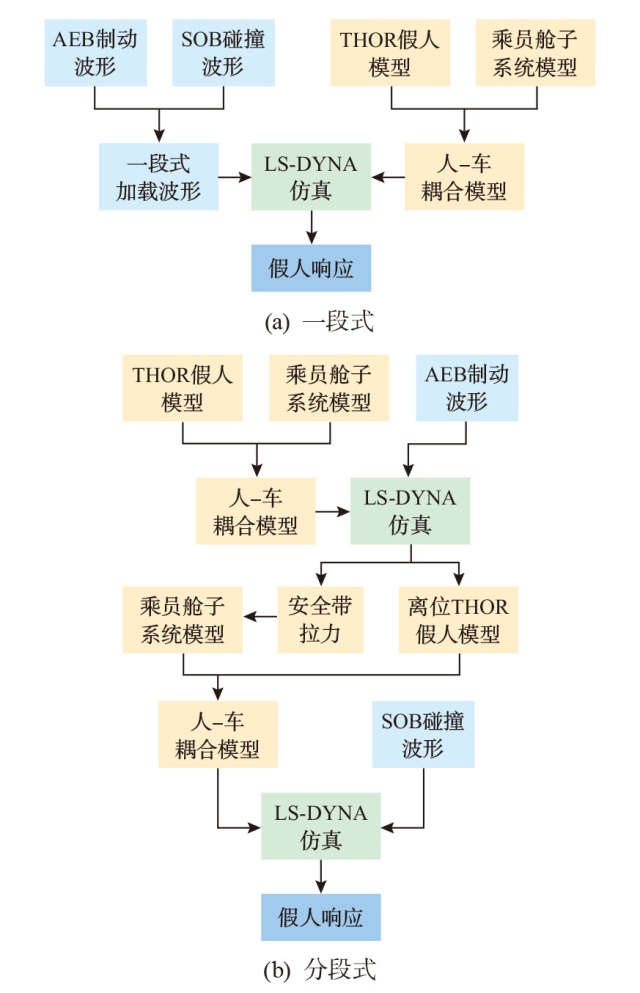
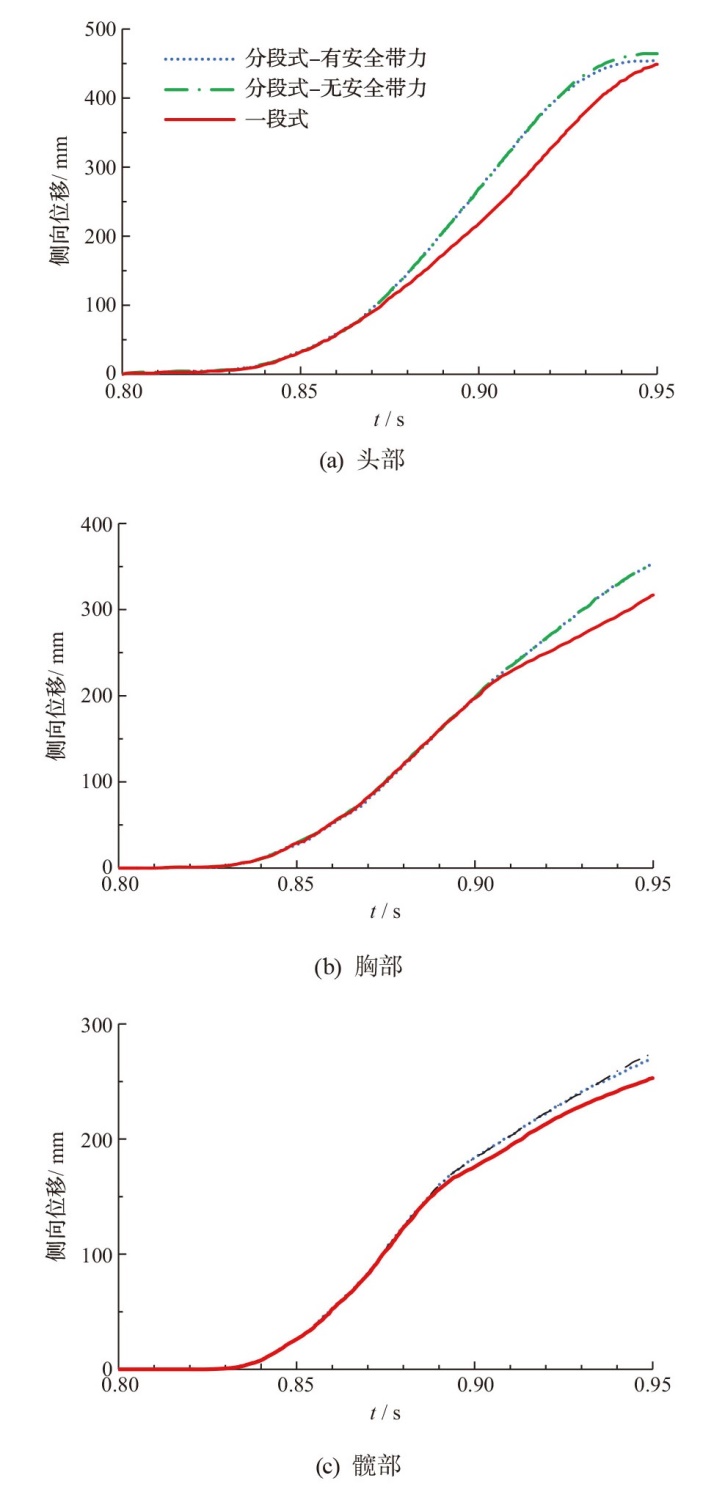
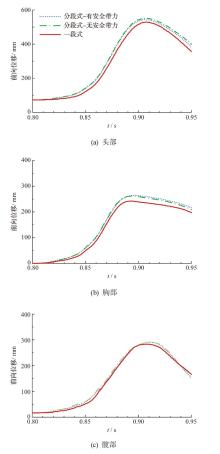
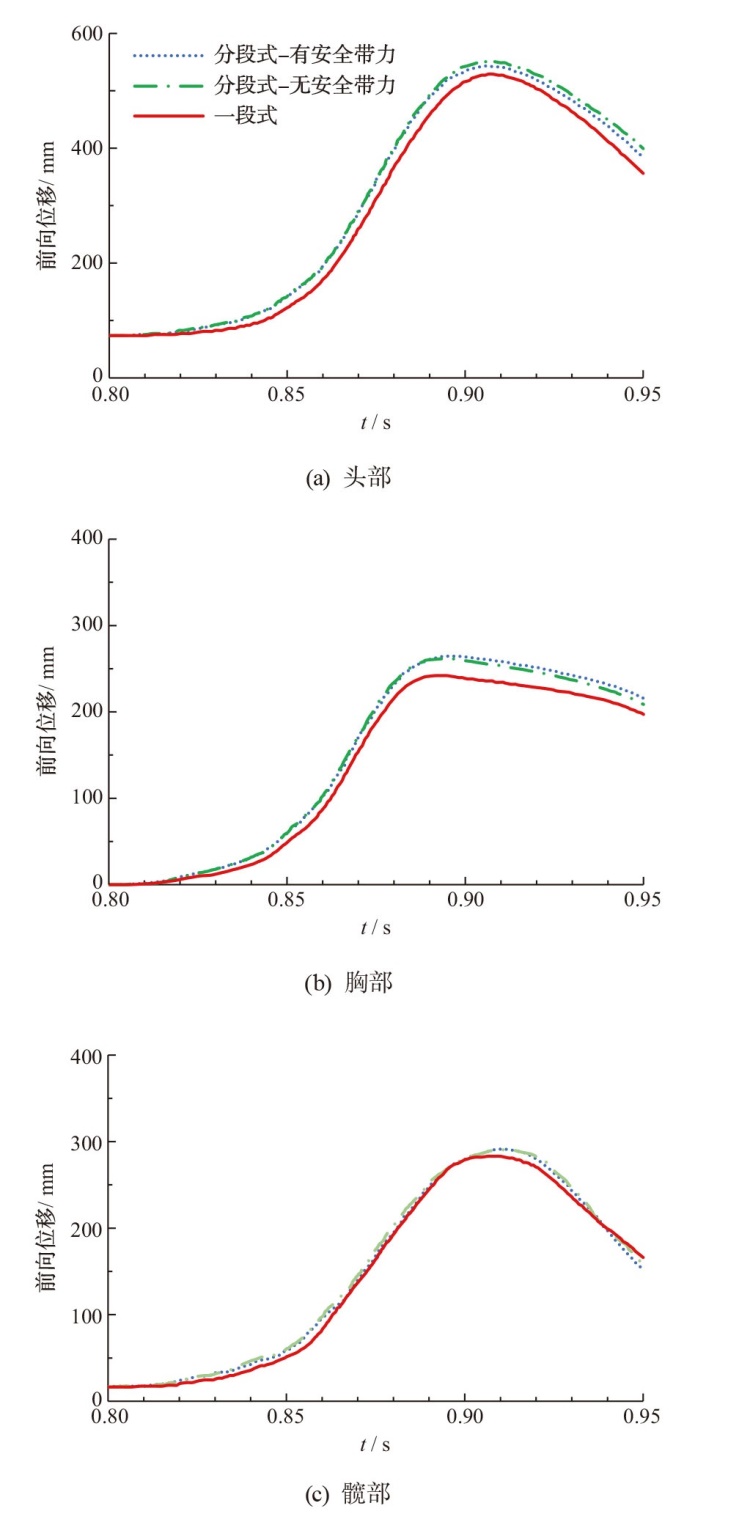
为对比“一段式”与“分段式”加载方法在模拟“AEB +碰撞”工况下的乘员响应差异,该文在验证车辆约束系统模型和对比Hybrid Ⅲ与THOR假人自动紧急制动系统(AEB)制动离位响应基础上,分别构建2种加载方法的“AEB+碰撞”仿真模型,对比假人运动学与损伤响应。结果表明:“分段式”加载方法下假人头部、胸部及髋部的前向与侧向位移整体大于“一段式”,2种加载方法在头部HIC15和3ms合成加速度、颈部损伤指标Nij等指标上差异较小(< 7%),但在颈部弯矩、胸部压缩速率及粘性指标(ηVC)指标上差异显著(17%~31%)。鉴于“一段式”和“分段式”加载在假人关键损伤指标上不可忽略的偏差,建议一体化安全虚拟测评中采用“一段式”加载。该文的研究结果能为主被动安全一体化虚拟测评方法的选取与规程制定提供定量依据。
中图分类号:
叶彬, 杨睿, 谢静思, 常意, 赵恒平, 杨佩龙. “AEB + 碰撞”一体化安全测评加载方法对比分析[J]. 汽车安全与节能学报, 2026, 17(5): 538-546.
YE Bin, YANG Rui, XIE Jingsi, CHANG Yi, ZHAO Hengping, YANG Peilong. Comparative analysis of loading methods for “AEB+Crash” integrated safety assessment[J]. Journal of Automotive Safety and Energy, 2026, 17(5): 538-546.
| 身体部位及损伤指标 | 头部 | 颈部 | 胸部 | |||||||
|---|---|---|---|---|---|---|---|---|---|---|
| HIC15 | 3 ms合成 加速度/ g | Nij | 伸张弯矩, My / Nm | 压缩量, D / mm | 压缩速率, V / (m·s-1) | 粘性指标, ηVC / (m·s-1) | ||||
| 一段式 | 533.10 | 67.98 | 0.39 | 40.05 | 47.83 | 2.97 | 0.42 | |||
| 分段式 | 保留安全带拉力 | 550.33 | 69.73 | 0.40 | 52.09 | 49.73 | 3.48 | 0.52 | ||
| 相对一段式差异 | 3.23% | 2.57% | 2.30% | 30.04% | 3.97% | 17.17% | 23.74% | |||
| 不保留安全带拉力 | 543.64 | 69.92 | 0.42 | 50.42 | 50.92 | 3.89 | 0.44 | |||
| 相对一段式差异 | 1.98% | 2.85% | 5.87% | 25.87% | 6.46% | 30.98% | 4.56% | |||
| [1] | 杨帅, 张金换, 钱占伟, 等. 汽车安全多领域融合的研究与展望[J]. 汽车安全与节能学报, 2022, 13(1): 29-47. |
| YANG Shuai, ZHANG Jinhuan, QIAN Zhanwei, et al. Research and prospect of multi-domain integration of automotive safety[J]. J Autom Safe Energ, 2022, 13(1): 29-47. (in Chinese) | |
| [2] | 胡林, 谷子逸, 王丹琦, 等. 汽车安全性测评规程现状及趋势展望[J]. 汽车工程, 2024, 46(2): 187-200. |
| HU Lin, GU Ziyi, WANG Danqi, et al. Current status and trend of automotive safety procedures/programs[J]. Autom Engineering, 2024, 46(2): 187-200. (in Chinese) | |
| [3] | 黄慧丽, 王刚. 主流汽车安全评价体系发展研究[J]. 标准科学, 2019, 4: 61-65, 77. |
| HUANG Huili, WANG Gang. Research on the develop-ment of main-stream automobile safety evaluation system[J]. Stand Sci, 2019, 4: 61-65, 77. (in Chinese) | |
| [4] | 中国汽车工程研究院股份有限公司. 中国汽车综合测评技术研究报告(2024)[M]. 北京: 机械工业出版社, 2024: 125-140. |
| China Automotive Engineering Research Institute Co., Ltd. China Automotive Comprehensive Evaluation Technology Research Report (2024)[M]. Beijing: China Machine Press, 2024: 125-140. (in Chinese) | |
| [5] | 任立海, 谭政, 陈浩, 等. 自动紧急转向工况下驾驶员离位响应的一体化仿真研究. 湖南大学学报 (自然科学版), 2024, 51(10): 27-36. |
| REN Lihai, TAN Zheng, CHEN Hao, et al. Integrated simulation research on driver out-of-position response of AES scenarios. J Hunan Univ (Nat Sci), 2024, 51(10): 27-36. (in Chinese) | |
| [6] | 王方, 谢一帆, 胡林, 等. 智能汽车自动紧急转向作用下乘员主被动安全研究[J]. 汽车工程, 2025, 47(2): 222-235. |
| WANG Fang, XIE Yifan, HU Lin, et al. Research on driver active and passive safety during automatic emergency steering for autonomous vehicles[J]. Autom Engineering, 2025, 47(2): 222-235. (in Chinese) | |
| [7] |
Hwang H, Kim T. Responses of vehicular occupants during emergency braking and aggressive lane-change maneuvers[J]. Sensors, 2024, 24: 6727.
doi: 10.3390/s24206727 URL |
| [8] |
Östh J, Olafsdãttir J M, Davidsson J, et al. Driver kinematic and muscle responses in braking events with standard and reversible pre-tensioned restraints: validation data for human models[J]. Stapp Car Crash J, 2013, 57: 1-41.
pmid: 24435725 |
| [9] | 任立海, 罗志秦, 陈浩, 等. 假人与人体模型在AEB作用下的驾驶员离位响应对比[J]. 汽车安全与节能学报, 2023, 14(4): 448-456. |
| REN Lihai, LUO Zhiqin, CHEN Hao, et al. Comparison of driver’s out-of-position response of dummy and human models under AEB[J]. J Autom Safe Energ, 2023, 14(4): 448-456. (in Chinese) | |
| [10] | Matsuda T, Yamada K, Hayashi S, et al. Simulation of occupant posture changes due to evasive manoeuvres and injury predictions in vehicle frontal and side collisions[C]// Proc IRCOBI Conf, Athens, Greece, 2018. |
| [11] | Donlon J, Richardson R, Jayathirtha M, et al. Kinematics of inboard-leaning occupants in frontal impacts[J]. Traf Inju Prev, 2020. 21(4): 272-277. |
| [12] | 崔东, 祁志楠, 张慧. 紧急制动下的驾驶员运动姿态变化与碰撞损伤研究[J]. 汽车工程, 2020, 42(8): 1060-1065. |
| CUI Dong, QI Zhinan, ZHANG Hui. Study on the motion posture change and crash injury of driver under autonomous emergency braking[J]. Autom Engineering, 2020, 42(8): 1060-1065. (in Chinese) | |
| [13] | 孙振东, 朱海涛, 彭伟强, 等. 汽车预碰撞制动下乘员离位影响及参数优化分析[J]. 汽车工程, 2023, 45(1): 112-118. |
| SHU Zhendong, ZHU Haitao, PENG Weiqiang, et al. Analysis on the influence of occupant displacement and parameter optimization under pre-crash braking condition[J]. Autom Engineering, 2023, 45(1): 112-118. (in Chinese) | |
| [14] | AHNG Xuerong, FENG Benchi, XUE Zhixiang, et al. The effectiveness of Q6 and PIPER 6-year-old models on quantification of the change of child sitting posture with AEB and its impact on child’s injures in frontal crash[J]. Traf Inju Prev, 2024, 25(6): 825-831. |
| [15] | Maheshwari J, Sarfare S, Falciani C, et al. Pediatric occupant human body model kinematic and kinetic response variation to changes in seating posture in simulated frontal impacts-with and without automatic emergency braking[J]. Traf Inju Prev, 2020, 21(sup1): S49-S53. |
| [16] |
Woitsch G, Sinz W. Influences of pre-crash braking induced dummy-Forward displacements on dummy behaviour during Euro-NCAP frontal crash test[J]. Accid Anal Prev, 2014, 62: 268-275
doi: 10.1016/j.aap.2013.10.012 pmid: 24211558 |
| [17] | C-NCAP. C-NCAP管理规则(2027年版),附录E: 正面主被动离位乘员保护虚拟测评规程[S]. 天津: 中国汽车技术研究中心有限公司, 2026. |
| C-NCAP. C-NCAP Management Regulation (2027 Edit)-Appendix E: Virtual testing protocol for frontal active-passive out-of-position occupant protection[S]. Tianjin: China Automotive Technology and Research Center Co., Ltd., 2026. (in Chinese) | |
| [18] | 胡雷, 许艾, 尹长青, 等. 乘员离位状态下的后碰鞭打损伤及试验方法研究[C]// 第19届国际汽车交通安全学术会议(INFATS 2025), 中国, 宁波, 2025. |
| HU Lei, XU Ai, YIN Changqin, et al. Research on whiplash injury and test methods in rear impact with out-of-position occupants[C]// Proc 19th Int’l Foru Autom Traf Safe (INFATS 2025), Ningbo, China, 2025. (in Chinese) | |
| [19] | C-IASI. 中国保险汽车安全指数规程(2023版),第2部分: 车内乘员安全指数, 驾驶员侧正面25%偏置碰撞试验规程[S]. 重庆: 中国汽车工程研究院股份有限公司, 2023. |
| CIASI. China insurance automotive safety index manage-ment regulation (Vers 2023)-Part 2: Vehicle occupant safety index, small overlap frontal driver-side crash test protocol[S]. Chongqing, China Automotive Engineering Research Institute Co., Ltd., 2023. (in Chinese) | |
| [20] | FAN Tiqiang, NIE Zhenlong, WAN Xinming, et al. Investi-gation of the driver injury risks in small overlap impact with automatic emergency braking[J]. Transport Safe Envi, 2025, 7(1): 028-31. |
| [21] | 任立海, 陈建卓, 范体强, 等. 小偏置碰撞工况下假人与人体模型的碰撞响应对比[J]. 湖南大学学报(自然科学版), 2025, 52(10): 75-86. |
| REN Lihai, CHEN Jianzhuo, FAN Tiqiang, et al. Compari-son of collision responses between dummies and human model in small overlap frontal crash[J]. J Hunan Univ (Nat Sci), 2025, 52(10): 75-86. (in Chinese) | |
| [22] | 商恩义, 周大永, 李月明, 等. AEB制动下主动安全带对乘员胸部损伤的影响[J]. 汽车零部件, 2020, 7: 23-27. |
| SHANG Enyi, ZHOU Dayong, LI Yueming, et al. Effect of active pre-tensioning seatbelt on occupant chest injury when AEB braking[J]. Autom Parts, 2020, 7: 23-27. (in Chinese) | |
| [23] |
LI Pingfei, LEI Yi, LIAO Jingqian, et al. Study of AEB and active seat belt on driver injury in vehicle-vehicle frontal oblique crash[J]. Sci Rep, 2023, 13: 22621.
doi: 10.1038/s41598-023-48729-7 |
| [24] | 于潇, 杨睿, 杨佩龙, 等. AEB曲线特征与驾驶员离位响应关联性分析[J]. 汽车工程学报, 2026, 6(1): 93-103. |
| YU Xiao, YANG Rui, YANG Peilong, et al. Effect of AEB braking profiles on occupant displacement kinematics[J]. Chin J Autom Engi, 2026, 6(1): 93-103. (in Chinese) |
| [1] | 费敬, 杨笑婷, 张心晴, 王沛丰, 白中浩, 胡勇. 不同倾斜姿态下THOR-AV与THOR-RS假人的正面碰撞响应对比研究[J]. 汽车安全与节能学报, 2026, 17(5): 527-537. |
| [2] | 樊晨旭, 关永学, 侯文彬, 付康, 徐莉. 感知不确定环境下基于概率约束的车辆紧急避撞策略[J]. 汽车安全与节能学报, 2026, 17(4): 503-510. |
| [3] | 王建强, 操建中, 童婷, 王锋. 载荷-车速耦合下物流配送电动车节能时空路径规划[J]. 汽车安全与节能学报, 2026, 17(3): 359-368. |
| [4] | 张帆, 于峰, 胡鑫磊, 张子晗, 朱煜, 姜腾龙, 裴天箫, 沈金华, 苍学俊, 李泉, 周青, 王辰. 面向组合驾驶辅助系统的安全事件评估方法与影响因素分析[J]. 汽车安全与节能学报, 2026, 17(2): 179-187. |
| [5] | 薛清元, 瞿珏, 王崴, 牛天林, 李幸. 基于信任理论的自动驾驶接管场景下HMI设计方法[J]. 汽车安全与节能学报, 2026, 17(2): 270-277. |
| [6] | 吴钟涛, 沈利霖, 李兵兵, 殷国栋, 陈波立. 转矩分配的多轴重载车辆主动抗侧翻控制策略[J]. 汽车安全与节能学报, 2026, 17(1): 40-49. |
| [7] | 赵剑, 公爵, 范科峰, 刘蓬勃, 李琳辉, 汪想, 徐正, 东泽源, 姚念民. 智能车辆结构-功能-信息强耦合安全与防护技术[J]. 汽车安全与节能学报, 2025, 16(6): 813-831. |
| [8] | 郑雯祥, 王丙雨, 杨垚, 龚悠, 秦利燕. 货车与电动两轮车碰撞形态对骑车人运动学及损伤分析[J]. 汽车安全与节能学报, 2025, 16(6): 859-866. |
| [9] | 关永学, 刘森海, 韩勇, 徐莉, 舒伟斌, 樊晨旭. 面向多障碍物场景的车辆紧急避撞耦合决策与轨迹规划方法[J]. 汽车安全与节能学报, 2025, 16(6): 945-954. |
| [10] | 邓功勋, 蔡娅妮, 雷飞兵, 刘恒金, 漆露霖, 樊瑜波. 汽车碰撞强度和先进约束系统参数对乘员损伤的影响[J]. 汽车安全与节能学报, 2025, 16(5): 698-706. |
| [11] | 田阳, 李相澎, 范义红, 李钊男, 李亮. 适用绊倒及非绊倒侧翻的改进二次预测型预警算法[J]. 汽车安全与节能学报, 2025, 16(5): 707-715. |
| [12] | 高超俊, 李祎承, 蔡英凤, 王海, 蒋金. 基于融合感知的自动驾驶汽车AEB控制研究[J]. 汽车安全与节能学报, 2025, 16(4): 629-637. |
| [13] | 朱慧婷, 牟燕燕, 兰晹, 项磊, 杨洁, 程志华, 王军良, 杨娜. 追尾碰撞下车用机械按摩座椅对乘员损伤的防护效果[J]. 汽车安全与节能学报, 2025, 16(4): 539-547. |
| [14] | 王文捷, 孙奕, 刘钊, 朱平. 基于复合深度Gauss回归网络的汽车ORS优化设计[J]. 汽车安全与节能学报, 2025, 16(3): 367-375. |
| [15] | 刘煜, 张辉达, 邬晓凡, 蒋韩, 李桂兵. 多种碰撞工况下的中国与西方体征驾驶员响应对比分析[J]. 汽车安全与节能学报, 2025, 16(3): 376-385. |
| 阅读次数 | ||||||
|
全文 |
|
|||||
|
摘要 |
|
|||||
