欢迎访问《汽车安全与节能学报》,

汽车安全与节能学报 ›› 2026, Vol. 17 ›› Issue (1): 50-58.DOI: 10.3969/j.issn.1674-8484.2026.01.005
黄志山1( ), 潘迪1,2,*(), 韩勇1,2, 肖宗瀚1, 刘慧1,2, 覃帧员3
收稿日期:2025-10-19
修回日期:2025-12-11
出版日期:2026-02-28
发布日期:2026-03-19
通讯作者:
潘迪,讲师。E-mail:pandi@xmut.edu.cn。
作者简介:黄志山(2000—),男(汉),重庆,硕士研究生。E-mail:shaynehuang@yeah.net。
基金资助:
HUANG Zhishan1(), PAN Di1,2,*(), HAN Yong1,2, XIAO Zonghan1, LIU Hui1,2, QIN Zhenyuan3
Received:2025-10-19
Revised:2025-12-11
Online:2026-02-28
Published:2026-03-19
摘要:
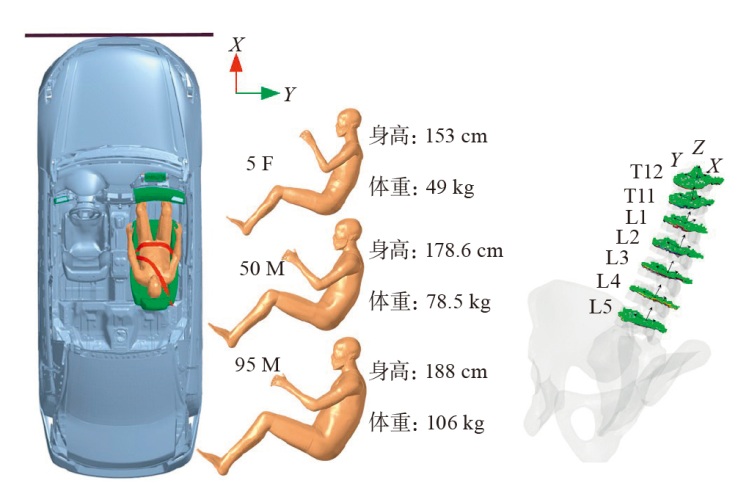
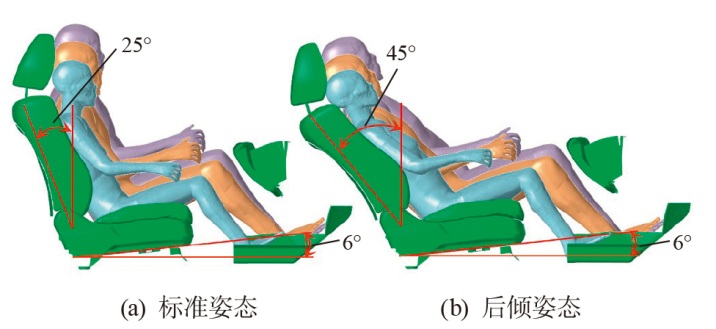
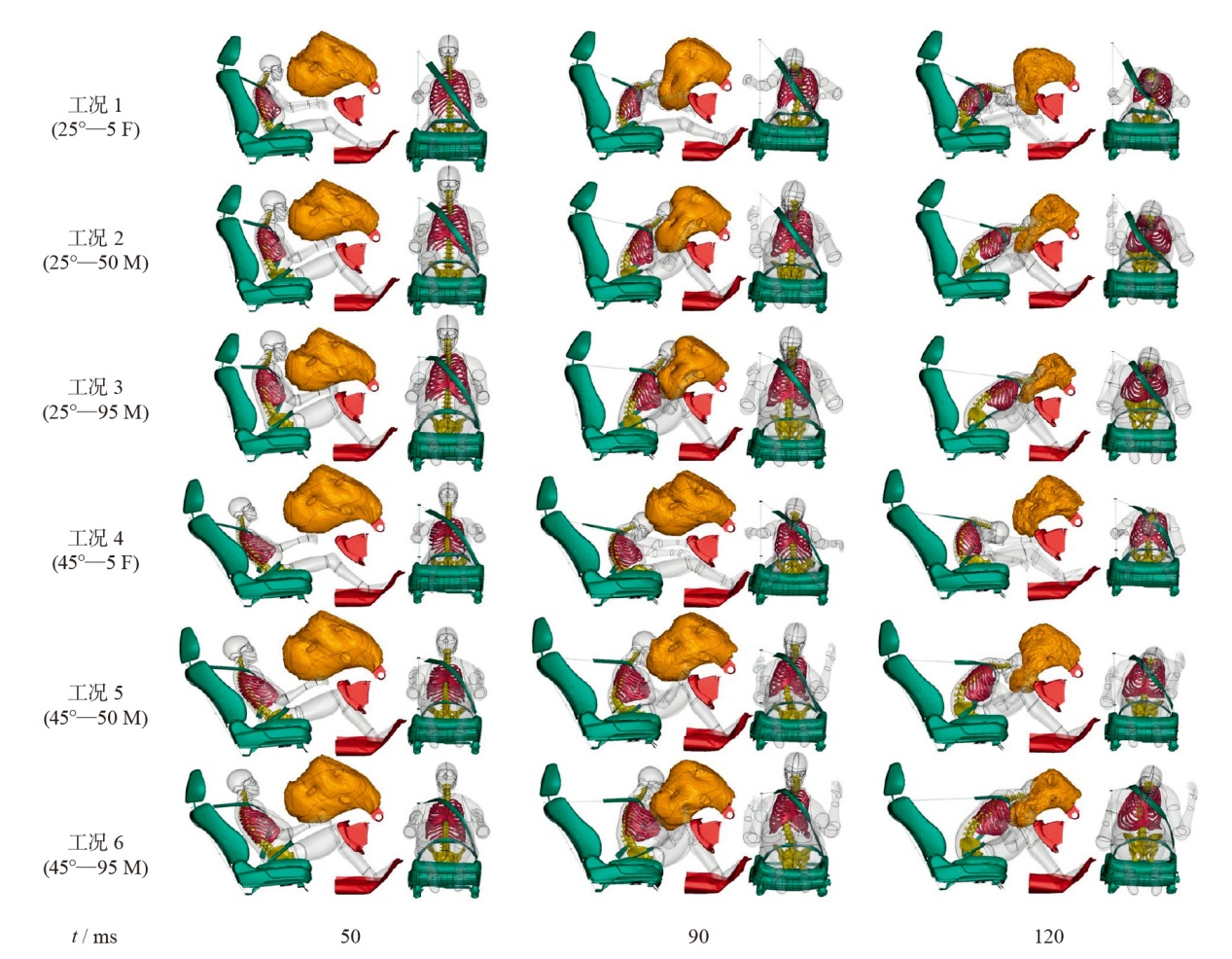
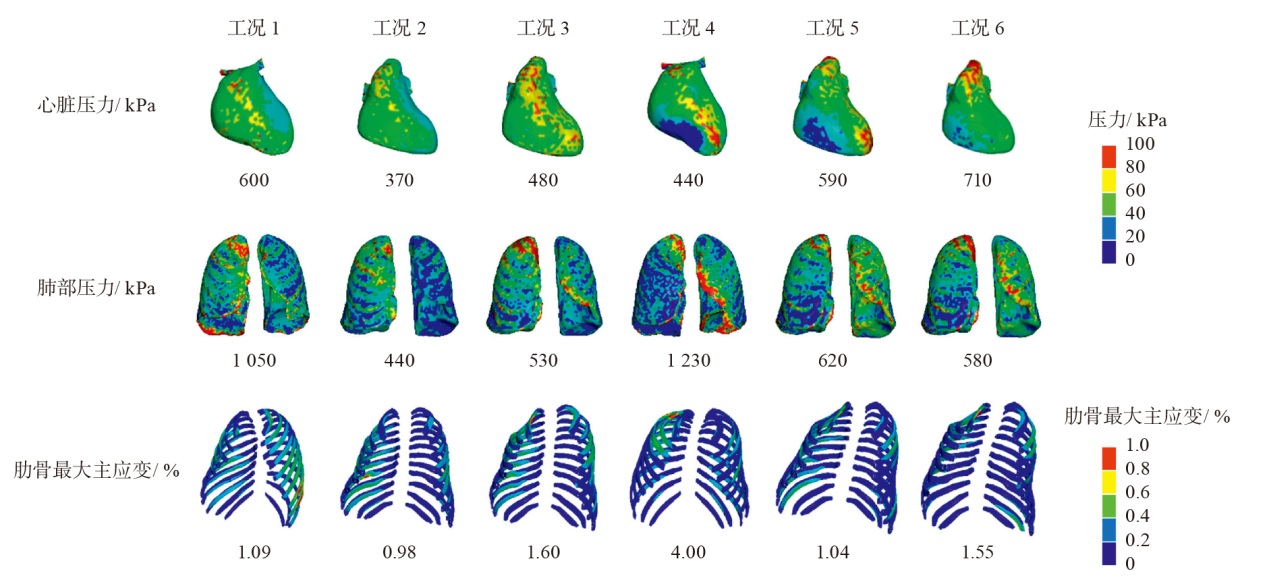
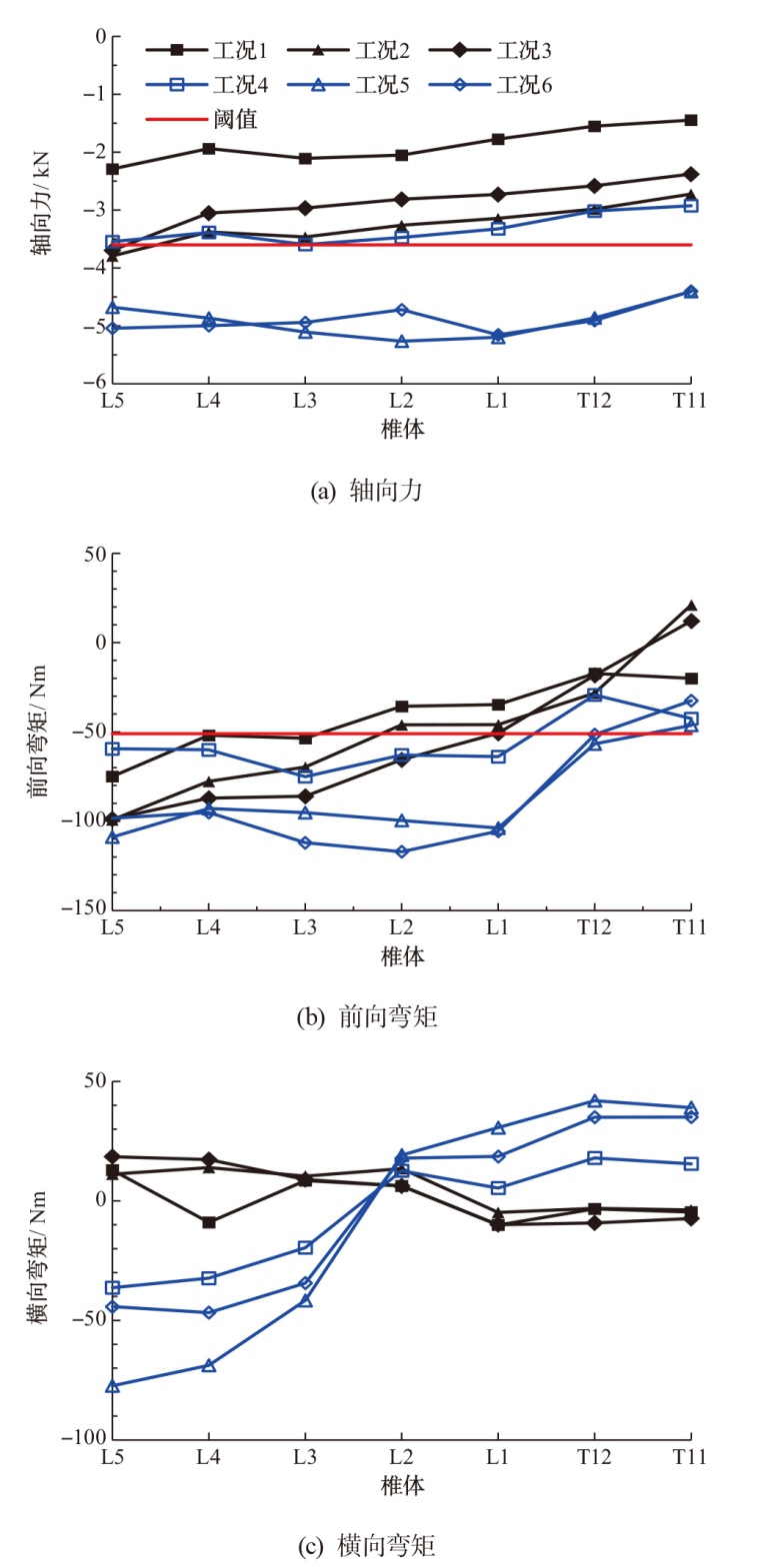
为探究正面碰撞中后倾姿态及体型差异对胸部及胸腰椎(T11—L5)损伤的影响,该文基于整车正面100%重叠刚性壁障碰撞模型,采用第5百分位女性(5 F)、第50(50 M)及第95百分位男性(95 M)人体有限元模型THUMS,对比了标准与后倾姿态下乘员的运动学响应与损伤风险。结果表明:后倾姿态会普遍加剧损伤风险,且损伤模式呈现显著的体型特异性。在后倾姿态下,5 F胸部损伤风险最为突出,其肺部压力高达1 230 kPa,肋骨最大主应变达4%;50 M与95 M的损伤风险则集中于胸腰椎,其中50 M的腰椎L2轴向力与前向弯矩峰值分别超损伤阈值44%、129%,95 M的腰椎L1轴向力超阈值38%,L5前向弯矩峰值超阈值111%;胸腰椎横向弯矩随体型增大而增加。
中图分类号:
黄志山, 潘迪, 韩勇, 肖宗瀚, 刘慧, 覃帧员. 正面碰撞中后倾乘员体型对胸腰椎损伤风险的影响[J]. 汽车安全与节能学报, 2026, 17(1): 50-58.
HUANG Zhishan, PAN Di, HAN Yong, XIAO Zonghan, LIU Hui, QIN Zhenyuan. Effects of occupant anthropometry on thoracolumbar injury risk in reclined postures during frontal collisions[J]. Journal of Automotive Safety and Energy, 2026, 17(1): 50-58.
| 损伤部位 | 损伤评价指标 | 参考阈值 |
|---|---|---|
| 胸部 | 胸部3 ms合成加速度/g | 60 [ |
| 胸部压缩量/mm | 高性能限值22 [ | |
| 低性能限值50 [ | ||
| 心脏压力/kPa | 170 [ | |
| 肺部压力/kPa | 16 [ | |
| 肋骨最大主应变(皮质骨) | 2.4% [ | |
| 胸腰椎 | 轴向力/kN | 3.6 [ |
| 前向弯矩/Nm | 51 [ | |
| 横向弯矩/Nm | 仅输出参考 |
| 损伤部位 | 损伤评价指标 | 参考阈值 |
|---|---|---|
| 胸部 | 胸部3 ms合成加速度/g | 60 [ |
| 胸部压缩量/mm | 高性能限值22 [ | |
| 低性能限值50 [ | ||
| 心脏压力/kPa | 170 [ | |
| 肺部压力/kPa | 16 [ | |
| 肋骨最大主应变(皮质骨) | 2.4% [ | |
| 胸腰椎 | 轴向力/kN | 3.6 [ |
| 前向弯矩/Nm | 51 [ | |
| 横向弯矩/Nm | 仅输出参考 |
| [1] | 中华人民共和国国家统计局. 中国统计年鉴[M]. 北京: 中国统计出版社, 2023: 24-25. |
| National Bureau of Statistics.2023 China Statistical Yearbook[M]. Beijing: China Statistics Press, 2023: 24-25. (in Chinese) | |
| [2] | 李海岩, 苏航杰, 祝贺, 等. 中国体征3岁儿童乘员损伤仿生模型在C-NCAP正面碰撞测试仿真中的应用[J]. 汽车工程, 2022, 44(12): 1944-1953. |
| LI Haiyan, SU Hangjie, ZHU He, et al. The application of the injury bionic model of Chinese three-year-old child occupant to the simulation of C-NCAP frontal crash tests[J]. Autom Engineering, 2022, 44(12): 1944-1953. (in Chinese) | |
| [3] | Sofia J, Katarina B, Annika L. Seating positions and activities in highly automated cars-a qualitative study of future automated driving scenarios[C]// Proc IRCOBI, Antwerp (Belgium), 2017: 17-11. |
| [4] | Östling M, Annika L. Occupant activities and sitting positions in automated vehicles in China and Sweden[C]// Proc ESV conf, Eindhoven (Netherlands), 2019: 19-83. |
| [5] | Schaefer L C, Junge M, Vörös I, et al. Odds ratios for reclined seating positions in real-world crashes[J]. Acci Anal Prev, 2021, 161(0): 106357. |
| [6] |
Richardson R, Donlon J P, Javathirtha M, et al. Kinematic and injury response of reclined PMHS in frontal impacts[J]. Stapp Car Crash J, 2020, 64: 83-153.
doi: 10.4271/2020-22-0004 pmid: 33636004 |
| [7] | Richardson R, Javathirtha M, Chastain K, et al. Thoraco-lumbar spine kinematics and injuries in frontal impacts with reclined occupants[J]. Traf Inju Prev, 2020, 21(1): S66-S71. |
| [8] | Yoganandan N, Sommasundaram K, Pintar F. Analysis of experimental injuries to obese occupants with different postures in frontal impact[J]. Acci Anal Prev, 2023, 193: 107294. |
| [9] | Baudrit P, Uriot J, Richard O, et al. Investigation of potential injury patterns and occupant kinematics in frontal impact with PMHS in reclined postures[J]. Stap Car Crash J, 2022, 66(1): 1-30. |
| [10] | Kang Y S, Detitt T, Marcallini A, et al. Responses and injuries of male post-mortem human subjects (PMHS) seated in an unreinforced production seat in rear-facing frontal impacts[C]// Proc IRCOBI, Stockholm (Sweden), 2024: 24-31. |
| [11] | Rawska K, Gepner B, Kulkarni S, et al. Submarining sensitivity across varied anthropometry in an autonomous driving system environment[J]. Traf Inju Prev, 2019, 20(2): 1-5. |
| [12] | Rawska K, Gepner B, Moreau M, et al. Submarining sensitivity across varied seat configurations in autonomous driving system environment[J]. Traf Inju Prev, 2020, 21(1): S1-S6. |
| [13] | Rawska K, Gepner B, Jason R. K. Effect of various restraint configurations on submarining occurrence across varied seat configurations in autonomous driving system environment[J]. Traf Inju Prev, 2021, 22(1): S128-S133. |
| [14] | Takeuchi Y, Tanaka Y, Azuma T, et al. Predictive modeling of submarining risk in car occupants based on pelvis angle and lap belt positioning[J]. Traf Inju Prev, 2024, 25(2): 147-155. |
| [15] | Leledakis A, Östh J, Iraeusi J, et al. Influence of an individualised shoulder belt position for diverse occupant anthropometries on seatbelt interaction in frontal and side Impacts[C]// Proc IRCOBI, Cambridge (UK), 2023: 23-82. |
| [16] | Singh H, Ganesan V, Davies J, et al. Vehicle interior and restraints modeling development of full vehicle finite element model including vehicle interior and occupant restraints systems for occupant safety analysis using THOR dummies[R]. Washington: national highway traffic safety administration, 2018. |
| [17] | Iwamoto M, Kisanuki Y, Watanabe I, et al. Development of a finite element model of the total human model for safety (THUMS) and application to injury reconstruction[C]// Proc IRCOBI, Munich (Germany), 2002: 31-42. |
| [18] | Boyle K, Fanta A, Reed M P, et al. Restraint systems considering occupant diversity and pre-crash posture[J]. Traf Inj Prev, 2020, 21(1): S31-S36. |
| [19] | Izumiyama T, Nishida N, Yamagata H, et al. Analysis of individual variabilities for lumbar and pelvic alignment in highly reclined seating postures and occupant kinematics in a collision[C]// Proc IRCOBI, Porto (Portugal), 2022: 22-113. |
| [20] | Hollowell W T, Gabler H C, STucki S L, et al. FMVSS NO. 208[S]. The United States: National highway traffic safety administration (NHTSA), 1966. |
| [21] | C-NCAP管理中心. C-NCAP管理规则(2024版)[S]. 天津: 中国汽车技术研究中心, 2024. |
| C-NCAP Management Center. C-NCAP management regulation (2024 version)[S]. Tianjin: China Automotive Technology and Research Center Co., 2024. (in Chinese) | |
| [22] |
Ruan J, El-jawahri R, Chai L, et al. Prediction and analysis of human thoracic impact responses and injuries in cadaver impacts using a full human body finite element model[J]. Stapp Car Crash J, 2003, 47: 299-321.
pmid: 17096254 |
| [23] | Kemper R A, Mcnally C, Pullins A C, et al. The biome-chanics of human ribs: material and structural properties from dynamic tension and bending tests[J]. Stapp Car Crash J, 2007, 51: 235-273. |
| [24] | Yoganandan N, Arun M W, Stemper B D, et al. Biome-chanics of human thoracolumbar spinal column trauma from vertical impact loading[J]. Anna Adva Autom Medi, 2013, 57: 155-166. |
| [25] |
Tushak S K, Donlona J P, Gepner B D. et al. Failure tolerance of the human lumbar spine in dynamic combined compression and flexion loading[J]. J Biomech, 2022, 135: 111051.
doi: 10.1016/j.jbiomech.2022.111051 URL |
| [26] | Boyle k J, Reed M P, Zaseck L W, et al. A human modelling study on occupant kinematics in highly reclined seats during frontal crashes[C]// Proc IRCOBI, Florence (Italy) 2019: 19-43. |
| [27] | 姬佩君. 均衡约束概念的乘员碰撞保护研究[D]. 北京: 清华大学, 2016. |
| JI Peijun. Study of uniform occupant restraint system on vehicle crash protection[D]. Beijing: Tsinghua university, 2016. (in Chinese) | |
| [28] | Joji I, Bernard H G. Thoracolumbar junction injuries after motor vehicle collision: are there differences in restrained and nonrestrained front seat occupants?[J]. J Neurosurge. Spin, 2007, 7(3): 311-314. |
| [29] | TANG Liang, ZHENG Jiajia, HU Jingwen. A numerical investigation of factors affecting lumbar spine injuries in frontal crashes[J]. Acci Anal Prev, 2020, 136(0): 105400. |
| [1] | 韩勇, 徐国超, 李明旺, 潘迪, 张海洋. 非法规侧面碰撞工况下近远端乘员损伤风险[J]. 汽车安全与节能学报, 2025, 16(1): 57-65. |
| [2] | 武和全, 李羿辉, 刘瑾, 张申奥. 不同坐姿乘员在自动驾驶汽车碰撞中的损伤仿真实验[J]. 汽车安全与节能学报, 2024, 15(4): 484-491. |
| [3] | 刘贽, 林淼, 代兵, 王文霞, 孟庆南, 莫富灏. 基于中国汽车-行人事故数据的老龄人与青壮年行人损伤特征对比分析[J]. 汽车安全与节能学报, 2024, 15(2): 154-160. |
| [4] | 武和全, 周惠来, 李羿辉, 胡林. 汽车正面碰撞中后排不同坐姿乘员损伤生物力学分析[J]. 汽车安全与节能学报, 2023, 14(6): 688-697. |
| [5] | 唐友名, 谢祥键, 孙贵斌, 王平, 张义, 孙冠豫. 男性老龄乘员年龄增长对损伤风险的影响[J]. 汽车安全与节能学报, 2023, 14(4): 413-420. |
| [6] | 叶凡, 王丙雨, 韩勇, 叶赛峰, 余意. 正碰下6岁儿童乘员的胸部运动学方程与损伤风险分析[J]. 汽车安全与节能学报, 2022, 13(4): 617-624. |
| [7] | 刘金明, 马华星, 李奎, 李桂兵. 行人头部与车辆碰撞中旋转速度对颅脑组织响应影响[J]. 汽车安全与节能学报, 2021, 12(1): 70-78. |
| [8] | 董宇喆,王波,张金换. 某车载圆柱形货箱防护装置的碰撞安全性设计改进[J]. JASE, 2019, 10(4): 467-473. |
| [9] | 曹立波,刘忠臣,吴俊,姚远,冯谢星. 四合一汽车辅助驾驶系统控制决策的开发与实车测试[J]. JASE, 2017, 08(02): 122-127. |
| [10] | 张金换, 杨洁, 金鑫, 沈明, 罗逍, 马春生. 中美人体尺寸差异及对车辆正碰中驾驶员损伤风险的影响( 英文)[J]. 汽车安全与节能学报, 2016, 07(02): 175-181. |
| [11] | 曹立波,刘飞霞,颜凌波. 腹部塞块刚度对女性乘员损伤参数及下潜的影响[J]. 汽车安全与节能学报, 2015, 6(04): 354-359. |
| [12] | 张金换, 李浩, 周勇, 付海龙, 黄杨, 肖凌云, 胡文浩, 董红磊. 支撑腿误使用对ISOFIX 型儿童座椅安全性能的影响[J]. 汽车安全与节能学报, 2015, 6(04): 360-364. |
| [13] | 胡远志, 梁永福, 蒋成约, 刘西, 廖高建, 冯擎峰, 刘卫国. 人体有限元模型THUMS 用于正面碰撞乘员损伤研究[J]. 汽车安全与节能学报, 2015, 6(04): 379-383. |
| [14] | 曹立波,周登科,朱结,江岸. 全承载式客车正面碰撞安全性的改进[J]. 汽车安全与节能学报, 2015, 6(01): 58-65. |
| [15] | 王月,尹高纪,周大永,刘卫国,孙立志. 某车型正面40% 偏置碰撞的车体结构优化[J]. 汽车安全与节能学报, 2014, 5(04): 371-377. |
| 阅读次数 | ||||||
|
全文 |
|
|||||
|
摘要 |
|
|||||
