Welcome to Journal of Automotive Safety and Energy,

Journal of Automotive Safety and Energy ›› 2025, Vol. 16 ›› Issue (6): 813-831.DOI: 10.3969/j.issn.1674-8484.2025.06.001
• Review, Progress and Prospects • Next Articles
ZHAO Jian1,*( ), GONG Jue1, FAN Kefeng2,*(), LIU Pengbo1, LI Linhui1, WANG Xiang1, XU Zheng1, DONG Zeyuan1, YAO Nianmin3
Received:2025-12-11
Revised:2025-12-20
Online:2025-12-31
Published:2026-01-12
CLC Number:
ZHAO Jian, GONG Jue, FAN Kefeng, LIU Pengbo, LI Linhui, WANG Xiang, XU Zheng, DONG Zeyuan, YAO Nianmin. Safety and protection technologies for intelligent vehicles with strongly coupled structural, functional and information domains[J]. Journal of Automotive Safety and Energy, 2025, 16(6): 813-831.
Add to citation manager EndNote|Ris|BibTeX
URL: https://www.journalase.com/EN/10.3969/j.issn.1674-8484.2025.06.001
| 研究方向 | 典型对象/场景 | 主要技术路径 | 关键挑战 |
|---|---|---|---|
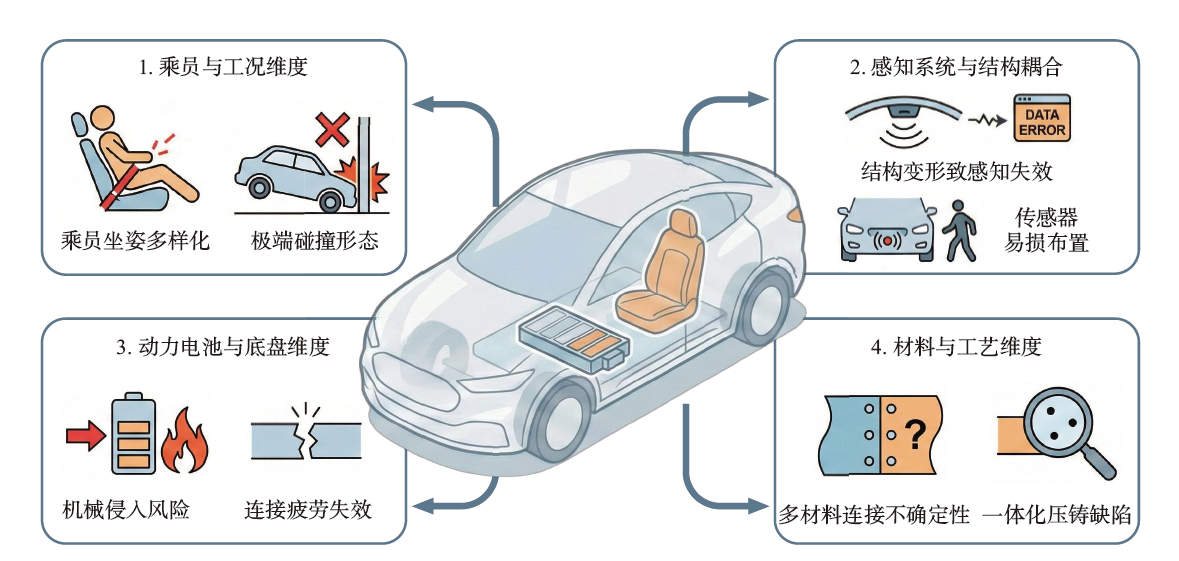
| 乘员保护与约束系统自适应 | 多体型、多姿态乘员,高等级自动驾驶座舱布局 | 生物力学模型与伤害判据,基于姿态/体型感知的约束自适应控制 | 长尾姿态覆盖不足,与主动安全和自动驾驶功能协同不充分 |
| 极端工况下的可控吸能结构及传感器外部防护 | 典型与极端碰撞工况,外覆件集成的雷达、摄像头等传感器 | 折纸/蜂窝等新型吸能构型,多目标轻量化优化,多层防护与电磁兼容一体化设计 | 对材料和工艺敏感,整车级集成与成本约束下工程适用性不足 |
| 电池包机械侵入防护与载荷路径优化 | 动力电池包及其周边结构,正碰、侧碰和底部障碍物撞击等工况 | 载荷传递路径规划,壳体/护板/侧梁等构件加强,复合材料与一体化底部护板设计 | 机械侵入-热失控耦合机理认知不足,多目标设计规范和安全裕度评估体系不完善 |
| 多材料连接与一体化车身结构设计 | 异种材料连接部位,大型一体化压铸件等承载结构 | 表面微结构与混合连接工艺,组织-性能关联建模与工艺优化 | 界面强度与耐久性不确定,局部损伤与修复困难,轻量化与可维护性之间权衡突出 |
| 研究方向 | 典型对象/场景 | 主要技术路径 | 关键挑战 |
|---|---|---|---|
| 乘员保护与约束系统自适应 | 多体型、多姿态乘员,高等级自动驾驶座舱布局 | 生物力学模型与伤害判据,基于姿态/体型感知的约束自适应控制 | 长尾姿态覆盖不足,与主动安全和自动驾驶功能协同不充分 |
| 极端工况下的可控吸能结构及传感器外部防护 | 典型与极端碰撞工况,外覆件集成的雷达、摄像头等传感器 | 折纸/蜂窝等新型吸能构型,多目标轻量化优化,多层防护与电磁兼容一体化设计 | 对材料和工艺敏感,整车级集成与成本约束下工程适用性不足 |
| 电池包机械侵入防护与载荷路径优化 | 动力电池包及其周边结构,正碰、侧碰和底部障碍物撞击等工况 | 载荷传递路径规划,壳体/护板/侧梁等构件加强,复合材料与一体化底部护板设计 | 机械侵入-热失控耦合机理认知不足,多目标设计规范和安全裕度评估体系不完善 |
| 多材料连接与一体化车身结构设计 | 异种材料连接部位,大型一体化压铸件等承载结构 | 表面微结构与混合连接工艺,组织-性能关联建模与工艺优化 | 界面强度与耐久性不确定,局部损伤与修复困难,轻量化与可维护性之间权衡突出 |
| 车载网络 | 应用 | 安全防护漏洞 |
|---|---|---|
| CAN | 发动机、动力转向、变速器、仪表盘、故障诊断等系统 | 无加密机制、缺乏身份认证机制、广播通信 |
| LIN | 车门、车灯、转向盘、座椅等系统 | 无加密机制、缺乏身份认证机制、主从架构脆弱 |
| FlexRay | 信息娱乐系统、高级动力总成、ABS等系统 | 无加密机制、高度依赖时间同步 |
| MOST | 车载摄像头、车载电视、车载电话、车载互联网等系统 | 无加密机制、环形拓扑单点失效 |
| 车载以太网 | 显示与导航系统、后座娱乐系统、驾驶辅助系统等 | 缺乏流量控制、广播通信 |
| 车载网络 | 应用 | 安全防护漏洞 |
|---|---|---|
| CAN | 发动机、动力转向、变速器、仪表盘、故障诊断等系统 | 无加密机制、缺乏身份认证机制、广播通信 |
| LIN | 车门、车灯、转向盘、座椅等系统 | 无加密机制、缺乏身份认证机制、主从架构脆弱 |
| FlexRay | 信息娱乐系统、高级动力总成、ABS等系统 | 无加密机制、高度依赖时间同步 |
| MOST | 车载摄像头、车载电视、车载电话、车载互联网等系统 | 无加密机制、环形拓扑单点失效 |
| 车载以太网 | 显示与导航系统、后座娱乐系统、驾驶辅助系统等 | 缺乏流量控制、广播通信 |
| 层级 | 主要目标 | 关键模块 | 典型手段 |
|---|---|---|---|
| 顶层设计与指标体系 | 统一安全元模型,构建跨域指标体系与场景库 | 安全元模型、指标/等级体系、场景库与用例管理 | 跨域失效链建模、安全指标分解与量化、场景分层编码 |
| 数据采集与场景构建 | 全面采集结构-功能-信息三域运行数据,并可控注入风险 | 物理状态采集、车载网络与V2X数据采集、场景重放与风险注入接口 | 传感器与总线数据记录、HIL/SIL接口、故障/攻击脚本库 |
| 分析评估与仿真验证 | 开展跨域风险分析与防护策略评估 | 多域协同仿真、风险评估与指标计算、策略验证模块 | 结构-功能-信息协同仿真、定量风险评估、多策略对比试验 |
| 测试管理与数据资产化 | 统一管理测试流程与数据资产,支撑闭环迭代 | 测试计划与流程管理、数据存储与标注、安全知识库与报告生成 | 测试过程追踪与回溯、场景与事件知识库构建、自动化报告生成 |
| 层级 | 主要目标 | 关键模块 | 典型手段 |
|---|---|---|---|
| 顶层设计与指标体系 | 统一安全元模型,构建跨域指标体系与场景库 | 安全元模型、指标/等级体系、场景库与用例管理 | 跨域失效链建模、安全指标分解与量化、场景分层编码 |
| 数据采集与场景构建 | 全面采集结构-功能-信息三域运行数据,并可控注入风险 | 物理状态采集、车载网络与V2X数据采集、场景重放与风险注入接口 | 传感器与总线数据记录、HIL/SIL接口、故障/攻击脚本库 |
| 分析评估与仿真验证 | 开展跨域风险分析与防护策略评估 | 多域协同仿真、风险评估与指标计算、策略验证模块 | 结构-功能-信息协同仿真、定量风险评估、多策略对比试验 |
| 测试管理与数据资产化 | 统一管理测试流程与数据资产,支撑闭环迭代 | 测试计划与流程管理、数据存储与标注、安全知识库与报告生成 | 测试过程追踪与回溯、场景与事件知识库构建、自动化报告生成 |
| [1] | 工业和信息化部. 汽车驾驶自动化分级[S]. 北京: 工业和信息化部, 2021. |
| Ministry of Industry and Information Technology. Classification of automated driving for automobiles[S]. Beijing: Ministry of Industry and Information Technology, 2021. (in Chinese) | |
| [2] | 工业和信息化部,交通运输部. 关于加强智能网联汽车生产企业及产品准入管理的意见[S]. 北京: 工业和信息化部, 2023. |
| Ministry of Industry and Information Technology, Ministry of Transport. Opinions on strengthening the access management of intelligent and connected vehicle manufacturers and products[S]. Beijing: Ministry of Industry and Information Technology, 2023. (in Chinese) | |
| [3] | 李克强, 李家文, 常雪阳, 等. 智能网联汽车云控系统原理及其典型应用[J]. 汽车安全与节能学报, 2020, 11(3): 261-275. |
| LI Keqiang, LI Jiawen, CHANG Xueyang, et al. Principle and typical applications of cloud control system for intelligent and connected vehicles[J]. J Autom Safe Energ, 2020, 11(3): 261-275. (in Chinese) | |
| [4] | 杨帅, 张金换, 钱占伟, 等. 汽车安全多领域融合的研究与展望[J]. 汽车安全与节能学报, 2022, 13(1): 29-47. |
| YANG Shuai, ZHANG Jinhuan, QIAN Zhanwei, et al. Research and prospect of multi-domain integration of automobile safety[J]. J Automo Safe Energ, 2022, 13(1): 29-47. (in Chinese) | |
| [5] | 国家市场监督管理总局, 国家标准化管理委员会. GB 11551-2014:汽车正面碰撞的乘员保护[S]. 北京: 中国标准出版社, 2014. |
| State Administration for Market Regulation,Standardization Administration of China. GB 11551-2014:Protection of the occupants in the event of a frontal collision for motor vehicles [S]. Beijing: China Standards Press, 2014. (in Chinese) | |
| [6] | 国家市场监督管理总局, 国家标准化管理委员会. GB 38031-2020: 电动汽车用动力蓄电池安全要求[S]. 北京: 中国标准出版社, 2020. |
| State Administration for Market Regulation,Standardization Administration of China. GB 38031-2020: Safety requirements for traction battery of electric vehicles [S]. Beijing: China Standards Press, 2020. (in Chinese) | |
| [7] | International Organization for Standardization (ISO). ISO 26262 Road vehicles:Functional safety [S]. Geneva: ISO, 2018. |
| [8] | 国家市场监督管理总局, 国家标准化管理委员会. GB/T 40861-2021: 汽车整车信息安全技术要求[S]. 北京: 中国标准出版社, 2021. |
| State Administration for Market Regulation,Standardization Administration of China. GB/T 40861-2021: Cybersecurity requirements for motor vehicles [S]. Beijing: China Standards Press, 2021. (in Chinese) | |
| [9] | Forman J, LIN Hongnan, Gepner B, et al. Occupant safety in automated vehicles-effect of seatback recline on occupant restraint[J]. Int’l J Autom Engi, 2019, 10(2): 139-143. |
| [10] | Naiek S M, Aungsuthar S, Harper C, et al. Battery electric vehicle safety issues and policy: A review[J]. World Elect Vehi J, 2025, 16(7): 1-18. |
| [11] | Almaskati D, Kermanshachi S, Pamidimukkala A. Investigating the impacts of autonomous vehicles on crash severity and traffic safety[J]. Front Built Environ, 2024, 10: 1-10. |
| [12] | Naito J, Suzuki R. Multi-material automotive bodies and dissimilar joining technology to realize multi-material[J]. Kobelco Tech Rev, 2020, 38(3): 32-37. |
| [13] | Meschut G, Janzen V, Olfermann T. Innovative and highly productive joining technologies for multi-material lightweight car body structures[J]. J Mater Engi Perform, 2014, 23(5): 1515-1523. |
| [14] | Lambiase F, Scipioni S I, Lee C J, et al. A state-of-the-art review on advanced joining processes for metal-composite and metal-polymer hybrid structures[J]. Materials, 2021, 14(8): 1-24. |
| [15] | Çam S, Sofuoğlu H. An investigation on crashworthiness performance of adhesive bonding in automobile hybrid front bumper system subjected to high-speed impact[J]. Int’l J Impact Engi, 2023, 173: 1-14. |
| [16] | Lordan E, ZHANG Yijie, Dou K, et al. High-pressure die casting: A review of progress from the EPSRC future lime hub[J]. Metals, 2022, 12(10): 1-17. |
| [17] | Belingardi G, Scattina A. Battery pack and underbody: Integration in the structure design for battery electric vehicles: Challenges and solutions[J]. Vehicles, 2023, 5(2): 498-514. |
| [18] | Krüger C, Spohr S, Merdivan D, et al. Avoiding structural redundancies between the vehicle body and the battery housing based on a functional integration approach[J]. Autom Engi Tech, 2022, 7(3): 197-208. |
| [19] | Kawsar I, LI Honggang, LIU Binghe, et al. Enhancing mechanical reliability and safety performance of a battery pack system for electric vehicles: A review[J]. eTransportation, 2025, 26: 1-37. |
| [20] | WANG Qigui, Andy W, Coryell J. Ultra-large aluminum shape casting: Opportunities and challenges[J]. China Foundry, 2024, 21(5): 397-408. |
| [21] | Tenkamp J, Awd M, Siddique S, et al. Fracture-mechanical assessment of the effect of defects on the fatigue lifetime and limit in cast and additively manufactured aluminum-silicon alloys from HCF to VHCF regime[J]. Metals, 2020, 10(7): 1-18. |
| [22] | United Nations Economic Commission for Europe. Uniform provisions concerning the approval of motor vehicles with regard to their pedestrian safety performance: UN Regulation No.127 [S]. Geneva: United Nations, 2012. |
| [23] | Matos F, Bernardino J, Durães J, et al. A survey on sensor failures in autonomous vehicles: Challenges and solutions[J]. Sensors, 2024, 24(16): 1-22. |
| [24] | Ayala R, Mohd T K. Sensors in autonomous vehicles: A survey[J]. J Autom Vehi Syst, 2021, 1(3): 1-12. |
| [25] | Jorlöv S, Bohman K, Larsson A. Seating positions and activities in highly automated cars-a qualitative study of future automated driving scenarios[C]// Int' l Res Conf Biomech Impact. Antwerp, Belgium. 2017: 11-17. |
| [26] | Köhler A L, Pelzer J, Seidel K, et al. Sitting postures and activities in autonomous vehicles-new requirements towards occupant safety[C]// Proc Hum Fact Ergon Soc Annu Meet. Los Angeles, USA. 2019, 63(1): 1874-1878. |
| [27] | Boin M. Occupant protection in alternative seating positions[C]// 15th LS-DYNA F. Bamberg, Germany. 2018. |
| [28] | Shim S, Kim T, Kim J. Sensitivity analysis on the effect of occupant-and vehicle-related parameters on injury risk during autonomous vehicle crash[J]. Appl Sci, 2025, 15(12): 1-23. |
| [29] | YANG Rong, LI Shiyu, CHENG Tianhao, et al. Enhanced side pole impact protection: Crashworthiness optimization for electric micro commercial vehicles[J]. Appl Sci, 2025, 15(4): 1-18. |
| [30] | Hierlinger T, Lienkamp M, Unger J, et al. Potential of a precrash lateral occupant movement in side collisions of (electric) minicars[J]. Traf Injur Prev, 2015, 16(1): 153-158. |
| [31] | 张金换, 刘明, 张朔, 等. 车辆碰撞中乘员各部位动态响应及能量关系研究[J]. 汽车安全与节能学报, 2010, 1(1): 23-29. |
| ZHANG Jinhuan, LIU Ming, ZHANG Shuo, et al. Dynamic response and energy relationship of a passenger's different parts in vehicle crash[J]. J Autom Safe Energ, 2010, 1(1): 23-29. (in Chinese) | |
| [32] | 张金换, 刘明, 陈立, 等. 汽车儿童安全保护的欧美法规对比及未来研究方向[J]. 汽车安全与节能学报, 2011, 2(3): 185-191. |
| ZHANG Jinhuan, LIU Ming, CHEN Li, et al. Child passenger safety regulation comparison between Europe and United States and the developing trends[J]. J Autom Safe Energ, 2011, 2(3): 185-191. (in Chinese) | |
| [33] | Adam T, Untaroiu C D. Identification of occupant posture using a bayesian classification methodology to reduce the risk of injury in a collision[J]. Transport Res C-Emer, 2011, 19(6): 1078-1094. |
| [34] | Tomita S, Shimanuki K, Nishigaki H, et al. Origami-inspired metamaterials with switchable energy absorption based on bifurcated motions of a Tachi-Miura polyhedron[J]. Mater Desig, 2023, 225: 1-11. |
| [35] | Zahedan N, Ahmadi H, Liaghat G H. Experimental and numerical investigation on the multi-optimization of reinforcing the side members of the vehicle structure[J]. Arch Civil Mech Engi, 2022, 22(1): 1-18. |
| [36] | Amiri N, Tasnim F, Anbarani M T, et al. Experimentally verified finite element modeling and analysis of a conformable piezoelectric sensor[J]. Smart Mate Struct, 2022, 30(8): 1-13. |
| [37] | 秦孔建, 吴志新, eds. 陈虹, 编. 智能网联汽车测试与评价技术[M]. 北京: 机械工业出版社, 2021: 235-239. |
| QIN Kongjian, WU Zhixin, CHEN Hong, Testing and Evaluation Technology of Intelligent Connected Vehicles [M]. Beijing: Mechanical Industry Press, 2021: 235-239. (in Chinese) | |
| [38] | ZHAO Jian, ZHONG Heng, SUN Rongjian, et al. A tunable two-stage bandpass filter incorporating two electromag-netically coupled curved beams[J]. J Microelectromech Syst, 2024, 33(4): 482-494. |
| [39] | ZHENG Xianze, ZHAO Jian, Kacem N, et al. Three-axis inertial sensing based on a valley topological phononic metamaterial[J]. Phys Rev Appl, 2025, 23(1): 1-9. |
| [40] | ZHAO Jian, ZHENG Xianze, Kacem N, et al. Electrostatically coupled tunable topological phononic metamaterials for angular velocity sensing[J]. Phys Rev B, 2024, 109(7): 1-7. |
| [41] | ZHENG Xianze, ZHAO Jian, Kacem N, et al. Toward acceleration sensing based on topological gyroscopic metamaterials[J]. Phys Rev B, 2022, 106(9): 1-10. |
| [42] | Mortazavi M A, Kheradpisheh A, Asgari M. An integrated energy absorbing module for battery protection of electric vehicle under lateral pole impact[J]. Int’l J Crashworth, 2023, 28(3): 321-333. |
| [43] | Salifu S, Desai D, Ogunbiyi O, et al. Comparative study of high velocity impact response of aluminium 3105-H18 and carbon fibre-epoxy composite double hat bumper beams[J]. Mater Today Proc, 2021, 38: 712-716. |
| [44] | Um H J, Hwang Y T, Bae I J, et al. Design and manufacture of thermoplastic carbon fiber/polyethylene terephthalate composites underbody shield to protect the lithium-ion batteries for electric mobility from ground impact[J]. Compos Part B-Eng, 2022, 238: 1-12. |
| [45] | 周华晨, 赵剑, 李海洋, 等. 压电式冲击传感器压电变系数多自由度力电耦合动力学分析与设计[J]. 机械工程学报, 2025, 61(4): 1-10. |
| ZHOU Huachen, ZHAO Jian, LI Haiyang, et al. Analysis and design of piezoelectric shock sensor piezoelectric variable coefficient multi-degree-of-freedom force-electric coupling dynamics[J]. J Mech Engi, 2025, 61(4): 1-10. (in Chinese) | |
| [46] | ZHAO Jian, ZHOU Huachen, LIU Pengbo, et al. Sensitivity enhancement for resonant multi-dimensional force sensor through integrated optimization of elastic structure and piezoelectric patch layout[J]. Sens Actu A: Phys, 2025: 1-14. |
| [47] | Shikimoto K, Ishida S, Jinnouchi W, et al. Effect of laser patterning preprocessing on fatigue strength of adhesive bonded joints using thin steel plate[J]. Mater Trans, 2020, 61(3): 469-474. |
| [48] | HUANG Minjie, JIANG Jufu, WANG Ying, et al. Correlation between microstructures and mechanical properties of super-sized new-energy automobile structural component formed by vacuum HPDC process[J]. J Mate Res, 2025, 36: 1146-1159. |
| [49] | Gryz K, Karpowicz J, Zradziński P. Complex electromagnetic issues associated with the use of electric vehicles in urban transportation[J]. Sensors, 2022, 22(5): 1-15. |
| [50] | GAO Feng, XU Mingli. Reduction of electric vehicle electromagnetic radiations using a global network model[J]. J Electromagn Engi Sci, 2023, 23(4): 335-343. |
| [51] | Chudy A, Stryczewska H D. Electromagnetic compatibility testing of electric vehicles and their chargers[J]. Info Autom Pomiary Gospod Ochr Środow, 2020, 10(3): 70-73. |
| [52] | Yeong D J, Velasco H G, Barry J, et al. Sensor and sensor fusion technology in autonomous vehicles: A review[J]. Sensors, 2021, 21(6): 1-37. |
| [53] | Raj T, Hashim F H, Huddin A B, et al. A survey on LiDAR scanning mechanisms[J]. Electron, 2020, 9(5): 1-25. |
| [54] | Kukkala V K, Tunnell J, Pasricha S, et al. Advanced driver-assistance systems: A path toward autonomous vehicles[J]. IEEE Consum Electron Magaz, 2018, 7(5): 18-25. |
| [55] | Hasch J, Topak E, Schnabel R, et al. Millimeter-wave technology for automotive radar sensors in the 77 GHz frequency band[J]. IEEE Trans Microw Theo Tech, 2012, 60(3): 845-860. |
| [56] | Yih P, Gerdes J C. Modification of vehicle handling characteristics via steer-by-wire[J]. IEEE Trans Contr Syst Tech, 2005, 13(6): 965-976. |
| [57] | Anwar S, ZHENG Bing. An antilock-braking algorithm for an eddy-current-based brake-by-wire system[J]. IEEE Trans Vehi Tech, 2007, 56(3): 1100-1107. |
| [58] | Isermann R, Schwarz R, Stölzl S. Fault-tolerant drive-by-wire systems[J]. IEEE Contr Syst Magaz, 2002, 22(5): 64-81. |
| [59] | Rodríguez A M, Matute J, Araluce J, et al. Fault tolerance and fallback strategies in connected and automated vehicles: A review[J]. IEEE Open J Intel Transport Syst, 2025, 6: 1-20. |
| [60] | 王宇, 张成糕, 郝雯娟. 永磁电机及其驱动系统容错技术综述[J]. 中国电机工程学报, 2022(1): 351-372. |
| WANG Yu, ZHANG Chenggao, HAO Wenjuan. A review of fault-tolerant technology of permanent magnet motor and its drive system[J]. Proc CSEE, 2022(1): 351-372. (in Chinese) | |
| [61] | 陶涛, 赵文祥, 程明, 等. 多相电机容错控制及其关键技术综述[J]. 中国电机工程学报, 2019(2): 316-326. |
| TAO Tao, ZHAO Wenxiang, CHENG Ming, et al. Review on fault-tolerant control and key technologies of multiphase motor[J]. Proc CSEE, 2019(2): 316-326. (in Chinese) | |
| [62] |
Grigorescu S, Trasnea B, Cocias T, et al. A survey of deep learning techniques for autonomous driving[J]. J Field Robot, 2020, 37(3): 362-386.
doi: 10.1002/rob.21918 |
| [63] | Janai J, Güney F, Behl A, et al. Computer vision for autonomous vehicles: Problems, datasets and state of the art[J]. Found Trend Comput Graph Vis, 2020, 12(1-3): 1-308. |
| [64] | YU Fengning, LIAN Jing, LI Linhui, et al. Cascade fusion of multi-modal and multi-source feature fusion by the attention for three-dimensional object detection[J]. Engi Appl Artif Intel, 2024, 133: 1-13. |
| [65] | Eykholt K, Evtimov I, Fernandes E, et al. Robust physical-world attacks on deep learning visual classification[C]// Proc IEEE Conf Comput Vis Patt Recogn. Salt Lake City, USA. 2018: 1625-1634. |
| [66] | CAO Yulong, XIAO Chaowei, Cyr B, et al. Adversarial sensor attack on lidar-based perception in autonomous driving[C]// Proc 2019 ACM SIGSAC Conf Comput Commun Secur. London, United Kingdom. 2019: 2267-2281. |
| [67] | Ibrahum A D M, Hussain M, Hong J E. Deep learning adversarial attacks and defenses in autonomous vehicles: A systematic literature review from a safety perspective[J]. Artif Intel Rev, 2024, 58(1): 1-53. |
| [68] | Petit J, Shladover S E. Potential cyberattacks on automated vehicles[J]. IEEE Trans Intel Transport Syst, 2014, 16(2): 546-556. |
| [69] | Paden B, Čáp M, Yong S Z, et al. A survey of motion planning and control techniques for self-driving urban vehicles[J]. IEEE Trans Intel Vehi, 2016, 1(1): 33-55. |
| [70] | Schwarting W, Alonso M J, Rus D. Planning and decision-making for autonomous vehicles[J]. Annu Rev Contr Robot Auton Syst, 2018, 1(1): 187-210. |
| [71] | Babu M, Theerthala R R, Singh A K, et al. Model predictive control for autonomous driving considering actuator dynamics[C] // 2019 Am Contr Conf. IEEE, 2019: 1983-1989. |
| [72] | LI Xuefang, LIU Chengyuan, CHEN Boli, et al. Robust adaptive learning-based path tracking control of autonomous vehicles under uncertain driving environments[J]. IEEE Trans Intel Transport Syst, 2022, 23(11): 20798-20809. |
| [73] | Koopman P, Wagner M. Autonomous vehicle safety: An interdisciplinary challenge[J]. IEEE Intel Transport Syst Magaz, 2017, 9(1): 90-96. |
| [74] | Shalev S S, Shammah S, Shashua A. On a formal model of safe and scalable self-driving cars[R/OL]. arXiv preprint arXiv: 1708.06374, 2017. |
| [75] | Menzel T, Bagschik G, Maurer M. Scenarios for development, test and validation of automated vehicles[C]// Proc IEEE Intel Vehi Symp (IV). IEEE, 2018: 1821-1827. |
| [76] | Bagschik G, Menzel T, Maurer M. Ontology based scene creation for the development of automated vehicles[C]// Proc IEEE Intel Vehi Symp (IV). IEEE, 2018: 1813-1820. |
| [77] | International Organization for Standardization (ISO). ISO/PAS 21448: Road vehicles-safety of the intended functionality [S]. Geneva: ISO, 2019. |
| [78] | FANG Yanfeng, WANG Weida, YANG Chao, et al. Brake-by-wire architecture design and analysis in accordance with functional safety standard[J]. Proc Instit Mech Engi Part D-J Autom Engi, 2023, 238(12): 3794-3808. |
| [79] | LI Yufeng, LIU Qi, ZHUANG Weihua, et al. Dynamic heterogeneous redundancy-based joint safety and security for connected automated vehicles: Preliminary simulation and field test results[J]. IEEE Vehi Tech Magaz, 2023, 18(2): 89-97. |
| [80] |
Hadraoui H E, Ouahabi N, Bazi N E, et al. Toward an intelligent diagnosis and prognostic health management system for autonomous electric vehicle powertrains: A novel distributed intelligent digital twin-based architecture[J]. IEEE Access, 2024, 12: 110729-110761.
doi: 10.1109/ACCESS.2024.3441517 URL |
| [81] | WANG Xuecheng, YANG Dongfang, LI Linhui, et al. Robust trajectory prediction based on efficient fusion of heterogeneous information[J]. IEEE Trans Vehi Tech, 75(1): 1-16. |
| [82] | Ferraro A, De C C. A fault detection and isolation scheme for autonomous car vehicle subjected to uncertainties and external disturbance [C]// 2024 32nd Med Conf Ctrl Aut (MED). IEEE, 2024: 7-12. |
| [83] | CHEN Hanzhi, SUN Rui, CHENG Qi, et al. A factor set-based GNSS fault detection and exclusion for vehicle navigation in urban environments[J]. GPS Solut, 2023, 27(2): 1-14. |
| [84] |
Abboush M, Knieke C, Rausch A. Intelligent identification of simultaneous faults of automotive software systems under noisy and imbalanced data using ensemble LSTM and random forest[J]. IEEE Access, 2023, 11: 140022-140040.
doi: 10.1109/ACCESS.2023.3340865 URL |
| [85] |
Stolte T, Loba M, Nee M, et al. Toward fault-tolerant vehicle motion control for over-actuated automated vehicles: A non-linear model predictive approach[J]. IEEE Access, 2023, 11: 10499-10519.
doi: 10.1109/ACCESS.2023.3239518 URL |
| [86] | TANG Lei, WANG Ruijie, LIU Zhanwen, et al. Scenario-based accelerated testing for SOTIF in autonomous driving: A review[J]. IEEE Internet Things J, 2024, 12(2): 1453-1470. |
| [87] | 汪想, 刘蓬勃, 赵剑, 等. 基于BEGAN的汽车CAN网络入侵检测数据增强方法研究[J]. 汽车工程, 2024, 46(8): 1394-1402, 1456. |
| WANG Xiang, LIU Pengbo, ZHAO Jian, et al. Research on data enhancement methods of BEGAN-based intrusion detection in automotive CAN networks[J]. Autom Engineering, 2024, 46(8): 1394-1402, 1456. (in Chinese) | |
| [88] | TAO Fei, ZHANG He, LIU Ang, et al. Digital twin in industry: State-of-the-art[J]. IEEE Trans Indu Info, 2018, 15(4): 2405-2415. |
| [89] | Kritzinger W, Karner M, Traar G, et al. Digital twin in manufacturing: A categorical literature review and classification[J]. IFAC Pap, 2018, 51(11): 1016-1022. |
| [90] |
Sedar R, Kalalas C, Vázquez G F, et al. A comprehensive survey of V2X cybersecurity mechanisms and future research paths[J]. IEEE Open J Commun Soc, 2023, 4: 325-391.
doi: 10.1109/OJCOMS.2023.3239115 URL |
| [91] | ZHANG Xinyu, LI Junxain, ZHOU Jingyi, et al. Vehicle-to-everything communication in intelligent connected vehicles: A survey and taxonomy[J]. Autom Inno, 2025, 8(1): 13-45. |
| [92] | Boualouache A, Engel T. A survey on machine learning-based misbehavior detection systems for 5G and beyond vehicular networks[J]. IEEE Commun Surv Tuto, 2023, 25(2): 1128-1172. |
| [93] | Gul B, Ertam F. In-vehicle communication cyber security: A comprehensive review of challenges and solutions[J]. Vehi Commun, 2024, 50: 1-27. |
| [94] | Rai R, Grover J, Sharma P, et al. Securing the CAN bus using deep learning for intrusion detection in vehicles[J]. Sci Rep, 2025, 15(1): 1-22. |
| [95] | Garofalaki Z, Kosmanos D, Moschoyiannis S, et al. Electric vehicle charging: A survey on the security issues and challenges of the open charge point protocol (OCPP)[J]. IEEE Commun Surv Tutor, 2022, 24(3): 1504-1533. |
| [96] | Hamdare S, Brown D J, Jha D N, et al. Cyber defense in OCPP for EV charging security risks[J]. Int'l J Info Secur, 2025, 24(3): 1-25. |
| [97] | Tanyıldız H, Şahin C B, Dinler Ö B, et al. Detection of cyber attacks in electric vehicle charging systems using a remaining useful life generative adversarial network[J]. Sci Rep, 2025, 15(1): 1-23. |
| [98] | International Organization for Standardization (ISO),SAE International (SAE). ISO/SAE 21434: Road vehicles-cybersecurity engineering [S]. Geneva: ISO; SAE, 2021. |
| [99] | Aljohani T, Almutairi A. A comprehensive survey of cyberattacks on EVs: Research domains, attacks, defensive mechanisms, and verification methods[J]. Defen Tech, 2024, 42: 31-58. |
| [100] |
任奎, 杨坤, 沈浩頲, 等. 智能网联汽车网络信息安全综述[J]. 网络空间安全科学学报, 2024, 2(6): 16-35.
doi: 10.20172/j.issn.2097-3136.240602 |
| REN Kui, YANG Kun, SHEN Haoting, et al. A survey on cybersecurity of connected and intelligent vehicles[J]. J Cybersp Secur Sci, 2024, 2(6): 16-35. | |
| [101] | Kifor C V, Popescu A. Automotive cybersecurity: A survey on frameworks, standards, testing and monitoring technologies[J]. Sensors, 2024, 24(18): 1-21. |
| [102] | Mwanje M D, Kaiwartya O, Aljaidi M, et al. Cyber security analysis of connected vehicles[J]. IET Intel Transport Syst, 2024, 18(7): 1175-1195. |
| [103] | Miller C, Valasek C. Remote exploitation of an unaltered passenger vehicle[J]. Black Hat USA, 2015, 91: 1-91. |
| [104] | United Nations Economic Commission for Europe (UNECE). UN Regulation No.155: Uniform provisions concerning the approval of vehicles with regards to cybersecurity and cybersecurity management system [S]. Geneva: UNECE, 2021. |
| [105] |
WANG Shibin, YAO Nianmin. LIAP: A local identity-based anonymous message authentication protocol in VANETs[J]. Comput Commun, 2017, 112: 154-164.
doi: 10.1016/j.comcom.2017.09.005 URL |
| [106] | WANG Shibin, YAO Nianmin, GONG Ning, et al. A trigger-based pseudonym exchange scheme for location privacy preserving in VANETs[J]. Peer-to-Peer Netw Appl, 2018, 11(3): 548-560. |
| [107] |
WANG Shibin, YAO Nianmin. A RSU-aided distributed trust framework for pseudonym-enabled privacy preser- vation in VANETs[J]. Wirel Netw, 2019, 25(3): 1099-1115.
doi: 10.1007/s11276-018-1681-8 |
| [108] | WANG Zhipeng, LI Bo, DAN Zhiqiang, et al. 3D LiDAR aided GNSS/INS integration fault detection, localization and integrity assessment in urban canyons[J]. Remo Sens, 2022, 14(18): 1-28. |
| [109] | ZHAO Hongbo, YANG Zhe. A novel fault detection and exclusion method for applying low-cost INS/GNSS integrated navigation system in urban environments[J]. IEEE Trans Intel Transport Syst, 2024, 26(1): 143-156. |
| [110] | YANG Mingliang, JIANG Kun, WEN Junze, et al. Real-time evaluation of perception uncertainty and validity verification of autonomous driving[J]. Sensors, 2023, 23(5): 1-21. |
| [111] | DONG Zeyuan, ZHAO Jian, ZHAO Baolin, et al. Higher order dynamic modeling and robust optimization of fully decoupled MEMS gyroscope with fabrication errors[J]. IEEE Sens J (accepted). |
| [112] | HU Peng, CHU Xixi, LV Laishui, et al. An efficient and secure data collection scheme for predictive maintenance of vehicles[J]. Advan Hoc Netw, 2023, 146: 1-11. |
| [113] | WU Yujing, LI Jinze, XU Yinan, et al. Dynamic rearrangement compression algorithm for intelligent connected vehicles[J]. IEEE Trans Vehi Tech, 2022, 71(10): 10350-10360. |
| [114] | XU Lipeng, WU Zhizhou, WANG Yinhai, et al. Compressing vehicle trajectory data using hybrid coding with kinematic motion prediction[J]. IEEE Trans Intel Transport Syst, 2024, 25(6): 5389-5401. |
| [115] | LYU Nana, ZHAO Jian, LIU Pengbo, et al. Scene-adaptive real-time fast dehazing and detection in driving environment[J]. IEEE Trans Intel Transport Syst, 2023, 24(12): 15288-15299. |
| [116] | LYU Nana, ZHAO Jian, LIU Pengbo, et al. RCQFusion: Radar and camera sensor fusion with joint quantization for robust object detection in autonomous driving[J]. IEEE Trans Instrum Meas, 2025, 74: 1-11. |
| [117] | Jo H J, Choi W. A survey of attacks on controller area networks and corresponding countermeasures[J]. IEEE Trans Intel Transport Syst, 2021, 23(7): 6123-6141. |
| [118] | Aliwa E, Rana O, Perera C, et al. Cyberattacks and countermeasures for in-vehicle networks[J]. ACM Comput Surv, 2021, 54(1): 1-37. |
| [1] | CHENG Rui, LU Chuncheng, YUAN Quan, CUI Tao, To. Jeremy, WANG Tao. Evaluation on the complexity of scenarios for VRU on urban roads based on self-organizing K-means [J]. Journal of Automotive Safety and Energy, 2025, 16(3): 386-395. |
| [2] | YANG Junru, ZHENG Sifa, XU Shucai, TIAN Ye, SUN Jian, SUN Chuan, LI Haoran. Design and research of an automated parking evaluation tool based on the OnSite platform [J]. Journal of Automotive Safety and Energy, 2025, 16(2): 334-343. |
| [3] | DI Yage, ZHOU Jian, LU Jie, QIN Jia, WEI Yuqin, WANG Congjin, HAO Zhaoyang, MIAO Xuelong. Functional safety concept design for EMB brake-by-wire system based on vehicle dynamic [J]. Journal of Automotive Safety and Energy, 2024, 15(6): 830-838. |
| [4] | SHI Tianjing, LI Xu. Traffic flow parameter prediction method based on dynamic graphs self-attention [J]. Journal of Automotive Safety and Energy, 2024, 15(5): 680-688. |
| [5] | HUANG Chen, JIA Dingpeng, SUN Xiaoqiang, XU Qing. Intelligent vehicle path planning method based on peripheral vehicle trajectory prediction [J]. Journal of Automotive Safety and Energy, 2024, 15(5): 753-762. |
| [6] | ZHOU Xing, LIU Fuyun, TANG Zhentian, DENG Jucai. Optimal lateral acceleration driver model based on trajectory prediction [J]. Journal of Automotive Safety and Energy, 2023, 14(3): 338-345. |
| [7] | CHENG Jie, ZHENG Kai, QIN Jia, WU Xiaodong. Functional safety analysis and application design of EMB system for intelligent vehicles [J]. Journal of Automotive Safety and Energy, 2023, 14(1): 69-79. |
| [8] | LI Wenli, XIAO Kaiwen, REN Yongpeng, LI Chao, Yi Fan. Path planning and control method for vehicle obstacle avoidance in pedestrian crossing scenes [J]. Journal of Automotive Safety and Energy, 2022, 13(3): 489-501. |
| [9] | FANG Liang, GUAN Zhiwei, WANG Tao, GONG Jinfeng, DU Feng. Collision avoidance model and its validation for intelligent vehicles based on deep learning LSTM [J]. Journal of Automotive Safety and Energy, 2022, 13(1): 104-111. |
| [10] | ZHAO Shuen, CHEN Wenbin, DENG Zhaoxue, LIU Wei. Trajectory tracking control for intelligent vehicles driving in curved road based on expanded state observers [J]. Journal of Automotive Safety and Energy, 2022, 13(1): 112-121. |
| [11] | WANG Hai, XU Yansong, CAI Yingfeng, CHEN Long. Overview of intelligent vehicle multi-target detection technology based on multi-sensor fusion [J]. Journal of Automotive Safety and Energy, 2021, 12(4): 440-455. |
| [12] | CAI Guoshun, LIU Haoji, FENG Jiwei, XU Liwei, YIN Guodong. Review on the research of motion planning and control for intelligent vehicles [J]. Journal of Automotive Safety and Energy, 2021, 12(3): 279-297. |
| [13] | LING Guoqing, LU Chao, HAN Longfei, WANG Ruixi. Test and evaluation method of pedestrian automatic emergency braking system [J]. Journal of Automotive Safety and Energy, 2020, 11(3): 296-304. |
| [14] | HU Yuanzhi,LIU Junsheng,HE Jia,XIAO Hang,SONG Jia . Vehicle object detection method based on data fusion of LADAR points and image [J]. Journal Of Automotive Safety And Energy, 2019, 10(4): 451-458. |
| [15] | JIN Zhilin, HE Linxuan, ZHAO Wanzhong . Detection and tracking method of lane line for intelligent vehicles under complex illumination condition [J]. Journal Of Automotive Safety And Energy, 2019, 10(4): 459-466. |
| Viewed | ||||||
|
Full text |
|
|||||
|
Abstract |
|
|||||
