Welcome to Journal of Automotive Safety and Energy,

Journal of Automotive Safety and Energy ›› 2025, Vol. 16 ›› Issue (3): 452-462.DOI: 10.3969/j.issn.1674-8484.2025.03.011
• Intelligent Driving and Intelligent Transportation • Previous Articles Next Articles
LIU Guosheng1( ), SU Xiner2, WANG Jianfeng1,*(), LIU Zhenwei1
Received:2024-11-09
Revised:2024-12-12
Online:2025-06-30
Published:2025-07-01
CLC Number:
LIU Guosheng, SU Xiner, WANG Jianfeng, LIU Zhenwei. Night lane detection method based on deep generation network[J]. Journal of Automotive Safety and Energy, 2025, 16(3): 452-462.
Add to citation manager EndNote|Ris|BibTeX
URL: https://www.journalase.com/EN/10.3969/j.issn.1674-8484.2025.03.011
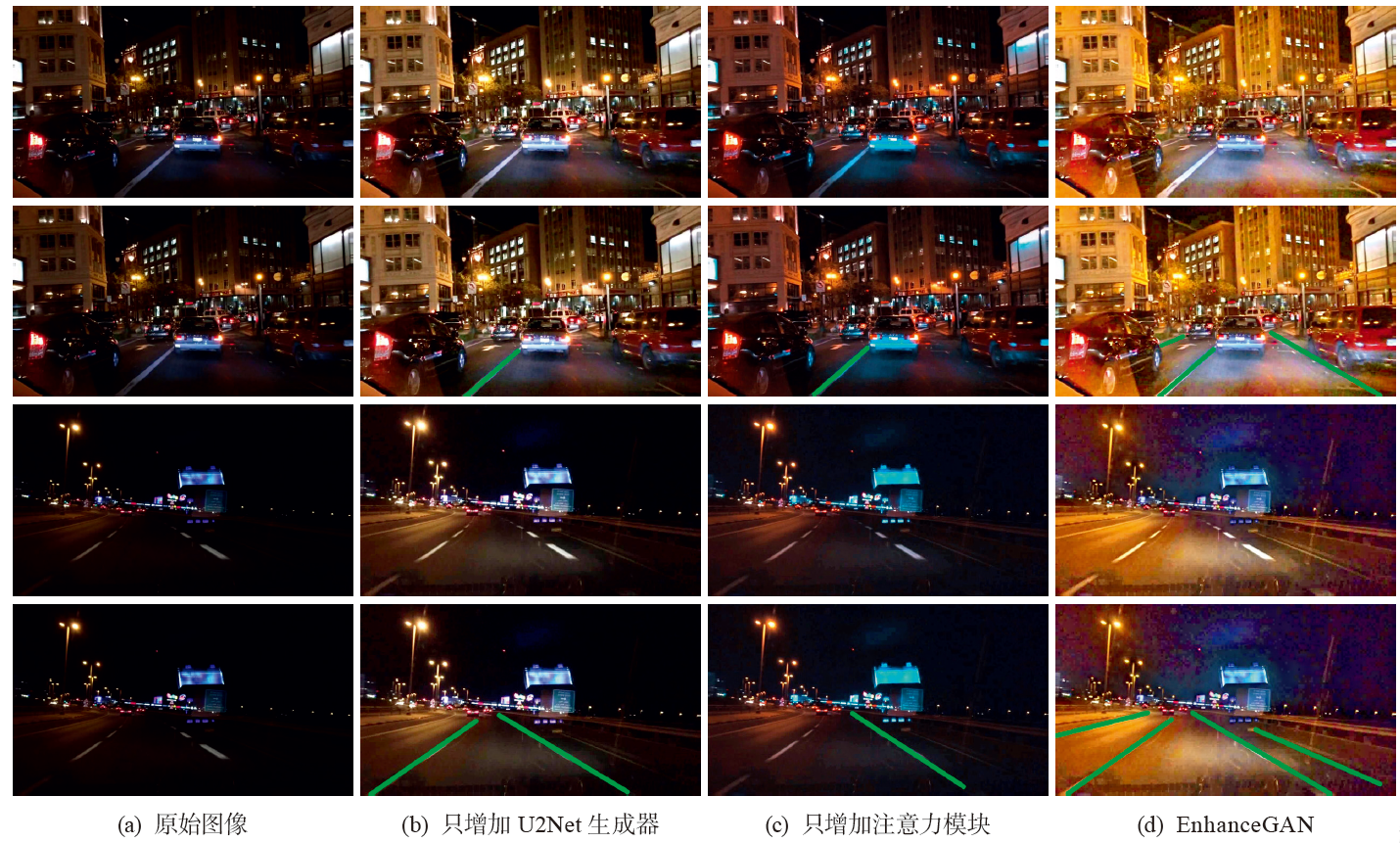
| 评价指标 | PSNR | SSIM | NIQE | Acc / % | FP / % | FN / % |
|---|---|---|---|---|---|---|
| 原始图像 | 4.152 2 | 83.72 | 21.96 | 25.09 | ||
| 只增加注意力模块 | 29.828 2 | 0.572 8 | 3.808 3 | 85.81 | 18.46 | 18.51 |
| 只增加U2Net生成器 | 30.342 1 | 0.791 6 | 3.632 1 | 86.31 | 33.01 | 19.02 |
| EnhanceGAN | 32.441 3 | 0.898 8 | 3.201 2 | 88.76 | 16.1 4 | 17.99 |
| 评价指标 | PSNR | SSIM | NIQE | Acc / % | FP / % | FN / % |
|---|---|---|---|---|---|---|
| 原始图像 | 4.152 2 | 83.72 | 21.96 | 25.09 | ||
| 只增加注意力模块 | 29.828 2 | 0.572 8 | 3.808 3 | 85.81 | 18.46 | 18.51 |
| 只增加U2Net生成器 | 30.342 1 | 0.791 6 | 3.632 1 | 86.31 | 33.01 | 19.02 |
| EnhanceGAN | 32.441 3 | 0.898 8 | 3.201 2 | 88.76 | 16.1 4 | 17.99 |
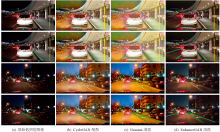
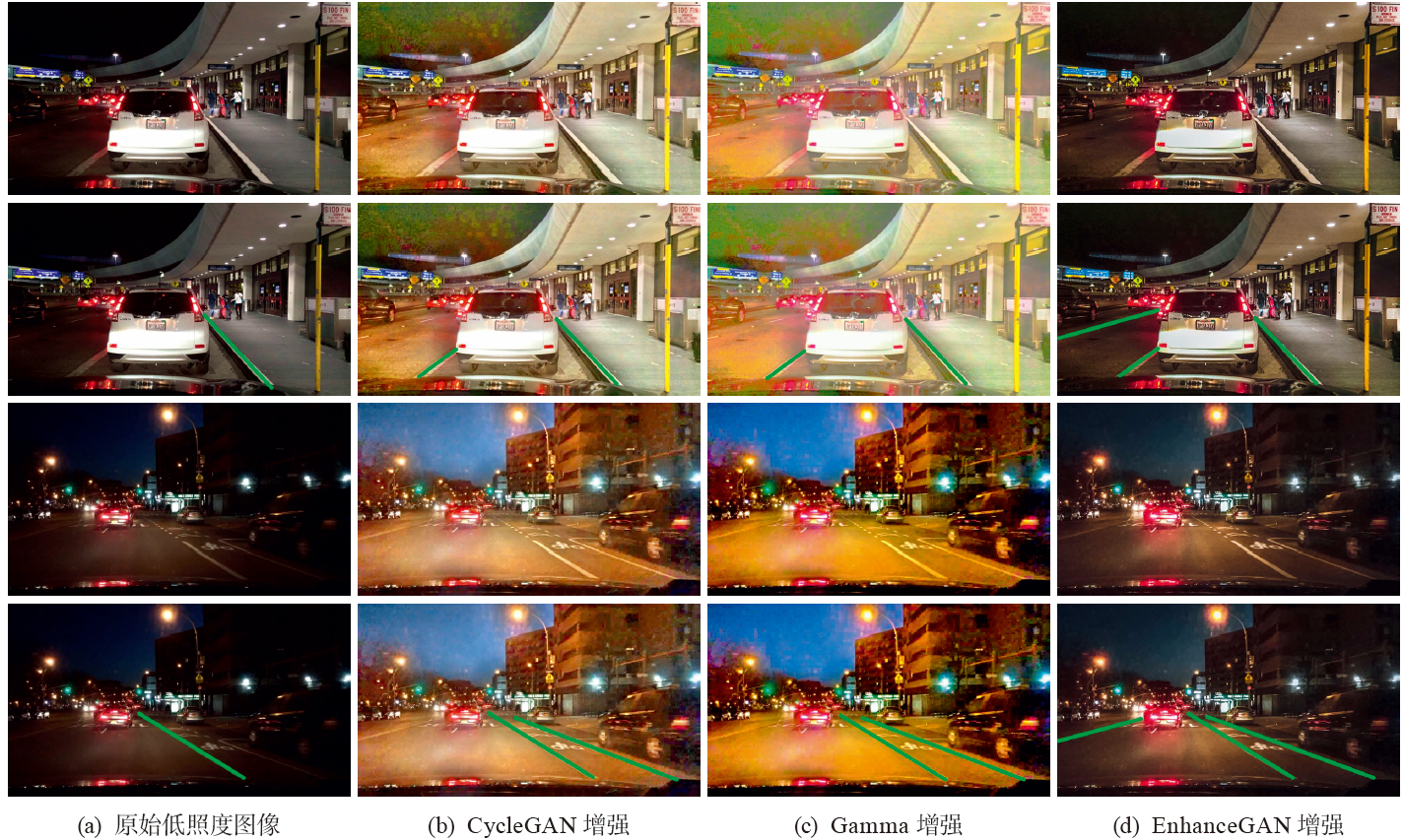
| 评价指标 | PSNR | SSIM | NIQE | Acc / % | FP / % | FN / % |
|---|---|---|---|---|---|---|
| 原始图像 | 4.453 1 | 83.72 | 21.96 | 25.09 | ||
| CycleGAN | 35.337 8 | 0.782 2 | 3.675 2 | 86.87 | 19.72 | 21.14 |
| Gamma校正 | 34.219 8 | 0.690 3 | 3.821 5 | 87.21 | 18.89 | 19.94 |
| EnhanceaGAN | 40.265 4 | 0.883 4 | 3.423 3 | 88.76 | 16.14 | 17.99 |
| 评价指标 | PSNR | SSIM | NIQE | Acc / % | FP / % | FN / % |
|---|---|---|---|---|---|---|
| 原始图像 | 4.453 1 | 83.72 | 21.96 | 25.09 | ||
| CycleGAN | 35.337 8 | 0.782 2 | 3.675 2 | 86.87 | 19.72 | 21.14 |
| Gamma校正 | 34.219 8 | 0.690 3 | 3.821 5 | 87.21 | 18.89 | 19.94 |
| EnhanceaGAN | 40.265 4 | 0.883 4 | 3.423 3 | 88.76 | 16.14 | 17.99 |
| 平台 | 模型 | Acc % | FP % | FN % | Parameter | FPS (帧 · s-1) |
|---|---|---|---|---|---|---|
| PC | LSTR | 87.20 | 7.62 | 4.30 | 765 787 | 137 |
| 本文 | 90.12 | 2.92 | 3.41 | 2 808 015 | 82 | |
| 工控机 | LSTR | 86.36 | 9.42 | 8.67 | 765 787 | 78 |
| 本文 | 89.51 | 6.23 | 3.79 | 2 808 015 | 51 |
| 平台 | 模型 | Acc % | FP % | FN % | Parameter | FPS (帧 · s-1) |
|---|---|---|---|---|---|---|
| PC | LSTR | 87.20 | 7.62 | 4.30 | 765 787 | 137 |
| 本文 | 90.12 | 2.92 | 3.41 | 2 808 015 | 82 | |
| 工控机 | LSTR | 86.36 | 9.42 | 8.67 | 765 787 | 78 |
| 本文 | 89.51 | 6.23 | 3.79 | 2 808 015 | 51 |
| 序号 | 偏离 次数 | 正确预 警次数 | 误警 次数 | 漏警 次数 | Acc / % | FP / % | FN / % |
|---|---|---|---|---|---|---|---|
| 1 | 128 | 119 | 3 | 9 | 92.96 | 2.34 | 7.03 |
| 2 | 326 | 308 | 9 | 18 | 93.90 | 2.74 | 5.48 |
| 3 | 792 | 742 | 23 | 50 | 93.68 | 2.90 | 6.31 |
| 4 | 67 | 62 | 2 | 5 | 92.53 | 2.98 | 7.46 |
| 5 | 237 | 217 | 7 | 20 | 91.56 | 2.95 | 8.43 |
| 6 | 23 | 20 | 2 | 3 | 86.95 | 8.69 | 13.04 |
| 序号 | 偏离 次数 | 正确预 警次数 | 误警 次数 | 漏警 次数 | Acc / % | FP / % | FN / % |
|---|---|---|---|---|---|---|---|
| 1 | 128 | 119 | 3 | 9 | 92.96 | 2.34 | 7.03 |
| 2 | 326 | 308 | 9 | 18 | 93.90 | 2.74 | 5.48 |
| 3 | 792 | 742 | 23 | 50 | 93.68 | 2.90 | 6.31 |
| 4 | 67 | 62 | 2 | 5 | 92.53 | 2.98 | 7.46 |
| 5 | 237 | 217 | 7 | 20 | 91.56 | 2.95 | 8.43 |
| 6 | 23 | 20 | 2 | 3 | 86.95 | 8.69 | 13.04 |
| [1] | 高轶男, 巩建强. 我国道路交通事故特征及致因分析[J]. 安全与环境学报, 2023, 23(11): 4013-4023. |
| GAO Yinan, GONG Jianqiang. Characteristics and mechanism of road traffic accidents[J]. J Safe Environ, 2023, 23(11): 4013-4023. (in Chinese) | |
| [2] | 李福俊, 顾敏明. 车道线实时检测与偏离预警系统设计与研究[J]. 光电子激光, 2018, 29(3): 298-304. |
| LI Fujun, GU Minming. Design and research on lane detection and the departure warning system[J]. J Optoelect Lase, 2018, 29(3): 298-304. (in Chinese) | |
| [3] | Kang J, Yoon T, Kim E, et al. Lane-level map-matching method for vehicle localization using GPS and camera on a high-definition map[J]. Sensors, 2020, 20(8): 2166-2188. |
| [4] | Rastiveis H, Shams A, Sarasua W, et al. Automated extraction of lane markings from mobile LiDAR point clouds based on fuzzy inference[J]. ISPRS J Photogram Remo Sens, 2019, 160: 149-166. |
| [5] | Munir F, Azam S, Jeon M, et al. LDNet: End-to-end lane marking detection approach using a dynamic vision sensor[J]. IEEE Trans Intel Transport Syst, 2021, 23(7): 9318-9334. |
| [6] | Ding D, Lee C, Lee K-Y. An adaptive road ROI determination algorithm for lane detection[C]// 2013 IEEE Int’l Conf IEEE Regi 10 (TENCON 2013), Xi'an, China, 2013: 1-4. |
| [7] | FU Mengyin, WANG Xinyu, MA Hongbin, et al. Multi-lanes detection based on panoramic camera[C]// 11th IEEE Int’l Conf Contr Auto (ICCA), Taichung, Taiwan, 2014: 655-660. |
| [8] | 陈洋, 黄孝慈, 吴训成. 基于改进卡尔曼滤波的车道线与车辆跟踪系统算法研究[J]. 计算机与数字工程, 2021, 49(7): 1363-1366. |
| CHNEG Yang, HUANG Xiaoci, WU Xuncheng. Research on algorithm of lane line and vehicle tracking system based on improved Kalman filter[J]. Comput Digit Engi, 2021, 49(7): 1363-1366. (in Chinese) | |
| [9] | Kim J-G, Yoo J-H, Koo J-C. Road and lane detection using stereo camera[C]// 2018 IEEE Int’l Conf Big Data Smart Comput (Big Comp), Shanghai, China, 2018: 649-652. |
| [10] | 杨淑琴, 马玉浩, 方铭宇, 等. 基于实例分割的复杂环境车道线检测方法[J]. 浙江大学学报, 2022, 56(4): 809-815. |
| YANG Shuqi, MA Yuhao, FANG Minyu, et al. Lane detection method in complex environments based on instance segmentation[J]. J Zhejiang University, 2022, 56(4): 809-815. (in Chinese) | |
| [11] | YAO Yifan, XIONG Huilin. LaneFormer: An efficient transformer-based network for fast lane detection[C]// 2022 China Auto Congress (CAC), Xiamen, 2022: 3111-3116. |
| [12] | LI Xiang, LI Jun, HU Xiaolin, et al. Line-CNN: End-to-end traffic line detection with line proposal unit[J]. IEEE Trans Intel Transport Syst, 2019, 21(1): 1-11. |
| [13] | 宋扬, 李竹. 基于深度图像增强的夜间车道线检测技术[J]. 计算机应用, 2019, 39(S2): 103-106. |
| SONG Yang, LI Zhu. Lane detection method based on image enhancement technique under night condition[J]. J Comput Appl, 2019, 39(S2): 103-106. (in Chinese) | |
| [14] |
郭克友, 王艺伟, 郭晓丽. LDA 与 LSD 相结合的车道线分类检测算法[J]. 计算机工程与应用, 2017, 53(24): 219-225.
doi: 10.3778/j.issn.1002-8331.1606-0116 |
| GUO Keyo, WANG Yiwei, GUO Xiaoli. Lane classification algorithm combined LDA and LSD[J]. Comput Engi Appl, 2017, 53(24): 219-225. (in Chinese) | |
| [15] | HE Gaoming, WANG Mei. Research on lane detection algorithm based on wavelet analysis and hough transform[C]// 2022 IEEE 21st Int’l Conf Ubiquit Comput Commun (IUCC/CIT/DSCI/SmartCNS), Chongqing: IEEE Press, 2022: 280-287. |
| [16] | CHEN Yiman, XIANG Zhiyu, DU Wentao. Improving lane detection with adaptive homography prediction[J]. Visu Comput, 2023, 39(2): 585-591. |
| [17] | LI Shoubiao, WU Xin, WU Zhifei, et al. Efficient multi-lane detection based on large-kernel convolution and location[J]. IEEE Access, 2023, 11: 58125-58135. |
| [18] | LIU Ruijin, YUAN Zejian, LIU Tie, et al. End-to-end lane shape prediction with transformers[C]// 2021 IEEE Winter Conf Appl Comput Visi (WACV), Waikoloa: IEEE Press, 2021: 3693-3701. |
| [19] | GAO Rong, HU Siqi, YAN Lingyu, et al. High-order deep infomax-guided deformable transformer network for efficient lane detection[J]. Sign, Imag Vide Proc, 2023, 17(6): 3045-3052. |
| [20] | 王杰, 陈黎卿, 黄莉莉, 等. 基于Retinex的弱光条件下车道线识别方法[J]. 计算机与数字工程, 2019, 47(2): 451-456. |
| WANG Jie, CHEN Liqi, HUANG Lili. Lane Recognition method in weak light condition based on Retinex[J]. Comput Digit Engi, 2019, 47(2): 451-456. (in Chinese) | |
| [21] | MA Hui, LÜ Wenhao, LI Yu, et al. Image adaptive contrast enhancement for low-illumination lane lines based on improved retinex and guided filter[J]. Appl Artifi Intel, 2021, 35(15): 1970-1989. |
| [22] |
周经美, 王钰, 宁航, 等. 面向多元场景结合GLNet的车道线检测算法[J]. 中国公路学报, 2021, 34(7): 118-127.
doi: 10.19721/j.cnki.1001-7372.2021.07.009 |
| ZHOU Jingmei, WANG Yu, NING Hang, et al. Lane detection algorithm based on GLNet for multiple scenes[J]. China J Highw Transport, 2021, 34(7): 118-127. (in Chinese) | |
| [23] | Son J, Yoo H, Kim S, et al. Real-time illumination invariant lane detection for lane departure warning system[J]. Expet Syst Appl, 2015, 42(4): 1816-1824. |
| [1] | LI Yixuan, WU Xiao, TANG Kai, LI Zheng. Research on electrical vehicle's sliding mode in small overlap impact crash test [J]. Journal of Automotive Safety and Energy, 2025, 16(6): 867-876. |
| [2] | CHENG Zeyang, DUAN Yiyang, YANG Mengmeng, FENG Zhongxiang, WANG He, ZHU Xiaojun, BAO Lixia. Recognition of the dangerous driving behaviors and the driving styles in weaving areas based on a hybrid neural network [J]. Journal of Automotive Safety and Energy, 2025, 16(5): 688-697. |
| [3] | LI Hao, ZHOU Hao. Emergency vehicle detection in noisy environments based on acoustic spectral-temporal information fusion [J]. Journal of Automotive Safety and Energy, 2025, 16(4): 529-538. |
| [4] | OUYANG Delin, QIU Yifan, WANG Yingchen, YANG Liang, MIN Haigen, WANG Wenjun, LI Guofa. End-to-end decision-making model for multi-task autonomous driving [J]. Journal of Automotive Safety and Energy, 2025, 16(4): 610-619. |
| [5] | WANG Yifei, LI Yonghang, ZHANG Yali, WANG Chang, WANG Taiqi, YUAN Huazhi. Lane detection algorithm based on adaptive segmentation network [J]. Journal of Automotive Safety and Energy, 2025, 16(3): 478-486. |
| [6] | LIU Yuqiu, TANG Liang, WANG Ningzhen. Physical adversarial attack on vehicle detection systems [J]. Journal of Automotive Safety and Energy, 2025, 16(1): 50-56. |
| [7] | DI Yage, ZHOU Jian, LU Jie, QIN Jia, WEI Yuqin, WANG Congjin, HAO Zhaoyang, MIAO Xuelong. Functional safety concept design for EMB brake-by-wire system based on vehicle dynamic [J]. Journal of Automotive Safety and Energy, 2024, 15(6): 830-838. |
| [8] | SHI Tianjing, LI Xu. Traffic flow parameter prediction method based on dynamic graphs self-attention [J]. Journal of Automotive Safety and Energy, 2024, 15(5): 680-688. |
| [9] | NIE Jin, ZHANG Xiang, ZHANG Yue, WANG Bingyu, YI Xiangxian, ZHOU Wu. Typical accident scene extraction and accident factor association rules analysis for truck-two-wheeler collisions [J]. Journal of Automotive Safety and Energy, 2024, 15(4): 503-510. |
| [10] | WEN Bin, DING Yifu, HU Yiming, PENG Shun, HU Hui. Vehicle and lane detection algorithm based on MSFA-Net [J]. Journal of Automotive Safety and Energy, 2024, 15(3): 433-442. |
| [11] | LI Wenli, REN Yongpeng, XIAO Kaiwen, SUN Yuanyuan. Pedestrian crossing simulation and vehicle right-turn obstacle avoidance path planning method [J]. Journal of Automotive Safety and Energy, 2024, 15(1): 99-110. |
| [12] | ZHANG Haimin. Algorithm of fatigue driving behavior recognition based on deep learning model [J]. Journal of Automotive Safety and Energy, 2024, 15(1): 121-128. |
| [13] | ZHANG Daowen, LEI Yi, REN Yao, TANG Kaiwen, DONG Xinchi, LUO Jing, HU Wenhao. Pedestrian lower limb dynamic response and injury biomechanical analysis based on pedestrian-vehicle collision accident reconstruction [J]. Journal of Automotive Safety and Energy, 2023, 14(6): 671-680. |
| [14] | WU Hequan, GONG Chuangye, REN Qifan, ZHOU Huilai, MAO Haojie. Effect of head rotation on neck responses under rear impact [J]. Journal of Automotive Safety and Energy, 2023, 14(3): 282-289. |
| [15] | ZHANG Xi, LIAO Yulan, LI Qinyi, CHEN Yiqing. Fault diagnosis of vehicle motor-bearings under safe running by digital-twin technology [J]. Journal of Automotive Safety and Energy, 2023, 14(2): 232-238. |
| Viewed | ||||||
|
Full text |
|
|||||
|
Abstract |
|
|||||
