Welcome to Journal of Automotive Safety and Energy,

Journal of Automotive Safety and Energy ›› 2024, Vol. 15 ›› Issue (5): 689-701.DOI: 10.3969/j.issn.1674-8484.2024.05.007
• Intelligent Driving and Intelligent Transportation • Previous Articles Next Articles
QU Guangyue( ), YANG Lan(), YUAN Meng, FANG Shan, LIU Songyan
Received:2024-08-19
Revised:2024-09-27
Online:2024-10-31
Published:2024-11-07
CLC Number:
QU Guangyue, YANG Lan, YUAN Meng, FANG Shan, LIU Songyan. A multimodal trajectory prediction method of pedestrians at signalized intersections for autonomous vehicles[J]. Journal of Automotive Safety and Energy, 2024, 15(5): 689-701.
Add to citation manager EndNote|Ris|BibTeX
URL: https://www.journalase.com/EN/10.3969/j.issn.1674-8484.2024.05.007
| 1:输入: SFM模型,SGAN模型,训练数据集,误差阈值 |
|---|
| 2:输出: 集成模型的最终预测结果 |
| 3:初始化: 样本数N,样本权重wi(1) = 1/ N,弱学习器数量T,权重系数αt |
| 4:FOR t = 1,…,T |
| 5:获取SFM和SGAN的预测结果ptpre,i |
| 6:计算样本错误率 |
| 7:计算弱学习器权重系数αt = {ln[(1 - εt) / εt]} / 2 |
| 8:更新样本权重wi(t+1) = wi(t) exp(αt || ptreal,i - ptpre,i ||) |
| 9:对样本权重进行归一化,使得 ∑wi = 1 |
| 10:累加弱学习器组成强学习器H(x) = H(x) + αtht(x) |
| 11:ENDFOR |
| 1:输入: SFM模型,SGAN模型,训练数据集,误差阈值 |
|---|
| 2:输出: 集成模型的最终预测结果 |
| 3:初始化: 样本数N,样本权重wi(1) = 1/ N,弱学习器数量T,权重系数αt |
| 4:FOR t = 1,…,T |
| 5:获取SFM和SGAN的预测结果ptpre,i |
| 6:计算样本错误率 |
| 7:计算弱学习器权重系数αt = {ln[(1 - εt) / εt]} / 2 |
| 8:更新样本权重wi(t+1) = wi(t) exp(αt || ptreal,i - ptpre,i ||) |
| 9:对样本权重进行归一化,使得 ∑wi = 1 |
| 10:累加弱学习器组成强学习器H(x) = H(x) + αtht(x) |
| 11:ENDFOR |
| 参数 | 标定值 |
|---|---|
| 行人作用强度系数,Ap | 0.83 |
| 行人距离影响系数,Bp | 1.89 |
| 斑马线外约束力强度,Ab | 0.45 |
| 斑马线距离影响系数,Bb | 0.94 |
| 斑马线内约束力强度,Abr | 0.22 |
| 斑马线距离影响系数,Bbr | 0.77 |
| 信号灯作用强度系数,As | 0.15 |
| 信号灯距离影响系数,Bs | 0.21 |
| 参数 | 标定值 |
|---|---|
| 行人作用强度系数,Ap | 0.83 |
| 行人距离影响系数,Bp | 1.89 |
| 斑马线外约束力强度,Ab | 0.45 |
| 斑马线距离影响系数,Bb | 0.94 |
| 斑马线内约束力强度,Abr | 0.22 |
| 斑马线距离影响系数,Bbr | 0.77 |
| 信号灯作用强度系数,As | 0.15 |
| 信号灯距离影响系数,Bs | 0.21 |
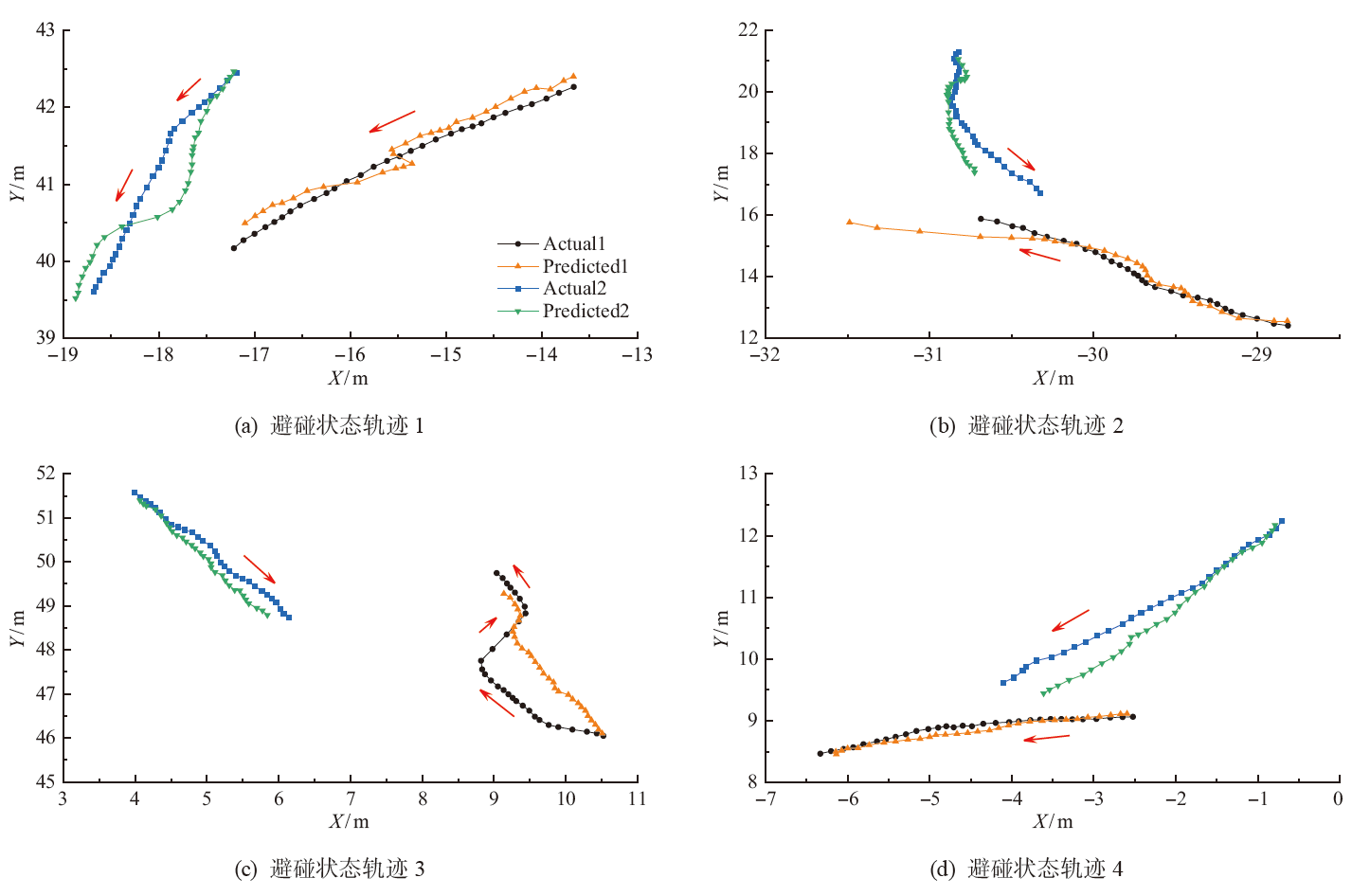
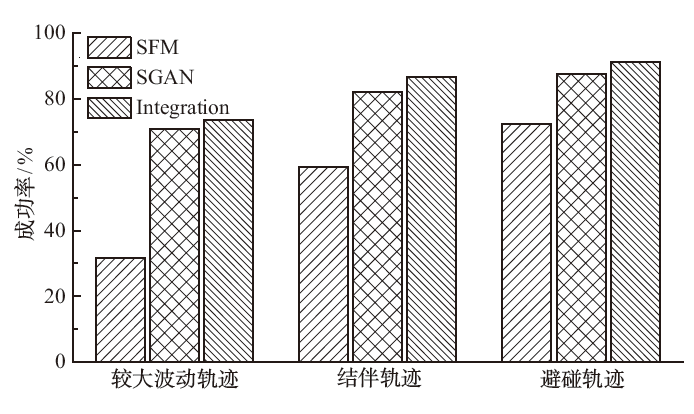
| [1] | 李克强, 熊辉, 刘金鑫. 面向弱势道路使用者的多目标运动轨迹预测方法[J]. 中国公路学报, 2022, 35(1): 298-315. |
| LI Keqiang, XIONG Hui, LIU Jinxin. Multi-objective motion trajectory prediction method for vulnerable road users[J]. Chin J Highw Transport, 2022, 35(1): 298-315. (in Chinese) | |
| [2] | Sharma N, Dhiman C, Indu S. Pedestrian intention prediction for autonomous vehicles: A comprehensive survey[J]. Neurocomput, 2022, 508: 120-152. |
| [3] | Fox E, Sudderth E B, Jordan M I, et al. Bayesian nonparametric inference of switching dynamic linear models[J]. IEEE Trans Sign Proce, 2011, 59(4): 1569-1585. |
| [4] | Kooij J F P, Schneider N, Flohr F, et al. Context-based pedestrian path prediction[C]// Proc Comput Visi-ECCV 2014: 13th Euro Conf, Part VI 13. Zurich, Switzerland, 2014: 618-633. |
| [5] | Rashid M M, Seyedi M R, Jung S. Simulation of pedestrian interaction with autonomous vehicles via social force model[J]. Simul Model Pract Theo, 2024, 132: 102901. |
| [6] | Lorenzo J, Parra I, Wirth F, et al. Rnn-based pedestrian crossing prediction using activity and pose-related features[C]// 2020 IEEE Intel Vehi Symp (IV). Las Vegas, NV, USA, IEEE, 2020: 1801-1806. |
| [7] | XUE Hao, Huynh D Q, Reynolds M. PoPPL: Pedestrian trajectory prediction by LSTM with automatic route class clustering[J]. IEEE Trans Neural Network Learn Syst, 2020, 32(1): 77-90. |
| [8] | Gupta A, Johnson J, LI Feifei, et al. Social gan: Socially acceptable trajectories with generative adversarial networks[C]// Proc IEEE Conf Comput Visi Patt Recog. Salt Lake City, UT, USA, 2018: 2255-2264. |
| [9] | Eiffert S, LI Kunming, SHAN Mao, et al. Probabilistic crowd GAN: Multimodal pedestrian trajectory prediction using a graph vehicle-pedestrian attention network[J]. IEEE Robot Auto Letts, 2020, 5(4): 5026-5033. |
| [10] | QUAN Ruijie, ZHU Linchao, WU Yu, et al. Holistic LSTM for pedestrian trajectory prediction[J]. IEEE Trans Imag Proce, 2021, 30: 3229-3239. |
| [11] | XU Yi, WANG Lichen, WANG Yizhou, et al. Adaptive trajectory prediction via transferable GNN[C]// Proc IEEE / CVF Conf Comput Visi Patt Recog. New Orleans, LA, USA, 2022: 6520-6531. |
| [12] | Dendorfer P, Elflein S, Leal-Taixé L. Mg-gan: A multi-generator model preventing out-of-distribution samples in pedestrian trajectory prediction[C]// Proc IEEE/CVF Int’l Conf Comput Visi. Montreal, Canada, 2021: 13158-13167. |
| [13] | KE Kexin, YANG Jian, LIU Yingjie, et al. Social Lode: Human trajectory prediction with latent odes[C]// ICASSP 2024-2024 IEEE Int’l Conf Acoust, Speech Sign Proc (ICASSP), Seoul, South Korea, IEEE, 2024: 5360-5364. |
| [14] | CHEN Hao, LIU Yinhua, HU Chuan, et al. Vulnerable road user trajectory prediction for autonomous driving using a data-driven integrated approach[J]. IEEE Trans Intel Transport Syst, 2023, 24(7): 7306-7317. |
| [15] | Sheykhfard A, Haghighi F, Kavianpour S, et al. Risk assessment of pedestrian red-light violation behavior using surrogate safety measures: Influence of human, road, vehicle, and environmental factors[J]. IATSS Res, 2023, 47(4): 514-525. |
| [16] | 周于涛, 吴华意, 成洪权, 等. 结合自注意力机制和结伴行为特征的行人轨迹预测模型[J]. 武汉大学学报(信息科学版), 2020, 45(12): 1989-1996. |
| ZHOU Yutao, WU Huayi, CHENG Hongquan, et al. Pedestrian trajectory prediction model combining self-attention mechanism and companion behavior characteristics[J]. Geomat Info Sci Wuhan Univ, 2020, 45(12): 1989-1996. (in Chinese) | |
| [17] | YANG Junheng, ZANG Xiaodong, CHEN Weiying, et al. Improved social force model based on pedestrian collision avoidance behavior in counterflow[J]. Phys A: Statist Mech Its Appl, 2024, 642: 129762. |
| [18] | LIU Yenchen, Jafari A, Shim J K, et al. Dynamic modeling and simulation of electric scooter interactions with a pedestrian crowd using a social force model[J]. IEEE Trans Intel Transport Syst, 2022, 23(9): 16448-16461. |
| [19] | ZENG Weiliang, Nakamura H, CHEN Peng. A modified social force model for pedestrian behavior simulation at signalized crosswalks[J]. Procedia-Social Beha Sci, 2014, 138: 521-530. |
| [20] | HU Xiangmin, CHEN Tao, SONG Yushan. Anticipation dynamics of pedestrians based on the elliptical social force mode l[J]. Chaos: An Interdisc J Nonlin Sci, 2023, 33: 073102. |
| [21] | ZENG Weiliang, CHEN Peng, Nakamura H, et al. Application of social force model to pedestrian behavior analysis at signalized crosswalk[J]. Transport Res Part C: Emerg Tech, 2014, 40: 143-159. |
| [22] | 曾浩, 蔡万翰, 任志刚, 等. 基于动态搜索策略离散粒子群算法的稀疏阵列约束优化[J]. 电子学报, 2023, 51(4): 783-791. |
| ZENG Hao, CAI Wanhan, REN Zhigang, et al. Sparse array constraint optimization based on discrete particle swarm optimization based on dynamic search strategy[J]. Acta Electron Sini, 2023, 51(4): 783-791. (in Chinese) | |
| [23] | Belghit A, Lazri M, Ouallouche F, et al. Optimization of one versus All-SVM using AdaBoost algorithm for rainfall classification and estimation from multispectral MSG data[J]. Advan Space Res, 2023, 71(1): 946-963. |
| [24] | 刘延钊, 黄志球, 沈国华, 等. 基于决策树和BN的自动驾驶车辆行为决策方法[J]. 系统工程与电子技术, 2022, 44(10): 3143-3154. |
| LIU Yanzhao, HUANG Zhiqiu, SHEN Guohua, et al. Behavioral decision-making method of autonomous vehicles based on decision tree and BN[J]. Syst Engi Electron, 2022, 44(10): 3143-3154. (in Chinese) | |
| [25] | Klusowski J M, Tian P M. Large scale prediction with decision trees[J]. J Am Statist Asso, 2024, 119(545): 525-537. |
| [26] | XU Yanchao, SHAO Wenbo, LI Jun, et al. SIND: A drone dataset at signalized intersection in China[C]// 2022 IEEE 25th Int’l Conf Intel Transport Syst (ITSC), Macau, China, IEEE, 2022: 2471-2478. |
| [27] | 桑海峰, 王金玉, 陈旺兴, 等. 基于第一视角的非自回归行人轨迹预测模型[J]. 电子学报, 2023, 51(5): 1266-1272. |
| SANG Haifeng, WANG Jinyu, CHEN Xinwang, et al. Non-autoregressive pedestrian trajectory prediction model based on first-person perspective[J]. Acta Electron Sinica, 2023, 51(5): 1266-1272. (in Chinese) |
| [1] | WEN Jiayan, ZOU Haifeng, ZHONG Wei, GAO Bolin, LU Yanbo. Vehicle speed planning method with the vehicle-road-cloud integration system and incorporating human-vehicle game theory [J]. Journal of Automotive Safety and Energy, 2026, 17(2): 261-269. |
| [2] | WU Hangzhe, JIAO Yizhou, LIU Yang, ZHONG Wei, WANG Shuihe, GUO Jinghua, ZHAO Jian. Predictive trajectory tracking control by a linear time-varying model for emergency collision avoidance of autonomous vehicles [J]. Journal of Automotive Safety and Energy, 2025, 16(6): 934-944. |
| [3] | ZHENG Xunjia, CAO Zeyi, CHEN Xing, LIU Hui, GAO Jianjie. Trajectory tracking control based on adaptive prediction time-domain MPC [J]. Journal of Automotive Safety and Energy, 2025, 16(5): 773-783. |
| [4] | PAN Yuheng, REN Chen, LU Weijia, LI Yang. DV-PointPillars 3D object detection model based on dual pooling attention mechanism and vertical feature fusion [J]. Journal of Automotive Safety and Energy, 2025, 16(5): 793-801. |
| [5] | OUYANG Delin, QIU Yifan, WANG Yingchen, YANG Liang, MIN Haigen, WANG Wenjun, LI Guofa. End-to-end decision-making model for multi-task autonomous driving [J]. Journal of Automotive Safety and Energy, 2025, 16(4): 610-619. |
| [6] | YANG Yao, WANG Bingyu, ZHANG Xiang, ZHANG Yue. Scenarios of electric two-wheeler and pedestrian collision accidents based on video information [J]. Journal of Automotive Safety and Energy, 2025, 16(3): 396-404. |
| [7] | LI Ziyuan, LIU Qiang, LI Dingli, LI Zilong. Blind spot traffic strategy for intelligent connected vehicles based on deep reinforcement learning [J]. Journal of Automotive Safety and Energy, 2025, 16(3): 470-477. |
| [8] | LI Guofa, OUYANG Delin, CHEN Chen, NIE Binging, ZHANG Wei, YU Huili, Liu Bin, ZHANG Qiang, WANG Wenjun, CHENG Bo, LI Shengbo. Review on driving risk monitoring and intervention technologies [J]. Journal of Automotive Safety and Energy, 2025, 16(2): 181-196. |
| [9] | WANG Zhenyu, YU Zhuoping, TIAN Wei, XIONG Lu, LI Zhuoren. Trajectory generation algorithm for simulated vehicles based on trajectory prediction models [J]. Journal of Automotive Safety and Energy, 2025, 16(2): 286-293. |
| [10] | HU Zhilong, PEI Xiaofei, ZHOU Honglong, WEI Weiran. Risk-sensitive hierarchical reinforcement learning decision-making for autonomous vehicles [J]. Journal of Automotive Safety and Energy, 2025, 16(2): 326-333. |
| [11] | YANG Junru, ZHENG Sifa, XU Shucai, TIAN Ye, SUN Jian, SUN Chuan, LI Haoran. Design and research of an automated parking evaluation tool based on the OnSite platform [J]. Journal of Automotive Safety and Energy, 2025, 16(2): 334-343. |
| [12] | QIN Yaqin, DONG Shuai, XIE Jiming, CHEN Liang, LIU Yonghua, GUO Miao. Methods for predicting vehicle trajectories in motorway weaving zones based on driving risk fields [J]. Journal of Automotive Safety and Energy, 2024, 15(6): 952-961. |
| [13] | CAO Liling, LIU Junli, JIN Shengye, CAO Shouqi, ZHOU Guofeng. Design of a remote multidimensional information real time interaction system for autonomous driving [J]. Journal of Automotive Safety and Energy, 2024, 15(6): 934-942. |
| [14] | LIU Yang, ZHAN Jiahao, LI Shen, LI Xiaopeng, CHEN Jun. Future of autonomous driving: Single autonomous driving and intelligent vehicle-infrastructure collaboration systems [J]. Journal of Automotive Safety and Energy, 2024, 15(5): 611-633. |
| [15] | LIU Peng, ZHAO Kegang, LIANG Zhihao, YE Jie. Vehicle longitudinal speed planning based on deep reinforcement learning CLPER-DDPG [J]. Journal of Automotive Safety and Energy, 2024, 15(5): 702-710. |
| Viewed | ||||||
|
Full text |
|
|||||
|
Abstract |
|
|||||
