Welcome to Journal of Automotive Safety and Energy,

Journal of Automotive Safety and Energy ›› 2026, Vol. 17 ›› Issue (3): 322-331.DOI: 10.3969/j.issn.1674-8484.2026.03.004
• Automotive Safety • Previous Articles Next Articles
SHI Xiaopeng1( ), CHEN Hao2, GUO Kai2,3, LIU Tianfu4, XIE Jiang1,*()
Received:2025-09-10
Revised:2026-05-13
Online:2026-06-30
Published:2026-07-02
CLC Number:
SHI Xiaopeng, CHEN Hao, GUO Kai, LIU Tianfu, XIE Jiang. Analysis of injury risk disparities between Chinese and Western occupants in small aircraft crash scenarios[J]. Journal of Automotive Safety and Energy, 2026, 17(3): 322-331.
Add to citation manager EndNote|Ris|BibTeX
URL: https://www.journalase.com/EN/10.3969/j.issn.1674-8484.2026.03.004
| 损伤项目 | 极限值 | 损伤项目 | 极限值 |
|---|---|---|---|
| 颅骨等效应力 | 10.1 MPa [ | 颈椎前弯矩 | 190 N?m [ |
| 颅内等效应力 | 15 kPa [ | 颈椎后弯矩 | 57 N?m [ |
| 颅内压力(轻微脑震荡) | 56 kPa [ | 颈椎皮质骨应力 | 236 MPa [ |
| 颅内压力(严重脑损伤) | 173 kPa [ | 颈椎松质骨应力 | 59 MPa [ |
| 颈椎轴向拉力 | 3.3 kN [ | 腰椎轴力 | 4.500 kN [ |
| 颈椎轴向压力 | 4.0 kN [ | 腰椎皮质骨应力 | 236 MPa [ |
| 损伤项目 | 极限值 | 损伤项目 | 极限值 |
|---|---|---|---|
| 颅骨等效应力 | 10.1 MPa [ | 颈椎前弯矩 | 190 N?m [ |
| 颅内等效应力 | 15 kPa [ | 颈椎后弯矩 | 57 N?m [ |
| 颅内压力(轻微脑震荡) | 56 kPa [ | 颈椎皮质骨应力 | 236 MPa [ |
| 颅内压力(严重脑损伤) | 173 kPa [ | 颈椎松质骨应力 | 59 MPa [ |
| 颈椎轴向拉力 | 3.3 kN [ | 腰椎轴力 | 4.500 kN [ |
| 颈椎轴向压力 | 4.0 kN [ | 腰椎皮质骨应力 | 236 MPa [ |

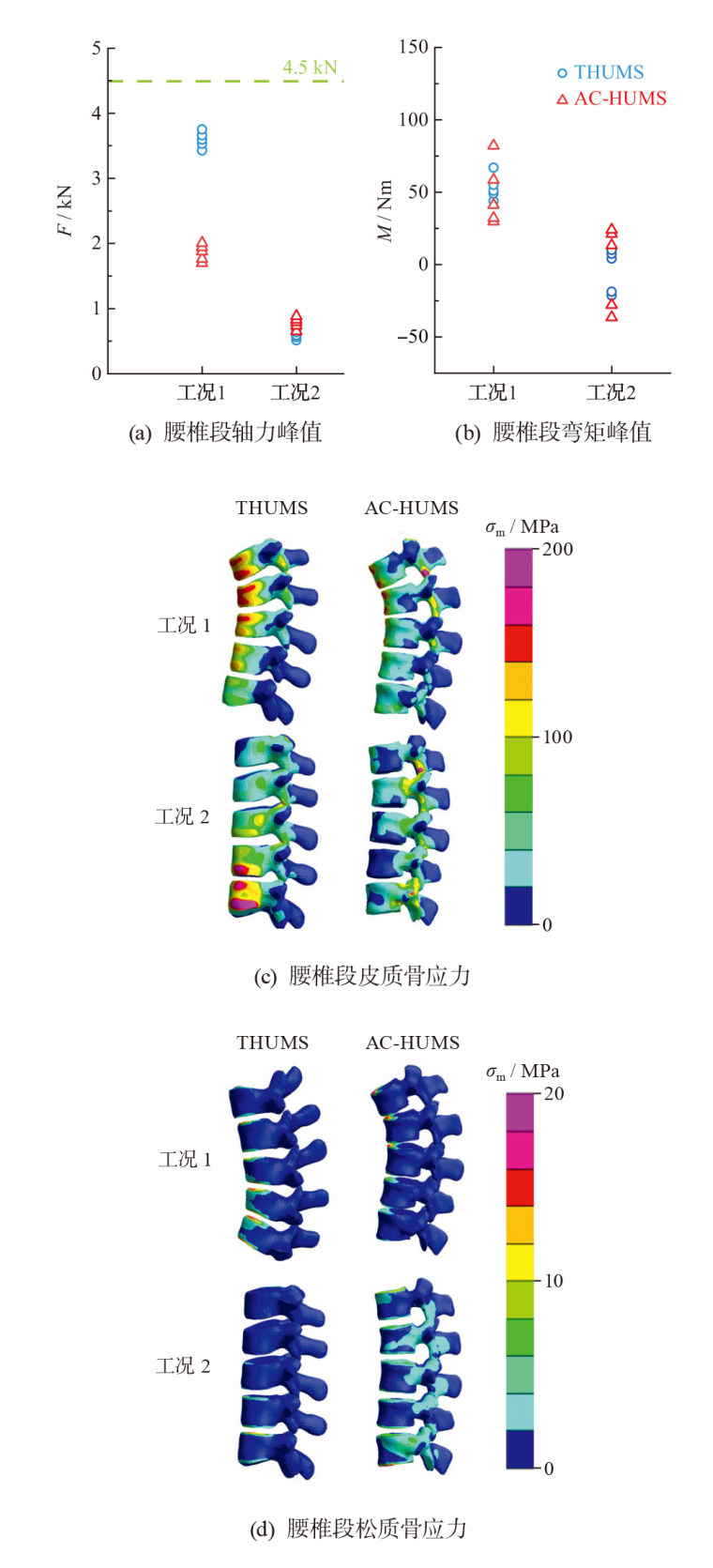
| 工况 | 腰椎段 | THUMS | AC-HUMS | |||
|---|---|---|---|---|---|---|
| P(Fz, My, SCSA) / % | 损伤风险/ % | P(Fz, My, SCSA) / % | 损伤风险/ % | |||
| 工况1 | L1 | 3.49 | 11.76 | 2.61 | 8.40 | |
| L2 | 1.82 | 1.96 | ||||
| L3 | 2.05 | 1.07 | ||||
| L4 | 1.93 | 1.05 | ||||
| L5 | 3.05 | 2.00 | ||||
| 工况2 | L1 | 3.40×10⁻⁴ | 1.97×10⁻³ | 3.89×10⁻² | 9.06×10⁻² | |
| L2 | 3.31×10⁻⁴ | 1.97×10⁻² | ||||
| L3 | 3.34×10⁻⁴ | 1.50×10⁻² | ||||
| L4 | 2.06×10⁻⁴ | 8.28×10⁻³ | ||||
| L5 | 7.64×10⁻⁴ | 8.84×10⁻³ | ||||
| 工况 | 腰椎段 | THUMS | AC-HUMS | |||
|---|---|---|---|---|---|---|
| P(Fz, My, SCSA) / % | 损伤风险/ % | P(Fz, My, SCSA) / % | 损伤风险/ % | |||
| 工况1 | L1 | 3.49 | 11.76 | 2.61 | 8.40 | |
| L2 | 1.82 | 1.96 | ||||
| L3 | 2.05 | 1.07 | ||||
| L4 | 1.93 | 1.05 | ||||
| L5 | 3.05 | 2.00 | ||||
| 工况2 | L1 | 3.40×10⁻⁴ | 1.97×10⁻³ | 3.89×10⁻² | 9.06×10⁻² | |
| L2 | 3.31×10⁻⁴ | 1.97×10⁻² | ||||
| L3 | 3.34×10⁻⁴ | 1.50×10⁻² | ||||
| L4 | 2.06×10⁻⁴ | 8.28×10⁻³ | ||||
| L5 | 7.64×10⁻⁴ | 8.84×10⁻³ | ||||
| [1] | Boyd D D. A review of general aviation safety (1984-2017) [J]. Aerosp Med Hum Perform, 2017, 88( 7): 657-664. |
| [2] | Wiegmann D A, Taneja N. Analysis of injuries among pilots involved in fatal general aviation airplane accidents[J]. Accid Anal Prev. 2003, 35(4): 571-577. |
| [3] | Amiri S, Naserkhaki S, Parnianpour M. Modeling and validation of a detailed FE viscoelastic lumbar spine model for vehicle occupant dummies[J]. Comput Biol Medi, 2018, 99: 191-200. |
| [4] | XIN Ye, Gaewsky J P, Jones D A, et al. Computational modeling and analysis of thoracolumbar spine fractures in frontal crash reconstruction[J]. Traf Inju Prev, 2018, 19(S2): S32-S39. |
| [5] |
朱鲜飞, 冯蕴雯, 薛小锋, 等. 水平冲击条件下不同撞击速度对乘员头部伤害影响分析[J]. 机械强度, 2020, 42(2): 374-383.
doi: 10.16579/j.issn.1001.9669.2020.02.018 |
| ZHU Xianfei, FENG Yunwen, XUE Xiaofeng, et al. Effect analysis of different impact velocities on occupant head injury under horizontal impact conditions[J]. J Mech Strength, 2020, 42(2): 374-383. (in Chinese) | |
| [6] |
Garofano A, Acanfora V, Riccio A. On the use of hybrid shock absorbers to increase safety of commercial aircraft passengers during a crash event[J]. Prog Aerosp Sci, 2024, 148: 101004.
doi: 10.1016/j.paerosci.2024.101004 URL |
| [7] | 陈家辉, 李艳军, 曹愈远, 等. 直升机后向座椅的适坠性仿真分析[J]. 科学技术与工程, 2023, 23(34): 14879-14887. |
| CHEN Jiahui, LI Yanjun, CAO Yuyuan, et al. Crashworth-iness simulation analysis of helicopter rear-facing seats[J]. Sci Tech Engi, 2023, 23(34): 14879-14887. (in Chinese) | |
| [8] | 曹愈远, 马心宇, 王景霖, 等. 载人 eVTOL 乘员保护系统适坠性与乘员损伤评估[J/OL]. 交通运输工程学报, 2026. (2026-1-27) [2026-05-25] https://doi.org/10.19818/j.cnki.1671-1637.2026.068. |
| CAO Yuyuan, MA Xinyu, WANG Jinglin, et al. Crashwor-thiness and occupant injury assessment of the occupant protection system for manned eVTOL[J/OL]. J Traf Transp Engi, 2026. (2026-1-27) [2026-05-25] https://doi.org/10.19818/j.cnki.1671-1637.2026.068. (in Chinese) | |
| [9] | Iwamoto M, Nakahira Y, Kimpara H. Development and validation of the total human model for safety (THUMS) toward further understanding of occupant injury mechan-isms in precrash and during crash, traffic injury prevention[J]. Traf Inju Prev, 2015, 16(S1): S36-S48. |
| [10] | 国家市场监督管理总局, 国家标准化管理委员会. GB/T 10000-2023: 中国成年人人体尺寸[S]. 北京: 中国标准出版社, 2023. |
| State Administration for Market Regulation, Standardi-zation Administration of China. GB/T 10000-2023: Human dimensions of Chinese adults. national technical committee on human ergonomics standardization[S]. Beijing: China Standards Press, 2023. (in Chinese) | |
| [11] | 尹彦, 杨洁, 马春生, 等. 东西方人体测量学尺寸差异分析[J]. 标准科学, 2015(7): 10-14. |
| YIN Yan, YANG Jie, MA Chunsheng, et al. Analysis of anthropometric dimension differences between eastern and western populations[J]. Stand Sci, 2015(7): 10-14. (in Chinese) | |
| [12] | 张金换, 杨洁, 金鑫, 等. 中美人体尺寸差异及对车辆正碰中驾驶员损伤风险的影响[J]. 汽车安全与节能学报, 2016, 7(2): 175-181. |
| ZHANG Jinhuan, YANG Jie, JIN Xin, et al. Differences in anthropometric dimensions between Chinese and American populations and their effects on driver injury risk in vehicle frontal impact[J]. J Autom Safe Energ, 2016, 7(2): 175-181. (in Chinese) | |
| [13] |
Niemeyer F, Wilke H-J, Schmidt H. Geometry strongly influences the response of numerical models of the lumbar spine: A probabilistic finite element analysis[J]. J Biomech, 45(8), 2012: 1414-1423.
doi: 10.1016/j.jbiomech.2012.02.021 pmid: 22436639 |
| [14] |
Naserkhaki S, Jaremko J L, Marwan El-R. Effects of inter-individual lumbar spine geometry variation on load-sharing: Geometrically personalized finite element study[J]. J Biomech, 49(13), 2016: 2909-2917.
doi: S0021-9290(16)30720-5 pmid: 27448498 |
| [15] | Rupp J D, Flannagan C A, Leslie A J, et al. Effects of BMI on the risk and frequency of AIS 3+ injuries in motor-vehicle crashes[C]// Obesity, Silver Spring, 2013, 21(1): E88-E97. |
| [16] | Meijer G J, Homminga J, Veldhuizen A G, et al. Influence of interpersonal geometrical variation on spinal motion segment stiffness: Implications for patient-specific mode-ling[J]. Spine, 2011, 36(14): E929-E935. |
| [17] | SHI Xiaopeng, DING Xianghe, GUO Kai, et al. Finite element comparison of human and hybrid iii responses in the airworthiness certification of normal aircraft[R]. SAE Tech Paper, 2024-01-7018. |
| [18] | 于潇, 杨笑婷, 费敬, 等. 基于特征参数分析的中国MPDB工况特征波形获取与应用[J]. 湖南大学学报(自然科学版), 2024, 51(10): 37-46. |
| YU Xiao, YANG Xiaoting, FEI Jing, et al. Acquisition and application of characteristic waveform for China MPDB condition based on feature parameter analysis[J]. J Hunan Univ (Nat Sci), 2024, 51(10): 37-46. (in Chinese) | |
| [19] |
Fahlstedt M, MENG Shiyang, Kleiven S. Influence of strain post-processing on brain injury prediction[J]. J Biomech, 2022, 132: 110940.
doi: 10.1016/j.jbiomech.2021.110940 URL |
| [20] | QIAN Jiaqi, WANG Qiang, LlU Yu, et al. Biofidelity evalu-ation of ac-hums pedestrian model based on generic sedan buck model[R]. SAE Tech Paper, 2025-01-8743. |
| [21] | 刘煜, 张辉达, 邬晓凡, 等. 多种碰撞工况下的中国与西方体征驾驶员响应对比分析[J]. 汽车安全与节能学报, 2025, 16(3): 376-385. |
| LIU Yu, ZHANG Huida, WU Xiaofan, et al. Comparative analysis of driver responses between Chinese and Western anthropometrics under various crash conditions[J]. J Autom Safe Energ, 2025, 16(3): 376-385. (in Chinese) | |
| [22] | Society of Automotive Engineering International. [S]. Wichita: SAE International, 2012. |
| [23] | 中华人民共和国交通运输部. [S]. 北京: 中华人民共和国交通运输部, 2022. |
| Ministry of Transport of the People's Republic of China. [S]. Beijing: Ministry of Transport of the People's Republic of China, 2022. (in Chinese) | |
| [24] | National Transportation Safety Board. Safety report-General aviation crashworthiness project: phase III—Acceleration loads and velocity changes of survivable general aviation accidents, NTSB/SR-85/02[R/OL]. Washington, National Transportation Safety Board, 1985. (1985-09-04) https://www.ntsb.gov/investigations/AccidentReports/Reports/SR8502.pdf. |
| [25] | Federal Aviation Administration. [S]. Washington, Federal Avia-tion Administration, 1988. |
| [26] | 冯成建. 基于典型交通事故的颅脑损伤力学机制研究[D]. 北京: 第三军医大学, 2013. |
| FENG Chengjian. Research on the mechanical mechanism of craniocerebral injury based on typical traffic accidents[D]. Beijing: Third Military Medical University, 2013. (in Chinese) | |
| [27] | Willinger R, Baumgartner D, Chinn B, et al. Head tolerance limits derived from numerical replication of real world accidents[C]// Int’l Res Coun Biomech Injury. UK: IRCOBI, 2000: 209-221. |
| [28] | Ward C C, Chan M, Nahum A M. lntracranial pressure-A brain injury criterion[R]. SAE Tech Paper, 801304, 1980. |
| [29] | Brownson P. The brace position for passenger aircraft: A biomechanical evaluation[D]. UK: University of Notting-ham, 1993. |
| [30] | Carter D R, Hayes W C. The compressive behavior of bone as a two-phase porous structure[J]. J Bone Joint Surg, 1977, 59(7): 954-962. |
| [31] | Brinckmann P, Biggemann M, Hilweg D. Prediction of the compressive strength of human lumbar vertebrae[J]. Clin Biom, 1989, 4: iii-iv, 1-27. |
| [32] | 于振浩, 敬霖, 黄志辉. 高速列车追尾碰撞时乘员头颈部损伤力学响应与风险评估[J]. 应用力学学报, 2024, 41(1): 77-89. |
| YU Zhenhao, JING Lin, HUANG Zhihui. Mechanical response and risk assessment of occupant head-neck injury during high-speed train rear-end collision[J]. Chin J Appl Mech, 2024, 41(1): 77-89. (in Chinese) | |
| [33] | Federal Aviation Administration. [S]. Washington DC: FAA, 2020. |
| [34] | Eppinger R, Sun E, Bandak F, et al. Development of impro-ved injury criteria for the assessment of advanced auto-motive restraint systems-II, DOT HS 808 856[R/OL]. Wash-ington, National Highway Traffic Safety Administration, 1999. (1999-11-01) https://rosap.ntl.bts.gov/view/dot/14738/dot_14738_DS1.pdf. |
| [35] | Johnson D, Koya B, Gayzik F S. Comparison of neck injury criteria values across human body models of varying complexity[J]. Front Bioengi Biotech. 2020(8): 985-996. |
| [36] |
John J D, Kumar G S, Yoganandan N. Cervical spine mor-phology and ligament property variations: A finite element study of their influence on sagittal bending characteristics[J]. J Biomech, 2019, 85: 18-26.
doi: 10.1016/j.jbiomech.2018.12.044 URL |
| [37] | Vasquez K B, Brozoski F T, Logsdon K P, et al. Retrospe-ctive analysis of injuries in underbody blast events: 2007-2010 [J]. Mil Med. 2018, 183(S1): 347-352. |
| [38] | Stemper B D, Yoganandan N, Baisden J L, et al. Rate-dependent fracture characteristics of lumbar vertebral bodies[J]. J Mech Beha Biom Mater, 2015, 41: 271-279. |
| [39] | Tushak S K, Gepner B D, Pipkorn B, et al. GHBMC-specific lumbar spine fracture risk prediction considering two different metrics[C]// Proc 2023 Int’l Resh Coun Biomech Inju. Cambridge, UK, 2023. |
| [1] | LIU Yu, ZHANG Huida, WU Xiaofan, JIANG Han, LI Guibing. Comparative analysis of driver response between Chinese and western drivers under various collision conditions [J]. Journal of Automotive Safety and Energy, 2025, 16(3): 376-385. |
| [2] | YI Wentao, TANG Ying, LEI Feibing, ZENG Dong, CAI Yani, LUO Binyin. Effects of head kinematic characteristics on diffuse brain injury in side pole impact [J]. Journal of Automotive Safety and Energy, 2025, 16(1): 66-76. |
| [3] | RONG Hai, JIANG Jianzhong, YAO Zaiqi, MA Kai. Parameter optimization of the sill beam section of an electric vehicle under side pole collision condition [J]. Journal of Automotive Safety and Energy, 2024, 15(6): 813-820. |
| [4] | HOU Zhiping, ZHU Haitao, LIU Cancan, YANG Jialin. Dimensionality reduction and reconstruction method of dummy biomechanics response based on adaptive autoencode [J]. Journal of Automotive Safety and Energy, 2024, 15(3): 337-343. |
| [5] | ZHANG Chen, WEI Wei, CHEN Jiaxing, MA Zhengwei. Design of pedestrian-safety-island height based on traffic accident reconstruction [J]. Journal of Automotive Safety and Energy, 2024, 15(2): 178-187. |
| [6] | WU Hequan, ZHOU Huilai, LI Yihui, HU Lin. Biomechanical analysis of occupant damage in different sitting positions in the rear seat in a frontal collision [J]. Journal of Automotive Safety and Energy, 2023, 14(6): 688-697. |
| [7] | LONG Yongcheng, HAO Haizhou, LI Fan, FEI Jing. Biofidelity of current legform impactor in pedestrian safety test [J]. Journal of Automotive Safety and Energy, 2021, 12(4): 475-482. |
| [8] | SHEN Xiaoyan, YU Zhengtao, QIN Xiao, CHEN Ye, ZHANG Guosheng, LI Jin. Crash characteristics of rear protective device of tank truck carrying dangerous goods based on finite element simulation [J]. Journal of Automotive Safety and Energy, 2021, 12(3): 364-372. |
| [9] | WU Yubao,NIU Weizhong,LEI Yuntao . Judgement of the worst condition of the crashworthiness in a front-to-side collision of two SUVs [J]. Journal Of Automotive Safety And Energy, 2020, 11(1): 79-85. |
| [10] | NIU Weizhong, LIU Jinxin, PAN Shengjuan. Influence of collision location and speed on the car body security in pole side impact of a passenger car [J]. Journal Of Automotive Safety And Energy, 2016, 07(01): 55-59. |
| [11] | CAO Libo, LIU Feixia, YAN Lingbo. Effects of abdomen block stiffness on female occupant injuries#br# and submarining trend [J]. Journal Of Automotive Safety And Energy, 2015, 6(04): 354-359. |
| [12] | . Application of the occupant injury investigation in frontal crash based on THUMS model [J]. Journal of Automotive Safety and Energy, 2015, 6(04): 379-383. |
| [13] | LI Fan, HU Wei, SU Sicheng, CAO Yingchun. Mixed dummy model with neck muscle force activation simulation [J]. Journal Of Automotive Safety And Energy, 2015, 6(03): 245-249. |
| [14] | ZHANG Jinhuan, LI Zhigang, HU Jingwen, CHENG Bo. Child passenger safety regulation comparison between Europe and United States and the developing trends [J]. Journal of Automotive Safety and Energy, 2011, 2(3): 185-191. |
| [15] | CHEN Hai-Bin, WANG Zheng-Guo, Albert I King, Liying ZHANG. Injury tolerance and mechanism of lower extremity in#br# automobile impact accidents [J]. Journal of Automotive Safety and Energy, 2010, 1(4): 253-259. |
| Viewed | ||||||
|
Full text |
|
|||||
|
Abstract |
|
|||||
