Welcome to Journal of Automotive Safety and Energy,

Journal of Automotive Safety and Energy ›› 2026, Vol. 17 ›› Issue (3): 279-295.DOI: 10.3969/j.issn.1674-8484.2026.03.001
• Review, Progress and Prospects • Next Articles
LIU Kaiqi1( ), KANG Fuxiang1, LI Wei1, GAO Bolin2
Received:2025-09-25
Revised:2026-04-24
Online:2026-06-30
Published:2026-07-02
CLC Number:
LIU Kaiqi, KANG Fuxiang, LI Wei, GAO Bolin. Review of LiDAR-based SLAM methods[J]. Journal of Automotive Safety and Energy, 2026, 17(3): 279-295.
Add to citation manager EndNote|Ris|BibTeX
URL: https://www.journalase.com/EN/10.3969/j.issn.1674-8484.2026.03.001
| 前端扫描匹配方法 | 优点 | 缺点 |
|---|---|---|
| ICP算法及其扩展算法 | 在较好的初始值下,收敛快 | 对噪声和初始条件敏感 |
| 相关性扫描匹配方法 | 全局暴力搜索,对噪声不敏感 | 资源消耗大,速度慢 |
| 正态分布变换方法 | 对噪声不敏感,能处理大型点云数据 | Gauss分布假设不成立时效果差 |
| 基于特征的匹配方法 | 具有旋转和缩放不变性 | 依赖特征提取方法的选择 |
| 前端扫描匹配方法 | 优点 | 缺点 |
|---|---|---|
| ICP算法及其扩展算法 | 在较好的初始值下,收敛快 | 对噪声和初始条件敏感 |
| 相关性扫描匹配方法 | 全局暴力搜索,对噪声不敏感 | 资源消耗大,速度慢 |
| 正态分布变换方法 | 对噪声不敏感,能处理大型点云数据 | Gauss分布假设不成立时效果差 |
| 基于特征的匹配方法 | 具有旋转和缩放不变性 | 依赖特征提取方法的选择 |
| 方法类型 | 方法与特征 | 优缺点 | 适用场景 |
|---|---|---|---|
| 栅格地图 | 将空间离散成网格,使用Bayes滤波等方法更新栅格的占据概率 | 表示直观,建图稳定;二维表示,难适应三维环境 | 早期SLAM系统,简单环境建图 |
| 稠密点云地图 | 拼接连续激光点云,获得高精细三维模型 | 精度高,细节丰富;计算和存储开销大 | 自动驾驶、三维建模 |
| 稀疏点云地图 | 提取关键特征(角点、边缘等)建图 | 计算效率高,占用资源低;细节表达能力弱 | 移动机器人、资源受限场景 |
| 八叉树地图 | 使用递归空间划分,构建占据概率的三维地图 | 存储高效,支持实时更新;结构复杂,构建较难 | 三维建图、长期运行系统 |
| 增量式建图 | 在运动过程中持续更新地图,实现动态扩展 | 支持实时性,适应大场景;易积累误差,需配合闭环优化 | 室外导航、动态环境 |
| 层次化/多分辨率地图 | 地图分为粗细2层,全局结构+局部高分辨率细节 | 效率与精度平衡;设计复杂,参数多 | 大规模环境建图 |
| 语义地图 | 融合语义分割与几何信息,提升地图表达能力 | 具备环境语义理解能力;训练代价高 | 服务机器人、人机交互场景 |
| 方法类型 | 方法与特征 | 优缺点 | 适用场景 |
|---|---|---|---|
| 栅格地图 | 将空间离散成网格,使用Bayes滤波等方法更新栅格的占据概率 | 表示直观,建图稳定;二维表示,难适应三维环境 | 早期SLAM系统,简单环境建图 |
| 稠密点云地图 | 拼接连续激光点云,获得高精细三维模型 | 精度高,细节丰富;计算和存储开销大 | 自动驾驶、三维建模 |
| 稀疏点云地图 | 提取关键特征(角点、边缘等)建图 | 计算效率高,占用资源低;细节表达能力弱 | 移动机器人、资源受限场景 |
| 八叉树地图 | 使用递归空间划分,构建占据概率的三维地图 | 存储高效,支持实时更新;结构复杂,构建较难 | 三维建图、长期运行系统 |
| 增量式建图 | 在运动过程中持续更新地图,实现动态扩展 | 支持实时性,适应大场景;易积累误差,需配合闭环优化 | 室外导航、动态环境 |
| 层次化/多分辨率地图 | 地图分为粗细2层,全局结构+局部高分辨率细节 | 效率与精度平衡;设计复杂,参数多 | 大规模环境建图 |
| 语义地图 | 融合语义分割与几何信息,提升地图表达能力 | 具备环境语义理解能力;训练代价高 | 服务机器人、人机交互场景 |
| 经典方法 | 扩展方法/出处文献 | 特点 |
|---|---|---|
| Cartographer [ | 大规模建图场景下的基于LiDAR的实时闭环检测方法 | |
| 蔡芸,等[ | 语义信息改进重定位 | |
| 沈欣,等[ | 速度积分位姿融合 | |
| LOAM[ | 将激光雷达的位姿估计与环境建图解耦为两个相对独立的计算单元 | |
| VLOAM [ | 融合视觉里程计和激光雷达里程计 | |
| LIMO [ | 激光雷达的深度信息与单目视觉的特征追踪能力结合 | |
| LeGO-LOAM [ | 引入轻量化、增加闭环检测 | |
| ZHANG Ji,et al [ | 集成激光雷达、视觉和惯性测量单元 | |
| LLOAM [ | 优化闭环检测、后端采用GTSAM 4.0因子图优化 | |
| LIOM [ | 针对高速环境优化 | |
| LOAM_livox [ | 针对小视场激光雷达的LOAM算法 | |
| F-LOAM [ | 针对计算有限的机器人平台进行轻量化 | |
| Hector-SLAM [ | 低计算资源下的高效定位与建图 | |
| ZHANG Yong,et al [ | 结合L-M优化和贝塞尔平滑动态加权A算法 | |
| 汪建华,等[ | 采用插值法和扩展Kalman法提高精度 | |
| 苏易衡,等[ | 降低对激光雷达精度和刷新频率的依赖 | |
| LIO-SAM [ | 紧耦合的激光雷达惯性里程计系统 | |
| WANG Ji,et al [ | 引入基于强度扫描上下文改进 | |
| MENG Xinyu,et al [ | 解决高度动态和无结构环境中的应用问题 | |
| Faster-LIO [ | 引入增量体素的激光惯性里程计方法 | |
| FAST-LIO2 [ | 引入高效的紧耦合迭代卡尔曼滤波器 | |
| 其他方法 | IMLS-SLAM [ | 仅依赖3D LiDAR数据进行定位和建图 |
| Barrau A,et al [ | 不变EKF在SLAM的应用 | |
| FastSLAM [ | 粒子滤波和Rao-Blackwellized滤波的应用 | |
| Gmapping [ | 基于FastSLAM 的高效2D SLAM 算法 | |
| Grisetti G,et al [ | 优化rao-blackwelized粒子滤波器 |
| 经典方法 | 扩展方法/出处文献 | 特点 |
|---|---|---|
| Cartographer [ | 大规模建图场景下的基于LiDAR的实时闭环检测方法 | |
| 蔡芸,等[ | 语义信息改进重定位 | |
| 沈欣,等[ | 速度积分位姿融合 | |
| LOAM[ | 将激光雷达的位姿估计与环境建图解耦为两个相对独立的计算单元 | |
| VLOAM [ | 融合视觉里程计和激光雷达里程计 | |
| LIMO [ | 激光雷达的深度信息与单目视觉的特征追踪能力结合 | |
| LeGO-LOAM [ | 引入轻量化、增加闭环检测 | |
| ZHANG Ji,et al [ | 集成激光雷达、视觉和惯性测量单元 | |
| LLOAM [ | 优化闭环检测、后端采用GTSAM 4.0因子图优化 | |
| LIOM [ | 针对高速环境优化 | |
| LOAM_livox [ | 针对小视场激光雷达的LOAM算法 | |
| F-LOAM [ | 针对计算有限的机器人平台进行轻量化 | |
| Hector-SLAM [ | 低计算资源下的高效定位与建图 | |
| ZHANG Yong,et al [ | 结合L-M优化和贝塞尔平滑动态加权A算法 | |
| 汪建华,等[ | 采用插值法和扩展Kalman法提高精度 | |
| 苏易衡,等[ | 降低对激光雷达精度和刷新频率的依赖 | |
| LIO-SAM [ | 紧耦合的激光雷达惯性里程计系统 | |
| WANG Ji,et al [ | 引入基于强度扫描上下文改进 | |
| MENG Xinyu,et al [ | 解决高度动态和无结构环境中的应用问题 | |
| Faster-LIO [ | 引入增量体素的激光惯性里程计方法 | |
| FAST-LIO2 [ | 引入高效的紧耦合迭代卡尔曼滤波器 | |
| 其他方法 | IMLS-SLAM [ | 仅依赖3D LiDAR数据进行定位和建图 |
| Barrau A,et al [ | 不变EKF在SLAM的应用 | |
| FastSLAM [ | 粒子滤波和Rao-Blackwellized滤波的应用 | |
| Gmapping [ | 基于FastSLAM 的高效2D SLAM 算法 | |
| Grisetti G,et al [ | 优化rao-blackwelized粒子滤波器 |
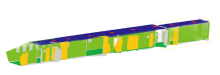
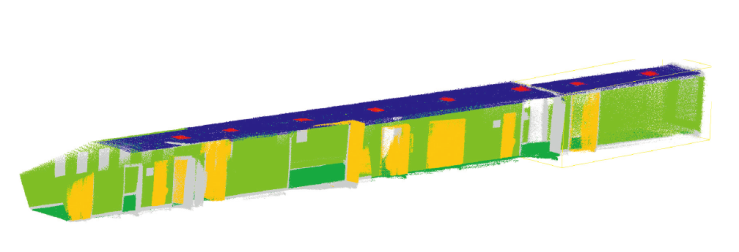
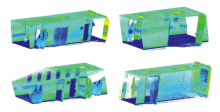
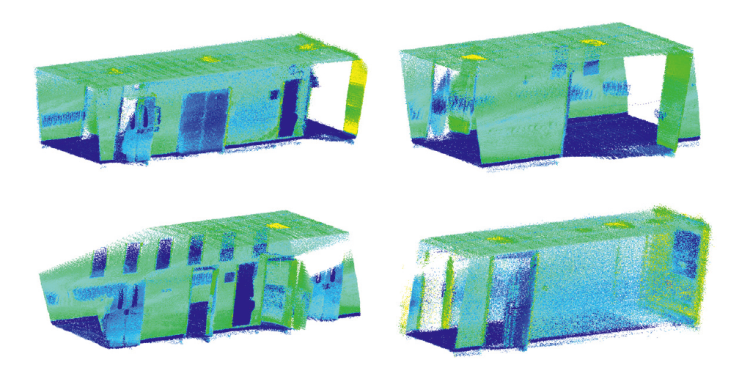
| 编号 | 类别 | 颜色 | 训练区域(点数) | 测试区域(点数) |
|---|---|---|---|---|
| 1 | 天花板 | 蓝色 | 259 883 | 83 571 |
| 2 | 地板 | 绿色 | 474 097 | 163 083 |
| 3 | 墙 | 黄绿色 | 3 675 802 | 1 445 094 |
| 4 | 门 | 橙色 | 1 259 442 | 452 910 |
| 5 | 灯 | 红色 | 14 571 | 4 025 |
| 6 | 未标记 | 灰色 | 1 760 796 | 169230 |
| 编号 | 类别 | 颜色 | 训练区域(点数) | 测试区域(点数) |
|---|---|---|---|---|
| 1 | 天花板 | 蓝色 | 259 883 | 83 571 |
| 2 | 地板 | 绿色 | 474 097 | 163 083 |
| 3 | 墙 | 黄绿色 | 3 675 802 | 1 445 094 |
| 4 | 门 | 橙色 | 1 259 442 | 452 910 |
| 5 | 灯 | 红色 | 14 571 | 4 025 |
| 6 | 未标记 | 灰色 | 1 760 796 | 169230 |
| 方法 | 天花板 | 地板 | 墙 | 门 | 灯 | mIoU | OA | mAcc | Avg.F1 |
|---|---|---|---|---|---|---|---|---|---|
| PointNet | 80.4 | 95.1 | 87.3 | 37.2 | 6.3 | 61.3 | 89.9 | 68.1 | 68.6 |
| PointNet++ | 84.6 | 99.0 | 84.2 | 21.4 | 70.0 | 71.8 | 89.9 | 80.4 | 80.0 |
| PTv1 | 86.0 | 98.9 | 91.8 | 59.9 | 74.6 | 82.2 | 94.2 | 88.4 | 89.6 |
| PTv2 | 83.9 | 99.1 | 91.1 | 61.8 | 76.5 | 82.5 | 94.0 | 88.1 | 89.8 |
| 方法 | 天花板 | 地板 | 墙 | 门 | 灯 | mIoU | OA | mAcc | Avg.F1 |
|---|---|---|---|---|---|---|---|---|---|
| PointNet | 80.4 | 95.1 | 87.3 | 37.2 | 6.3 | 61.3 | 89.9 | 68.1 | 68.6 |
| PointNet++ | 84.6 | 99.0 | 84.2 | 21.4 | 70.0 | 71.8 | 89.9 | 80.4 | 80.0 |
| PTv1 | 86.0 | 98.9 | 91.8 | 59.9 | 74.6 | 82.2 | 94.2 | 88.4 | 89.6 |
| PTv2 | 83.9 | 99.1 | 91.1 | 61.8 | 76.5 | 82.5 | 94.0 | 88.1 | 89.8 |
| [1] | 刘洋, 占佳豪, 李深, 等. 自动驾驶技术的未来:单车智能和智能车路协同[J]. 汽车安全与节能学报, 2024, 15(5): 611-633. |
| LIU Yang, ZHAN Jiahao, LI Shen, et al. Future of autono-mous driving: Single autonomous driving and intelligent vehicle-infrastructure collaboration systems[J]. J Autom Safe Energ, 2024, 15(5): 611-633. (in Chinese) | |
| [2] |
杨蒙蒙, 江昆, 温拓朴, 等. 自动驾驶高精度地图众源更新技术现状与挑战[J]. 中国公路学报, 2023, 36(5): 244-259.
doi: 10.19721/j.cnki.1001-7372.2023.05.021 |
|
YANG Mengmeng, JIANG Kun, WEN Tuopu, et al. Current status and challenges of crowdsourced updating technology for high-precision maps in autonomous driving[J]. Chin J Highw Transport, 2023, 36(5): 244-259. (in Chinese)
doi: 10.19721/j.cnki.1001-7372.2023.05.021 |
|
| [3] | QIN Tong, CHEN Tongqing, CHEN Yilun, et al. Avp-slam:Semantic visual mapping and localization for autonomous vehicles in the parking lot [C]// 2020 IEEE/RSJ Int’l Conf Intel Robo Syst (IROS). IEEE, 2020: 5939-5945. |
| [4] | QIN Tong, ZHENG Yuxin, CHEN Tongqing, et al. A light-weight semantic map for visual localization towards auto-nomous driving [C]// 2021 IEEE Int’l Conf Robo Auto (ICRA). IEEE, 2021: 11248-11254. |
| [5] | ZHENG Han, ZHANG Jiale, JIANG Mingyang, et al. Embodied escaping: End-to-end reinforcement learning for robot navigation in narrow environment[J]. arXiv preprint arXiv: 2503.03208, 2025. |
| [6] | 张亮, 刘智宇, 曹晶瑛, 等. 扫地机器人增强位姿融合的Cartographer算法及系统实现[J]. 软件学报, 2020, 31(9): 2678-2690. |
| ZHANG Liang, LIU Zhiyu, CAO Jingying, et al. Carto-grapher algorithm and system implementation with enhanced pose fusion for sweeping robots[J]. J Software, 2020, 31(9): 2678-2690. (in Chinese) | |
| [7] | 大疆创新. 禅思L2 [EB/OL]. 大疆创新. [2025-09-19] https://enterprise.dji.com/cn/zenmuse-l2. |
| DJI. Zenmuse L2 [EB/OL]. DJI. [2025-09-19] https://enterprise.dji.com/cn/zenmuse-l2. (in Chinese) | |
| [8] | YUE Xiangdi, ZHANG Yihuan, CHEN Jiawei, et al. LiDAR-based SLAM for robotic mapping: state of the art and new frontiers[J]. Indu Robo:Int’l J Robo Res Appl, 2024, 51(2): 196-205. |
| [9] |
刘铭哲, 徐光辉, 唐堂, 等. 激光雷达SLAM算法综述[J]. 计算机工程与应用, 2024, 60(1): 1-14.
doi: 10.3778/j.issn.1002-8331.2308-0455 |
| LIU Mingzhe, XU Guanghui, TANG Tang, et al. A review of LiDAR SLAM algorithms[J]. Comput Engi Appl, 2024, 60(1): 1-14. (in Chinese) | |
| [10] | 大疆创新. Horizon户外数据包[EB/OL]. 大疆创新. [2025-09-19] https://terra-1-g.djicdn.com/65c028cd298f4669a7f0e40e50ba1131/Showcase/horizon_outdoor.bag. |
| DJI. Horizon outdoor data bag[EB/OL]. DJI. [2025-09-19] https://terra-1-g.djicdn.com/65c028cd298f4669a7f0e40e50ba1131/Showcase/horizon_outdoor.bag. (in Chinese) | |
| [11] | Besl P J, McKay N D. Method for registration of 3-D shapes[C]// Sens Fusi IV: Contr Parad Data Struct. Spie, 1992, 1611: 586-606. |
| [12] | Censi A. An ICP variant using a point-to-line metric[C]// 2008 IEEE Int’l Conf Robo Auto. IEEE, 2008: 19-25. |
| [13] | Low K L. Linear least-squares optimization for point-to-plane ICP surface registration[J]. Chapel Hill, Univ North Carolina, 2004, 4(10): 1-3. |
| [14] | Segal A, Haehnel D, Thrun S. Generalized-ICP[C]// Robo: Sci Syst. Seattle, WA.2009, 2(4): 435. |
| [15] | Serafin J, Grisetti G. NICP:Dense normal based point cloud registration [C]// 2015 IEEE/RSJ Int’l Conf Intel Robo Syst (IROS). IEEE, 2015: 742-749. |
| [16] | Olson E B. Real-time correlative scan matching[C]// 2009 IEEE Int’l Conf Robo Auto. IEEE, 2009: 4387-4393. |
| [17] | Magnusson M, Andreasson H, Nuchter A, et al. Appearance-based loop detection from 3D laser data using the normal distributions transform[C]// 2009 IEEE Int’l Conf Robo Auto. IEEE, 2009: 23-28. |
| [18] | 周治国, 曹江微, 邸顺帆. 3D 激光雷达 SLAM 算法综述[J]. 仪器仪表学报, 2021, 42(9): 13-27. |
| ZHOU Zhiguo, CAO Jiangwei, DI Shunfan. A review of 3D LiDAR SLAM algorithms[J]. Chin J Sci Instrum, 2021, 42(9): 13-27. (in Chinese) | |
| [19] | 刘剑, 白迪. 基于特征匹配的三维点云配准算法[J]. 光学学报, 2018, 38(12): 1215005. |
| LIU Jian, BAI Di. Three-dimensional point cloud registra-tion algorithm based on feature matching[J]. Acta Opti Sini, 2018, 38(12): 1215005. (in Chinese) | |
| [20] | WU Ming, CHENG Chao, SHANG Huiliang. 2d lidar slam based on Gauss-Newton[C]// 2021 Int’l Conf Netw Syst AI (INSAI). IEEE, 2021: 90-94. |
| [21] | ZHANG Kang, DONG Chaoyi, GAO Liangliang, et al. A graph-optimized SLAM with improved Levenberg-Marquardt algorithm[C]// 2023 9th Int’l Conf Contr, Deci Info Tech (CoDIT). IEEE, 2023: 1821-1825. |
| [22] | LYU Pengfei, GUO Jia, SHA Qixin, et al. The comparison of gauss-newton and dog-leg in isam for AUV [C]// 2019 IEEE Underw Tech (UT). IEEE, 2019: 1-4. |
| [23] | DU Yongquan. G2o[EB/OL]. G2O Tutorial. [2025-09-19] https://ltslam-doc.readthedocs.io/en/latest/tutorial/g2o/g2o_tutorial.html. |
| [24] | Google. Ceres-solver[EB/OL]. Google. [2025-09-19] http://ceres-solver.org/. |
| [25] | ZHENG Tiantian, FENG Wang, XU Zhengyueang. An improved Gtsam-based nonlinear optimization algorithm in ORBSLAM3[C]// 2022 Int’l Conf Intel Transport, Big Data Smart City (ICITBS). IEEE, 2022: 30-33. |
| [26] | Bailey T, Nieto J, Guivant J, et al. Consistency of the EKF-SLAM algorithm[C]// 2006 IEEE/RSJ Int’l Conf Intel Robo Syst. IEEE, 2006: 3562-3568. |
| [27] | QI Song, HAN Jianda. An adaptive UKF algorithm for the state and parameter estimations of a mobile robot[J]. Acta Auto Sini, 2008, 34(1): 72-79. |
| [28] | Abdelrasoul Y, Saman A B S H M, Sebastian P. A quanti-tative study of tuning ROS gmapping parameters and their effect on performing indoor 2D SLAM [C]// 2016 2nd IEEE Int’l Symp Robo Manufact Auto (ROMA). IEEE, 2016: 1-6. |
| [29] | Kaess M, Ranganathan A, Dellaert F. iSAM: Incremental smoothing and mapping[J]. IEEE Trans Robo, 2008, 24(6): 1365-1378. |
| [30] | Kaess M, Johannsson H, Roberts R, et al. iSAM2: Incre-mental smoothing and mapping using the Bayes tree[J]. Int’l J Robo Res, 2012, 31(2): 216-235. |
| [31] | Cummins M J, Newman P M. Fab-map:Appearance-based place recognition and mapping using a learned visual vocabulary model [C]// Proc 27th Int’l Conf Mach Learn (ICML-10). Haifa, Israel. 2010: 3-10. |
| [32] | Dubé R, Dugas D, Stumm E, et al. Segmatch:Segment based place recognition in 3d point clouds [C]// 2017 IEEE Int’l Conf Robo Auto (ICRA). IEEE, 2017: 5266-5272. |
| [33] | Kim G, Kim A. Scan context:Egocentric spatial descriptor for place recognition within 3d point cloud map [C]// 2018 IEEE/RSJ Int’l Conf Intel Robo Syst (IROS). IEEE, 2018: 4802-4809. |
| [34] | Kim G, Choi S, Kim A. Scan context++: Structural place recognition robust to rotation and lateral variations in urban environments[J]. IEEE Trans Robo, 2021, 38(3): 1856-1874. |
| [35] | SHAN Tixiao, Englot B, Duarte F, et al. Robust place recognition using an imaging lidar [C]// 2021 IEEE Int’l Conf Robo Auto (ICRA). IEEE, 2021: 5469-5475. |
| [36] | Campos C, Elvira R, Rodríguez J J G, et al. Orb-slam3: An accurate open-source library for visual, visual-inertial, and multimap slam[J]. IEEE Trans Robo, 2021, 37(6): 1874-1890. |
| [37] | 李升波, 关阳, 侯廉, 等. 深度神经网络的关键技术及其在自动驾驶领域的应用[J]. 汽车安全与节能学报, 2019, 10(2): 119-145. |
| LI Shengbo, GUAN Yang, HOU Lian, et al. Key technique of deep neural network and its applications in autonomous driving[J]. J Autom Safe Energ, 2019, 10(2): 119-145. (in Chinese) | |
| [38] | CHEN Xieyuanli, Läbe T, Milioto A, et al. OverlapNet: Loop closing for LiDAR-based SLAM[J]. arXiv preprint arXiv: 2105.11344, 2021. |
| [39] | MA Junyi, ZHANG Jun, XU Jintao, et al. Overlaptrans-former: An efficient and yaw-angle-invariant transformer network for lidar-based place recognition[J]. IEEE Robo Auto Lett, 2022, 7(3): 6958-6965. |
| [40] | Cattaneo D, Vaghi M, Valada A. Lcdnet: Deep loop closure detection and point cloud registration for lidar slam[J]. IEEE Trans Robo, 2022, 38(4): 2074-2093. |
| [41] | Moravec H, Elfes A. High resolution maps from wide angle sonar[C]// Proc. 1985 IEEE Int’l Conf Robo Auto. IEEE, 1985, 2: 116-121. |
| [42] | Newcombe R A, Lovegrove S J, Davison A J. DTAM: Dense tracking and mapping in real-time[C]// 2011 Int’l Conf Comput Visi. IEEE, 2011: 2320-2327. |
| [43] | Informatik IX Computer Vision Group. RGBD-dataset[EB/OL]. TUM. [2025-09-19] https://cvg.cit.tum.de/data/datasets/rgbd-dataset. |
| [44] | Mur-Artal R, Montiel J M M, Tardos J D. ORB-SLAM: a versatile and accurate monocular SLAM system[J]. IEEE Trans Robo, 2015, 31(5): 1147-1163. |
| [45] | Hornung A, Wurm K M, Bennewitz M, et al. OctoMap: An efficient probabilistic 3D mapping framework based on octrees[J]. Auton Robo, 2013, 34: 189-206. |
| [46] | DENG Junyuan, WU Qi, CHEN Xieyuanli, et al. Nerf-loam: Neural implicit representation for large-scale incremental lidar odometry and mapping[C]// Proc IEEE/CVF Int’l Conf Comput Visi. 2023: 8218-8227. |
| [47] | LI Qi, WANG Yue, WANG Yilun, et al. Hdmapnet:An online HD map construction and evaluation framework [C]// 2022 Int’l Conf Robo Auto (ICRA). IEEE, 2022: 4628-4634. |
| [48] | Hess W, Kohler D, Rapp H, et al. Real-time loop closure in 2D LIDAR SLAM [C]// 2016 IEEE Int’l Conf Robo Auto (ICRA). IEEE, 2016: 1271-1278. |
| [49] | ZHANG Ji, Singh S. LOAM: Lidar odometry and mapping in real-time[C]// Robo: Sci Syst, Berkeley, CA. 2014, 2(9): 1-9. |
| [50] | Kohlbrecher S, Von Stryk O, Meyer J, et al. A flexible and scalable SLAM system with full 3D motion estimation[C]// 2011 IEEE Int’l Symp Safe, Secu, Resc Robo. IEEE, 2011: 155-160. |
| [51] | SHAN Tixiao, Englot B, Meyers D, et al. Lio-sam:Tightly-coupled lidar inertial odometry via smoothing and mapping [C]// 2020 IEEE/RSJ Int’l Conf Intel Robo Syst (IROS). IEEE, 2020: 5135-5142. |
| [52] | 蔡芸, 曾超, 王磊, 等. 语义先验改进Cartographer的机器人重定位方法[J]. 农业机械学报, 2025, 56(6): 585-593, 683. |
| CAI Yun, ZENG Chao, WANG Lei, et al. Semantic prior enhanced robot relocation method for cartographer[J]. Trans Chin Soc Agri Mach, 2025, 56(6): 585-593, 683. (in Chinese) | |
| [53] | 沈欣, 闵华松. 基于速度积分位姿融合的改进Cartographer算法[J]. 应用激光, 2021, 41(5): 1063-1069. |
| SHEN Xin, MIN Huasong. An improved cartographer algorithm based on velocity integration pose fusion[J]. Appl Lase, 2021, 41(5): 1063-1069. (in Chinese) | |
| [54] | ZHANG Ji, Singh S. Visual-lidar odometry and mapping: Low-drift, robust, and fast [C]// 2015 IEEE Int’l Conf Robo Auto (ICRA). IEEE, 2015: 2174-2181. |
| [55] | Graeter J, Wilczynski A, Lauer M. Limo:Lidar-monocular visual odometry [C]// 2018 IEEE/RSJ Int’l Conf Intel Robo Syst (IROS). IEEE, 2018: 7872-7879. |
| [56] | SHAN Tixiao, Englot B. Lego-loam:Lightweight and ground-optimized lidar odometry and mapping on variable terrain [C]// 2018 IEEE/RSJ Int’l Conf Intel Robo Syst (IROS). IEEE, 2018: 4758-4765. |
| [57] | ZHANG JI, Singh S. Laser-visual-inertial odometry and mapping with high robustness and low drift[J]. J Field Robo, 2018, 35(8): 1242-1264. |
| [58] | JI Xingliang, ZUO Lin, ZHANG Changhua, et al. Lloam:Lidar odometry and mapping with loop-closure detection based correction [C]// 2019 IEEE Int’l Conf Mech Auto (ICMA). IEEE, 2019: 2475-2480. |
| [59] | ZHAO Shibo, FANG Zheng, LI HaoLai, et al. A robust laser-inertial odometry and mapping method for large-scale highway environments [C]// 2019 IEEE/RSJ Int’l Conf Intel Robo Syst (IROS). IEEE, 2019: 1285-1292. |
| [60] | LIN Jiarong, ZHANG Fu. Loam livox: A fast, robust, high-precision LiDAR odometry and mapping package for LiDARs of small FoV [C]// 2020 IEEE Int’l Conf Robo Auto (ICRA). IEEE, 2020: 3126-3131. |
| [61] | WANG Han, WANG Chen, CHNE Chunlin, et al. F-loam:Fast lidar odometry and mapping [C]// 2021 IEEE/RSJ Int’l Conf Intel Robo Syst (IROS). IEEE, 2021: 4390-4396. |
| [62] | Kohlbrecher S, Meyer J. ROS. hector_slam[EB/OL]. ROS. [2025-09-19] https://wiki.ros.org/hector_slam. |
| [63] |
ZHANG Yong, LI Renjie, WANG Fenghong, et al. An autonomous navigation strategy based on improved hector slam with dynamic weighted a* algorithm[J]. IEEE Access, 2023, 11: 79553-79571.
doi: 10.1109/ACCESS.2023.3299293 URL |
| [64] | 汪建华, 黄磊, 石雨婷, 等. 基于优化Hector-SLAM算法的机器人自主导航系统设计[J]. 工程设计学报, 2023, 30(6): 678-686. |
| WANG Jianhua, HUANG Lei, SHI Yuting, et al. Design of robot autonomous navigation system based on optimized hector-SLAM algorithm[J]. J Engi Desi, 2023, 30(6): 678-686. (in Chinese) | |
| [65] | 苏易衡, 张奇志, 周亚丽. 适用于低端激光雷达的优化 Hector SLAM 算法[J]. 实验室研究与探索, 2019, 38(9): 47-51. |
| SU Yiheng, ZHANG Qizhi, ZHOU Yali. An optimized hector SLAM algorithm suitable for low-end LiDARs[J]. Res Expl Lab, 2019, 38(9): 47-51. (in Chinese) | |
| [66] | WANG Chao, ZHANG Guobao, ZHANG Ming. Research on improving LIO-SAM based on intensity scan context[C]// J Phys: Conf Seri. IOP Publishing, 2021, 1827(1): 012193. |
| [67] | MENG Xinyu, CHEN Xi, CHEN Shaofeng, et al. An improved LIO-SAM algorithm by integrating image information for dynamic and unstructured environments[J]. Measu Sci Tech, 2024, 35(9): 96313. |
| [68] | BAI Chunge, XIAO Tao, CHEN Yajie, et al. Faster-LIO: Lightweight tightly coupled LiDAR-inertial odometry using parallel sparse incremental voxels[J]. IEEE Robo Auto Lett, 2022, 7(2): 4861-4868. |
| [69] | XU Wei, CAI Yixi, HE Dongjiao, et al. Fast-lio2: Fast direct lidar-inertial odometry[J]. IEEE Trans Robo, 2022, 38(4): 2053-2073. |
| [70] | Deschaud J E. IMLS-SLAM:Scan-to-model matching based on 3D data [C]// 2018 IEEE Int’l Conf Robo Auto (ICRA). IEEE, 2018: 2480-2485. |
| [71] | Barrau A, Bonnabel S. An EKF-SLAM algorithm with consistency properties[J]. arXiv preprint arXiv:1510.06263, 2015. |
| [72] | Montemerlo M, Thrun S, Koller D, et al. FastSLAM: A factored solution to the simultaneous localization and mapping problem[J]. AAAI/IAAI, 2002, 593598: 593-598. |
| [73] | Grisetti G, Stachniss C, Burgard W. Improved techniques for grid mapping with rao-blackwellized particle filters[J]. IEEE Trans Robo, 2007, 23(1): 34-46. |
| [74] | Grisetti G, Tipaldi G D, Stachniss C, et al. Fast and accurate SLAM with Rao-Blackwellized particle filters[J]. Robo Auto Syst, 2007, 55(1): 30-38. |
| [75] | LIVOX. livox-hap[EB/OL]. LIVOX. [2025-09-19] https://www.livoxtech.com/hap. |
| [76] | Qi C R, SU Hao, MO Kaichun, et al. Pointnet: Deep learning on point sets for 3d classification and segmentation[C]// Proc IEEE Conf Comput Visi Patt Recog. 2017: 652-660. |
| [77] | Ruizhongtai Q C, YI Li, SU Hao, et al. Pointnet++: Deep hierarchical feature learning on point sets in a metric space[J]. Advan Neur Info Proc Syst, 2017, 30: 5105-5114. |
| [78] | ZHAO Hengshuang, JIANG Li, JIA Jiaya, et al. Point transformer[C]// Proc IEEE/CVF Int’l Conf Comput Visi. Held Virtually. 2021: 16259-16268. |
| [79] | WU Xiaoyang, LAO Yixing, JIANG Li, et al. Point transformer V2: Grouped vector attention and partition-based pooling[J]. Advan Neur Info Proc Syst, 2022, 35: 33330-33342. |
| [80] | 王海, 徐岩松, 蔡英凤, 等. 基于多传感器融合的智能汽车多目标检测技术综述[J]. 汽车安全与节能学报, 2021, 12(4): 440-455. |
| WANG Hai, XU Yansong, CAI Yingfeng, et al. Overview of intelligent vehicle multi-target detection technology based on multi-sensor fusion[J]. J Autom Safe Energ, 2021, 12(4): 440-455. (in Chinese) | |
| [81] | ZHANG Xiao, LI Shuaixin. SL-SLAM: A robust visual-inertial SLAM based deep feature extraction and matching[J]. arXiv e-prints, 2024: arXiv: 2405.03413. |
| [82] | Quach C H, Phung M D, Le H V, et al. SupSLAM:A robust visual inertial SLAM system using SuperPoint for unmanned aerial vehicles [C]// 2021 8th NAFOSTED Conf Info Comput Sci (NICS). IEEE, 2021: 507-512. |
| [83] | DeTone D, Malisiewicz T, Rabinovich A. Superpoint: Self-supervised interest point detection and description[C]// Proc IEEE Conf Comput Visi Patt Recog Worksh. Salt Lake City, UT.2018: 224-236. |
| [84] | Xieyuanli C, Milioto A, Palazzolo E, et al. Suma++:Efficient lidar-based semantic slam [C]// 2019 IEEE/RSJ Int’l Conf Intel Robo Syst (IROS). IEEE, 2019: 4530-4537. |
| [85] | Milioto A, Vizzo I, Behley J, et al. Rangenet++:Fast and accurate lidar semantic segmentation [C]// 2019 IEEE/RSJ Int’l Conf Intel Robo Syst (IROS). IEEE, 2019: 4213-4220. |
| [86] | HE Yicheng, CHEN Guangcheng, ZHANG Hong. Optimi-zing NeRF-based SLAM with Trajectory Smoothness Constraints[J]. arXiv preprint arXiv:2410.08780, 2024. |
| [87] | WANG Peng, ZHAO Lingzhe, ZHANG Yin, et al. MBA-SLAM: Motion blur aware dense visual SLAM with radiance fields representation[J]. arXiv preprint arXiv:2411.08279, 2024. |
| [88] | Chung C M, Tseng Y C, Hsu Y C, et al. Orbeez-slam:A real-time monocular visual slam with ORB features and nerf-realized mapping [C]// 2023 IEEE Int’l Conf Robo Auto (ICRA). IEEE, 2023: 9400-9406. |
| [89] | Isaacson S, Kung P C, Ramanagopal M, et al. Loner: Lidar only neural representations for real-time slam[J]. IEEE Robo Auto Lett, 2023, 8(12): 8042-8049. |
| [90] | TAO Yifu, Bhalgat Y, Fu L F T, et al. SiLVR:Scalable LiDAR-visual reconstruction with neural radiance fields for robotic inspection [C]// 2024 IEEE Int’l Conf Robo Auto (ICRA). IEEE, 2024: 17983-17989. |
| [91] | 张顺, 李雪娇, 覃小婷, 等. 基于多传感器融合技术 SLAM 的研究[J]. 汽车实用技术, 2025, 50(4): 16-19. |
| ZHANG Shun, LI Xuejiao, QIN Xiaoting, et al. Research on SLAM based on multi-sensor fusion technology[J]. Autom Appl Tech, 2025, 50(4): 16-19. (in Chinese) | |
| [92] | YIN Jie, LI Ang, XI Wei, et al. Ground-fusion:A low-cost ground slam system robust to corner cases [C]// 2024 IEEE Int’l Conf Robo Auto (ICRA). IEEE, 2024: 8603-8609. |
| [1] | LI Maoyue, LV Hongyu, HE Xiangmei, XU Guangqi, YU Wei. Surrounding vehicle recognition and information map construction technology in automatic driving [J]. Journal of Automotive Safety and Energy, 2022, 13(1): 131-141. |
| Viewed | ||||||
|
Full text |
|
|||||
|
Abstract |
|
|||||
