Welcome to Journal of Automotive Safety and Energy,

Journal of Automotive Safety and Energy ›› 2021, Vol. 12 ›› Issue (3): 314-321.DOI: 10.3969/j.issn.1674-8484.2021.03.005
• Automotive Safety • Previous Articles Next Articles
QU Xian1( ), YU Feng1, ZHANG Jinlong2
Received:2021-02-03
Online:2021-09-30
Published:2021-10-09
CLC Number:
QU Xian, YU Feng, ZHANG Jinlong. Simulation analysis for the effect of notchback-car rear structure on wake-field aerodynamic characteristics[J]. Journal of Automotive Safety and Energy, 2021, 12(3): 314-321.
Add to citation manager EndNote|Ris|BibTeX
URL: https://www.journalase.com/EN/10.3969/j.issn.1674-8484.2021.03.005
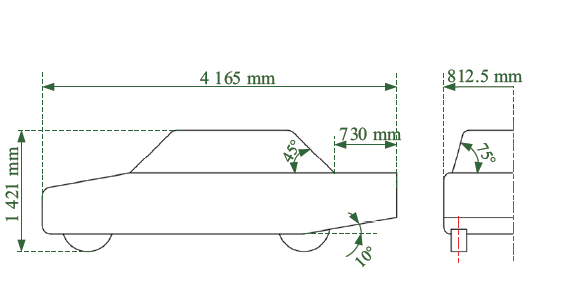
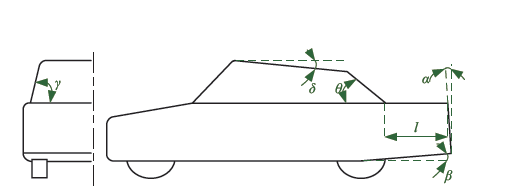
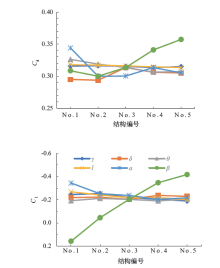
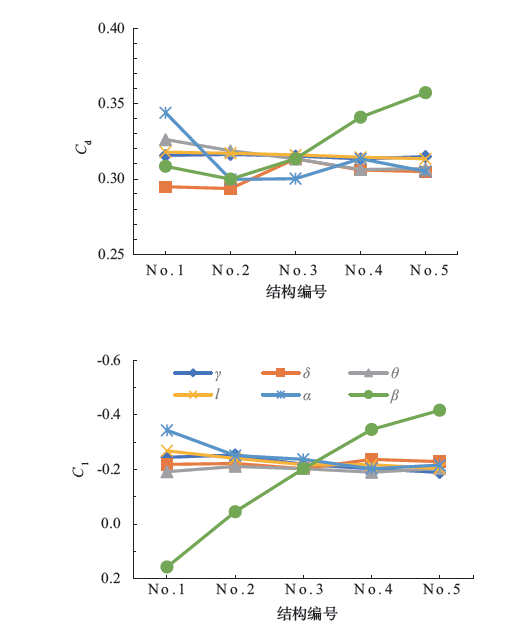
| 结构编号 | α / (°) | β / (°) | γ / (°) | δ / (°) | θ / (°) | l / mm |
|---|---|---|---|---|---|---|
| No.1 | -20 | 0 | 60 | -4 | 30 | 410 |
| No.2 | -10 | 5 | 65 | -2 | 35 | 490 |
| No.3 | 0 | 10 | 70 | 0 | 40 | 570 |
| No.4 | 10 | 15 | 75 | 2 | 45 | 650 |
| No.5 | 20 | 20 | 80 | 4 | 50 | 730 |
| 结构编号 | α / (°) | β / (°) | γ / (°) | δ / (°) | θ / (°) | l / mm |
|---|---|---|---|---|---|---|
| No.1 | -20 | 0 | 60 | -4 | 30 | 410 |
| No.2 | -10 | 5 | 65 | -2 | 35 | 490 |
| No.3 | 0 | 10 | 70 | 0 | 40 | 570 |
| No.4 | 10 | 15 | 75 | 2 | 45 | 650 |
| No.5 | 20 | 20 | 80 | 4 | 50 | 730 |
| [1] | 傅立敏. 汽车设计与空气动力学[M]. 北京: 机械工业出版社, 2011: 50-70. |
| FU Liming. Automobile Design and Aerodynamics [M]. Beijing: China Machine Press, 2011: 50-70. (in Chinese) | |
| [2] | 许建民. 减阻装置对厢式货车气动特性的影响[J]. 机械科学与技术, 2018, 37(6):941-948. |
| XU Jianmin. Influence of drag reducing device on aerodynamic characteristics of van type truck[J]. Mech Sci Tech for Aerospace Engineering, 2018, 37(6):941-948. (in Chinese) | |
| [3] | 李胜琴, 赵银宝, 冯新园, 等. 基于外部流场的汽车底部结构优化设计[J]. 森林工程, 2019, 35(3):100-106. |
| LI Shengqin, ZHAO Yinbao, FENG Xinyuan, et al. Optimization design of vehicle bottom structure based on the vehicle external flow field performance[J]. Forest Engi, 2019, 35(3):100-106. (in Chinese) | |
| [4] | Blocken B, Van Druenen T, Toparlar Y, et al. Aerodynamic drag in cycling pelotons: New insights by CFD simulation and wind tunnel testing[J]. J Wind Engi Indu Aerodyna, 2018, 179:319-337. |
| [5] |
Bell J R, Burton D, Thompson M C, et al. The effect of tail geometry on the slipstream and unsteady wake structure of high-speed trains[J]. Exp Therm Fluid Sci, 2017, 83:215-230.
doi: 10.1016/j.expthermflusci.2017.01.014 URL |
| [6] | 刘成晔, 谢金法, 袁传义, 等. 阶背车尾流结构的数值模拟分析[J]. 系统仿真学报, 2009, 21(21):6897-6900. |
| LIU Chengye, XIE Jinfa, YUAN Chuanyi, et al. Numerical analysis of wake structure for hatchback car[J]. J Syst Simu, 2009, 21(21):6897-6900. (in Chinese) | |
| [7] | 张之豪, 王宇萌, 王庆洋, 等. 2020中国汽车工程学会年会论文集[C]// 2020: 1578-1583. |
| ZHANG Zhihao, WANG Yumeng, WANG Qingyang, et al. Experimental study on three- dimensional wake structure of DrivAer standard model using Auto-PIV[C]// 2020 Proc Chin Soc Auto Engi Annu Meeting, 2020: 1578-1583. (in Chinese) | |
| [8] |
Aubrun S, McNally J, Alvi F, et al. Separation flow control on a generic ground vehicle using steady microjet arrays[J]. Experiments in Fluids, 2011, 51:1177-1187.
doi: 10.1007/s00348-011-1132-0 URL |
| [9] | 张英朝, 杜冠茂, 田思, 等. 35°Ahmed 模型气动射流减阻主动控制[J]. 吉林大学学报(工学版), 2019, 49(2):351-358. |
| ZHANG Yingchao, DU Guanmao, TIAN Si, et al. Active flow control of 350 ahmed model to reduce aerodynamic drag with steady jet[J]. J Jilin Univ (Engi Tech Ed), 2019, 49(2):351-358. (in Chinese) | |
| [10] |
ZHENG Hui, HU Xingjun, GUO Peng, et al. Separation flow control of a generic ground vehicle using an SDBD plasma actuator[J]. Energies, 2019, 12(20):3805. (in Chinese)
doi: 10.3390/en12203805 URL |
| [11] | 余志生. 汽车理论[M]. 北京: 机械工业出版社, 2009: 12-14. |
| YU Zhisheng. Automobile Theory [M]. Beijing: China Machine Press, 2009: 12-14. (in Chinese) | |
| [12] | 王佳, 杨志刚, 朱晖 等. 典型角度对汽车气动阻力特性影响的仿真分析[J]. 计算机仿真, 2013, 30(10):184-186. |
| WANG Jia, YANG Zhigang, ZHU Hui, et al. Simulation analysis of effect of typical angels on automotive aerodynamic drag[J]. Computer Simu, 2013, 30(10):184-186. (in Chinese) | |
| [13] |
Lee E, Lee S. Drag reduction of a heavy vehicle using a modified boat tail with lower inclined air deflector[J]. J Visualization, 2017, 20(4):743-752.
doi: 10.1007/s12650-017-0426-6 URL |
| [14] | 朱晖, 郑子浩, 杨志刚. 车尾水平收缩气动减阻的规律及机理[J]. 同济大学学报(自然科学版), 2017, 9(45):1377-1382. |
| ZHU Hui, ZHENG Zihao, YANG Zhigang. Regulation and mechanism of aerodynamic drag reduction by horizontal tail contraction[J]. J Tongji Univ (Nat Sci Ed), 2017, 9(45):1377-1382. (in Chinese) | |
| [15] | 袁志群, 杨明智, 张炳荣. 汽车底部复杂流场的主动和被动控制减阻方法研究[J]. 汽车工程, 2019, 5(41):537-544, 555. |
| YUAN Zhiqun, YANG Mingzhi, ZHANG Bingrong. A study on car drag reduction by active and passive control of complex underbody flow field[J]. Automotive Engineering, 2019, 5(41):537-544, 555. (in Chinese) | |
| [16] | 王师. MIRA 模型组气动特性风洞试验研究[D]. 长沙: 湖南大学, 2011. |
| WANG Shi. Experimental investigation on aerodynamic characteristic of MIRA model group wind tunnel[D]. Changsha: Hunan University, 2011. (in Chinese) | |
| [17] | 谷正气, 王师, 仇键, 等. MIRA模型组尾部造型风洞试验研究[J]. 科技导报, 2011, 29(8):67-71. |
| GU Zhengqi, WANG Shi, QIU Jian, et al. Wind tune tests of MIRA model group for study of vehicle’s rear shape[J]. Sci Tech Rev, 2011, 29(8):67-71. (in Chinese) | |
| [18] | 聂云. 车尾造型对凹坑型非光滑车身气动减阻的影响与优化[D]. 长沙: 湖南大学, 2014. |
| NIE Yun. The influence and optimization of vehicle’s rear shape for aerodynamic drag reduction of pit type non-smooth body[D]. Chang-sha: Hunan University, 2014. (in Chinese) | |
| [19] | 张甫仁, 张金龙, 屈贤, 等. 侧风中前窗角度对汽车稳定性影响的数值模拟[J]. 汽车安全与节能学报, 2015, 6(2):145-149. |
| ZHANG Furen, ZHANG Jinlong, QU Xian, et al. Numerical simulation on the influence of different front window angle of automobile stability in crosswind[J]. J Autom Safe Energ, 2015, 6(2):145-149. (in Chinese) | |
| [20] | 王东, 章辰益, 李理光, 等. 敞篷车与硬顶车流场特性的CFD对比研究[J]. 汽车工程, 2015, 37(1):78-82. |
| WANG Dong, ZHANG Chenyi, LI Liguang, et al. A CFD-based comparative study on the flow field characteristics of a cabriolet and its hardtop variant[J]. Automotive Engineering, 2015, 37(1):78-82. (in Chinese) | |
| [21] | 屈贤, 余烽. 基于正交试验设计的阶背车尾部结构优化[J]. 汽车安全与节能学报, 2017, 8(1):59-64. |
| QU Xian, YU Feng. Optimization on stepping automotive wake structures based on orthogonal test method[J]. J Autom Safe Energ, 2017, 8(1):59-64. (in Chinese) |
| [1] | CAI Senlin, WEI Mingshan, SONG Panpan, WEI Hongge. Cooling performance simulation of the power battery pack based on straight liquid cooling plate [J]. Journal of Automotive Safety and Energy, 2021, 12(3): 380-385. |
| [2] | CHEN Yuyao, WEI Mingrui. Three-dimensional multiphysics numerical simulation of solid oxide fuel cell for internal methane reforming [J]. Journal of Automotive Safety and Energy, 2021, 12(2): 243-250. |
| [3] | HE Ping, RUAN Haoda , MEI Jiahua , WANG Congyang , LI Zhaoyang. Cooling strategy of a dual fuel injector needle valve under micro pilot ignition condition [J]. Journal of Automotive Safety and Energy, 2020, 11(3): 406-412. |
| [4] | QU Xian, YU Feng. Optimization on stepping automotive wake structures based on orthogonal test method [J]. Journal of Automotive Safety and Energy, 2017, 08(01): 59-64. |
| [5] | WU Xiaomin, HOU Juncai, ZHANG Cong, CUI Yunchen, DUAN Hao, LI Chao. Effect of DC/AC electric field acting on premixed methane-air spherically expanding flame [J]. Journal Of Automotive Safety And Energy, 2016, 07(01): 78-85. |
| [6] | HAN Yong, XIE Jingping, LU Xiaoping, WANG Fang, HUANG Hongwu, MIZUNO Koji. Parameter optimization of CRS' seatbelt constraint paths based on design-of-experiment (DOE) [J]. Journal Of Automotive Safety And Energy, 2015, 6(03): 230-236. |
| [7] | ZHOU Yunshan, JIA Jiefeng. Parameters optimization of hybrid electric vehicle based on orthogonal experimental design and multi-objective genetic algorithm [J]. Journal Of Automotive Safety And Energy, 2014, 5(04): 324-330. |
| [8] | WANG Yue, YIN Gaoji, ZHOU Dayong, LIU Weiguo, SUN Lizhi. Car-body structure optimization of front 40% offset impact on a vehicle [J]. Journal Of Automotive Safety And Energy, 2014, 5(04): 371-377. |
| [9] | WANG Dong, WANG Yajun, SHI Yuliang, WU Shenrong, ZHAO Zheng, WU Te. Numerical simulation and test validation of automotive laminated windshield glass [J]. Journal Of Automotive Safety And Energy, 2014, 5(03): 263-269. |
| [10] | CUI Shujuan, CHEN Keming. Simulation and structure optimal analysis for small-overlap frontal-impact of a vehicle [J]. Journal Of Automotive Safety And Energy, 2014, 5(02): 139-144. |
| [11] | LIU Yongfeng, JIA Xiaoshe, PEI Pucheng, LU Yong. Numerical simulations and experiments of oxygen-enriched combustion in engine and using liquid oxygen to solidify carbon [J]. Journal of Automotive Safety and Energy, 2014, 5(01): 76-82. |
| [12] | CHE Kaikai, WANG Meisong. Comparison on three methods for simulating safety airbag deployment [J]. Journal Of Automotive Safety And Energy, 2013, 4(3): 250-256. |
| [13] | YANG Xin, XU Shucai, ZHANG Jinhuan, MA Chuns heng . National regulation comparison for special school bus betweens China and US and dynamic tests of school bus seats [J]. Journal Of Automotive Safety And Energy, 2013, 4(2): 152-160. |
| [14] | JIAN Xiaochun, WANG Xiao. Simulation of crashworthiness during front impact and offset impact and vehicle body structure improvement [J]. Journal of Automotive Safety and Energy, 2011, 2(3): 212-216. |
| [15] | HUO Na, ZHANG Guixin, ZHANG Feng, LIU Yongxi, Zhang Qing. Simulation and experimental investigation of auto ignition using microwave plasma [J]. Journal of Automotive Safety and Energy, 2011, 2(3): 217-222. |
| Viewed | ||||||
|
Full text |
|
|||||
|
Abstract |
|
|||||
