Welcome to Journal of Automotive Safety and Energy,

Journal of Automotive Safety and Energy ›› 2023, Vol. 14 ›› Issue (2): 133-156.DOI: 10.3969/j.issn.1674-8484.2023.02.001
JING Xiaojun, REN Shuojin, WANG Xiaowei, LI Tengteng, FANG Maodong
Online:2023-04-30
Published:2023-04-27
About author:Prof. FANG Maodong, He is a deputy director of chief engineer office and a senior chief expert of China Automotive Technology and Research Center Co., Ltd. (CATARC), the director of National Engineering Laboratory of Mobile Source Emission Control Technology and the director of Automotive Environmental Protection Branch of the China Society of Automotive Engineering (SAE-China). He obtained expert special allowance and certificate from the State Council in 2013. He received his bachelor degree from Tsinghua University in 1990 and master degree of business administration (MBA) from Tianjin University in 2005. He has been working on the vehicle emission and fuel economy control for more than 30 years and published more than 30 papers. He took the lead in 5 national standards on the vehicle emission and fuel economy including GB 18352, Limits and Measurement methods for emissions from light-duty vehicles. He was in charge of Chinese National Projects of The research on the relationship between vehicle emissions and fuel components and the technical route for vehicle stage VI emission standards.
CLC Number:
JING Xiaojun, REN Shuojin, WANG Xiaowei, LI Tengteng, FANG Maodong. Basic ideas and development trend of heavy-duty vehicle emission regulations in next stage[J]. Journal of Automotive Safety and Energy, 2023, 14(2): 133-156.
Add to citation manager EndNote|Ris|BibTeX
URL: https://www.journalase.com/EN/10.3969/j.issn.1674-8484.2023.02.001
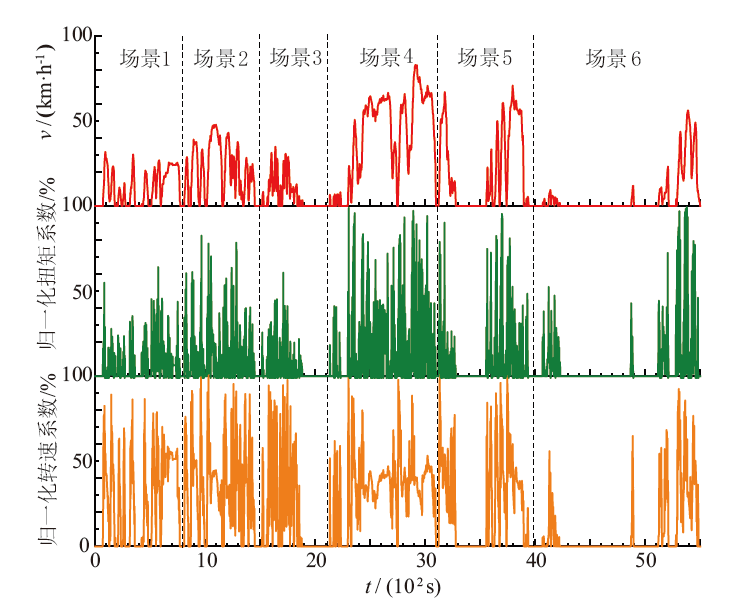
| 场景 | 来源 | 平均车速/(km·h-1) | 平均功率/ % | 倒拖占比/ % | 怠速占比/ % |
|---|---|---|---|---|---|
| ① 持续低负荷 | 送餐车 | 11 | 5 | 15 | 31 |
| ② 持续低负荷 | 配货车 | 14 | 6 | 19 | 30 |
| ③ 持续低负荷 | 配货车 | 7 | 3 | 15 | 53 |
| ④ 中速巡航到倒拖 | 配货车 | 43 | 14 | 28 | 10 |
| ⑤ 高到低负荷到倒拖和短怠速 | 送餐车 | 24 | 9 | 34 | 18 |
| ⑥ 低到高负荷到服务(比如原地作业) | 转运车 | 4.5 | 4 | 5 | 66 |
| 场景 | 来源 | 平均车速/(km·h-1) | 平均功率/ % | 倒拖占比/ % | 怠速占比/ % |
|---|---|---|---|---|---|
| ① 持续低负荷 | 送餐车 | 11 | 5 | 15 | 31 |
| ② 持续低负荷 | 配货车 | 14 | 6 | 19 | 30 |
| ③ 持续低负荷 | 配货车 | 7 | 3 | 15 | 53 |
| ④ 中速巡航到倒拖 | 配货车 | 43 | 14 | 28 | 10 |
| ⑤ 高到低负荷到倒拖和短怠速 | 送餐车 | 24 | 9 | 34 | 18 |
| ⑥ 低到高负荷到服务(比如原地作业) | 转运车 | 4.5 | 4 | 5 | 66 |
| 污染物① | 欧七提案② | EPA 2027 | CARB 2027 | |||||
|---|---|---|---|---|---|---|---|---|
| 冷态 | 热态 | SET和FTP | LLC | FTP和RMC | LLC | |||
| NOx | 350 | 90 | 47.0 | 67.1 | 26.8 | 67.1 | ||
| PM | 12 | 8 | 6.7 | 6.7 | 6.7 | 6.7 | ||
| PN | 5×10¹¹ | 2×10¹¹ | - | - | - | - | ||
| CO | 3 500 | 200 | 8 046.1 | 8 046.1 | 20 115.3 | 20 115.3 | ||
| NMOG/NMHC | 200 | 50 | - | - | 187.7 | 187.7 | ||
| NH3 | 65 | 65 | - | - | - | - | ||
| CH4 | 500 | 350 | 134.1③ | - | - | - | ||
| N2O | 160 | 100 | 134.1③ | - | - | - | ||
| HCHO | 30 | 30 | - | - | 67.1 | 67.1 | ||
| THC | - | - | 80.5 | 187.7 | - | - | ||
| 污染物① | 欧七提案② | EPA 2027 | CARB 2027 | |||||
|---|---|---|---|---|---|---|---|---|
| 冷态 | 热态 | SET和FTP | LLC | FTP和RMC | LLC | |||
| NOx | 350 | 90 | 47.0 | 67.1 | 26.8 | 67.1 | ||
| PM | 12 | 8 | 6.7 | 6.7 | 6.7 | 6.7 | ||
| PN | 5×10¹¹ | 2×10¹¹ | - | - | - | - | ||
| CO | 3 500 | 200 | 8 046.1 | 8 046.1 | 20 115.3 | 20 115.3 | ||
| NMOG/NMHC | 200 | 50 | - | - | 187.7 | 187.7 | ||
| NH3 | 65 | 65 | - | - | - | - | ||
| CH4 | 500 | 350 | 134.1③ | - | - | - | ||
| N2O | 160 | 100 | 134.1③ | - | - | - | ||
| HCHO | 30 | 30 | - | - | 67.1 | 67.1 | ||
| THC | - | - | 80.5 | 187.7 | - | - | ||
| 参数 | 正常行驶条件 | 扩展行驶条件 |
|---|---|---|
| 扩展行驶除数 | - | 2 (适用于满足本列条件之一时的排放测量结果) |
| 环境温度 | -7~35 ℃ | -10~-7 ℃或35~45 ℃ |
| 最高海拔 | 1.6 km | 1.6~1.8 km |
| 牵引/空气动力学修正 | 不允许 | 根据生产商规范,至多至限速 |
| 车辆负载 | ≥10 % | <10 % |
| 辅助 | 正常使用时允许 | - |
| 冷启动 | 包含 | - |
| 行程组合 | 正常使用场景 | - |
| 最短行程 | 最大允许总质量<16 t的车辆:5 000 km 最大允许总质量>16 t的车辆:10 000 km | 最大允许总质量<16 t的车辆:3 000~5 000 km 最大允许总质量>16 t的车辆:3 000~10 000 km |
| 参数 | 正常行驶条件 | 扩展行驶条件 |
|---|---|---|
| 扩展行驶除数 | - | 2 (适用于满足本列条件之一时的排放测量结果) |
| 环境温度 | -7~35 ℃ | -10~-7 ℃或35~45 ℃ |
| 最高海拔 | 1.6 km | 1.6~1.8 km |
| 牵引/空气动力学修正 | 不允许 | 根据生产商规范,至多至限速 |
| 车辆负载 | ≥10 % | <10 % |
| 辅助 | 正常使用时允许 | - |
| 冷启动 | 包含 | - |
| 行程组合 | 正常使用场景 | - |
| 最短行程 | 最大允许总质量<16 t的车辆:5 000 km 最大允许总质量>16 t的车辆:10 000 km | 最大允许总质量<16 t的车辆:3 000~5 000 km 最大允许总质量>16 t的车辆:3 000~10 000 km |
| 项目 | 条件 |
|---|---|
| PEMS设备 | 零点漂移检查过程 |
| 环境压力 | < 82.5 kPa |
| 环境温度 | θamb < -7 ℃,或当海拔h≤1.676 4 km时, θamb <(- 0.008 33 h + 68)×5/9 ℃ |
| 海拔 | >1.676 4 km |
| 冷却水温度 | 2024—2026型年:<70 ℃ |
| 后处理 | 主动再生过程 |
| 发动机 | 停机或转速为0 |
| 项目 | 条件 |
|---|---|
| PEMS设备 | 零点漂移检查过程 |
| 环境压力 | < 82.5 kPa |
| 环境温度 | θamb < -7 ℃,或当海拔h≤1.676 4 km时, θamb <(- 0.008 33 h + 68)×5/9 ℃ |
| 海拔 | >1.676 4 km |
| 冷却水温度 | 2024—2026型年:<70 ℃ |
| 后处理 | 主动再生过程 |
| 发动机 | 停机或转速为0 |
| 项目 | 内容 |
|---|---|
| 测试设备 | 试验室底盘测功机或PEMS设备 |
| 冷却水温度 | 第1次到达70 ℃或5 min内稳定在±2℃ |
| 车身附件 | 启动冷却风扇、交变电机、空压机、冷却水泵、润滑油泵、燃油泵等怠速所需的车身附件,驾驶室空调系统开至最热或最冷 |
| 测试时长 | 最少30 min且发动机转速不超过1 100 r/min |
| 项目 | 内容 |
|---|---|
| 测试设备 | 试验室底盘测功机或PEMS设备 |
| 冷却水温度 | 第1次到达70 ℃或5 min内稳定在±2℃ |
| 车身附件 | 启动冷却风扇、交变电机、空压机、冷却水泵、润滑油泵、燃油泵等怠速所需的车身附件,驾驶室空调系统开至最热或最冷 |
| 测试时长 | 最少30 min且发动机转速不超过1 100 r/min |
| 项目 | 内容 | ||
|---|---|---|---|
| 测试开始 | 发动机启动之前开始测试,冷却水温度< 40 ℃ | ||
| 窗口划分 | SI | 仅1个窗口:开始于当天第1组连续有效数据,结束于最后1组连续有效数据 | |
| CI | 宽度≤ (300±1) s; 窗口开始结束必须为有效数据; 包含≥ 600 s连续无效数据的窗口为无效窗口; 第1个窗口为第1组不包含无效数据的300 s; 最后1个窗口为最后1组不包含无效数据的300 s | ||
| 数据处理 | NOx进行湿度修正;排放负值不重置为0 | ||
| 分区 | 负荷比 | ① | |
| Bin 1 | L ≤ 6 % | ||
| Bin 2 | L > 6 % | ||
| 排放计算 | SI | ② | |
| CI | Bin 1 | ||
| Bin 2 | |||
| 项目 | 内容 | ||
|---|---|---|---|
| 测试开始 | 发动机启动之前开始测试,冷却水温度< 40 ℃ | ||
| 窗口划分 | SI | 仅1个窗口:开始于当天第1组连续有效数据,结束于最后1组连续有效数据 | |
| CI | 宽度≤ (300±1) s; 窗口开始结束必须为有效数据; 包含≥ 600 s连续无效数据的窗口为无效窗口; 第1个窗口为第1组不包含无效数据的300 s; 最后1个窗口为最后1组不包含无效数据的300 s | ||
| 数据处理 | NOx进行湿度修正;排放负值不重置为0 | ||
| 分区 | 负荷比 | ① | |
| Bin 1 | L ≤ 6 % | ||
| Bin 2 | L > 6 % | ||
| 排放计算 | SI | ② | |
| CI | Bin 1 | ||
| Bin 2 | |||
| 分区 | NOx ①/ [mg(kWh)-1] | NOx调整 ② | PM / [mg(kWh)-1] | HC / [mg(kWh)-1] | CO / [mg(kWh)-1] |
|---|---|---|---|---|---|
| Bin 1 | 10.0 g/s | (25-θ?amb)0.335 | - | - | - |
| Bin 2 | 77.8 | (25-θ?amb)2.95 | 10.1 | 160.9 | 12.1 |
| SET和FTP | 46.9 | - | 6.7 | 80.5 | 8.0 |
| LLC | 67.1 | - | 6.7 | 187.7 | 8.0 |
| 分区 | NOx ①/ [mg(kWh)-1] | NOx调整 ② | PM / [mg(kWh)-1] | HC / [mg(kWh)-1] | CO / [mg(kWh)-1] |
|---|---|---|---|---|---|
| Bin 1 | 10.0 g/s | (25-θ?amb)0.335 | - | - | - |
| Bin 2 | 77.8 | (25-θ?amb)2.95 | 10.1 | 160.9 | 12.1 |
| SET和FTP | 46.9 | - | 6.7 | 80.5 | 8.0 |
| LLC | 67.1 | - | 6.7 | 187.7 | 8.0 |
| 时间 | 组合牵引车 | 专业车辆 | |||
|---|---|---|---|---|---|
| 中型 | 重型 | 轻型 | 中型 | 重型 | |
| 2014 | 673.2 | 637.0 | 804.6 | 804.6 | 760.4 |
| 2017 | 653.1 | 616.9 | 772.4 | 772.4 | 744.3 |
| 2021 | 634.3 | 599.4 | 755.0 | 730.9 | 687.9 |
| 2024 | 618.2 | 584.7 | 744.3 | 721.5 | 678.6 |
| 时间 | 组合牵引车 | 专业车辆 | |||
|---|---|---|---|---|---|
| 中型 | 重型 | 轻型 | 中型 | 重型 | |
| 2014 | 673.2 | 637.0 | 804.6 | 804.6 | 760.4 |
| 2017 | 653.1 | 616.9 | 772.4 | 772.4 | 744.3 |
| 2021 | 634.3 | 599.4 | 755.0 | 730.9 | 687.9 |
| 2024 | 618.2 | 584.7 | 744.3 | 721.5 | 678.6 |
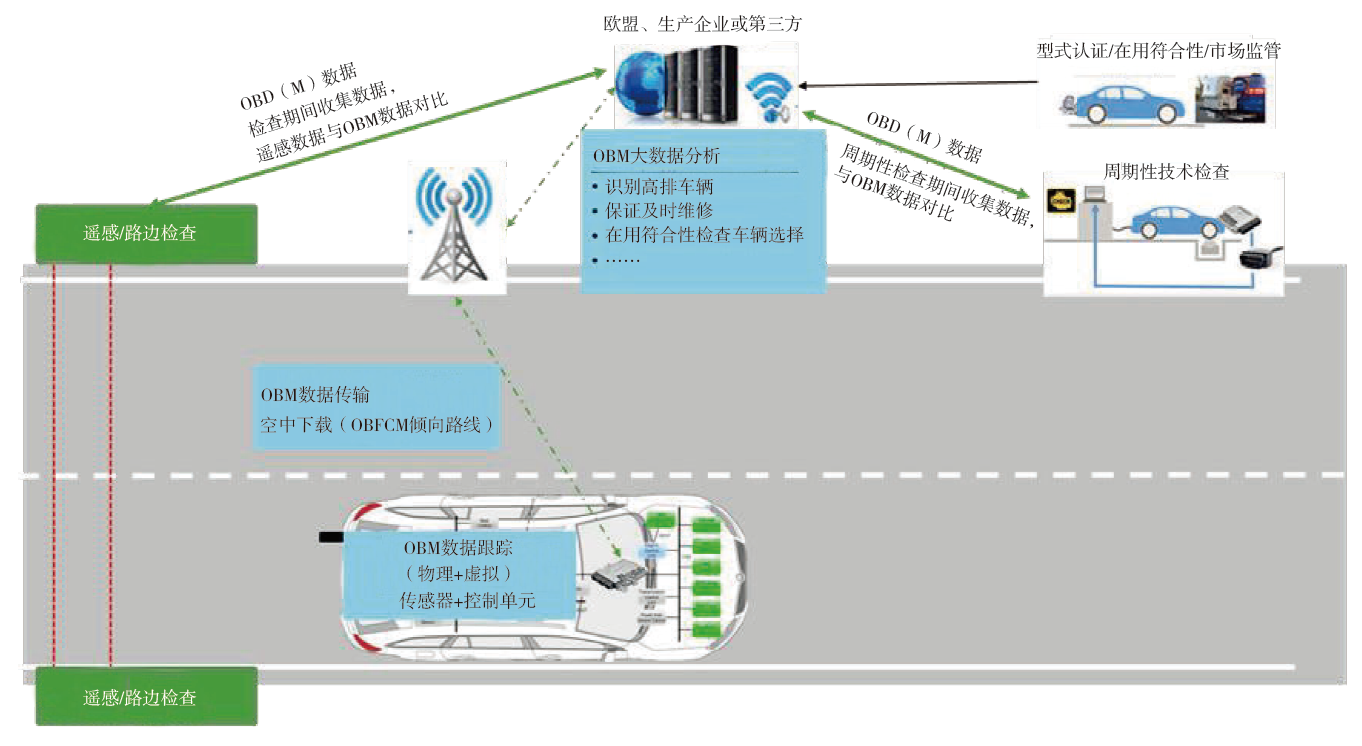
| 项目 | 内容 |
|---|---|
| 监控污染 物[ | NOx和NH3传感器:排放水平及排放控制系统失效监控; PM传感器:DPF功能监测,不进行PM测量 |
| 通讯协议[ | 基于OBFCM协议,间歇式信号传输 |
| 监控平台[ | 方案1:各成员国独立建立并共享数据; 方案2:建立统一的共享监控平台 |
| 数据累计 方法[ | 暂不考虑逐秒排放记录 1) 一段距离或时间窗口的尾气排放累计值; 2) 分区(binning)监控方法; 3) 超限制时间TaL(time above limit)方法 |
| 监控功能[ | 1) 通过故障灯或跛行模式提示排放超标以强制维修; 2) 在OBD基础上增强故障监控; 3) 在用符合性和市场监管测试样车信息; 4) 排放控制系统实时校准反馈; 5) PHEV电子围栏(特定区域仅允许纯电模式); 6) 排放超标后激活跛行模式; 7) 篡改监测 |
| 认证测试[ | 1) 通过与PEMS设备对比验证数据准确性和完整性; 2) 超排或OBM传感器失效后OBD报警灯激活验证; 3) 实车OBD数据可靠性验证 |
| OBM允许 偏差[ | 预计100%~150%欧七排放限值 |
| 有效行程[ | 1) 标准要求的环境温度和海拔之内; 2) NOx传感器传输有效数据; 3) 高于最短距离或者功的限值; 4) 停车时间长于4天之后的行程无效 |
| 有效数据[ | 建议采用最近10个有效行程进行平均,且满足 1) 所有行程在4周之内; 2) 平均行驶里程大于100 km; 3) 最近1个行程有效(避免重复的平均值); 4) 最近10个行程有效行程比例高于50% |
| 监控数据[ | 1) 平均排放(当前和生命周期); 2) 行驶里程; 3) 行程排放(近4星期和所有行程用于平均); 4) 平均DPF再生频率; 5) MIL激活日期时间; 6) OBM标定的时期和行驶里程 |
| 项目 | 内容 |
|---|---|
| 监控污染 物[ | NOx和NH3传感器:排放水平及排放控制系统失效监控; PM传感器:DPF功能监测,不进行PM测量 |
| 通讯协议[ | 基于OBFCM协议,间歇式信号传输 |
| 监控平台[ | 方案1:各成员国独立建立并共享数据; 方案2:建立统一的共享监控平台 |
| 数据累计 方法[ | 暂不考虑逐秒排放记录 1) 一段距离或时间窗口的尾气排放累计值; 2) 分区(binning)监控方法; 3) 超限制时间TaL(time above limit)方法 |
| 监控功能[ | 1) 通过故障灯或跛行模式提示排放超标以强制维修; 2) 在OBD基础上增强故障监控; 3) 在用符合性和市场监管测试样车信息; 4) 排放控制系统实时校准反馈; 5) PHEV电子围栏(特定区域仅允许纯电模式); 6) 排放超标后激活跛行模式; 7) 篡改监测 |
| 认证测试[ | 1) 通过与PEMS设备对比验证数据准确性和完整性; 2) 超排或OBM传感器失效后OBD报警灯激活验证; 3) 实车OBD数据可靠性验证 |
| OBM允许 偏差[ | 预计100%~150%欧七排放限值 |
| 有效行程[ | 1) 标准要求的环境温度和海拔之内; 2) NOx传感器传输有效数据; 3) 高于最短距离或者功的限值; 4) 停车时间长于4天之后的行程无效 |
| 有效数据[ | 建议采用最近10个有效行程进行平均,且满足 1) 所有行程在4周之内; 2) 平均行驶里程大于100 km; 3) 最近1个行程有效(避免重复的平均值); 4) 最近10个行程有效行程比例高于50% |
| 监控数据[ | 1) 平均排放(当前和生命周期); 2) 行驶里程; 3) 行程排放(近4星期和所有行程用于平均); 4) 平均DPF再生频率; 5) MIL激活日期时间; 6) OBM标定的时期和行驶里程 |
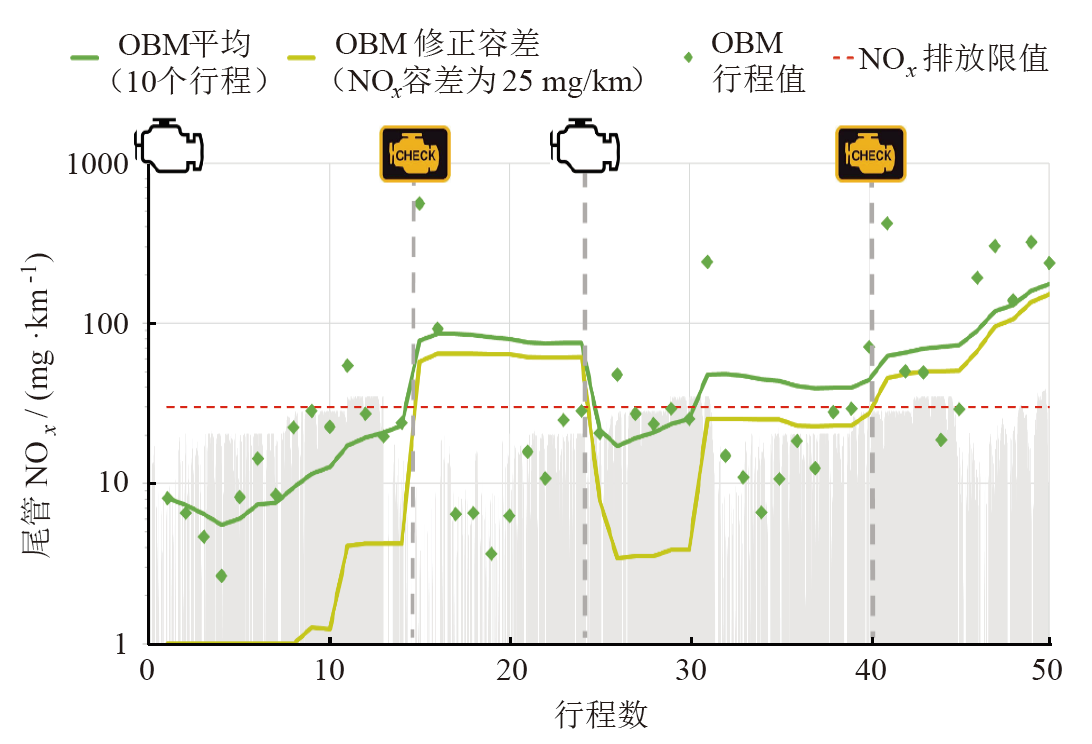
| 排放物 | 原理 | 精度(浓度范围) | 寿命 | 现阶段 | 发展目标 |
|---|---|---|---|---|---|
| NOx | 氧化锆电流式 | ±10×10-6 (0~10-4); ±10% ( > 10-4 ) | 6 000 h | 受NH3干扰; 露点检测 | 无露点、防水; NOx、NH3二元监测; 寿命1万h |
| NH3 | 混合电势 | ±5×10⁻⁶ (10-5) | 5 000 h/ (25万km) | 受H2O、O2、SO2、NO2干扰;工作温度:200~450 ℃ | NOx/ NH3分离算法; NOx + NH3组合监测 |
| PM(/PN) | Al2O3或ZrO3 电阻式 | - | - | 非连续式,借助压差传感器 进行DPF诊断 | 静电式;扩散冲量技术(可同时测量PM和PM);激光诱导荧光式(LII) |
| CO/HC/ CH4/N2O | 尚无成熟产品 | - | - | - | - |
| 排放物 | 原理 | 精度(浓度范围) | 寿命 | 现阶段 | 发展目标 |
|---|---|---|---|---|---|
| NOx | 氧化锆电流式 | ±10×10-6 (0~10-4); ±10% ( > 10-4 ) | 6 000 h | 受NH3干扰; 露点检测 | 无露点、防水; NOx、NH3二元监测; 寿命1万h |
| NH3 | 混合电势 | ±5×10⁻⁶ (10-5) | 5 000 h/ (25万km) | 受H2O、O2、SO2、NO2干扰;工作温度:200~450 ℃ | NOx/ NH3分离算法; NOx + NH3组合监测 |
| PM(/PN) | Al2O3或ZrO3 电阻式 | - | - | 非连续式,借助压差传感器 进行DPF诊断 | 静电式;扩散冲量技术(可同时测量PM和PM);激光诱导荧光式(LII) |
| CO/HC/ CH4/N2O | 尚无成熟产品 | - | - | - | - |
| 政策 | 中短期:欧七;基于目前排放传感器的升级 | 长期:下阶段;基于未来排放传感器 | |
|---|---|---|---|
| 单车 | 超排识别 强制维修 | NOx、NH3:基于传感器数据; PM(/PN):基于先进DPF诊断; CO/HC/CH4:基于模型 | NOx、NH3:基于先进传感器; PM/PN:基于先进传感器; CO/HC/CH4:依据传感器情况 |
| 篡改诊断 | NOx、NH3、PM/PN:OBD合理性检查; NOx:基于云数据诊断 | 基于云数据对所有排放物篡改诊断 | |
| 车辆检查升级 | NOx、NH3、PM/PN:高排车辆强制在下次周期性车检 时进行排放和OBM检查; 低排放车辆适当较少周期性车检 | 充分减少或完全替代周期性车检/在用符合 性测试 | |
| 长期排放监控 | NOx和NH3:排放监控;记录平均排放、 距离、行程排放、再生频率、时间日期、行驶里程 | NOx、NH3、PM/PN:排放监控; CO/HC/CH4:依据传感器情况 | |
| 车型 | 放松在用符合性 检查 | NOx、NH3、PM(/PN):降低测试负担 (减少测试车辆数量) | NOx、NH3、PM/PN:替代在用符合性检查; 其他排放物:依据传感器情况 |
| 在用符合性和市场监管车辆选择 | NOx、NH3和DPF诊断:通过单车S-MIL反馈 | 所有排放物:通过单车S-MIL反馈 | |
| 篡改诊断 | NOx:基于云数据诊断(车型被篡改车辆 数量) | 所有排放物:基于云数据诊断 | |
| 排放符合性监控 | NOx和NH3:排放监控;通过多车数据弥合不确定性; 不考虑边界条件和驾驶工况的排放评估 | 所有排放物:排放符合性监控 |
| 政策 | 中短期:欧七;基于目前排放传感器的升级 | 长期:下阶段;基于未来排放传感器 | |
|---|---|---|---|
| 单车 | 超排识别 强制维修 | NOx、NH3:基于传感器数据; PM(/PN):基于先进DPF诊断; CO/HC/CH4:基于模型 | NOx、NH3:基于先进传感器; PM/PN:基于先进传感器; CO/HC/CH4:依据传感器情况 |
| 篡改诊断 | NOx、NH3、PM/PN:OBD合理性检查; NOx:基于云数据诊断 | 基于云数据对所有排放物篡改诊断 | |
| 车辆检查升级 | NOx、NH3、PM/PN:高排车辆强制在下次周期性车检 时进行排放和OBM检查; 低排放车辆适当较少周期性车检 | 充分减少或完全替代周期性车检/在用符合 性测试 | |
| 长期排放监控 | NOx和NH3:排放监控;记录平均排放、 距离、行程排放、再生频率、时间日期、行驶里程 | NOx、NH3、PM/PN:排放监控; CO/HC/CH4:依据传感器情况 | |
| 车型 | 放松在用符合性 检查 | NOx、NH3、PM(/PN):降低测试负担 (减少测试车辆数量) | NOx、NH3、PM/PN:替代在用符合性检查; 其他排放物:依据传感器情况 |
| 在用符合性和市场监管车辆选择 | NOx、NH3和DPF诊断:通过单车S-MIL反馈 | 所有排放物:通过单车S-MIL反馈 | |
| 篡改诊断 | NOx:基于云数据诊断(车型被篡改车辆 数量) | 所有排放物:基于云数据诊断 | |
| 排放符合性监控 | NOx和NH3:排放监控;通过多车数据弥合不确定性; 不考虑边界条件和驾驶工况的排放评估 | 所有排放物:排放符合性监控 |
| 监控方式 | 参数 | 内燃机和非插电式混合动力 | 插电式混合动力 |
|---|---|---|---|
| 随车记录[ 远程上传[ | VIN | √ | √ |
| 累计燃油消耗量 / L | √ | √ | |
| 累计行驶里程 / km | √ | √ | |
| 电量消耗过程累计燃油消耗量 / L | - | √ | |
| 驾驶员可选电量增加过程 累计燃油消耗量 / L | - | √ | |
| 电量消耗且发动机关闭总行驶里程 / km | - | √ | |
| 电量消耗且发动机运行总行驶里程 / km | - | √ | |
| 驾驶员可选电量增加过程 累计行驶里程 / km | - | √ | |
| 累计电池充电量 / kWh | - | √ | |
| 随车记录[ | 发动机燃油消耗率 / (g·s-1) | √ | √ |
| 发动机燃油消耗率 / (L·h-1) | √ | √ | |
| 车辆燃油消耗率 / (g·s-1) | √ | √ | |
| 车辆速度 / (km·h-1) | √ | √ | |
| 数据公开[ | 每100 km平均燃油消耗量 / L | √ | - |
| 每100 km平均电能消耗量 / kWh | √ | √ | |
| 平均CO2排放 / (g·km-1) | √ | - | |
| 远程监控和认证过程中平均燃油 消耗量的差异 | √ | - | |
| 远程监控和认证过程中平均电能 消耗量的差异 | √ | √ | |
| 远程监控和认证过程中平均CO2 排放的差异 | √ | - |
| 监控方式 | 参数 | 内燃机和非插电式混合动力 | 插电式混合动力 |
|---|---|---|---|
| 随车记录[ 远程上传[ | VIN | √ | √ |
| 累计燃油消耗量 / L | √ | √ | |
| 累计行驶里程 / km | √ | √ | |
| 电量消耗过程累计燃油消耗量 / L | - | √ | |
| 驾驶员可选电量增加过程 累计燃油消耗量 / L | - | √ | |
| 电量消耗且发动机关闭总行驶里程 / km | - | √ | |
| 电量消耗且发动机运行总行驶里程 / km | - | √ | |
| 驾驶员可选电量增加过程 累计行驶里程 / km | - | √ | |
| 累计电池充电量 / kWh | - | √ | |
| 随车记录[ | 发动机燃油消耗率 / (g·s-1) | √ | √ |
| 发动机燃油消耗率 / (L·h-1) | √ | √ | |
| 车辆燃油消耗率 / (g·s-1) | √ | √ | |
| 车辆速度 / (km·h-1) | √ | √ | |
| 数据公开[ | 每100 km平均燃油消耗量 / L | √ | - |
| 每100 km平均电能消耗量 / kWh | √ | √ | |
| 平均CO2排放 / (g·km-1) | √ | - | |
| 远程监控和认证过程中平均燃油 消耗量的差异 | √ | - | |
| 远程监控和认证过程中平均电能 消耗量的差异 | √ | √ | |
| 远程监控和认证过程中平均CO2 排放的差异 | √ | - |
| 额定功率百分比 / % | 车速 / (km·h-1) | ||||
|---|---|---|---|---|---|
| 0 | (0,16] | (16, 40] | (40, 64] | (64, ∞) | |
| (0,25] | Bin 2 | Bin 3 | Bin 4 | Bin 5 | Bin 6 |
| (25,50] | Bin 7 | Bin 8 | Bin 9 | Bin 10 | |
| (50,100] | Bin 11 | Bin 12 | Bin 13 | Bin 14 | |
| 额定功率百分比 / % | 车速 / (km·h-1) | ||||
|---|---|---|---|---|---|
| 0 | (0,16] | (16, 40] | (40, 64] | (64, ∞) | |
| (0,25] | Bin 2 | Bin 3 | Bin 4 | Bin 5 | Bin 6 |
| (25,50] | Bin 7 | Bin 8 | Bin 9 | Bin 10 | |
| (50,100] | Bin 11 | Bin 12 | Bin 13 | Bin 14 | |
| 数据项 | 燃油消耗 | 行驶距离 | 能量输出 | 运行时间 | 激活计数 |
|---|---|---|---|---|---|
| 激活的100 h | 发动机、怠速取力器、车辆 | 余热回收、车辆、主动技术 | 发动机、余热回收、正动能 | 发动机、怠速、市区、取力器、余热回收、启停、主动技术 | 自动熄火 |
| 存储的100 h | 同上 | 同上 | 同上 | 怠速、市区、取力器、余热回收、启停、主动技术 | 同上 |
| 生命 周期 | 同上 | 同上 | 同上 | 市区、余热回收、启停、主动技术 | 同上 |
| 数据项 | 燃油消耗 | 行驶距离 | 能量输出 | 运行时间 | 激活计数 |
|---|---|---|---|---|---|
| 激活的100 h | 发动机、怠速取力器、车辆 | 余热回收、车辆、主动技术 | 发动机、余热回收、正动能 | 发动机、怠速、市区、取力器、余热回收、启停、主动技术 | 自动熄火 |
| 存储的100 h | 同上 | 同上 | 同上 | 怠速、市区、取力器、余热回收、启停、主动技术 | 同上 |
| 生命 周期 | 同上 | 同上 | 同上 | 市区、余热回收、启停、主动技术 | 同上 |
| 生效时间 | 参数 |
|---|---|
| 2022年及之后 | 发动机额定功率、车速、NOx上游质量流量、NOx下游质量流量 |
| 2024年及之后 | 发动机额定转速、发动机系族、反应剂指定喷射量、反应剂喷射模式、反应剂实际喷射量、当前循环反应剂用量、目标氨储量、实际氨储量(模型值)、SCR上游温度、SCR下游温度、NOx传感器读取稳定性、EGR质量流量、发动机燃油消耗率、车辆燃油消耗率、碳氢喷射率、碳氢喷嘴工作循环、后处理燃料压力、进气增压出口温度、驱动系统激活、底盘仪表读取、发动机仪表读取(如适用)、混合动力/纯电充电状态、混合动力/纯电电池电压、混合动力/纯电电池电流、指定进气流量、曲轴箱压力、曲轴箱油分离器转速、蒸发系统清洗压力、车速限制器限值 |
| 生效时间 | 参数 |
|---|---|
| 2022年及之后 | 发动机额定功率、车速、NOx上游质量流量、NOx下游质量流量 |
| 2024年及之后 | 发动机额定转速、发动机系族、反应剂指定喷射量、反应剂喷射模式、反应剂实际喷射量、当前循环反应剂用量、目标氨储量、实际氨储量(模型值)、SCR上游温度、SCR下游温度、NOx传感器读取稳定性、EGR质量流量、发动机燃油消耗率、车辆燃油消耗率、碳氢喷射率、碳氢喷嘴工作循环、后处理燃料压力、进气增压出口温度、驱动系统激活、底盘仪表读取、发动机仪表读取(如适用)、混合动力/纯电充电状态、混合动力/纯电电池电压、混合动力/纯电电池电流、指定进气流量、曲轴箱压力、曲轴箱油分离器转速、蒸发系统清洗压力、车速限制器限值 |
| 类型 | 项目 | 参数(如适用) |
|---|---|---|
| 压燃 | 发动机和车辆参数 | P档、N档、制动开关、离合开关、排气门控制线圈输出、排气门位置(指令和实际)、输出轴扭矩 |
| DOC | 进口温度、出口温度 | |
| DPF | 碳载量、灰载量 | |
| EGR | EGR压差 | |
| 压燃 | SCR | 反应剂浓度相关、反应剂冷却控制阀(指令和实际)、反应剂箱温度、反应剂系统压力、反应剂泵指令百分比、反应剂喷嘴控制状态、反应剂管路加热输出、反应剂喷射量(指令和实际) |
| 阶梯限速 | 相关附加参数 | |
| 点燃 | 空燃加强参数 | 时间比例,累计时间,节气门、发动机保护、催化器保护数值追踪、峰值效率 |
| 类型 | 项目 | 参数(如适用) |
|---|---|---|
| 压燃 | 发动机和车辆参数 | P档、N档、制动开关、离合开关、排气门控制线圈输出、排气门位置(指令和实际)、输出轴扭矩 |
| DOC | 进口温度、出口温度 | |
| DPF | 碳载量、灰载量 | |
| EGR | EGR压差 | |
| 压燃 | SCR | 反应剂浓度相关、反应剂冷却控制阀(指令和实际)、反应剂箱温度、反应剂系统压力、反应剂泵指令百分比、反应剂喷嘴控制状态、反应剂管路加热输出、反应剂喷射量(指令和实际) |
| 阶梯限速 | 相关附加参数 | |
| 点燃 | 空燃加强参数 | 时间比例,累计时间,节气门、发动机保护、催化器保护数值追踪、峰值效率 |
| 车型 | 高速 | 中速 | 低速 | 客运 | |||||||
|---|---|---|---|---|---|---|---|---|---|---|---|
| 定义 / (km·h-1) | > 40.2 ① | 24.1~40.2 ① | < 24.1 ① | > 30座 | |||||||
| 阶梯限速 | t non-idle / h | vmax/ (km·h-1) | t non-idle / h | vmax/ (km·h-1) | t non-idle / h | vmax/ (km·h-1) | t non-idle / h | vmax/ (km·h-1) | |||
| 0 | 104.6 | 0 | 88.5 | 0 | 72.4 | 0 | 104.6 | ||||
| 6 | 96.6 | 6 | 80.5 | 5 | 64.4 | 80 | 80.5 | ||||
| 12 | 88.5 | 12 | 72.4 | 10 | 56.3 | 180 | 40.2 | ||||
| 60 | 80.5 | 45 | 64.4 | 30 | 40.2 | ||||||
| 86 | 72.4 | 70 | 56.3 | ||||||||
| 119 | 64.4 | 90 | 40.2 | ||||||||
| 144 | 56.3 | ||||||||||
| 164 | 40.2 | ||||||||||
| 每阶段开始 | 每5 min降低1.6 km/h,直至达到限制车速 | ||||||||||
| 车型 | 高速 | 中速 | 低速 | 客运 | |||||||
|---|---|---|---|---|---|---|---|---|---|---|---|
| 定义 / (km·h-1) | > 40.2 ① | 24.1~40.2 ① | < 24.1 ① | > 30座 | |||||||
| 阶梯限速 | t non-idle / h | vmax/ (km·h-1) | t non-idle / h | vmax/ (km·h-1) | t non-idle / h | vmax/ (km·h-1) | t non-idle / h | vmax/ (km·h-1) | |||
| 0 | 104.6 | 0 | 88.5 | 0 | 72.4 | 0 | 104.6 | ||||
| 6 | 96.6 | 6 | 80.5 | 5 | 64.4 | 80 | 80.5 | ||||
| 12 | 88.5 | 12 | 72.4 | 10 | 56.3 | 180 | 40.2 | ||||
| 60 | 80.5 | 45 | 64.4 | 30 | 40.2 | ||||||
| 86 | 72.4 | 70 | 56.3 | ||||||||
| 119 | 64.4 | 90 | 40.2 | ||||||||
| 144 | 56.3 | ||||||||||
| 164 | 40.2 | ||||||||||
| 每阶段开始 | 每5 min降低1.6 km/h,直至达到限制车速 | ||||||||||
| 发动机类型 | 当前寿命 | 2027型年及以后寿命 | |||||
|---|---|---|---|---|---|---|---|
| km | 年 | 103 h | km | 年 | 103 h | ||
| 点燃式重型发动机 | 177 027.8 | 10 | - | 321 868.8 | 15 | 10 | |
| 轻型重型发动机 | 177 027.8 | 10 | - | 434 522.9 | 15 | 13 | |
| 中型重型发动机 | 297 728.6 | 10 | - | 563 270.4 | 12 | 17 | |
| 重型重型发动机 | 700 064.6 | 10 | 22 | 1 046 073.6 | 11 | 32 | |
| 发动机类型 | 当前寿命 | 2027型年及以后寿命 | |||||
|---|---|---|---|---|---|---|---|
| km | 年 | 103 h | km | 年 | 103 h | ||
| 点燃式重型发动机 | 177 027.8 | 10 | - | 321 868.8 | 15 | 10 | |
| 轻型重型发动机 | 177 027.8 | 10 | - | 434 522.9 | 15 | 13 | |
| 中型重型发动机 | 297 728.6 | 10 | - | 563 270.4 | 12 | 17 | |
| 重型重型发动机 | 700 064.6 | 10 | 22 | 1 046 073.6 | 11 | 32 | |
| 车型 | 欧七提案 | 欧六 | 国六 | |||
|---|---|---|---|---|---|---|
| 主有效寿命期 | 额外的有效寿命期 | 有效寿命期 | 有效寿命期 | |||
| M1, N1, M2 | 16万km或8年 | 20 万km或10年 | 16万km或5年 | 20万km或5年 | ||
| N2, N3 < 16 t, M3 < 7.5 t | 30万km或8年 | 37.5万km | 30万km或6年 | 30万km或6年 | ||
| N3 > 16 t, M3 > 7.5 t | 70万km或15年 | 87.5 万km | 70 万km或7年 | 70万km或7年 | ||
| 车型 | 欧七提案 | 欧六 | 国六 | |||
|---|---|---|---|---|---|---|
| 主有效寿命期 | 额外的有效寿命期 | 有效寿命期 | 有效寿命期 | |||
| M1, N1, M2 | 16万km或8年 | 20 万km或10年 | 16万km或5年 | 20万km或5年 | ||
| N2, N3 < 16 t, M3 < 7.5 t | 30万km或8年 | 37.5万km | 30万km或6年 | 30万km或6年 | ||
| N3 > 16 t, M3 > 7.5 t | 70万km或15年 | 87.5 万km | 70 万km或7年 | 70万km或7年 | ||
| [1] | 中国汽车工业协会, 中国汽车工程研究院股份有限公司, 一汽解放汽车有限公司. 中国商用车汽车产业发展报告[M]. 北京: 社会科学文献出版社, 2022:2-4. |
| China Association of Automobile Manufacturers, China Automotive Engineering Research Institute Co., Ltd, FAW Jiefang Automobile Co., Ltd. Annual report on the development of China’s commercial vehicle industry[M]. Beijing: Social Sciences Academic Press (China), 2022: 2-4. (in Chinese) | |
| [2] | 中国汽车工业协会. 2022年汽车工业产销情况[EB/OL]. (2023-01-12), http://www.caam.org.cn/chn/4/cate_32/con_5236639.html. |
| China Association of Automobile Manufacturers. 2022 Automobile industry production and sales[EB/OL]. (2023-01-12), http://www.caam.org.cn/chn/4/cate_32/con_5236639.html. (in Chinese) | |
| [3] | CLOVE. Euro 7 impact assessment study[R/OL]. Luxembourg: Publications Office of the European Union, 2022. [2022-11-09],https://op.europa.eu/en/publication-detail/-/publication/213be66d-5f1c-11ed-92ed-01aa75ed71a1/language-en. |
| [4] | The Organisation for Economic Co-Operation and Development. Non-exhaust particulate emissions from road transport: An ignored environmental policy challenge[R/OL]. Paris: OECD, 2020.(2020-12-07),https://www.actu-environnement.com/media/pdf/news-36643-rapport-ocde-emissions-hors-echappement.pdf. |
| [5] | 生态环境部. 2022中国移动源环境管理年报[Z/OL]. (2022-12-01),https://www.mee.gov.cn/ywdt/xwfb/202212/t20221207_1007157.shtml. |
| Ministry of Ecology and Environment China. 2022 China mobile source environmental management annual report[Z/OL]. (2022-12-01),https://www.mee.gov.cn/ywdt/xwfb/202212/t20221207_1007157.shtml. (in Chinese) | |
| [6] | 帅石金, 王志, 马骁, 等. 碳中和背景下内燃机低碳和零碳技术路径及关键技术[J]. 汽车安全与节能学报, 2021, 12(4): 417-439. |
| SHUAI Shijin, WANG Zhi, MA Xiao, et al. Low carbon and zero carbon technology paths and key technologies of ICEs under the background of carbon neutrality[J]. J Autom Safe Energ, 2021, 12(4): 417-439. (in Chinese) | |
| [7] | European Environment Agency. Air quality in Europe 2022[R/OL]. Web report: European Environment Agency, 2022. (2022-11-24),https://www.eea.europa.eu/publications/air-quality-in-europe-2022. |
| [8] | European Environment Agency. European Union emission inventory report 1990-2020[R/OL]. Web report: European Environment Agency, 2022. (2022-05-31),https://www.eea.europa.eu/publications/annual-european-union-greenhouse-gas-1. |
| [9] | The European Commission.Euro 7. Proposal for a regulation of the European Parliament and of the Council on type-approval of motor vehicles and engines and of systems, components and separate technical units intended for such vehicles, with respect to their emissions and battery durability (Euro 7) and repealing Regulations (EC) No 715/2007 and (EC) No 595/2009[S]. Brussels: The European Commission, 2022. |
| [10] | The European Council. Fit for 55[EB/OL]. 2023. (2023-03-29), https://www.consilium.europa.eu/en/policies/green-deal/fit-for-55-the-eu-plan-for-a-green-transition. |
| [11] | The U.S. 40 CFR. Environmental Protection Agency. Control of air pollution from new motor vehicles: Heavy-duty engine and vehicle standards[S]. The United States Environment Protection Agency (EPA), U S, 2022. |
| [12] | The California Air Resources Board.California exhaust emission standards and test procedures for 2004 and subsequent model heavy-duty diesel engines and vehicles[S]. Sacramento: California Air Resources Board, 2020. |
| [13] | The European Parliament and the Council of the European Union.Regulation (EU) 2018/858[S]. Official J European Union, 2018, 61:L 151. |
| [14] |
Hodnebrog Ø, Etminan M, Fuglestvedt Js, et al. Global warming potentials and radiative efficiencies of halocarbons and related compounds: A comprehensive review[J]. Rev Geophy, 2013, 51(2): 300-378.
doi: 10.1002/rog.20013 URL |
| [15] | Portmann Rw, Daniel Js, Ravishankara Ar. Stratospheric ozone depletion due to nitrous oxide: influences of other gases[J]. Philosoph Trans Roy Soc B: Biolog Sci, 2012, 367(1593): 1256-1264. |
| [16] | GAO Zhiming, Josh P, Tim L, et al. Global kinetic modeling of NH3-SCR with two sites of NH3 storage on Cu-SSZ-13[J]. Chem Engi J, 2021, 406: 127120. |
| [17] |
GAO Feng, Charles Hf P. Recent progress in atomic-level understanding of Cu/SSZ-13 selective catalytic reduction catalysts[J]. Catalysts, 2018, 8(4): 1-23.
doi: 10.3390/catal8010001 URL |
| [18] |
ZHANG Dong, Yang Ralph T. N2O formation pathways over zeolite-supported Cu and Fe catalysts in NH3-SCR[J]. Energ Fuel, 2018, 32(2): 2170-2182.
doi: 10.1021/acs.energyfuels.7b03405 URL |
| [19] |
WANG Denghui, YAO Qi, HUI Shen, et al. N2O and NO formation from NH3 oxidation over MnOx/TiO2 catalysts[J]. Fuel, 2018, 234: 650-655.
doi: 10.1016/j.fuel.2018.07.073 URL |
| [20] | Kent S H. Review of nitrous oxide (N2O) emissions from motor vehicles[J]. SAE Int’l J Fuel Lubration, 2020, 13(1): 79-98. |
| [21] |
PAN Da, TAO Lei, SUN Kang, et al. Methane emissions from natural gas vehicles in China[J]. Nature Commun, 2020, 11(1): 4588.
doi: 10.1038/s41467-020-18141-0 |
| [22] |
JIANG Dong, Konstantin K, WANG Yong. Low-temperature methane oxidation for efficient emission control in natural gas vehicles: Pd and beyond[J]. ACS Cataly, 2020, 10(23): 14304-14314.
doi: 10.1021/acscatal.0c03338 URL |
| [23] |
Robert B, Yann G, Kurt S, et al. A review of human carcinogens—part F: Chemical agents and related occupations[J]. Lancet Oncology, 2009, 10(12): 1143-1144.
doi: 10.1016/s1470-2045(09)70358-4 pmid: 19998521 |
| [24] |
WEI Lijiang, YAO Chunde, WANG Quangang, et al. Combustion and emission characteristics of a turbocharged diesel engine using high premixed ratio of methanol and diesel fuel[J]. Fuel, 2015, 140: 156-163.
doi: 10.1016/j.fuel.2014.09.070 URL |
| [25] |
GENG Peng, ZHANG Hui, YANG Shichun, et al. Comparative study on measurements of formaldehyde emission of methanol/gasoline fueled SI engine[J]. Fuel, 2015, 148: 9-15.
doi: 10.1016/j.fuel.2015.01.075 URL |
| [26] |
Peter F N, Anne R T, Stuart J D. Effects of vehicle type and fuel quality on real world toxic emissions from diesel vehicles[J]. Atmosph Environ, 2008, 42(21): 5291-5303.
doi: 10.1016/j.atmosenv.2008.02.049 URL |
| [27] |
Ricardo B S, Tommaso S, Roberto G, et al. Real-Time measurements of formaldehyde emissions from modern vehicles[J]. Energies, 2022, 15(20): 7680.
doi: 10.3390/en15207680 URL |
| [28] |
Günther O, Zachary S, Viorel A, et al. Translocation of inhaled ultrafine particles to the brain[J]. Inhalation Toxicology, 2004, 16(6-7): 437-445.
doi: 10.1080/08958370490439597 pmid: 15204759 |
| [29] | Yusuf M K, PENG Weihan, Nathan S, et al. Heavy-duty engines exhaust Sub-23 nm solid particle number measurements[J]. SAE Technical Paper, 2021-01-5024, 2021. |
| [30] | 汪晓伟, 凌健, 景晓军, 等. 重型国六发动机细颗粒物数量排放特性[J]. 内燃机工程, 2022, 43(6): 78-83+90. |
| WANG Xiaowei, LIN Jian, JING Xiaojun, et al. Emission Characteristics of Fine Particle Number of China VI Heavy-Duty Engines[J]. Chin Inte Combust Engine Engi, 2022, 43(6): 78-83+90. (in Chinese) | |
| [31] | Christopher S. Low NOx demonstration program - Stage 2[R]. San Antonio: SwRI, 2020. |
| [32] | Christopher S. Heavy-duty engine low-load emission control calibration, low-load test cycle development, and evaluation of engine broadcast torque and fueling accuracy during low-load operation[R]. San Antonio: Southwest Research Institute, 2020. |
| [33] | The California Air Resources Board. Initial statement of reason: Public hearing to consider the proposed heavy-duty engine and vehicle omnibus regulation and associated amendments.[R]. Sacramento: California Air Resources Board, 2020. |
| [34] | 汪晓伟, 景晓军, 高涛, 等. 重型车低负荷运行特征及NOx排放特性[J]. 中国环境科学, 2022, 42(11): 5063-5071. |
| WANG Xiaowei, JING Xiaojun, GAO Tao, et al. Low load running characteristics and NOx emission under low load for heavy-duty diesel vehicles[J]. Chin Environ Sci, 2022, 42(11): 5063-5071. | |
| [35] | Francisco P, Aaron I, Huzeifa B. Estimated cost of diesel emissions-control technology to meet future california low NOx standards in 2024 and 2027[R/OL]. Web report: The international council on clean transportation, 2020. [2020-05-29],https://theicct.org/wp-content/uploads/2021/06/HDV-emissions-compliance-cost-may2020.pdf. |
| [36] | Christopher S, Gary N, Bryan Z, et al. CARB low NOx stage 3 program - Final results and summary[J]. SAE Int’l J Advan Curr Pract Mobil, 2021, 3(4): 1508-1525. |
| [37] | Bryan Z, Christopher S, Gary N, et al. CARB Low NOx Stage 3 Program - Aftertreatment evaluation and down selection[R]. SAE Technical Paper, 2020-01-1402. |
| [38] | 吕立群, 尹航, 王军方, 等. 基于功基窗口法的国六重型柴油车实际道路排放研究[J]. 中国环境科学, 2021, 41(8): 3539-3545. |
| LÜ Liqun, YIN Hang, WANG Junfang. et al. Research on real driving emissions from China-VI heavy-duty diesel vehicles based on work-based window method[J]. Chin Environ Sci, 2021, 41(8): 3539-3545. (in Chinese) | |
| [39] |
Mendoza-Villafuerte P, Suarez-Bertoa R, Giechaskiel B., et al. NOx, NH3, N2O and PN real driving emissions from a Euro VI heavy-duty vehicle. Impact of regulatory on-road test conditions on emissions[J]. Sci Total Environ, 2017, 609: 546-555.
doi: 10.1016/j.scitotenv.2017.07.168 URL |
| [40] |
ZHANG Xiaowen, LI Jingyuan, LIU Haoye, et al. A fuel-consumption based window method for PEMS NOx emission calculation of heavy-duty diesel vehicles: Method description and case demonstration[J]. J Environ Manag, 2023, 325: 116446.
doi: 10.1016/j.jenvman.2022.116446 URL |
| [41] | The U.S. Inventory of U.S. Environment Protection Agency. greenhouse gas emissions and sinks: 1990-2020[R/OL]. United States Environment Protection Agency, 2022. [2023-04-13],https://www.epa.gov/ghgemissions/inventory-us-greenhouse-gas-emissions-and-sinks-1990-2020. |
| [42] | The U.S.Environment Protection Agency. Greenhouse gas emissions model (GEM) v4.0 user guide[EB/OL]. 2022. [2022-08-31],https://www.epa.gov/regulations-emissions-vehicles-and-engines/greenhouse-gas-emissions-model-gem-medium-and-heavy-duty#overview. |
| [43] | The European Commission. Vehicle energy consumption calculation tool - VECTO[EB/OL]. 2023. [2023-02-0], https://climate.ec.europa.eu/eu-action/transport-emissions/road-transport-reducing-co2-emissions-vehicles/vehicle-energy-consumption-calculation-tool-vecto_en. |
| [44] | CLOVE. Technical studies for the development of euro 7: Testing, pollutants and emission limits[R/OL]. Luxembourg: Publications Office of the European Union, 2022. [2022-11-09],https://op.europa.eu/en/publication-detail/-/publication/6a995fe6-5f1d-11ed-92ed-01aa75ed71a1/language-en. |
| [45] | CLOVE. Technical studies for the development of euro 7: Simplification[R/OL]. Luxembourg: Publications Office of the European Union, 2022. [2022-11-09],https://op.europa.eu/en/publication-detail/-/publication/f92cf78f-5f1c-11ed-92ed-01aa75ed71a1/language-en. |
| [46] | Volker M, Holger P, Joschka S, et al. On-Board Monitoring to meet upcoming EU-7 emission standards-Squaring the circle between effectiveness and robust realization[J]. Transport Engi, 2022, 10: 100138. |
| [47] | The European Commission.Commission Regulation (EU) 2018/1832[S]. The European Commission: Official J European Union, 2018, 61: L 301. |
| [48] | 钱国刚, 方茂东, 周华. 欧盟2020年车辆燃油消耗量实时监示(OBFCM)法规初窥[J]. 汽车工业研究, 2019 (4): 6-11. |
| QIAN Guogang, FANG Maodong, ZHOU Hua. Review of the EU 2020 vehicle fuel consumption real-time monitoring (OBFCM)[J]. Auto Ind Res, 2019, (4): 6-11. (in Chinese) | |
| [49] | The European Commission.Commission implementing regulation (EU) 2021/392[S]. The European Commission: Official J European Union, 2021, 64: L 77. |
| [50] | The California Air Resources Board.Section 1971.1, Title 13, California code of regulations[S]. The California Air Resources Board, 2019. |
| [51] | The California Air Resources Board.Section 1971.1, Title 13, California code of regulations[S]. The California Air Resources Board, 2022. |
| [52] | Kris V, Susana A L, Henrik G, et al. Transport non-exhaust PM-emissions: An overview of emission estimates, relevance, trends and policies[R/OL]. The European Environment Information and Observation Network (Eionet), 2021. [2021-03-02],https://www.eionet.europa.eu/etcs/etc-atni/products/etc-atni-reports/etc-atni-report-5-2020-transport-non-exhaust-pm-emissions-an-overview-of-emission-estimates-relevance-trends-and-policies. |
| [53] |
Rjh V T, Aj P A. Non-exhaust PM emissions from electric vehicles[J]. Atmosph Environ, 2016, 134: 10-17.
doi: 10.1016/j.atmosenv.2016.03.017 URL |
| [54] | Linke M. Brake wear emissions[R/OL]. Riverside, California: AVL, 2022. [2022-03-18],https://www.cert.ucr.edu/media/8711/download?attachment. |
| [55] | The European Commission. Commission staff working document: Impact assessment report accompanying the document proposal for a regulation of the European Parliament and of the council(Euro 7) part1/3[R/OL]. Brussels: The European Commission, 2022. [2022-11-09],https://single-market-economy.ec.europa.eu/publications/euro-7-standard-proposal_en. |
| [56] | UNECE. UNECE to develop global methodology to measure particle emissions from vehicles’ braking systems[R/OL]. UNECE, 2021. [2021-01-13],https://unece.org/environment/press/unece-develop-global-methodology-measure-particle-emissions-vehicles-braking. |
| [57] | Woo Sang-Hee, Kim Yongrae, Lee Sunyoup, et al. Characteristics of brake wear particle (BWP) emissions under various test driving cycles[J]. Wear, 2021, 480: 203936. |
| [58] | John K, Allison D, ZHAO Yuke, et al. Brake wear in particulate matter emission modeling: final report[R/OL]. Sacramento: California Dept. of Transportation, 2021. [2021-05-18],https://dot.ca.gov/-/media/dot-media/programs/research-innovation-system-information/documents/final-reports/ca21-3232-final-report-a11y.pdf. |
| [59] | The California Air Resources Board. EMFAC 2021(v1.0.2)[M/OL]. Sacramento, The California Air Resources Board. 2021.(2021-05-02),https://content.govdelivery.com/accounts/CARB/bulletins/314a532. |
| [60] | The California Air Resources Board. Brake & tire wear emissions[EB/OL]. 2021. [2021-02-11],https://ww2.arb.ca.gov/resources/documents/brake-tire-wear-emissions. |
| [61] | James J S, Glynis C L, Martin M S, et al. Characterization of metals emitted from motor vehicles[R/OL]. Health Effects Institute, 2006. [2006-03-01],https://www.healtheffects.org/system/files/Schauer.pdf. |
| [62] |
WANG Yachao, YIN Hang, YANG Zhengjun, et al. Assessing the brake particle emissions for sustainable transport: A review[J]. Renew Sustain Energ Rev, 2022, 167: 112737.
doi: 10.1016/j.rser.2022.112737 URL |
| [63] | Kwak Ji-Hyun, Kim Hongsuk, Lee Janghee, et al. Characterization of non-exhaust coarse and fine particles from on-road driving and laboratory measurements[J]. Sci Total Environ, 2013, 458: 273-282. |
| [64] | Leonidas C, Theodoros G, Alexandra Z, et al. Study of brake wear particle emissions of a minivan on a chassis dynamometer[J]. Emission Contr Sci Tech, 2018, 4(4): 271-278. |
| [65] | Jens W, Ulf O. A field study of airborne particle emissions from automotive disc brakes[J]. Proceed Institut Mech Engi, Part D: J Autom Engi, 2015, 229(6): 747-757. |
| [66] |
Marcel M, Theodoros G, Tero L, et al. Brake wear particle emissions of a passenger car measured on a chassis dynamometer[J]. Atmosph, 2019, 10(9): 556.
doi: 10.3390/atmos10090556 URL |
| [67] | ZHANG Mengzhu, YIN Hang, TAN Jianwei, et al. A comprehensive review of tyre wear particles: Formation, measurements, properties, and influencing factors[J]. Atmosph Environ, 2023: 119597. |
| [1] | WU Zhongtao, SHEN Lilin, LI Bingbing, YIN Guodong, CHEN Boli. Active anti-rollover control strategy for multi-axle heavy-duty vehicles based on torque distribution [J]. Journal of Automotive Safety and Energy, 2026, 17(1): 40-49. |
| [2] | TONG Chang, REN Shuojin, LI Tengteng, LIU Dong, LIU Lin, ZHANG Peng, LIU Zhiwei, JING Xiaojun, YANG Zhengjun. Testing and statistics of the heavy-duty vehicle chassis dynamometer fuel consumption measurement [J]. Journal of Automotive Safety and Energy, 2024, 15(4): 553-560. |
| [3] | FU Yang, WANG Buyu, SHUAI Shijin. Life cycle analysis of greenhouse gas emissions from passenger cars based on energy and materials in China [J]. Journal of Automotive Safety and Energy, 2023, 14(6): 744-754. |
| [4] | CAI Kaiyuan, WANG Zhi, LIU Yi, CHEN Qingchu, QI Yunliang, LIN Hao, LU Wenjian, ZHANG Shenhuan, YIN Yong. Optimization of diesel injection strategy for ammonia-diesel dual-fuel engines with high compression ratio [J]. Journal of Automotive Safety and Energy, 2023, 14(6): 783-789. |
| [5] | XU Ting, CHEN Shuyi, PENG Chong, CHEN Yixin, LIANG Zekai, ZHAO Lei. Parameter relationship between exhaust emissions and driving behaviors for commercial heavy-duty vehicles [J]. Journal of Automotive Safety and Energy, 2023, 14(3): 365-374. |
| [6] | REN Shuojin, ZHANG Chao, LI Gang, LI Tengteng, Yu Quanshun, GUAN Min, JI Zhe, JING Xiaojun. Heavy-duty vehicle emission characteristics based on the remote-monitoring three-bin moving-average window method [J]. Journal of Automotive Safety and Energy, 2023, 14(3): 375-384. |
| [7] | REN Shuojin, TONG Chang, LI Gang, ZHANG Chao, LI Tengteng, LIU Dong, ZHANG Peng, LIU Zhiwei, GUAN Min. A comparison study between heavy-duty remote monitoring and on-road experimental data [J]. Journal of Automotive Safety and Energy, 2023, 14(2): 239-248. |
| [8] | ZHANG Fan, LI Liang, YU Jintao. Comparative test of influence of load conditions on specific emissions of heavy-duty vehicles with different calculation methods [J]. Journal of Automotive Safety and Energy, 2022, 13(2): 397-405. |
| [9] | Gautam Kalghatgi. Challenges of energy transition needed to meet decarbonisation targets set up to address climate change [J]. Journal of Automotive Safety and Energy, 2020, 11(3): 276-286. |
| [10] | BAO Xiaofeng, LYU Meng, ZHU Rencheng. Progress of emission control standards for light-duty vehicles in China [J]. Journal Of Automotive Safety And Energy, 2017, 08(03): 213-225. |
| [11] | JIANG Haobin, XU Zhe, TANG Bin, GENG Guoqing. Energy-saving electronically controlled hydraulic steering system for heavy-duty vehicles based on electromagnetic clutch [J]. Journal Of Automotive Safety And Energy, 2014, 5(02): 201-208. |
| [12] | Reggie ZHAN. Reducing Real-World Automotive Emissions in Major Cities in China [J]. Journal Of Automotive Safety And Energy, 2012, 3(1): 1-11. |
| [13] | WANG Michael Quanlu, KODJAK Drew, CAIHao. Vehicle and Fuel Development in an Energy and Environmentally Constrained World [J]. Journal of Automotive Safety and Energy, 2011, 2(4): 271-293. |
| [14] | WANG Haitao, HU Jingnan, BAO Xiaofeng, WU Ye, XIE Shuxia, LI Zhenhua. Emission characteristics of gasoline taxi cabs complying with China Ⅳ emission standards during cold and hot starts [J]. Journal of Automotive Safety and Energy, 2010, 1(2): 146-151. |
| Viewed | ||||||
|
Full text |
|
|||||
|
Abstract |
|
|||||
