Welcome to Journal of Automotive Safety and Energy,

Journal of Automotive Safety and Energy ›› 2022, Vol. 13 ›› Issue (3): 421-428.DOI: 10.3969/j.issn.1674-8484.2022.03.002
• Automotive Safety • Previous Articles Next Articles
QI Chang1,2( ), FU Lirong1, SUN Yong1, WEI Wentao1, YANG Shu1,2,*()
Received:2021-09-28
Revised:2022-08-20
Online:2022-09-30
Published:2022-10-04
Contact:
YANG Shu
E-mail:qichang@dlut.edu.cn;yangshu@dlut.edu.cn
CLC Number:
QI Chang, FU Lirong, SUN Yong, WEI Wentao, YANG Shu. Low velocity impact resistance of thermoplastic fiber reinforced metal laminates[J]. Journal of Automotive Safety and Energy, 2022, 13(3): 421-428.
Add to citation manager EndNote|Ris|BibTeX
URL: https://www.journalase.com/EN/10.3969/j.issn.1674-8484.2022.03.002
| 密度, ρ | 1.72 g/cm3 |
|---|---|
| Poisson比, μ12 | 0.33 |
| 剪切模量 | 5.6 GPa |
| 纤维方向弹性模量 | 19.7 GPa |
| 基体方向弹性模量 | 8.5 GPa |
| 纤维方向压缩强度 | 329 MPa |
| 纤维方向拉伸强度 | 929 MPa |
| 基体方向压缩强度 | 285 MPa |
| 基体方向拉伸强度 | 26 MPa |
| 剪切强度 | 73 MPa |
| 密度, ρ | 1.72 g/cm3 |
|---|---|
| Poisson比, μ12 | 0.33 |
| 剪切模量 | 5.6 GPa |
| 纤维方向弹性模量 | 19.7 GPa |
| 基体方向弹性模量 | 8.5 GPa |
| 纤维方向压缩强度 | 329 MPa |
| 纤维方向拉伸强度 | 929 MPa |
| 基体方向压缩强度 | 285 MPa |
| 基体方向拉伸强度 | 26 MPa |
| 剪切强度 | 73 MPa |
| 单向铺层 | 正交铺层 | ||||||
|---|---|---|---|---|---|---|---|
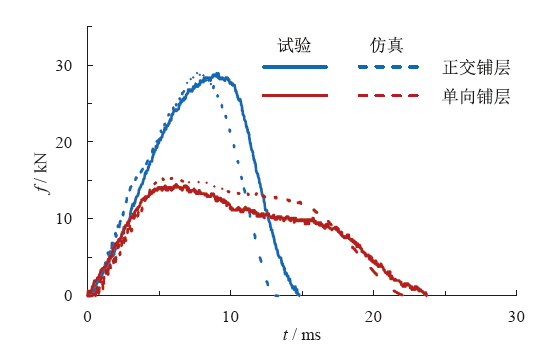
| fmax kN | tmax ms | Δt ms | fmax kN | tmax ms | Δt ms | ||
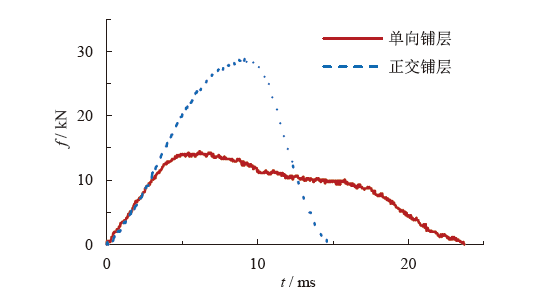
| 试验 | 14.48 | 6.15 | 23.69 | 28.98 | 9.14 | 14.57 | |
| 仿真 | 15.46 | 5.49 | 22.63 | 29.04 | 7.96 | 13.31 | |
| 误差 / % | 6.8 | 10.7 | 4.5 | 0.2 | 12.9 | 8.6 | |
| 单向铺层 | 正交铺层 | ||||||
|---|---|---|---|---|---|---|---|
| fmax kN | tmax ms | Δt ms | fmax kN | tmax ms | Δt ms | ||
| 试验 | 14.48 | 6.15 | 23.69 | 28.98 | 9.14 | 14.57 | |
| 仿真 | 15.46 | 5.49 | 22.63 | 29.04 | 7.96 | 13.31 | |
| 误差 / % | 6.8 | 10.7 | 4.5 | 0.2 | 12.9 | 8.6 | |
| 纤维铺层 | fmax / kN | U / J | D / mm | γ / % | S / mm2 |
|---|---|---|---|---|---|
| 单向 | 8.36 | 25.5 | 7.90 | 70.83 | 34.01 |
| 正交 | 8.48 | 25.0 | 7.66 | 69.44 | 26.98 |
| 斜向 | 8.12 | 25.9 | 7.78 | 71.94 | 57.97 |
| 准各向同性 | 8.29 | 25.6 | 7.72 | 71.11 | 32.50 |
| 纤维铺层 | fmax / kN | U / J | D / mm | γ / % | S / mm2 |
|---|---|---|---|---|---|
| 单向 | 8.36 | 25.5 | 7.90 | 70.83 | 34.01 |
| 正交 | 8.48 | 25.0 | 7.66 | 69.44 | 26.98 |
| 斜向 | 8.12 | 25.9 | 7.78 | 71.94 | 57.97 |
| 准各向同性 | 8.29 | 25.6 | 7.72 | 71.11 | 32.50 |
| [1] | 陈勇, 庞宝君, 郑伟, 等. 玻璃纤维增强铝合金层板低速冲击力学特性及低温影响研究[J]. 振动与冲击, 2014, 33(17): 203-208. |
| CHEN Yong, PANG Baojun, ZHENG Wei, et al. Low velocity impact performance of glass fiber-reinforced aluminum laminates and effect of exposure temperature[J]. J Vibr Shock, 2014, 33 (17): 203-208. (in Chinese) | |
| [2] | 万云, 章继峰, 周利民, 等. 玻璃纤维铝合金板低速冲击损伤演化数值模拟[J]. 华中科技大学学报(自然科学版), 2015, 43(2): 94-97. |
| WAN Yun, ZHANG Jifeng, ZHOU Limin, et al. Numerical simulation of damage evolution on low-velocity impact of glass fiber reinforced aluminum laminates[J]. J Huazhong Univ of Sci Tech (Nat Sci Ed), 2015, 43(2): 94-97. (in Chinese) | |
| [3] | 彭世伟, 陈立明, 刘后常, 等. 热塑性复合材料蜂窝夹芯板的低速冲击失效行为[J]. 重庆大学学报, 2020, 43(2): 82-90. |
| PENG Shiwei, CHEN Liming, LIU Houchang, et al. Low-velocity impact failure behavior of thermoplastic composite honeycomb sandwich panel[J]. J Chongqing Univ, 2020, 43(2): 82-90. (in Chinese) | |
| [4] |
Santiago R, Cantwell W, Alves M. Impact on thermoplastic fibre-metal laminates: Experimental observations[J]. Composite Struc, 2017, 159: 800-817.
doi: 10.1016/j.compstruct.2016.10.011 URL |
| [5] |
Bienias J, Jakubczak P, Dadej K. Low-velocity impact resistance of aluminium glass laminates: Experimental and numerical investigation[J]. Composite Struc, 2016, 152: 339-348.
doi: 10.1016/j.compstruct.2016.05.056 URL |
| [6] | 袁潇洒, Bhuwan S, 郭华鑫, 等. Ti/Cf/PEEK混杂层板低速冲击及剩余拉伸性能实验研究[J]. 振动与冲击, 2020, 39(22): 96-102. |
| YUAN Xiaosa, Bhuwan S, GUO Huaxin, et al. Experimental study on the low velocity impact damage and residual tensile properties of Ti/Cf/PEEK hybrid laminates[J]. J Vibr Shock, 2020, 39(22): 96-102. (in Chinese) | |
| [7] |
Santiago R C, Cantwell W J, Jones N, et al. The modelling of impact loading on thermoplastic fibre-metal laminates[J]. Composite Struc, 2018, 189: 228-238.
doi: 10.1016/j.compstruct.2018.01.052 URL |
| [8] |
Sarasini F, Tirillò J, Ferrante L, et al. Effect of temperature and fiber type on impact behavior of thermoplastic fiber metal laminates[J]. Composite Struc, 2019, 223: 110961.
doi: 10.1016/j.compstruct.2019.110961 URL |
| [9] |
Carrillo J G, Gonzalez-Canche N G, Flores-Johnson E A, et al. Low velocity impact response of fibre metal laminates based on aramid fibre reinforced polypropylene[J]. Composite Struc, 2019, 220: 708-716.
doi: 10.1016/j.compstruct.2019.04.018 URL |
| [10] | 陈虞杰. Al/Gf/PP热塑性纤维金属层板温热条件下变形规律研究[D]. 南京: 南京航空航天大学, 2019. |
| CHEN Yujie. Deformation regularity of AL/Gf/PP thermoplastic based fiber metal laminate under warm condition[D]. Nanjing: University of Aeronautics and Astronautics, 2019. (in Chinese) | |
| [11] | 杨栋栋. Ti/APC-2纤维金属层板的制备与力学性能研究[D]. 南京: 南京航空航天大学, 2013. |
| YANG Dongdong. Study on the preparation and mech-anical properties of Ti/APC-2 fiber metal laminates[D]. Nanjing: University of Aeronautics and Astronautics, 2013. (in Chinese) | |
| [12] | 汪泽幸, 吴波, 古占华, 等. 热塑性FMLs制备工艺与力学性能的研究现状[J]. 产业用纺织品, 2019, 37(6): 1-7. |
| WANG Xingze, WU Bo, GU Zhanhua, et al. Research status of preparation and mechanical properties of thermoplastic fiber-metal laminates[J]. Technical Textiles, 2019, 37(6): 1-7. (in Chinese) | |
| [13] | 胡兴弟. UHMWPE纤维增强热塑性复合材料低速冲击响应特性研究[D]. 长沙: 湖南大学, 2018. |
| HU Xingdi. Research on the response characteristics of UHMWPE fiber reinforced thermoplastic composites under low-velocity impact[D]. Changsha: Hunan University, 2018. (in Chinese) | |
| [14] | 赵文理. 碳纤维增强热塑性复合材料低速冲击数值模拟研究[D]. 济南: 山东大学, 2020. |
| ZHAO Wenli. Numerical study on low-velocity impact behavior of carbon fiber reinforced thermoplastic composites[D]. Jinan: Shandong University, 2020. (in Chinese) | |
| [15] | 刘庆辉. 玻璃纤维增强尼龙6复合材料性能研究[D]. 长春: 长春工业大学, 2012. |
| LIU Qinghui. Study on properties of glass fiber reinforced polyamide 6 composites[D]. Changchun: Changchun University of Technology, 2012. (in Chinese) | |
| [16] | 曾小平. 玻璃纤维增强铝合金层合板低速冲击损伤性能分析[D]. 哈尔滨: 哈尔滨工业大学, 2012. |
| ZENG Xiaoping. Analysis of damage properties in glass fiber reinforced aluminum alloy laminates under low velocity impact[D]. Harbin:Harbin Institute of Technology, 2012. (in Chinese) | |
| [17] | 刘增, 魏新奇, 夏勇. 表征平纹编织碳纤维复合材料特性的两种连续损伤模型[J]. 汽车安全与节能学报, 2019, 10(3): 293-299. |
| LIU Zeng, WEI Xinqi, XIA Yong. Two continuum damage mechanic models for characterization of plain woven carbon fiber composites[J]. J Automotive Safe Energy, 2019, 10(3): 293-299. (in Chinese) | |
| [18] |
Subbaramaiah R, Prusty B G, Pearce G M K, et al. Crashworthy response of fibre metal laminate top hat structures[J]. Composite Struc, 2017, 160: 773-781.
doi: 10.1016/j.compstruct.2016.10.112 URL |
| [19] |
LI Lijun, SUN Lingyu, WANG Taikun, et al. Repeated low-velocity impact response and damage mechanism of glass fiber aluminium laminates[J]. Aerospace Sci Tech, 2019, 84: 995-1010.
doi: 10.1016/j.ast.2018.11.038 URL |
| [1] | LI Yixuan, WU Xiao, TANG Kai, LI Zheng. Research on electrical vehicle's sliding mode in small overlap impact crash test [J]. Journal of Automotive Safety and Energy, 2025, 16(6): 867-876. |
| [2] | ZHANG Peilin, LI Yibing. Simulation study on energy absorption characteristics of laminated windshield under sunlight [J]. Journal of Automotive Safety and Energy, 2025, 16(4): 558-567. |
| [3] | XU Shiwei, JI Zhikang, XIAO Peijie, YUAN Quan, YUAN Qiuqi, LIU Yu, LI Junhong, LI Kewei, LI Jianyu, ZENG Zhuoran, XIAO Zhi, HE Cong. Status and prospect of automobile lightweight technology [J]. Journal of Automotive Safety and Energy, 2025, 16(1): 16-31. |
| [4] | ZHU Haiyun, LIU Qingyun, LI Qi, SONG Huibin, GUO Ruiwu, ZHAO Yang. Improvement of roof strength of truck cab based on new regulations [J]. Journal of Automotive Safety and Energy, 2024, 15(2): 161-168. |
| [5] | QU Xian, ZHANG Jinlong, QU Lihong. Structure design and optimization of a disc-drum hybrid magnetorheological device for pedal force control [J]. Journal of Automotive Safety and Energy, 2023, 14(6): 698-706. |
| [6] | LI Zitian, LI Bin, HUO Shenyang, ZHANG Jing, LÜ Xiaoxia. Temperature rising state of the brake disc of electric bus on long-downhill considering kinetic energy recovery [J]. Journal of Automotive Safety and Energy, 2023, 14(3): 274-281. |
| [7] | LI Xue, ZHANG Furen, LU Xinglong, HUANG Zhikai, ZHAO Haodong, SHI Yazhou. Performance optimization of a snake-like channel liquid cooled plate for lithium-ion power batteries [J]. Journal of Automotive Safety and Energy, 2023, 14(3): 385-392. |
| [8] | ZHANG Yi , HE Wei, JIN Qianqian, PAN Di, HAN Yong. Finite element analysis of the bicycle-helmet protective performances on cyclist head [J]. Journal of Automotive Safety and Energy, 2020, 11(2): 189-197. |
| [9] | WANG Xinyi, LIU Xiaoying, CHEN Cong, TANG Liang, WANG Donglin. Factors for affecting risk of human lumbar spine injuries under dropping conditions [J]. Journal Of Automotive Safety And Energy, 2018, 9(2): 178-185. |
| [10] | LI Shunming, QIAN Weiwei. Analysis on dynamic characteristics of leaf spring [J]. Journal Of Automotive Safety And Energy, 2018, 9(2): 194-199. |
| [11] | HAN Yong, XIE Jingping, LU Xiaoping, WANG Fang, HUANG Hongwu, MIZUNO Koji. Parameter optimization of CRS' seatbelt constraint paths based on design-of-experiment (DOE) [J]. Journal Of Automotive Safety And Energy, 2015, 6(03): 230-236. |
| [12] | ZHU Chuanmin, WANG Can, CHEN Ke. Structural design and performance simulation of an aluminum#br# alloy front bumper system [J]. Journal Of Automotive Safety And Energy, 2013, 4(4): 356-360. |
| [13] | HAN Yong , MIZUNO Koji , MATSUI Yasuhiro. Dynamic Response and Injury Risk of Pedestrians in Mini Car Collision [J]. Journal Of Automotive Safety And Energy, 2013, 4(3): 244-249. |
| [14] | Chen Keming, Hu Lijuan, Hu Yanshu. Small-overlap frontal-impact assessments for a vehicle made in China [J]. Journal Of Automotive Safety And Energy, 2013, 4(1): 27-34. |
| Viewed | ||||||
|
Full text |
|
|||||
|
Abstract |
|
|||||
