欢迎访问《汽车安全与节能学报》,

汽车安全与节能学报 ›› 2025, Vol. 16 ›› Issue (3): 345-366.DOI: 10.3969/j.issn.1674-8484.2025.03.001
• 综述与展望 • 下一篇
李理光( ), 商权波, 唐泳健, 邓俊
收稿日期:2025-06-02
修回日期:2025-06-09
出版日期:2025-06-30
发布日期:2025-07-01
作者简介:李理光(1962—),男(白族),教授。E-mail :liguang@tongji.edu.cn。
基金资助:
LI Liguang(), SHANG Quanbo, TANG Yongjian, DENG Jun
Received:2025-06-02
Revised:2025-06-09
Online:2025-06-30
Published:2025-07-01
摘要:
在全球化石能源消耗与气候变化引发的碳减排需求和能源低碳化与零碳化转型的背景下,氨氢融合燃料内燃机(ICEs)因其零碳排放潜力成为交通运输领域的关注热点和重要研究方向之一。氨燃料具有高携氢能量密度、易储运和高抗爆性等优势,但其燃烧速度低,燃料含氮特性使其污染物排放具有高氮氧化物(NOx)、未燃氨(NH3)和氧化亚氮(N2O)的特点,在内燃机领域的氨氢融合燃料燃烧优化与近零排放控制是一项全新研究,面临艰巨的挑战。本文综述了氨氢融合燃料内燃机的排放特性及近零排放控制技术的最新研究进展。首先,在排放机理方面,氨燃料燃烧过程中NOx的生成路径复杂,受当量比、压力和温度等因素影响,早期的机理研究主要聚焦在低压和中高温范围,但与内燃机高压高温差距较大,是当前研究的重点。其次,缸内污染物生成与控制是降低排放的重要措施,通过优化燃料喷射策略、点火时刻和进气条件,能够有效平衡污染物排放与热效率关系。研究表明,氨氢融合,即氢气助燃可提升燃烧效率,减少未燃氨和N2O排放,但会增加NOx生成。最后,缸外后处理技术是实现近零排放的关键。由于氨氢燃料燃烧排放的特殊性,需要开发全新的专用后处理系统,包括选择性催化还原(SCR)技术处理NOx,氨泄漏氧化催化器(ASC)和针对高温室效应的N2O抑制生成与还原的新型催化剂。此外,氢气选择性催化还原(H2-SCR)技术为处理氨氢发动机中的氢气排放提供了新思路。未来研究需进一步优化缸内燃烧与后处理系统的协同控制,开发低温高效催化剂,并探索组合式后处理方案,以满足日益严格的排放法规和近零排放。氨氢融合燃料内燃机在实现碳中和目标中具有广阔应用前景,但其广泛应用仍需解决包括排放控制等技术瓶颈问题。
中图分类号:
李理光, 商权波, 唐泳健, 邓俊. 氨氢融合燃料内燃机排放特性与近零排放控制[J]. 汽车安全与节能学报, 2025, 16(3): 345-366.
LI Liguang, SHANG Quanbo, TANG Yongjian, DENG Jun. Review on the emission characteristics and near-zero emission control for ammonia-hydrogen internal combustion engines[J]. Journal of Automotive Safety and Energy, 2025, 16(3): 345-366.
| 燃料 种类 | 燃烧影响 | 排放影响 |
|---|---|---|
| 氢气 | 提高循环热效率以及功率 | 无碳排放,NOx排放与化石燃料相近 |
| 天然气 | 减小峰值压力 | 增大NOx、NH3排放,减小CO2排放 |
| 汽油 | 提升功率,减小峰值压力 | 增大NOx、NH3排放,减小CO2排放 |
| 柴油 | 显著提升扭矩 | 减小HC、CO2,减小NOx(氨的掺混比例小于70%) |
| DME | 扩大发动机载荷限制 | 增大HC、CO、NOx排放 |
| 燃料 种类 | 燃烧影响 | 排放影响 |
|---|---|---|
| 氢气 | 提高循环热效率以及功率 | 无碳排放,NOx排放与化石燃料相近 |
| 天然气 | 减小峰值压力 | 增大NOx、NH3排放,减小CO2排放 |
| 汽油 | 提升功率,减小峰值压力 | 增大NOx、NH3排放,减小CO2排放 |
| 柴油 | 显著提升扭矩 | 减小HC、CO2,减小NOx(氨的掺混比例小于70%) |
| DME | 扩大发动机载荷限制 | 增大HC、CO、NOx排放 |
| 作者 | 催化剂 | 测试条件 | NO转化效率 |
|---|---|---|---|
| WANG Fei等[ | Pt-Fe/ZSM-5 | 500×10-6 NO,500×10-6 NH3,10% O2,5% H2O,SV = 140 000 h-1 | > 90% (190~300 ℃) |
| WANG Yuhang等[ | Ce/Fe/WUiO-66-derived | 500×10-6 NH3,500×10-6 NO,200×10-6 SO2, 30 000 h-1 | > 80% (250~450 ℃) |
| QIN Guozhen等[ | MIL-101(Fe)-derived | 500×10-6 NH3,500×10-6 NO,30 000 h-1 | 80% @210 ℃ |
| SONG Kunli等[ | Mn-Fe-BTC | 500×10-6 NH3,500×10-6 NO,36 000 h-1 | 60~270 ℃,> 80% |
| SONG Kunli等[ | TEOS&Mn-BTC | 500×10-6 NH3,500×10-6 NO,72 000 h-1 | 60~330 ℃,> 80%,提升N2的选择敏感性 |
| SONG Kunli等[ | IPA-Mn-BTC | 500×10-6 NH3,500×10-6 NO,36 000 h-1,6% H2O | 60~230 ℃,> 80 %,提升了水热老化性能 |
| JIA Yang等[ | Cu-BTC-derived | 500×10-6 NH3,500×10-6 NO,40 000 h-1 | 270~390 ℃,> 80% |
| S. Katarzyna等[ | Mn-HKUST-1 | 1 000×10-6 NH3,1 000×10-6 NO,13 360 h-1 | 185 ℃,60% |
| 作者 | 催化剂 | 测试条件 | NO转化效率 |
|---|---|---|---|
| WANG Fei等[ | Pt-Fe/ZSM-5 | 500×10-6 NO,500×10-6 NH3,10% O2,5% H2O,SV = 140 000 h-1 | > 90% (190~300 ℃) |
| WANG Yuhang等[ | Ce/Fe/WUiO-66-derived | 500×10-6 NH3,500×10-6 NO,200×10-6 SO2, 30 000 h-1 | > 80% (250~450 ℃) |
| QIN Guozhen等[ | MIL-101(Fe)-derived | 500×10-6 NH3,500×10-6 NO,30 000 h-1 | 80% @210 ℃ |
| SONG Kunli等[ | Mn-Fe-BTC | 500×10-6 NH3,500×10-6 NO,36 000 h-1 | 60~270 ℃,> 80% |
| SONG Kunli等[ | TEOS&Mn-BTC | 500×10-6 NH3,500×10-6 NO,72 000 h-1 | 60~330 ℃,> 80%,提升N2的选择敏感性 |
| SONG Kunli等[ | IPA-Mn-BTC | 500×10-6 NH3,500×10-6 NO,36 000 h-1,6% H2O | 60~230 ℃,> 80 %,提升了水热老化性能 |
| JIA Yang等[ | Cu-BTC-derived | 500×10-6 NH3,500×10-6 NO,40 000 h-1 | 270~390 ℃,> 80% |
| S. Katarzyna等[ | Mn-HKUST-1 | 1 000×10-6 NH3,1 000×10-6 NO,13 360 h-1 | 185 ℃,60% |
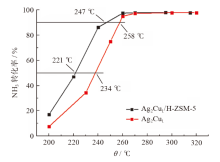
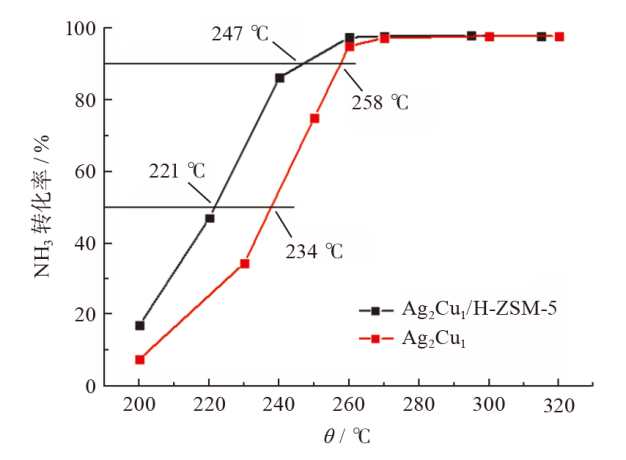
| 作者 | 催化剂 | T90 / ℃ | N2选择性/ % | 反应条件 |
|---|---|---|---|---|
| WANG Zhong等[ | Ag / ZSM-5 | 110 | 75 | 1000×10-6 NH3,10 vol% O2,35 000 h-1空速 |
| SUN Mengmeng等[ | Pt Cu / ZSM-5 | 245 | 77 | 180×10-6 NH3,8 vol% O2,100 000 h-1空速 |
| 孙萌萌等[ | FeCu / ZSM-5 | 350 | >90 | 2×10⁻⁸ NH3,10% O2,8% CO2,100 000 h-1 |
| G-K. King等[ | Fe-ZSM-5 | 500 | 98 | 0.5 vol% NH3,2.5 vol% O2,40 ml/min总流速,0.1 g催化剂 |
| ZHANG Tao等[ | Cu-SSZ-13 | 200 | 95 | 500×10-6 NH3,5 vol% O2,200 ml/min总流速,160 000 h-1空速 |
| M. Rutkowska等[ | FeCr / Beta | 400 | >90 | 0.5 vol% NH3,2.5vol% O2,40 ml/min 总流速,空速24 L·(h·g)-1 |
| LIN Mingyue等[ | Au / Nb2O5 | 245 | 95 | 50×10-6 NH3,20% O2,总流量100 ml/min |
| S. Sachi等[ | Pt / Al2O3 | 250 | 50 | 0.5% NH3,5% O2,66 000 h-1 |
| 作者 | 催化剂 | T90 / ℃ | N2选择性/ % | 反应条件 |
|---|---|---|---|---|
| WANG Zhong等[ | Ag / ZSM-5 | 110 | 75 | 1000×10-6 NH3,10 vol% O2,35 000 h-1空速 |
| SUN Mengmeng等[ | Pt Cu / ZSM-5 | 245 | 77 | 180×10-6 NH3,8 vol% O2,100 000 h-1空速 |
| 孙萌萌等[ | FeCu / ZSM-5 | 350 | >90 | 2×10⁻⁸ NH3,10% O2,8% CO2,100 000 h-1 |
| G-K. King等[ | Fe-ZSM-5 | 500 | 98 | 0.5 vol% NH3,2.5 vol% O2,40 ml/min总流速,0.1 g催化剂 |
| ZHANG Tao等[ | Cu-SSZ-13 | 200 | 95 | 500×10-6 NH3,5 vol% O2,200 ml/min总流速,160 000 h-1空速 |
| M. Rutkowska等[ | FeCr / Beta | 400 | >90 | 0.5 vol% NH3,2.5vol% O2,40 ml/min 总流速,空速24 L·(h·g)-1 |
| LIN Mingyue等[ | Au / Nb2O5 | 245 | 95 | 50×10-6 NH3,20% O2,总流量100 ml/min |
| S. Sachi等[ | Pt / Al2O3 | 250 | 50 | 0.5% NH3,5% O2,66 000 h-1 |
| 编号 | 车辆型号 | 发动机型号 | 车辆/发动机编号 | 后处理 技术 | 测试循环 | N2O排放速率 | N2O在温室气体 排放中比例/ % | |
|---|---|---|---|---|---|---|---|---|
| (mg·mile-1) | [mg·(bhp·h)-1] | |||||||
| 1 | 城市公交 | 2026 Cummins ISL 2800 | 2 | 催化 DPF | 公路模式 | 155 | -2 | |
| 2 | 重型卡车 | 2004 Cummins ISX 450 | 2 | 无 | HD-UDDS | 23 | -0.3 | |
| 3 | 重型卡车 | 2004 Caterpillar C-11 | 1 | 无 | HD-FTP | 5 | 0.26 | |
| 氧化催化 | HD-FTP | 11.4 | 0.41 | |||||
| 4 | 重型卡车 | 2002 Mark AI-300A | 1 | 无 | HD-FTP | 6 | 0.3 | |
| 催化 DPF | HD-FTP | 14~19 | 0.7~0.9 | |||||
| 5 | 长途货运卡车 | 2004 Mercedes MBE4000 | 1 | 无 | HD-UDDS | 11 | 0.2 | |
| 2003 Cummins ISMM400 | 1 | 无 | HD-UDDS | 8 | 0.2 | |||
| 1999 Caterpillar C-12 | 1 | 无 | HD-UDDS | 12 | 0.2 | |||
| 6 | 长途货运卡车 | 1996 Caterpilar 3126E | 1 | 氧化催化 | HD-FTP | 10 | 0.2 | |
| 编号 | 车辆型号 | 发动机型号 | 车辆/发动机编号 | 后处理 技术 | 测试循环 | N2O排放速率 | N2O在温室气体 排放中比例/ % | |
|---|---|---|---|---|---|---|---|---|
| (mg·mile-1) | [mg·(bhp·h)-1] | |||||||
| 1 | 城市公交 | 2026 Cummins ISL 2800 | 2 | 催化 DPF | 公路模式 | 155 | -2 | |
| 2 | 重型卡车 | 2004 Cummins ISX 450 | 2 | 无 | HD-UDDS | 23 | -0.3 | |
| 3 | 重型卡车 | 2004 Caterpillar C-11 | 1 | 无 | HD-FTP | 5 | 0.26 | |
| 氧化催化 | HD-FTP | 11.4 | 0.41 | |||||
| 4 | 重型卡车 | 2002 Mark AI-300A | 1 | 无 | HD-FTP | 6 | 0.3 | |
| 催化 DPF | HD-FTP | 14~19 | 0.7~0.9 | |||||
| 5 | 长途货运卡车 | 2004 Mercedes MBE4000 | 1 | 无 | HD-UDDS | 11 | 0.2 | |
| 2003 Cummins ISMM400 | 1 | 无 | HD-UDDS | 8 | 0.2 | |||
| 1999 Caterpillar C-12 | 1 | 无 | HD-UDDS | 12 | 0.2 | |||
| 6 | 长途货运卡车 | 1996 Caterpilar 3126E | 1 | 氧化催化 | HD-FTP | 10 | 0.2 | |
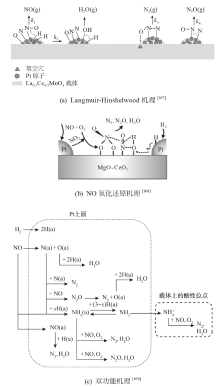
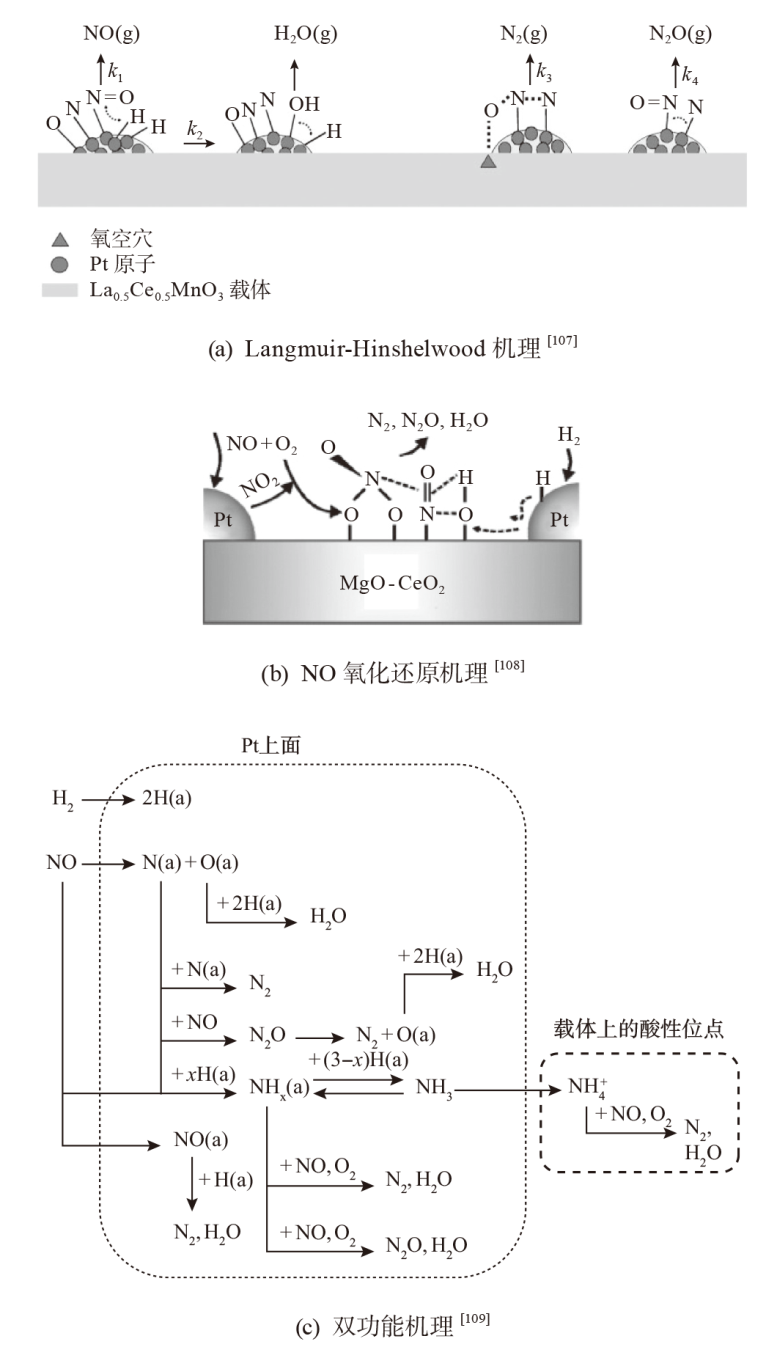
| 作者 | 催化剂 | 测试气体 | 最大NOx 转化效率/ % | 高活性温度 窗口/ ℃ |
|---|---|---|---|---|
| YU Qing等[ | Pt / Cr / ZSM-35 | 0.1% NO, 0.5% H2, 6.7% O2, 80 000 h-1 | > 95 | 80~150 |
| O. G. George等[ | Pt / MgO-CeO2 | 0.015% NO, 0.2% H2, 2% O2, 33 000 h-1 | ≈ 100 | 120~180 |
| LIU Zhiming等[ | Pt / TiO2-WO3 | 0.025% NO, 0.1% H2, 5% O2, 53 000 h-1 | > 90 | 100~200 |
| LI Jia等[ | Pd-Ir / TiO2 | 0.1% NO, 0.3% H2, 5% O2, 60 000 h-1 | > 80 | 140~200 |
| XU Chaochao等[ | Co-FePd | 0.1% NO, 1% H2, 3% O2, 23 400 h-1 | > 96 | 170~250 |
| C. K. Vasiliki等[ | Pt / Al2O3 | 0.05% NO, 0.1% H2, 5% O2, 80 000 h-1 | > 91 | 95~200 |
| HONG Zhe等[ | Pt / SSZ-13 | 0.1% NO, 0.5% H2, 10% O2, 50 000 h-1 | > 81 | 80~140 |
| DUAN Kaijiao等[ | Pd0.5 / TiO2-Al2O3 | 0.025% NO, 0.1% H2, 5% O2, 50 000 h-1 | > 90 | 100~250 |
| 作者 | 催化剂 | 测试气体 | 最大NOx 转化效率/ % | 高活性温度 窗口/ ℃ |
|---|---|---|---|---|
| YU Qing等[ | Pt / Cr / ZSM-35 | 0.1% NO, 0.5% H2, 6.7% O2, 80 000 h-1 | > 95 | 80~150 |
| O. G. George等[ | Pt / MgO-CeO2 | 0.015% NO, 0.2% H2, 2% O2, 33 000 h-1 | ≈ 100 | 120~180 |
| LIU Zhiming等[ | Pt / TiO2-WO3 | 0.025% NO, 0.1% H2, 5% O2, 53 000 h-1 | > 90 | 100~200 |
| LI Jia等[ | Pd-Ir / TiO2 | 0.1% NO, 0.3% H2, 5% O2, 60 000 h-1 | > 80 | 140~200 |
| XU Chaochao等[ | Co-FePd | 0.1% NO, 1% H2, 3% O2, 23 400 h-1 | > 96 | 170~250 |
| C. K. Vasiliki等[ | Pt / Al2O3 | 0.05% NO, 0.1% H2, 5% O2, 80 000 h-1 | > 91 | 95~200 |
| HONG Zhe等[ | Pt / SSZ-13 | 0.1% NO, 0.5% H2, 10% O2, 50 000 h-1 | > 81 | 80~140 |
| DUAN Kaijiao等[ | Pd0.5 / TiO2-Al2O3 | 0.025% NO, 0.1% H2, 5% O2, 50 000 h-1 | > 90 | 100~250 |
| [1] | Mohammed E-A, Medhat N A, Ahmed A. Towards sustainable hydrogen and ammonia internal combustion engines: Challenges and opportunities[J]. Fuel, 2024, 364: 131090. |
| [2] | Kumar R B, Rahman A Q, Kumar S J. Advances in perovskite membranes for carbon capture & utilization: a sustainable approach to CO2 emissions reduction: A review[J]. J Environ Manag, 2025, 380: 124924. |
| [3] | 中国气象局. 《2024年全球碳收支》 称: 全球CO2排放量今年或创历史新高[M/OL]. (2024-11-18) https://www.cma.gov.cn/ztbd/2024zt/20241104/2024110403/202411/t20241118_6697461.html. |
| China Meteorological Administration. “2024 Global Carbon Budget” states that global CO2 emissions may reach a new historical high this year[M/OL]. (2024-11-18) https://www.cma.gov.cn/ztbd/2024zt/20241104/2024110403/202411/t20241118_6697461.html. (in Chinese) | |
| [4] | LIU Jiaxin, LIU Xiaoyu, REN Songyan, et al. The potential role of zero-carbon technologies to drive carbon neutrality in the transportation sector: A case study in Guangdong Province of China[J]. Int’l J Hydro Energ, 2025, 116: 139-154. |
| [5] | LI Yinan, LAN Song, Ryberg M, et al. A quantitative roadmap for China towards carbon neutrality in 2060 using methanol and ammonia as energy carriers[J]. iScience, 2021, 24(6): No 102513. |
| [6] | 习近平. 继往开来, 开启全球应对气候变化新征程[N]. 人民日报, 2020-12-13. |
| XI Jinping. Building on past achievements and opening a new journey for global climate action[N]. People's Daily, 2020-12-13. (in Chinese) | |
| [7] | 中国环境报. 今年扎实开展“碳达峰十大行动” 交通运输领域将靠哪些手段实现目标?[N/OL]. (2024-03-25) http://www.ce.cn/cysc/stwm/gd/202403/25/t20240325_38946465.shtml. |
| China Environment News. This year, we will steadfastly implement the “ Ten Major Actions for Carbon Peaking.” By what means will the transportation sector achieve its goals?[N/OL]. (2024-03-25) http://www.ce.cn/cysc/stwm/gd/202403/25/t20240325_38946465.shtml. (in Chinese) | |
| [8] | 福建省工业和信息化厅. 2024年中国汽车产销量均超3100万辆[B/OL]. (2025-01-14) |
| Fujian Provincial Department of Industry and Information Technology. In 2024, both China's vehicle production and sales exceeded 31 million units[B/OL]. (2025-01-14) https://gxt.fujian.gov.cn/zwgk/xw/hydt/xydt/202501/t20250114_6700310.htm. (in Chinese) | |
| [9] | JI Changwei, WANG Zhe, WANG Du, et al. Experimental and numerical study on premixed partially dissociated ammonia mixtures. Part I: Laminar burning velocity of NH3/H2/N2/Air mixtures[J]. Int’l J Hydro Energ, 2022, 47(6): 4171-4184. |
| [10] | CHAI Waisong, BAO Yulei, JIN Pengfei, et al. A review on ammonia, ammonia-hydrogen and ammonia-methane fuels[J]. Renew Sustain Energ Rev, 2021, 147: No 111254. |
| [11] | 陈彦泽. 氨气富氧预混燃烧实验与机理分析[D]. 哈尔滨: 哈尔滨工业大学, 2021. |
| CHEN Yanze. Ammonia oxygen-enriched combustion experiment and mechanism analysis[D]. Harbin: Harbin Institute of Technology, 2021. (in Chinese) | |
| [12] | Massaguer A, Pujol T, Comamala M, et al. Feasibility study on a vehicular thermoelectric generator coupled to an exhaust gas heater to improve aftertreatment’s efficiency in cold-starts[J]. Appl Therm Engi, 2020, 167: 114702. |
| [13] | Shawn G M, Dennis A N, Stanislav B V, et al. The fuel mix limits and efficiency of a stoichiometric, ammonia, and gasoline dual fueled spark ignition engine[J]. J Engi Gas Turb Power, 2008, 130(4): 169-176. |
| [14] | Pavlos D, Rahat J. A review of ammonia as a compression ignition engine fuel[J]. Int’l J Hydro Energ, 2020, 45(11): 7098-7118. |
| [15] | Walter K E, David H E. Mechanism of decay of ammonia in flame gases from an NH3/O2flame[J]. Combust Flame, 2004, 20(3): 381-388. |
| [16] | James A M, Mitchell D S, Robert M G, et al. Kinetic modeling of the oxidation of ammonia in flames[J]. Combust Sci Tech, 2007, 34(1-6): 149-176. |
| [17] | Anthony M D, Chou Mau-Song, David S. Kinetics of rich ammonia flames[J]. Int’l J Chem Kinet, 2004, 16(6): 633-653. |
| [18] | Salimian S, Hanson K R, Kruger H C. High temperature study of the reactions of O and OH with NH3[J]. Int’l J Chem Kinet, 2004, 16(6): 725-739. |
| [19] | MENG Xiangyu, ZHAO Chenhan, CUI Zechuan, et al. Understanding of combustion characteristics and NO generation process with pure ammonia in the pre-chamber jet-induced ignition system[J]. Fuel, 2023, 331: No 125743. |
| [20] | Ekenechukwu C O, Yuji N, Sophie C, et al. Experimental and numerical study of the laminar burning velocity of CH4-NH3-Air premixed flames[J]. Combust Flame, 2018, 187: 185-198. |
| [21] | TIAN Zhenyu, LI Yuyang, ZHANG Lidong, et al. An experimental and kinetic modeling study of premixed NH3/CH4/O2/Ar flames at low pressure[J]. Combust Flame, 2009, 156(7): 1413-1426. |
| [22] | XIAO Hua, Agustin V-M, Philip B J. Modeling combustion of ammonia/hydrogen fuel blends under gas turbine conditions[J]. Energg Fuels, 2017, 31(8): 8631-8642. |
| [23] | Shankar S A, Debojit S S, Kumar D S, et al. Effect of intermediate radicals on NOx and De-NOx characteristics of NH3/H2/Air flames at high pressure[J]. Chem Engi Tech, 2023, 46: 1-10. |
| [24] | Olivier M, Eric P L. Experimental and modeling study on the high-temperature oxidation of ammonia and related NOx chemistry[J]. Combust Flame, 2015, 162(3): 554-570. |
| [25] | ZHU Denghao, QU Zhechao, LI Mengdi, et al. Investigation on the NO formation of ammonia oxidation in a shock tube applying tunable diode laser absorption spectroscopy[J]. Combust Flame, 2022, 246: 112389. |
| [26] | Glarborg P, Miller A J, Ruscic B, et al. Modeling nitrogen chemistry in combustion[J]. Prog Energ Combu Sci, 2018, 67: 31-68. |
| [27] | Shrestha P K, Lhuillier C, Barbosa A A, et al. An experimental and modeling study of ammonia with enriched oxygen content and ammonia/hydrogen laminar flame speed at elevated pressure and temperature[J]. Proc Combu Inst, 2021, 38: 2163-2174. |
| [28] | Akihiro H, Takashi G, Rentaro M, et al. Laminar burning velocity and Markstein length of ammonia/air premixed flames at various pressures[J]. Fuel, 2015, 159: 98-106. |
| [29] | 杨斌, 张英佳, 李玉阳, 等. 面向碳中和的燃烧反应动力学研究进展与展望[J]. 工程热物理学报, 2022, 43(8): 1993-2008. |
| YANG Bin, ZHANG Yingjia, LI Yuyang, et al. Research progress and prospect of combustion reaction kinetics for carbon neutrality[J]. J Engi Thermophys, 2022, 43(8): 1993-2008. (in Chinese) | |
| [30] | Henry W M. Experiments on ammonia, and an account of a new method of analyzing it, by combustion with oxygen and other gases; in a letter to Humphry Davy, Esq Sec R S &C from William Henry, M D, FRSVP of the Lit and Phil Society, and physician to the infirmary, at Manchester[J]. Philosoph Trans Roya Soc London, 1997, 99: 430-449. |
| [31] | 夏鑫, 蔺建民, 李妍, 等. 氨混合燃料体系的性能研究现状[J]. 化工进展, 2021, 41(5): 1-10. |
| XIA Xin, LIN Jianmin, LI Yan, et al. Research progress on performance and application of ammonia fuel on engines[J]. Chem Ind Engi Prog, 2021, 41(5): 1-10. (in Chinese) | |
| [32] | Walter C, William H L, Harry R M. Ammonia as an engine fuel[J]. SAE Tech Paper, 1965: No 650052. |
| [33] | Pearsall T J. Ammonia application to reciprocating engines[M]. Continental Aviation and Engineering Corp Detroit MI. 1967, 1: 1-121. |
| [34] | Starkman S E, James E G, Newhall K H. Ammonia as a diesel engine fuel: Theory and application[C]// National Fuels and Lubricants, Powerplants, Transportation Meetings. SAE Technical Paper, 1967: No 670946. |
| [35] | LI Tie, ZHOU Xinyi, WANG Ning, et al. A Comparison between low- and high-pressure injection dual-fuel modes of diesel-pilot-ignition ammonia combustion engines[J]. J Energ Instit, 2022, 102: 362-373. |
| [36] | Amin Y, GUO Hongsheng, Shouvik D, et al. A study on split diesel injection on thermal efficiency and emissions of an ammonia/diesel dual-fuel engine[J]. Fuel, 2022, 316: No 123412. |
| [37] | Aaron J R, Kong Song-Charng. Demonstration of compression-ignition engine combustion using ammonia in reducing greenhouse gas emissions[J]. Energy Fuels, 2008, 22(5): 2963-2971. |
| [38] | Zehra S, İmdat Z A, Orhan D. Experimental investigation of the effects of ammonia solution (NH3OH) on engine performance and exhaust emissions of a small diesel engine[J]. Fuel, 2018, 214: 330-341. |
| [39] | Christopher W G, Kong Song-Charng. Performance characteristics of a compression-ignition engine using direct-injection ammonia-dme mixtures[J]. Fuel, 2013, 103: 1069-1079. |
| [40] | Mørch S C, Bjerre A, Gøttrup P M, et al. Ammonia/hydrogen mixtures in an Si-engine: Engine performance and analysis of a proposed fuel system[J]. Fuel, 2011, 90(2): 854-864. |
| [41] | Fredrik R W, Anders I, Jesper S. Experimental investigation of nitrogen based emissions from an ammonia fueled Si-engine[J]. Fuel, 2013, 111: 239-247. |
| [42] | WANG Qiao, WANG Huanhuan, CHEN Haodong, et al. New insights into the NH3/N2O/Ar system: Key steps in N2O evolution[J]. Proc Combust Instit, 2024, 40(1-4): No 105236. |
| [43] | Valera-Medina A, XIAO Hua, Owen-Jones M, et al. Ammonia for power[J]. Prog Energ Combust Sci, 2018, 69: 63-102. |
| [44] | Charles L, Pierre B, Francesco C, et al. Combustion characteristics of ammonia in a modern spark-ignition engine[R]. SAE Tech Paper, 2019, 2019-24-0237. |
| [45] | Charles L, Pierre B, Francesco C, et al. Performance and emissions of an ammonia-fueled SI engine with hydrogen enrichment[R]. SAE Tech Paper, 2019, No 2019-24-0137. |
| [46] | Charles L, Pierre B, Francesco C, et al. Experimental study on ammonia/hydrogen/air combustion in spark ignition engine conditions[J]. Fuel, 2020, 269: No 117448. |
| [47] | DENG Jun, SHANG Quanbo, JI Meng, et al. The formation process of the gaseous pollutant emissions in pure ammonia fueled engines with pre-chamber jet ignition[J]. Int’l J Hydro Energ, 2024, 82: 544-558. |
| [48] | SHENG Quanbo, JI Meng, LI Liguang, et al. Numerical investigations on formation process of N2O in ammonia/hydrogen fueled pre-chamber jet ignition engine[R]. SAE Tech Paper, 2023, 2023-01-7023. |
| [49] | SHANG Quanbo, JI Meng, LI Liguang, et al. NOx emission characteristics of active pre-chamber jet ignition engine with ammonia hydrogen blending fuel[R]. SAE Tech Paper, 2023, 2023-01-1629. |
| [50] | ZHAO Shihao, QIANG Yanfei, MA Tianfang, et al. Numerical investigation on the synergistic effect of intake air temperature and hydrogen volume ratio on combustion and emissions of ammonia-enriched hydrogen spark-ignition engine[J]. Int’l J Hydro Energ, 2025, 103: 999-1012. |
| [51] | ZHU Jizhen, LIU Ruihan, LIN Hao, et al. Computational insights into flame development and emission formation in an ammonia engine with hydrogen-assisted pre-chamber turbulent jet ignition[J]. Energ Conv Manag, 2024, 314: No 118706. |
| [52] | YU Zining, YANG Rui, YUE Zongyu, et al. Investigating the impacts of charge composition and temperature on ammonia/hydrogen combustion in a heavy-duty spark-ignition engine[J]. Int’l J Hydro Energ, 2024, 95: 31-42. |
| [53] | ZHU Tiankui, YAN Xin, GAO Zhan, et al. Combustion and emission characteristics of ammonia-hydrogen fueled si engine with high compression ratio[J]. Int’l J Hydro Energ, 2024, 62: 579-590. |
| [54] | YAN Yuchao, LIU Zhentao, LIU Jinlong. Computational analysis of ammonia-hydrogen blends in homogeneous charge compression ignition engine operation[J]. Proc Safe Environ Protect, 2024, 190: 1263-1272. |
| [55] | QIANG Yanfei, ZHAO Shihao, SU Fangxu, et al. Experimental and numerical assessment on co-combustion of hydrogen with ammonia in passive pre-chamber engines[J]. Appl Therm Engi, 2025, 259: No 124919. |
| [56] | LIN Zhelong, LIU Shang, SUN Qiyang, et al. Effect of injection and ignition strategy on an ammonia direct injection-hydrogen jet ignition (ADI-HJI) engine[J]. Energy, 2024, 306: No 132502. |
| [57] | LIN Zhelong, LIU Shang, LIU Wei, et al. Numerical investigation of ammonia-rich combustion produces hydrogen to accelerate ammonia combustion in a direct injection SI engine[J]. Int’l J Hydro Energ, 2024, 49: 338-351. |
| [58] | WANG Zhi, QI Yunliang, SUN Qiyang, et al. Ammonia combustion using hydrogen jet ignition (AHJI) in internal combustion engines[J]. Energy, 2024, 291: No 130407. |
| [59] | CAI Tao, ZHAO Dan, Ephraim G. Overview of fundamental kinetic mechanisms and emission mitigation in ammonia combustion[J]. Chem Engi J, 2023, 458: No 141391. |
| [60] | XU Xiaowei, LIU Enlong, ZHU Neng, et al. Review of the current status of ammonia-blended hydrogen fuel engine development[J]. Energies, 2022, 15(3): No 1023. |
| [61] | Masaoki I, Hirofumi S. A comparative study of “Standard”, “Fast” and “NO2” SCR reactions over Fe/zeolite catalyst[J]. Appl Cataly A: General, 2010, 390(1-2): 71-77. |
| [62] | Koebel M, Elsener M, Kleemann M. Urea-SCR: A promising technique to reduce NOx emissions from automotive diesel engines[J]. Cataly Today, 2000, 59(3-4): 335-345. |
| [63] | Servati H, Petreanu S P S. Marshall S, et al. A NOx reduction solution for retrofit applications: A simple urea SCR technology[R]. SAE Tech Paper, 2005, 2005-01-1857. |
| [64] | 楼狄明, 张正兴, 谭丕强, 等. 车用柴油机选择性催化还原技术研究进展[J]. 环境科学与技术, 2009, 32(12): 103-108. |
| LOU Diming, ZHANG Zhengxing, TAN Piqiang, et al. Progress of research on selective catalytic reduction technology for vehicle diesel engine[J]. Environ Sci Tech, 2009, 32(12): 103-108. | |
| [65] | David C, Magdi M, ZHANG Sanhong, et al. The study of exhaust heating to improve SCR cold start performance[J]. SAE Int’l J Engi, 2015, 8(3): 1187-1195. |
| [66] | David C Q, Jeremy S, Arvind T, et al. Greenhouse gas emissions from heavy-duty natural gas, hybrid, and con-ventional diesel on-road trucks during freight transport[J]. Atmosph Environ, 2017, 168: 36-45. |
| [67] | LIU Wenjie, LONG Yifei, LIU Shinian, et al. Promotional effect of Ce in NH3-SCO and NH3-SCR reactions over Cu-Ce/SCR catalysts[J]. J Ind Engi Chem, 2022, 107: 197-206. |
| [68] | YANG Shijian, WANG Chizhong, LI Junhua, et al. Low temperature selective catalytic reduction of NO with NH3 over Mn-Fe spinel: Performance, mechanism and kinetic study[J]. Appl Cataly B: Environ, 2011, 110: 71-80. |
| [69] | Raja S, Alphin M S, Sivachandiran L, et al. TiO2-carbon nanotubes composite supported MNOx-CuO catalyst for low-temperature NH3-SCR of NO: Investigation of SO2 and H2O tolerance[J]. Fuel, 2022, 307: No 121886. |
| [70] | ZHANG Dong, Ralph Y T. N2O formation pathways over zeolite-supported Cu and Fe catalysts in NH3-SCR[J]. Energy Fuels, 2018, 32(2): 2170-2182. |
| [71] | WANG Fei, ZHU Ying, LI Zhao, et al. Promoting effect of acid sites on NH3-SCO activity with water vapor participation for Pt-Fe/ZSM-5 catalyst[J]. Cataly Today, 2021, 376: 311-317. |
| [72] | WANG Yuhang, ZHANG Guodong, XI Yongjie, et al. Elucidating the electron confinement effect on CeFeW/ZrO2 catalysts to enhance SO2 resistance in the low temperature NH3-SCR reaction[J]. Separat Purif Tech, 2024, 346: No 127569. |
| [73] | QIN Guozhen, ZHENG Jianfeng, LI Yifan, et al. Tailor the crystal planes of Mil-101(Fe) derivatives to enhance the activity of SCR reaction at medium and low temperature[J]. J Collo Inter Sci, 2022, 615: 432-444. |
| [74] | SONG Kunli, GUO Kaiyu, LÜ Yixuan, et al. Rational regulation of reducibility and acid site on Mn-Fe-Btc to achieve high low-temperature catalytic denitration performance[J]. ACS Appl Mater Inter, 2023, 15(3): 4132-4143. |
| [75] | SONG Kunli, SHI Jianwen, ZHOU Xinya, et al. Design of dual-ligand coordination in metal organic frameworks for breaking the seesaw effect between De-NO activity and N2 selectivity[J]. Appl Catal B: Environ Energ, 2024, 354: No 124131. |
| [76] | SONG Kunli, HU Jiyuan, LU Peng, et al. Low-temperature selective catalytic reduction of NOx with NH3: Exploring the mechanism of enhancing H2O tolerance through methylation functionalization and structural regulation in Ipax-Mn-Btc[J]. Appl Cataly B: Environ, 2024, 343: No 123548. |
| [77] | YANG Jia, LIU Yuling, ZHAO Penghe, et al. Chemical thermodynamic and catalytic mechanism analysis of Cu-Btc-Derived Cuox/C catalyst for selective catalytic reduction (SCR)[J]. Molecular Catalysis, 2022, 531: No 112710. |
| [78] | Katarzyna S, Gérard D, Abdelali Z, et al. Investigation of Mn promotion on Hkust-1 metal-organic frameworks for low-temperature selective catalytic reduction of NO with NH3[J]. Chem Catal Chem, 2021, 13(18): 4029-4037. |
| [79] | Magdalena J. TPR study and catalytic performance of noble metals modified Al2O3, TiO2 and ZrO2 for low-temperature NH3-SCO[J]. Cataly Commun, 2015, 70: 66-71. |
| [80] | Hung C M. Characterization and performance of Pt-Pd-Rh cordierite monolith catalyst for selectivity catalytic oxidation of ammonia[J]. J Hazard Mater, 2010, 180(1-3): 561-565. |
| [81] | 周明东, 孙强, 白继峰, 等. Ag2Cu1/H-ZSM-5合金催化剂在NH3-SCO反应中的性能研究[J]. 石油化工高等学校学报, 2019, 32(6): 14-21. |
| ZHOU Mingdong, SUN Qiang, BAI Jifeng, et al. Study on the performance of Ag2Cu1/HZSM5 alloy catalyst in NH3-SCR reaction[J]. J Petrochem Univ, 2019, 32(6): 14-21. (in Chinese) | |
| [82] | WANG Zhong, SUN Qiang, WANG Da, et al. Hollow ZSM-5 Zeolite encapsulated Ag nanoparticles for SO2-resistant selective catalytic oxidation of ammonia to nitrogen[J]. Separat Purif Tech, 2019, 209: 1016-1026. |
| [83] | SUN Mengmeng, WANG Suning, LI Yuanshan, et al. Promotion of catalytic performance by adding Cu into Pt/ZSM-5 catalyst for selective catalytic oxidation of ammonia[J]. J Taiwan Instit Chem Engi, 2017, 78: 401-408. |
| [84] | 孙萌萌, 曹毅, 兰丽, 等. 铁铜双金属催化剂选择性催化氧化氨为氮气(英文)[J]. 物理化学学报, 2014, 30(12): 2300-2306. |
| SUN Mengmeng, CAO Yi, LAN Li, et al. Selective catalytic oxidation of ammonia to nitrogen over iron and copper bimetallic catalysts[J]. Acta Phys-Chim Sin, 2014, 30(12): 2300-2306. (in Chinese) | |
| [85] | Kinga G-M, Kamila B, Karolina A T, et al. IR studies of Fe modified ZSM-5 zeolites of diverse mesopore topologies in the terms of their catalytic performance in NH3-SCR and NH3-SCO processes[J]. Appl Cataly B: Environ, 2015, 179: 589-598. |
| [86] | ZHANG Tao, CHANG Huazhen, YOU Yanchen, et al. Excellent activity and selectivity of one-pot synthesized Cu-SSZ-13 catalyst in the selective catalytic oxidation of ammonia to nitrogen[J]. Environ Sci Tech, 2018, 52(8): 4802-4808. |
| [87] | Rutkowska M, Duda M, Macina D, et al. Mesoporous beta zeolite functionalisation with excry oligocations; catalytic activity in the NH3-SCO process[J]. Microp Mesop Mater, 2019, 278: 1-13. |
| [88] | LIN Mingyue, AN Baoxiang, Takashi T, et al. Features of Nb2O5 as a metal oxide support of Pt and Pd catalysts for selective catalytic oxidation of NH3 with High N2 selectivity[J]. J Cataly, 2020, 389: 366-374. |
| [89] | Sachi S, Michael P H, Krishna K, et al. Selective oxidation of ammonia to nitrogen on Bi-functional Cu-SSZ-13 and Pt/Al2O3 monolith catalyst[J]. Cataly Today, 2016, 267: 130-144. |
| [90] | Union Council of the European. Regulation on type-approval of motor vehicles and engines and of systems, components and separate technical units intended for such vehicles, with respect to their emissions and battery durability (Euro 7) - Analysis of the final compromise text with a view to agreement. 2023. Interinstitutional File: 2022/0365(COD). |
| [91] | Kent H S. Review of nitrous oxide (N2O) emissions from motor vehicles[J]. SAE Int’l J Fuel Lubr, 2020, 13(1): 79-98. |
| [92] | Lisa A G, Greg R, Deborah R, et al. Greenhouse gas emissions from heavy-duty vehicles[J]. Atmosph Environ, 2008, 42(19): 4665-4681. |
| [93] | LIU Zongkuan, ZHOU Lei, ZHONG Lijia, et al. Enhanced combustion of ammonia engine based on novel air-assisted pre-chamber turbulent jet ignition[J]. Energ Conv Manag, 2023, 276: No 116526. |
| [94] | Christine M R, Pierre B, Clément D, et al. Operating limits for ammonia fuel spark-ignition engine[J]. Energies, 2021, 14: No 4141. |
| [95] | LIU Zongkuan, ZHOU Lei, WEI Haiqiao. Experimental investigation on the performance of pure ammonia engine based on reactivity controlled turbulent jet ignition[J]. Fuel, 2023, 335: No 127116. |
| [96] | Syed M, Marina K, Ali A, et al. Nitrogen oxide emissions analyses in ammonia/hydrogen/air premixed swirling flames[J]. Energy, 2022, 260: No 117994. |
| [97] | Pekridis G, Athanasiou C, Konsolakis M, et al. N2O abatement over Γ-Al2O3 supported catalysts: Effect of reducing agent and active phase nature[J]. Topic Cataly, 2009, 52(13-20): 1880-1887. |
| [98] | Haber J, Machej T, Janas J, et al. Catalytic decomposition of N2O[J]. Cataly Today, 2004, 90(1-2): 15-19. |
| [99] | Michalis K. Recent advances on nitrous oxide (N2O) decomposition over non-noble-metal oxide catalysts: catalytic performance, mechanistic considerations, and surface chemistry aspects[J]. ACS Cataly, 2015, 5(11): 6397-6421. |
| [100] | LIU Zhiming, HE Fang, MA Lingling, et al. Recent advances in catalytic decomposition of N2O on noble metal and metal oxide catalysts[J]. Cataly Surv Asia, 2016, 20(3): 121-132. |
| [101] | Burch R, Daniells T S, Breen P J, et al. A Combined transient and computational study of the dissociation of N2O on platinum catalysts[J]. J Cataly, 2004, 224(2): 252-260. |
| [102] | HUANG Chengyun, MA Zhen, MIAO Changxi, et al. Catalytic decomposition of N2O over Rh/Zn-Al2O3 catalysts[J]. RSC Advan, 2017, 7(8): 4243-4252. |
| [103] | Rachid A, Akimasa T, Ahmed B, et al. N2O catalytic decomposition over nano-sized particles of co-substituted Fe3O4 substrates[J]. Appl Cataly A: General, 2013, 450: 253-260. |
| [104] | Nunzio R, Debora F, Guido S, et al. N2O catalytic decomposition over various spinel-type oxides[J]. Cataly Today, 2007, 119(1-4): 228-232. |
| [105] | 陈然, 郭淼鑫, 杜君臣, 等. 氢气选择性催化还原Pd基催化剂研究进展[J]. 贵金属, 2024, 45(4): 76-85, 95. |
| CHEN Ran, GUO Miaoxin, DU Junchen, et al. Research progress on palladium-based catalysts for NOx reduction by H2-SCR[J]. Preci Metal, 2024, 45(4): 76-85, 95. (in Chinese) | |
| [106] | LIU Zhiming, LI Junhua, Woo Seong Ihl. Recent advances in the selective catalytic reduction of NOx by hydrogen in the presence of oxygen[J]. Energ Environ Sci, 2012, 5(10): 8799-8814. |
| [107] | Costa N C, Stathopoulos N V, Belessi C V, et al. An investigation of the NO/H2/O2 (Lean-DeNOx) reaction on a highly active and selective Pt/La0.5Ce0.5MnO3 catalyst[J]. J Cataly 2001, 197(2): 350-364. |
| [108] | Costas N C, Angelos M E. Mechanistic aspects of the H2-SCR of NO on a novel Pt/MgO-CeO2 catalyst[J]. J Phys Chem C, 2007, 111(7): 3010-3020. |
| [109] | Junji S, Masanori H, Ken-ichi S, et al. Factors controlling activity and selectivity for SCR of NO by hydrogen over supported platinum catalysts[J]. J Phys Chem B, 2004, 108(47): 18327-18335. |
| [110] | GUAN Yu, LIU Yinhe, LÜ Qiang, et al. Review on the selective catalytic reduction of no with H2 by using novel catalysts[J]. J Environ Chem Engi, 2021, 9(6): No 106770. |
| [111] | Melanie L, Schott Florian J P, Michael B, et al. NOx reduction by H2 on WOx/ZrO2-supported Pd catalysts under lean conditions[J]. Appl Cataly B: Environ, 2012, 117-118: 275-282. |
| [112] | YU Qing, Richter Manfred, KONG Fanxiao, et al. Selective catalytic reduction of No by hydrogen over Pt/ZSM-35[J]. Catalysis Today, 2010, 158(3-4): 452-458. |
| [113] | WU Peng, LI Landong, YU Qing, et al. Study on Pt/Al-Mcm-41 for No selective reduction by hydrogen[J]. Cataly Today, 2010, 158(3-4): 228-234. |
| [114] | YU Qing, Manfred R, LI Landong, et al. The promotional effect of Cr on catalytic activity of Pt/ZSM-35 for H2-SCR in excess oxygen[J]. Cataly Commun, 2010, 11(11): 955-959. |
| [115] | George G O, Angelos M E. Industrial NOx control via H2-SCR on a novel supported-Pt nanocatalyst[J]. Chem Engi J, 2011, 170(2-3): 424-432. |
| [116] | LIU Zhiming, LU Yunan, YUAN Lei, et al. Selective catalytic reduction of NOx with H2 over WO3 promoted Pt/TiO2 catalyst[J]. Appl Cataly B: Environ, 2016, 188: 189-197. |
| [117] | LI Jia, WU Guangjun, GUAN Naijia, et al. NO selective reduction by hydrogen over bimetallic Pd-Ir/TiO2 catalyst[J]. Cataly Commun, 2012, 24: 38-43. |
| [118] | XU Chaochao, SUN Wei, CAO Limei, et al. Highly efficient Pd-doped ferrite spinel catalysts for the selective catalytic reduction of NO with H2 at low temperature[J]. Chem Engi J, 2016, 289: 231-238. |
| [119] | Vasiliki K C, Barbara K C, Petros G S, et al. Regulating the catalytic properties of Pt/Al2O3 through nanoscale inkjet printing[J]. Cataly Commun, 2018, 103: 69-73. |
| [120] | HONG Zhe, SUN Xianyong, WANG Zhong, et al. Pt/SSZ-13 as an efficient catalyst for the selective catalytic reduction of NOx with H2[J]. Cataly Sci Tech, 2019, 9(15): 3994-4001. |
| [121] | DUAN Kaijiao, CHEN Biaohua, ZHU Tianle, et al. Mn Promoted Pd/TiO2-Al2O3 catalyst for the selective catalytic reduction of NO by H2[J]. Appl Cataly B: Environ, 2015, 176-177: 618-626. |
| [122] | WANG Lifeng, YIN Chengyang, Ralph T Y. Selective catalytic reduction of nitric oxide with hydrogen on supported Pd: Enhancement by hydrogen spillover[J]. Appl Cataly A: General, 2016, 514: 35-42. |
| [123] | QI Gongshin, WANG Lifeng, Ralph T Y. Low-temperature selective catalytic reduction (SCR) of NOx with NH3 over zolites and metal oxide-based catalysts and recent developments of H2-SCR[M]// Urea-SCR Technology for DeNOx after Treatment of Diesel Exhausts. Nova I, Tronconi E. New York, NY: Springer New York, 2014: 149-177. |
| [124] | Park Young-Kwon, Kim Beom-Sik. Catalytic removal of nitrogen oxides (NO, NO2, N2O) from ammonia-fueled combustion exhaust: A review of applicable technologies[J]. Chem Engi J, 2023, 461: No 141958. |
| [125] | Khalek A I, Blanks G M, Merritt M P, et al. Regulated and unregulated emissions from modern 2010 emissions-compliant heavy-duty on-highway diesel engines[J]. J Air Waste Manag Assoc, 2015, 65(8): 987-1001. |
| [126] | Massimo C, Grigorios K, Ioannis K, A modeling study of soot and De-NOx reaction phenomena in SCRF systems[R]. SAE Technical Paper, 2011: 2011-37-0031. |
| [127] | 陈贵升. 基于EGR技术的低排放重型柴油机燃烧技术研究[D]. 天津: 天津大学, 2013. |
| CHEN Guishen. Investigation on combustion technology of low-emission HD diesel engines with EGR technology[D]. Tianjin: Tianjin University, 2013. | |
| [128] | 帅石金, 唐韬, 赵彦光, 等. 柴油车排放法规及后处理技术的现状与展望[J]. 汽车安全与节能学报, 2012, 3(3): 200-217. |
| SUUAI Shijin, TANG Tao, ZHAO Yanguang, et al. State of the art and outlook of diesel emission regulations and aftertreatment technologies[J]. J Autom Safe Energ, 2012, 3(3): 200-217. (in Chinese) | |
| [129] | 马冬, 孟庆斌, 谷雪景, 等. 基于模糊综合评价法的重型柴油车排放控制技术评价[J]. 安全与环境学报, 2019, 19(3): 947-953. |
| MA Dong, MENG Qingbin, GU Xuejing, et al. Emission control technology assessment of heavy duty diesel vehicles based on comprehensive fuzzy evaluation[J]. J Safe Environ, 2019, 19(3): 947-953. | |
| [130] | Mufaddel D, Satyum J, Erik W K, et al. Strategies for neeting phase 2 GHG and Ultra-low NOx emission standards for heavy-duty diesel engines[J]. SAE Int’l J Engi, 2018, 11(6): 1109-1122. |
| [131] | ZHANG Yunhua, LOU Diming, TAN Piqiang, et al. Effect of SCR downsizing and ammonia slip catalyst coating on the emissions from a heavy-duty diesel engine[J]. Energy Reports, 2022, 8: 749-757. |
| [132] | 李理光, 邓俊, 冀蒙, 等. 一种基于氨氢燃料动力系统的污染物排放处理系统[P]. China, 2022: CN 217976361 U. |
| LI Liguang, DENG Jun, JI Meng, et al. An emission control system for ammonia-hydrogen fueled power systems[P]. China, 2022: CN 217976361 U. (in Chinese) | |
| [133] | SUN Yu, QIAN Yejian, GONG Zhen, et al. Experimental and numerical study of Cu-Ssz-13 SCR system for NOx reduction and hydrothermal aging under diesel exhaust conditions[J]. Fuel, 2024, 356: No 129617. |
| [134] |
Ahyun K, Woo Youngmin, JANG Jinyoung, et al. Availability of NH3 adsorption in vanadium-based SCR for reducing NOx emission and NH3 slip[J]. J Ind Eng Chem, 2019, 78: 433-439.
doi: 10.1016/j.jiec.2019.05.024 |
| [135] | YAO Dongwei, LI Yuxi, LIU Biao, et al. Mechanism-based kinetic modeling of N2O formation on SCR activity over Cu-SSZ-13 catalysts for diesel vehicle[J]. Appl Cataly A: General, 2022, 648: No 118915. |
| [136] | Gill S S, Chatha S G, Tsolakis A, et al. Assessing the effects of partially decarbonising a diesel engine by Co-fuelling with dissociated ammonia[J]. Int’l J Hydro Energ, 2012, 37(7): 6074-6083. |
| [1] | 胡圣琦, 王洁, 蔡云凯, 祝能. 氨替代率对柴油发动机的燃烧及排放性能的仿真[J]. 汽车安全与节能学报, 2024, 15(3): 395-401. |
| [2] | 张鼎成, 张光德, 陈书郅. 喷油策略对甲醇/PODEn双燃料压燃燃烧特性的影响[J]. 汽车安全与节能学报, 2023, 14(4): 513-520. |
| [3] | 付雪青, 何邦全, 徐思鹏, 赵华, 郭文翠, 杨建军, 高海洋, 李振国. 二甲醚微火焰引燃高稀释汽油混合气燃烧和排放特性[J]. 汽车安全与节能学报, 2021, 12(4): 580-586. |
| [4] | 汪晓伟,景晓军,秦孔建, 闫 峰. 轻型插电式混合动力汽车实际行驶污染物排放特性[J]. JASE, 2018, 9(2): 209-214. |
| [5] | 佟德辉,任烁今,李云强,王志坚,张海燕,王志,王建昕. 降低压缩比改善HCII 燃烧中高负荷特性的试验研究[J]. JASE, 2016, 07(04): 412-419. |
| 阅读次数 | ||||||
|
全文 |
|
|||||
|
摘要 |
|
|||||
