欢迎访问《汽车安全与节能学报》,

汽车安全与节能学报 ›› 2026, Vol. 17 ›› Issue (5): 511-526.DOI: 10.3969/j.issn.1674-8484.2026.05.001
• 综述与展望 • 下一篇
曹佳乐1,2( ), 依平1,2,*(), 薛雪峰1, 李铁1,2
收稿日期:2026-10-16
修回日期:2026-10-27
出版日期:2026-10-31
发布日期:2026-11-08
通讯作者:
*依平,副教授。E-mail:yipingshjt@sjtu.edu.cn。上海交通大学船舶海洋与建筑工程学院长聘副教授。于大连理工大学获得博士学位,先后在法国石油研究院(Institute Français du Pétrole et des Energies Nouvelles,IFP)和美国明尼苏达大学做博士后研究,曾赴美国普渡大学和日本东京工业大学进行访问学习。长期从事绿色及极地船舶动力装置及系统设计研究,特别是在真实流体相变传热传质、亚/跨/超临界射流机理及数学仿真建模方面积累了丰富经验。在Physics of Fluids、 International Journal of Heat and Mass Transfer、International Journal of Thermal Science、International Journal of Multiphase Flow等专业学术期刊和国际液体雾化与喷雾系统研究会(Institute for Liquid Atomization and Spray System,ILASS)、国际液体雾化与喷雾系统大会(International Conference on Liquid Atomization and Spray Systems,ICLASS)以及美国机械工程师学会(American Society of Mechanical Engineers,ASME)等国际会议发表论文60余篇,被SCI/EI收录40余篇。曾获得中国内燃机学会优秀博士学位论文、ILASS-Asia国际会议最佳论文、国际OpenFOAM燃烧研讨会优秀论文等荣誉,曾入选上海市浦江人才计划。近年来主持了国家自然科学面上基金、青年基金、上海市自然科学基金、国防基础加强计划项目子课题、海军装备预研,以及与中船重工(China Ship Building Industry Corporation,CSIC)等多种校企合作项目。
作者简介:曹佳乐(1995—),男(汉族),辽宁,博士后研究员。E-mail:sjtucaojiale@sjtu.edu.cn。
基金资助:
CAO Jiale1,2(), YI Ping1,2,*(), XUE Xuefeng1, LI Tie1,2
Received:2026-10-16
Revised:2026-10-27
Online:2026-10-31
Published:2026-11-08
Contact:
YI Ping is an associate professor with Tenure in the School of Ocean and Civil Engineering at Shanghai Jiao Tong University. She received his Ph.D. from Dalian University of Technology,and subsequently conducted postdoctoral research at the Institute Français du Pétrole et des Energies Nouvelles (IFP) and the University of Minnesota (USA). He was a visiting scholar at Purdue University (USA) and Tokyo Institute of Technology (Japan). His research primarily focuses on the power engine and system designs for Green ships and Polar Vessels. He has extensive expertise in real-fluid phase transitions, sub-/trans-/supercritical jet dynamics, and numerical/mathematical simulation modeling. She has authored over 60 papers in leading peer-reviewed journals, such as Physics of Fluids, International Journal of Heat and Mass Transfer, International Journal of Thermal Sciences, and International Journal of Multiphase Flow, and in prominent international conferences including Institute for Liquid Atomization and Spray System (ILASS), International Conference on Liquid Atomization and Spray Systems (ICLASS), and American Society of Mechanical Engineers (ASME), with more than 40 indexed by SCI/EI. She is a recipient of the Shanghai Pujiang Program, the Outstanding Doctoral Dissertation Award from the Chinese Society for Internal Combustion Engines, the Best Paper Award at the ILASS-Asia Conference, and the Outstanding Paper Award at the International OpenFOAM Workshop. In recent years, She has led numerous prestigious research projects, including the National Natural Science Foundation of China (General and Youth Programs), the Shanghai Natural Science Foundation, and industry-university collaborative projects with China Shipbuilding Industry Corporation (CSIC) and other industrial partners.
摘要:
提高内燃机热效率、降低燃烧室传热损失是实现动力系统节能降碳的重要途径。压燃发动机高压喷雾燃烧及火焰撞壁过程具有显著的非定常特征,局部壁面瞬态热流受喷射动量、燃烧放热、近壁湍流输运及火焰辐射共同影响,呈现复杂的时空非均匀性与历史依赖性。准确表征其传热规律及物理机制,是发动机热负荷预测与高效热管理的重要基础。该文围绕喷雾火焰发展、近壁输运及瞬态热流响应,系统综述压燃发动机撞壁喷雾火焰的传热特性、实验诊断方法及预测模型。首先,分析喷射条件、环境参数及壁面特性对局部瞬态热流的影响,讨论对流与辐射传热的动态演化及其贡献;其次,比较快速响应热电偶、磷光测温、微机电系统(MEMS)薄膜传感器及光学诊断等方法的适用性,重点评述瞬态热流反演、对流与辐射分离及近壁流动表征技术;进一步,分析传统传热关联式、累积喷射特征速度及累积喷射动能模型的物理基础与局限性。现有研究表明,撞壁喷雾火焰的局部热流不仅取决于瞬时热力学状态,还与喷射历程及近壁湍流演化密切相关,表现出相对于燃烧放热的相位滞后及喷射结束后的持续传热特征。最后,从近壁多物理场同步诊断、非平衡瞬态传热建模、低碳与零碳燃料传热机制及局部热负荷调控等方面展望未来研究方向,为压燃发动机瞬态传热预测与热管理优化提供参考。
中图分类号:
曹佳乐, 依平, 薛雪峰, 李铁. 压燃发动机撞壁喷雾火焰瞬态传热机理与表征方法综述[J]. 汽车安全与节能学报, 2026, 17(5): 511-526.
CAO Jiale, YI Ping, XUE Xuefeng, LI Tie. Review of mechanisms and characterization methods for transient heat transfer in wall-impinging spray flames in compression-ignition engines[J]. Journal of Automotive Safety and Energy, 2026, 17(5): 511-526.
| 方法 | 获取变量 | 主要限制 |
|---|---|---|
| 全局能量平衡[ | 循环或稳态能量分配 | 难定位局部热流;未计入的能量项影响收支核算 |
| 缸压热力学分析[ | 压力、表观放热及气体状态 | 比热与质量假设;传热修正可能形成循环依赖 |
| 快响应热电偶[ | 离散位置表面温度 | 热流依赖导热反演;测点代表性有限 |
| MEMS薄膜热电阻[ | 局部高带宽热响应 | 封装、耐久性与热物性标定 |
| 红外与磷光测温[ | 二维或局部表面温度 | 光学通道、表面性质与基底导热 |
| 方法 | 获取变量 | 主要限制 |
|---|---|---|
| 全局能量平衡[ | 循环或稳态能量分配 | 难定位局部热流;未计入的能量项影响收支核算 |
| 缸压热力学分析[ | 压力、表观放热及气体状态 | 比热与质量假设;传热修正可能形成循环依赖 |
| 快响应热电偶[ | 离散位置表面温度 | 热流依赖导热反演;测点代表性有限 |
| MEMS薄膜热电阻[ | 局部高带宽热响应 | 封装、耐久性与热物性标定 |
| 红外与磷光测温[ | 二维或局部表面温度 | 光学通道、表面性质与基底导热 |
| 诊断 | 主要观测量 | 关键误差或假设 |
|---|---|---|
| 双色测温[ | 碳烟表观温度、光学参数 | 视线积分、辐射模型、两波段标定 |
| 自然发光成像[ | 可见火焰轮廓与亮度 | 阈值、曝光、碳烟生成和氧化 |
| 火焰图像测速[ | 发光纹理平面位移 | 发光纹理随反应变化、遮挡、窗口尺度 |
| 微PIV或PTV [ | 近壁速度场 | 壁面定位、反光、粒子跟随性 |
| 辐射重建[ | 壁面辐射热流估计 | 几何视角、介质衰减、吸收率 |
| 总热流减辐射[ | 对流热流残差 | 时间同步与两项误差共同传播 |
| 诊断 | 主要观测量 | 关键误差或假设 |
|---|---|---|
| 双色测温[ | 碳烟表观温度、光学参数 | 视线积分、辐射模型、两波段标定 |
| 自然发光成像[ | 可见火焰轮廓与亮度 | 阈值、曝光、碳烟生成和氧化 |
| 火焰图像测速[ | 发光纹理平面位移 | 发光纹理随反应变化、遮挡、窗口尺度 |
| 微PIV或PTV [ | 近壁速度场 | 壁面定位、反光、粒子跟随性 |
| 辐射重建[ | 壁面辐射热流估计 | 几何视角、介质衰减、吸收率 |
| 总热流减辐射[ | 对流热流残差 | 时间同步与两项误差共同传播 |
| 模型 | 特征输入 | 适用边界 |
|---|---|---|
| Annand [ | 气体状态、速度及辐射项 | 总体传热;辐射项仍需标定 |
| Woschni [ | 平均活塞速度与燃烧压力差 | 空间平均;难直接解析喷射撞击区 |
| Hohenberg [ | 压力、温度、容积及活塞速度 | 循环计算便利;局部机制被平均 |
| 累计喷射速度[ | 喷油率积分、几何和时间尺度 | 考虑喷射历程;未直接描述耗散 |
| Gingrich [ | 累计喷油量、物性及放热修正项 | 高强化发动机空间平均量 |
| AIKE模型[ | 喷油率、出口速度、生成与耗散 | 需辨识转化效率与耗散参数;仍待跨工况验证 |
| 相似层级 | 相似变量 | 偏差 |
|---|---|---|
| 几何相似[ | 喷孔、撞壁距离、壁面形状 | 卷吸及发展区域不同 |
| 喷射历程[ | 喷油率波形与归一化持续期 | 动量和动能输入历史不同 |
| 流动与反应[ | 贯穿、着火、升举与停留时间 | 形态相似而温度场不同 |
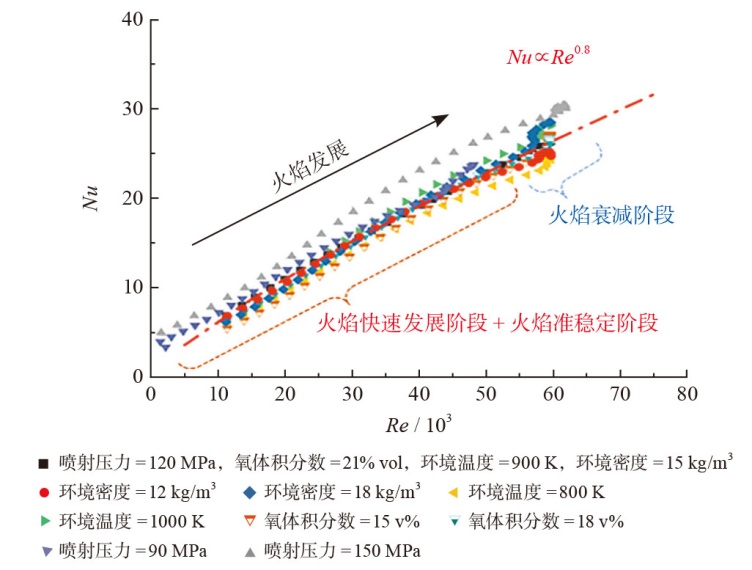
| 气相传热[ | 速度、物性、温差及长度定义 | Nu-Re关系不可直接比较 |
| 固体与测量[ | 热扩散时间、壁温和分辨率 | 表面响应及峰值平滑不同 |
| 相似层级 | 相似变量 | 偏差 |
|---|---|---|
| 几何相似[ | 喷孔、撞壁距离、壁面形状 | 卷吸及发展区域不同 |
| 喷射历程[ | 喷油率波形与归一化持续期 | 动量和动能输入历史不同 |
| 流动与反应[ | 贯穿、着火、升举与停留时间 | 形态相似而温度场不同 |
| 气相传热[ | 速度、物性、温差及长度定义 | Nu-Re关系不可直接比较 |
| 固体与测量[ | 热扩散时间、壁温和分辨率 | 表面响应及峰值平滑不同 |
| 研究方向 | 问题与挑战 | 重点研究方向 |
|---|---|---|
| 近壁边界层诊断 | 近壁温度与流动梯度难以直接解析 | 多物理量同步诊断与近壁输运机制研究 |
| 非平衡传热建模 | 热流滞后及历史效应表征不足 | 发展考虑湍流输运与记忆效应的动态模型 |
| 多尺度耦合模拟 | 多物理过程耦合复杂,预测误差较大 | 高保真模拟与多物理量联合验证 |
| 低碳与零碳燃料 | 传热关联式失效及辐射/对流主导机制演变不明 | 揭示燃料特性影响并建立跨燃料关联 |
| 局部热负荷调控 | 局部热负荷与整体热效率难以兼顾 | 喷射、燃烧与壁面热管理协同优化 |
| 工程预测与应用 | 模型跨工况预测能力及工程适用性不足 | 构建多尺度预测与实机验证体系 |
| [1] | Heywood J B. Internal Combustion Engine Fundamentals (2nd ed)[M]. New York: McGraw-Hill Education, 2018: 715-760. |
| [2] |
Borman G, Nishiwaki K. Internal-combustion engine heat transfer[J]. Prog Energ Combust Sci, 1987, 13: 1-46.
doi: 10.1016/0360-1285(87)90005-0 URL |
| [3] | Fonseca L, Olmeda P, Novella R M, et al. Internal combus-tion engine heat transfer and wall temperature modeling: an overview[J]. Arch Comput Meth Engi, 2020, 27(5): 1661-1679. |
| [4] | Dec J E. A conceptual model of DI diesel combustion based on laser-sheet imaging[R]. SAE Technical Paper 1997: 970873. |
| [5] | Flynn P, Durrett R, Hunter G, et al. Diesel combustion: An integrated view combining laser diagnostics, chemical kinetics, and empirical validation[R]. SAE Technical Paper, 1999-01-0509, 1999. |
| [6] | Kamimoto T, Takahashi H, Kobayashi H, et al. Convective heat transfer of an impinging diesel flame in a rapid comp-ression machine[R]. SAE Technical Paper, 1982: 821035. |
| [7] | LI Shiwen, Kamimoto T, Kobori S, et al. Heat transfer from impinging diesel flames to the combustion chamber wall[R]. SAE Technical Paper, 1997: 970896. |
| [8] | Mahmud R, Kurisu T, Nishida K, et al. Effects of injection pressure and impingement distance on flat-wall impinging spray flame and its heat flux under diesel engine-like condition[J]. Advan Mech Engi, 2019, 11(7): 1-15. |
| [9] | Mahmud R, Kurisu T, Nishida K, et al. Experimental study on flat-wall impinging spray flame and its heat flux on wall under diesel engine-like condition: First report-effect of impingement distance[J]. Proc Instit Mech Engi, Part D: J Autom Engi, 2019, 233: 2187-2202. |
| [10] | Gingrich E M. High-output diesel engine heat transfer[D]. Madison: University of Wisconsin-Madison, 2020. |
| [11] | Gingrich E M, Tess M, Korivi V, et al. High-output diesel engine heat transfer: Part 1, Comparison between piston heat flux and global energy balance[J]. Int’l J Engi Res, 2022, 23(8): 1417-1431. |
| [12] | Gingrich E M, Tess M, Korivi V, et al. High-output diesel engine heat transfer: Part 2, Instantaneous spatially aver-aged heat transfer correlation[J]. Int’l J Engi Res, 2022, 23(9): 1435-1452. |
| [13] | 曹佳乐. 柴油机喷雾火焰撞壁瞬时传热特性研究[D]. 上海: 上海交通大学, 2026. |
| CAO Jiale. Characteristics of the transient heat transfer of diesel flames impinging on the wall[D]. Shanghai: Shanghai Jiao Tong University, 2026. (in Chinese) | |
| [14] |
CAO Jiale, ZHOU Xinyi, CHEN Run, et al. Characteristics of the transient heat transfer of impinging flames and correlation analysis using a new characteristic velocity under CI engine-like conditions[J]. Proc Combust Instit, 2024, 40: 105356.
doi: 10.1016/j.proci.2024.105356 URL |
| [15] | CAO Jiale, ZHOU Xinyi, XU Xingyu, et al. Scaling trans-ient heat transfer in impinging flames under compression-ignition engine-like conditions[J]. Appl Therm Engi, 2025, 271: 126352. |
| [16] | CAO Jiale, CHEN Hao, XUE Xuefeng, et al. Simultaneous measurement and view-factor reconstruction of radiative and convective heat transfer of impinging flames under engine-like conditions[J]. Appl Therm Engi, 2026, 287: 129393. |
| [17] | Moreira A L N, Moita A S, Panão M R. Advances and challenges in explaining fuel spray impingement: how much of single droplet impact research is useful?[J]. Prog Energ Combust Sci, 2010, 36(5): 554-580. |
| [18] |
Rusly A M, Kook S, Hawkes E R, et al. The shortening of lift-off length associated with jet-wall and jet-jet inter-action in a small-bore optical diesel engine[J]. Fuel, 2014, 125: 1-14.
doi: 10.1016/j.fuel.2014.02.004 URL |
| [19] | Le M K, Kook S. Injection pressure effects on the flame development in a light-duty optical diesel engine[J]. SAE Int’l J Engi, 2015, 8(2): 609-624. |
| [20] |
Le M K, Zhang R, Rao L, et al. The development of hydr-oxyl and soot in a methyl decanoate-fuelled automotive-size optical diesel engine[J]. Fuel, 2016, 166: 320-332.
doi: 10.1016/j.fuel.2015.11.006 URL |
| [21] |
Pillai A L, Kai R, Murata T, et al. Numerical analysis of heat transfer characteristics of spray flames impinging on a wall under CI engine-like conditions[J]. Combust Flame, 2022, 239: 111615.
doi: 10.1016/j.combustflame.2021.111615 URL |
| [22] |
WANG Dongfang, SHI Zhongjie, YANG Ziming, et al. Numerical analysis of heat transfer between a wall and diesel spray: Effect on ignition characteristics[J]. Fuel, 2023, 334: 126595.
doi: 10.1016/j.fuel.2022.126595 URL |
| [23] |
WANG Dongfang, OUYANG Qiming, LI Yikai, et al. Heat and mass transfer mechanistic investigation of wall intervention on spray ignition characteristics under aviation piston engine-like conditions[J]. Exper Therm Fluid Sci, 2024, 158: 111247.
doi: 10.1016/j.expthermflusci.2024.111247 URL |
| [24] | Aizawa T, Kinoshita T, Akiyama S, et al. Infrared high-speed thermography of combustion chamber wall impinged by diesel spray flame[J]. Int’l J Engi Res, 2022, 23(7): 1116-1130. |
| [25] | Kawaguchi A, Wakisaka Y, Nishikawa N, et al. Thermo-swing insulation to reduce heat loss from the combustion chamber wall of a diesel engine[J]. Int’l J Engi Res, 2019, 20: 805-816. |
| [26] | Takahashi T, Miyagawa Y, Kinoshita H, et al. Infrared high-speed thermography of combustion chamber wall impinged by diesel spray flame: Effects of wall surface roughness on heat transfer[J]. Trans Soc Autom Engi Japan, 2022, 53(5): 839-844. |
| [27] | Morel T, Keribar R. Heat radiation in D.I. diesel engines[R]. SAE Technical Paper, 1986: 860445. |
| [28] | Struwe F J, Foster D E. In-cylinder measurement of parti-culate radiant heat transfer in a direct injection diesel engine[R]. SAE Technical Paper, 2003-01-0072, 2003. |
| [29] | Skeen S, Manin J, Pickett L, et al. Quantitative spatially resolved measurements of total radiation in high-pressure spray flames[R]. SAE Technical Paper, 2014-01-1252, 2014. |
| [30] | Shimizu F, Aizawa T. High-speed IR thermography of radiant heat transfer on chamber wall impinged by diesel spray flame[J/OL]. JSAE Engi Rev, 2025, 15(8). (2025-09-04) [2026-10-14] https://www2.jsae.or.jp/engine_rev/backnumber/15-08/01.html. |
| [31] | Benajes J, Martin J, Garcia A, et al. An investigation of radiation heat transfer in a light-duty diesel engine[J]. SAE Int’l J Engi, 2015, 8: 2199-2212. |
| [32] | Gatowski J A, Balles E N, Chun K M, et al. Heat release analysis of engine pressure data[R]. SAE Technical Paper, 1984: 841359. |
| [33] | Brunt M F J, Rai H, Emtage A L. The calculation of heat release energy from engine cylinder pressure data[R]. SAE Technical Paper, 1998: 981052. |
| [34] | Lancaster D R, Krieger R B, Lienesch J H. Measurement and analysis of engine pressure data[R]. SAE Technical Paper, 1975: 750026. |
| [35] | Cheung H M, Heywood J B. Evaluation of a one-zone burn-rate analysis procedure using production SI engine pressure data[R]. SAE Technical Paper, 1993: 932749. |
| [36] | Brunt M F J, Pond C R. Evaluation of techniques for absolute cylinder pressure correction[R]. SAE Technical Paper, 1997: 970036. |
| [37] | Brunt M F J, Emtage A L. Evaluation of burn rate routines and analysis errors[R]. SAE Technical Paper, 1997: 970037. |
| [38] |
Alam T, Kumar R. A review on thin film fast response heat transfer gauges[J]. Rev Sci Instrum, 2021, 92: 031501.
doi: 10.1063/5.0015932 URL |
| [39] | Marr M A, Wallace J S, Chandra S, et al. A fast response thermocouple for internal combustion engine surface temperature measurements[J]. Exper Therm Fluid Sci, 2010, 34(2): 183-189. |
| [40] | Assanis D N, Badillo E. Evaluation of alternative thermo-couple designs for transient heat transfer measurements in metal and ceramic engines[R]. SAE Technical Paper, 1989: 890571. |
| [41] |
Mohammed H, Abdullah A, Hou Y. Design and fabrication of coaxial surface junction thermocouples for transient heat transfer measurements[J]. Measu Sci Tech, 2008, 19: 075401.
doi: 10.1088/0957-0233/19/7/075401 URL |
| [42] | Dejima K, Nakabeppu O. Local instantaneous heat flux measurements in an internal combustion engine using a MEMS sensor[J]. Appl Therm Engi, 2022, 201: 117747. |
| [43] | 出島一仁, 中別府修, 中村優斗, 等. エンジン内壁面の熱流束を測定する金属基板MEMSセンサの開発[J]. 日本機械学会論文集, 2018, 84(858): 17-00414. |
| Dejima K, Nakabeppu O, Nakamura Y, et al. Development of metal substrate MEMS sensors for wall heat flux mea-surement in engines[J]. Trans JSME, 2018, 84(858): 17-00414. (in Japanese) | |
| [44] | Dejima K, Nakabeppu O, Moussou J, Pilla G. Application of a MEMS heat flux sensor to heat transfer research on an impinging diesel jet[J]. Int’l J Engi Res, 2022, 23(3): 497-511. |
| [45] |
Binder C, Feuk H, Richter M. Phosphor thermometry for in-cylinder surface temperature measurements in diesel engines[J]. J Luminescence, 2020, 226: 117415.
doi: 10.1016/j.jlumin.2020.117415 URL |
| [46] |
Khalid A H, Kontis K. Thermographic phosphors for high temperature measurements: Principles, current state of the art and recent applications[J]. Sensors, 2008, 8: 5673-5744.
doi: 10.3390/s8095673 pmid: 27873836 |
| [47] | Binder C, Abou Nada F, Richter M, et al. Heat loss analysis of a steel piston and a YSZ coated piston in a heavy-duty diesel engine using phosphor thermometry measurements[J]. SAE Int’l J Engi, 2017, 10: 1954-1968. |
| [48] | Binder C, Matamis A, Richter M, et al. Study on heat losses during flame impingement in a diesel engine using phosphor thermometry surface temperature measurements[R]. SAE Technical Paper, 2019-01-0556, 2019. |
| [49] | Aizawa T, Kosaka H. Laser-induced phosphorescence thermography of combustion chamber wall of diesel engine[J]. SAE Int’l J Fuel Lubri, 2009, 1(1): 549-558. |
| [50] | Brübach J, Pflitsch C, Dreizler A, Atakan B. On surface temperature measurements with thermographic phosphors: a review[J]. Prog Energ Combust Sci, 2013, 39(1): 37-60. |
| [51] | 薛雪峰, 李铁, 王宁, 等. 基于激光诱导磷光的火焰碰壁时壁温测试技术研究[J]. 内燃机工程, 2021, 42(6): 23-29. |
| XUE Xuefeng, LI Tie, WANG Ning, et al. Wall Temperature Measurement with Flame Impingement via Laser-Induced Phosphorescence[J]. Chin Inter Combust Engine Engi-neer, 2021, 42(6): 23-29. (in Chinese) | |
| [52] | Gingrich E, Janecek D, Ghandhi J. Experimental investi-gation of the impact of in-cylinder pressure oscillations on piston heat transfer[J]. SAE Int’l J Engi, 2016, 9: 1958-1969. |
| [53] | Gingrich E, Splitter D, Ghandhi J. Experimental investi-gation of piston heat transfer in a light-duty engine under conventional diesel, homogeneous charge compression ignition, and reactivity-controlled compression ignition combustion regimes[R]. SAE Technical Paper, 2014-01-1182, 2014. |
| [54] |
Ojo A O, Escofet-Martin D, Collins J, et al. Experimental investigation of thermal boundary layers and associated heat loss for transient engine-relevant processes using HRCARS and phosphor thermometry[J]. Combust Flame, 2021, 233: 111567.
doi: 10.1016/j.combustflame.2021.111567 URL |
| [55] |
Witkowski D, Rothamer D A. Evaluation of 15-kHz high-speed Pr:YAG phosphor surface thermometry of a thermal barrier coating in a reciprocating IC engine[J]. Proc Combust Instit, 2023, 39: 1289-1297.
doi: 10.1016/j.proci.2022.07.088 URL |
| [56] |
Ojo A, Escofet-Martin D, Peterson B. High-precision 2D surface phosphor thermometry at kHz-rates during flame-wall interaction in narrow passages[J]. Proc Combust Instit, 2023, 39: 1455-1463.
doi: 10.1016/j.proci.2022.09.048 URL |
| [57] | ZHAO Hua, Ladommatos N. Optical diagnostics for soot and temperature measurement in diesel engines[J]. Prog Energ Combust Sci, 1998, 24(3): 221-255. |
| [58] |
Musculus M P B, Singh S, Reitz R D. Gradient effects on two-color soot optical pyrometry in a heavy-duty DI diesel engine[J]. Combust Flame, 2008, 153: 216-227.
doi: 10.1016/j.combustflame.2007.10.023 URL |
| [59] | Hottel H C, Broughton F P. Determination of true tempe-rature and total radiation from luminous gas flames[J]. Indu Engi Chem Analy Edit, 1932, 4: 166-175. |
| [60] | Kamimoto T, Murayama Y. Re-examination of the emissivity of diesel flames[J]. Int’l J Engi Res, 2012, 13: 255-268. |
| [61] | Rao L, Kook S. Optimisation of image processing para-meters for flame image velocimetry (FIV) measurement in a single-cylinder, small-bore optical diesel engine[R]. SAE Technical Paper, 2019-01-0719, 2019. |
| [62] | YANG Jinxin, RAO Lingzhe, ZHANG Yilong, et al. Flame image velocimetry analysis of reacting jet flow fields with a variation of injection pressure in a small-bore diesel engine[J]. Int’l J Eng Res, 2021, 22(9): 2968-2981. |
| [63] | YANG Jinxin, RAO Lingzhe, de Silva C, et al. The appli-cation of flame image velocimetry to after-injection effects on flow fields in a small-bore diesel engine[J]. SAE Int’l J Engi, 2022, 15(3): 321-333. |
| [64] |
Alharbi A Y, Sick V. Investigation of boundary layers in internal combustion engines using a hybrid algorithm of high-speed micro-PIV and PTV[J]. Exper Fluids, 2010, 49: 949-959.
doi: 10.1007/s00348-010-0870-8 URL |
| [65] | Jainski C, Lu Louise, Dreizler A, et al. High-speed micro particle image velocimetry studies of boundary-layer flows in a direct-injection engine[J]. Int’l J Engi Res, 2013, 14(3): 247-259. |
| [66] |
Alzuabi M K, Wu A, Sick V. Experimental and numerical investigation of temperature fluctuations in the near-wall region of an optical reciprocating engine[J]. Proc Combust Insti, 2021, 38: 5879-5887.
doi: 10.1016/j.proci.2020.08.062 URL |
| [67] | WU Angela, Alzuabi M K, Sick V. Spatial correlation and length scale analysis of the near-wall flow and temperature distribution of an internal combustion engine[R]. SAE Technical Paper, 2020-01-1106, 2020. |
| [68] |
Yokoyama E, Shimura M, Kamata M, et al. Simultaneous high-speed and high-resolution PIV and heat flux measure-ments near piston top under tumble enhanced condition[J]. Flow, Turb Combust, 2022, 109: 1011-1037.
doi: 10.1007/s10494-022-00360-8 |
| [69] |
Schmidt M, Welch C, Illmann L, et al. High-speed mea-surements and conditional analysis of boundary-layer flows at engine speeds up to 2500 rpm in a motored IC engine[J]. Proc Combust Instit, 2023, 39: 4841-4850.
doi: 10.1016/j.proci.2022.07.199 URL |
| [70] | Annand W J D. Heat transfer in the cylinders of recipro-cating internal combustion engines[J]. Proc Instit Mech Engi, 1963, 177: 973-996. |
| [71] | Woschni G. A universally applicable equation for the inst-antaneous heat transfer coefficient in the internal combus-tion engine[R]. SAE Technical Paper, 1967: 670931. |
| [72] | Hohenberg G. Advanced approaches for heat transfer calculations[R]. SAE Technical Paper, 1979: 790825. |
| [73] | Sihling K, Woschni G. Experimental investigation of the instantaneous heat transfer in the cylinder of a high speed diesel engine[R]. SAE Technical Paper, 1979: 790833. |
| [74] | Finol C A, Robinson K. Thermal modelling of modern engines: A review of empirical correlations to estimate the in-cylinder heat transfer coefficient[J]. Proc Instit Mech Engi, Part D: J Autom Engi, 2006, 220: 1765-1781. |
| [75] | HAN Zhiyu, Reitz R D. A temperature wall function form-ulation for variable-density turbulent flows with application to engine convective heat transfer modeling[J]. Int’l J Heat Mass Trans, 1997, 40(3): 613-625. |
| [76] |
Zama Y, Odawara Y, Furuhata T. Experimental investi-gation on velocity inside a diesel spray after impingement on a wall[J]. Fuel, 2017, 203: 757-763.
doi: 10.1016/j.fuel.2017.04.099 URL |
| [77] | Schmitt M, Frouzakis C E, Wright Y M, et al. Direct num-erical simulation of the compression stroke under engine-relevant conditions: Evolution of the velocity and thermal boundary layers[J]. Int’l J Heat Mass Trans, 2015, 91: 948-960. |
| [78] | Renaud A, Ding C P, Jakirlic S, et al. Experimental charac-terization of the velocity boundary layer in a motored IC engine[J]. Int’l J Heat Fluid Flow, 2018, 71: 366-377. |
| [79] |
Ma P C, Ewan T, Jainski C, et al. Development and analysis of wall models for internal combustion engine simulations using high-speed micro-PIV measurements[J]. Flow, Turb Combust, 2017, 98: 283-309.
doi: 10.1007/s10494-016-9734-5 URL |
| [80] | Rutland C.J. Large-eddy simulations for internal combu-stion engines: a review[J]. Int’l J Engi Res, 2011, 12(5): 421-451. |
| [81] | Schmitt M, Frouzakis C E, Wright Y M, et al. Investigation of wall heat transfer and thermal stratification under engine-relevant conditions using direct numerical simulation[J]. Proc Combust Instit, 2016, 36(3): 3137-3144. |
| [82] |
Bolla M, Impagnatiello M, Keskinen K, et al. Development of an algebraic wall heat transfer model for LES in IC engines using DNS data[J]. Proc Combust Instit, 2021, 38: 5811-5819.
doi: 10.1016/j.proci.2020.06.273 URL |
| [83] | Ma P C, Greene M, Sick V, et al. Non-equilibrium wall-modeling for internal combustion engine simulations with wall heat transfer[J]. Int’l J Engi Res, 2017, 18: 15-25. |
| [84] | Perini F. Non-equilibrium law-of-the-wall modeling for improved heat transfer predictions: Model development and validation[R]. SAE Technical Paper, 2022-01-0405, 2022. |
| [85] | Pandey A, Schlautman J, LIU Zhe, et al. Conjugate heat transfer analysis of an i-4 engine including pistons, liners, block, heads, water cooling jacket, and oil cooling jets[R]. SAE Technical Paper, 2024-01-2696, 2024. |
| [86] | Kutej L, Klink A, Wegt S, et al. Eddy-resolving simulation of conjugate heat transfer in a test specimen pertinent to cooling channels in IC engines[R]. SAE Technical Paper, 2024-01-2692, 2024. |
| [87] | Impagnatiello M, Bolla M, Keskinen K, et al. Systematic assessment of data-driven approaches for wall heat transfer modelling for LES in IC engines using DNS data[J]. Int’l J Heat Mass Trans, 2022, 183: 122109. |
| [88] |
Valera-Medina A, XIAO Hua, Owen-Jones M, et al. Am-monia for power[J]. Prog Energ Combust Sci, 2018, 69: 63-102.
doi: 10.1016/j.pecs.2018.07.001 URL |
| [89] |
ZHEN Xudong, WANG Yang. An overview of methanol as an internal combustion engine fuel[J]. Renew Sustain Energ Rev, 2015, 52: 477-493.
doi: 10.1016/j.rser.2015.07.083 URL |
| [90] | White C M, Steeper R R, Lutz A E. The hydrogen-fueled internal combustion engine: A technical review[J]. Int’l J Hydro Energ, 2006, 31: 1292-1305. |
| [91] | WANG Ning, LI Tie, ZHOU Xinyi, et al. Characteristics of high-pressure ammonia spray combustion under diesel-like conditions[J]. Appl Therm Engi, 2024, 257(Part B): 124335. |
| [92] |
LI Shiyan, WANG Ning, LI Tie, et al. Experimental inves-tigation on liquid length of direct-injection ammonia spray under engine-like conditions[J]. Energy, 2024, 301: 131758.
doi: 10.1016/j.energy.2024.131758 URL |
| [1] | 方 成,杨福源,欧阳明高,等. 新一代压燃发动机控制平台开发[J]. JASE, 2017, 08(04): 403-411. |
| 阅读次数 | ||||||
|
全文 |
|
|||||
|
摘要 |
|
|||||
