欢迎访问《汽车安全与节能学报》,

汽车安全与节能学报 ›› 2026, Vol. 17 ›› Issue (2): 261-269.DOI: 10.3969/j.issn.1674-8484.2026.02.012
文家燕1( ), 邹海峰1,2, 钟薇2,*(), 高博麟2, 卢彦博2
收稿日期:2025-11-15
修回日期:2026-01-20
出版日期:2026-04-30
发布日期:2026-04-30
通讯作者:
钟薇,助理研究员。E-mail:zhongwei@mail.tsinghua.edu.cn。
作者简介:文家燕(1981—),男(汉),广西,教授。E-mail:wenjiayan2012@126.com。
基金资助:
WEN Jiayan1(), ZOU Haifeng1,2, ZHONG Wei2,*(), GAO Bolin2, LU Yanbo2
Received:2025-11-15
Revised:2026-01-20
Online:2026-04-30
Published:2026-04-30
摘要:
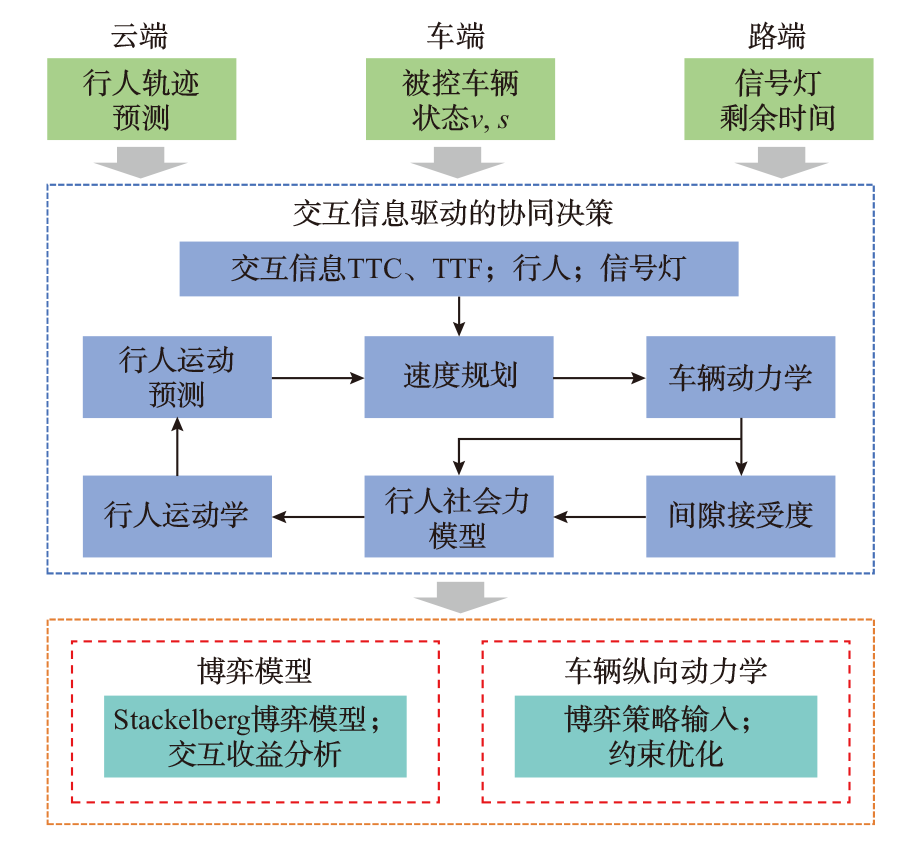
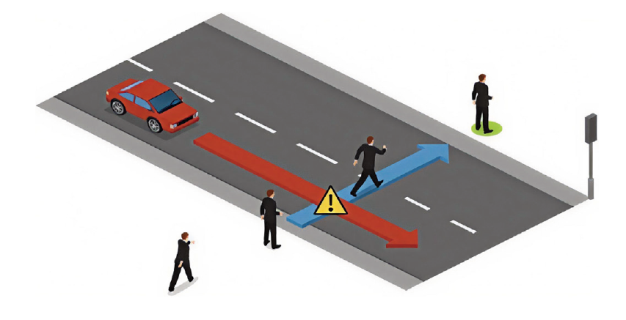
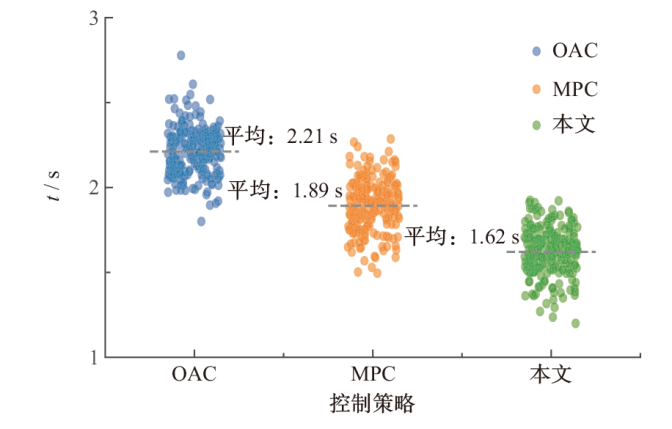
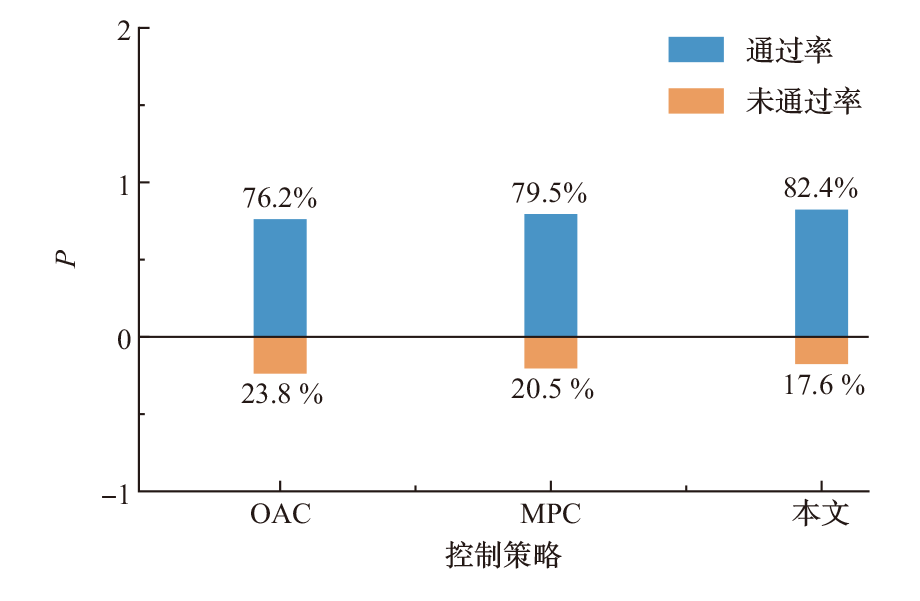
该文研究了自动驾驶车辆的人车交互行为(VPI),以解决行人突发横穿而导致的连续性与安全性的冲突。基于路侧感知与云端历史信息,构建行人过街社会力模型,以表征行人行为,并向车端下发数据。提出双层协同决策控制策略:上层引入Stackelberg博弈模型;下层采用改进模型预测控制(MPC)。以上层博弈结果为轨迹优化目标。在道路不受控行驶城市路段,进行了VPI场景的仿真实验。结果表明: 相较于单一避障控制(OAC)和MPC方法,用本文方法交互耗时分别减少0.59 s和0.27 s,红绿灯通过率提高6.2%和2.9%。从而,本文方法提升车辆在通行时间限内的效率性与安全性,能模拟人车协同与冲突场景。
中图分类号:
文家燕, 邹海峰, 钟薇, 高博麟, 卢彦博. 融合人车博弈论的车路云一体化系统车速规划方法[J]. 汽车安全与节能学报, 2026, 17(2): 261-269.
WEN Jiayan, ZOU Haifeng, ZHONG Wei, GAO Bolin, LU Yanbo. Vehicle speed planning method with the vehicle-road-cloud integration system and incorporating human-vehicle game theory[J]. Journal of Automotive Safety and Energy, 2026, 17(2): 261-269.
| 车辆速度, | N(8, 0.8) m/s |
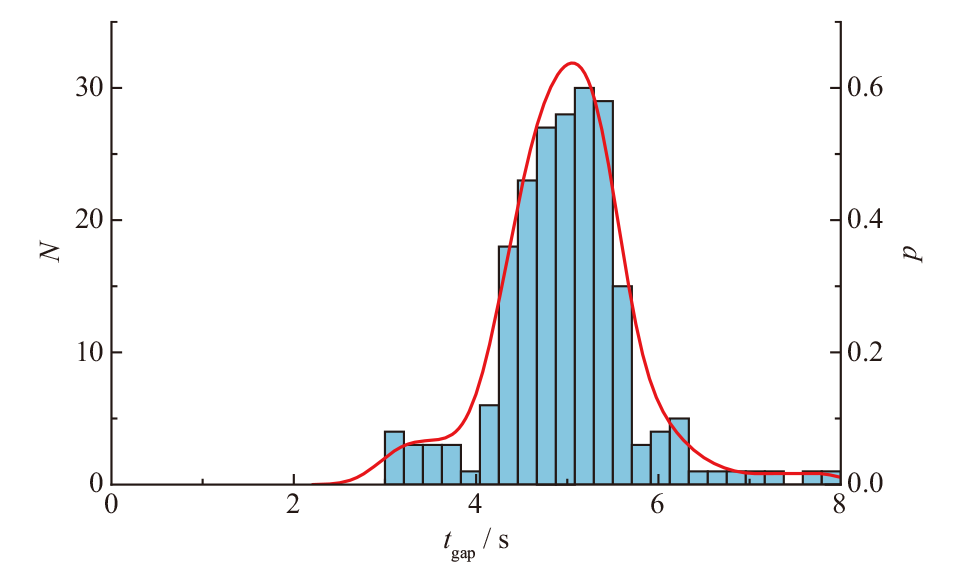
| 期望间隙接受度,tgap | N(4.25, 0.8) s |
| 最大加速度,vmax | 4 m/s2 |
| 最小减速度,vmin | -4 m/s2 |
| 最大观测距离,dobs | 30 m |
| 行人距离,dp | 3.5 m |
| 期望间歇均值,μgap | 2.5 s |
| 期望间隙标准差,σgap | 0.4 s |
| 仿真时间步长,?t | 0.1 s |
| 仿真总时长,T | 10 s |
| 车辆速度, | N(8, 0.8) m/s |
| 期望间隙接受度,tgap | N(4.25, 0.8) s |
| 最大加速度,vmax | 4 m/s2 |
| 最小减速度,vmin | -4 m/s2 |
| 最大观测距离,dobs | 30 m |
| 行人距离,dp | 3.5 m |
| 期望间歇均值,μgap | 2.5 s |
| 期望间隙标准差,σgap | 0.4 s |
| 仿真时间步长,?t | 0.1 s |
| 仿真总时长,T | 10 s |
| 行人 | 方法 | TTC均值/ s | CR / % | YR / % |
|---|---|---|---|---|
| OAC | 5.22 | 0.14 | 71.2 | |
| 年轻人 | MPC | 2.73 | 1.57 | 59.2 |
| 本文 | 3.98 | 0.07 | 47.7 | |
| 中年人 | OAC | 5.45 | 0.11 | 72.3 |
| MPC | 2.66 | 2.2 | 57.7 | |
| 本文 | 4.07 | 0.05 | 50.2 | |
| 老年人 | OAC | 5.53 | 0.09 | 74.9 |
| MPC | 2.92 | 1.67 | 56.3 | |
| 本文 | 4.22 | 0.02 | 49.1 |
| 行人 | 方法 | TTC均值/ s | CR / % | YR / % |
|---|---|---|---|---|
| OAC | 5.22 | 0.14 | 71.2 | |
| 年轻人 | MPC | 2.73 | 1.57 | 59.2 |
| 本文 | 3.98 | 0.07 | 47.7 | |
| 中年人 | OAC | 5.45 | 0.11 | 72.3 |
| MPC | 2.66 | 2.2 | 57.7 | |
| 本文 | 4.07 | 0.05 | 50.2 | |
| 老年人 | OAC | 5.53 | 0.09 | 74.9 |
| MPC | 2.92 | 1.67 | 56.3 | |
| 本文 | 4.22 | 0.02 | 49.1 |
| θ1 | θ2 | θ3 | TTC均值/ s | tgap均值/ s | CR / % | YR / % |
|---|---|---|---|---|---|---|
| 1.2 | 1.5 | 1.1 | 3.96 | 4.22 | 0.072 | 47.5 |
| 1.5 | 1.5 | 1.1 | 4.02 | 4.55 | 0.066 | 49.3 |
| 2.0 | 1.5 | 1.1 | 4.14 | 5.21 | 0.051 | 52.6 |
| 1.2 | 2.0 | 1.1 | 3.74 | 3.94 | 0.23 | 44.3 |
| 1.2 | 2.5 | 1.1 | 3.31 | 3.48 | 0.48 | 40.4 |
| 1.2 | 1.5 | 1.3 | 3.57 | 4.03 | 0.12 | 45.2 |
| 1.2 | 1.5 | 1.5 | 3.36 | 3.88 | 0.34 | 41.8 |
| θ1 | θ2 | θ3 | TTC均值/ s | tgap均值/ s | CR / % | YR / % |
|---|---|---|---|---|---|---|
| 1.2 | 1.5 | 1.1 | 3.96 | 4.22 | 0.072 | 47.5 |
| 1.5 | 1.5 | 1.1 | 4.02 | 4.55 | 0.066 | 49.3 |
| 2.0 | 1.5 | 1.1 | 4.14 | 5.21 | 0.051 | 52.6 |
| 1.2 | 2.0 | 1.1 | 3.74 | 3.94 | 0.23 | 44.3 |
| 1.2 | 2.5 | 1.1 | 3.31 | 3.48 | 0.48 | 40.4 |
| 1.2 | 1.5 | 1.3 | 3.57 | 4.03 | 0.12 | 45.2 |
| 1.2 | 1.5 | 1.5 | 3.36 | 3.88 | 0.34 | 41.8 |
| [1] | ZOU Fengjiao, Ogle J, JIN Weimin, et al. Pedestrian behavior interacting with autonomous vehicles: Role of AV operation and signal indication and roadway infrastructure[C]// IEEE Conf Virt Real 3D User Interf Abstr Workshops (VRW), 2023: 821-822. |
| [2] | LIANG Zijun, ZHAN Xuejuan, WANG Ruihan, et al. Identification of factors influencing the operational effect of the green wave on urban arterial roads based on association analysis[J]. Appl Sci, 2023, 13(14): 8372. |
| [3] | Rasouli A, Kotseruba I. Intend-wait-cross: Towards modeling realistic pedestrian crossing behavior[C]// 2022 IEEE Intell Vehi Symp (IV). IEEE, 2022: 83-90. |
| [4] | 瞿广跃, 杨澜, 袁梦, 等. 面向自动驾驶汽车的信号交叉口行人多模态轨迹预测方法[J]. 汽车安全与节能学报, 2024, 15(5): 689-701. |
| QU Guangyue, YANG Lan, YUAN Meng, et al. Pedestrian multi-modal trajectory prediction method for signalized intersections oriented to autonomous vehicles[J]. J Autom Safe Energ, 2024, 15(5): 689-701. (in Chinese) | |
| [5] | Kapania N R, Govindarajan V, Borrelli F, et al. A hybrid control design for autonomous vehicles at uncontrolled crosswalks[C]// 2019 IEEE Intel Vehi Symp (IV). IEEE, 2019: 1604-1611. |
| [6] |
Helbing D, Molnar P. Social force model for pedestrian dynamics[J]. Phys Rev E, 1995, 51(5): 4282-4286.
pmid: 9963139 |
| [7] | Shrivas A, Kumar A. Modified social force model for pedestrian-vehicle interactions at a signalized intersection[J]. Transport Lett, 2024, 16(4): 307-319. |
| [8] |
LI Hanchu, LIAO Ziyi, RUI Yikang, et al. A physical law constrained deep learning model for vehicle trajectory prediction[J]. IEEE Internet Things J, 2023, 10(24): 22775-22790.
doi: 10.1109/JIOT.2023.3305395 URL |
| [9] |
Bjørnskau T. The zebra crossing game: Using game theory to explain a discrepancy between road user behaviour and traffic rules[J]. Safe Sci, 2017, 92: 298-301.
doi: 10.1016/j.ssci.2015.10.007 URL |
| [10] | ZHU Dianchen, Sze N N. Propensities of red light running of pedestrians at the two-stage crossings with split pedestrian signal phases[J]. Acci Anal Prev, 2021, 151: 105958. |
| [11] |
Amini R E, Dhamaniya A, Antoniou C. Towards a game theoretic approach to model pedestrian road crossings[J]. Transport Res Procedia, 2021, 52: 692-699.
doi: 10.1016/j.trpro.2021.01.083 URL |
| [12] | 周倩西, 巫诚诚, 胡政, 等. 基于组合博弈的高速作业区人机共驾切换策略决策[J]. 汽车安全与节能学报, 2025, 16(3): 487-495. |
| ZHOU Qianxi, WU Chengcheng, HU Zheng, et al. Decision-making of human-machine co-driving switching strategy in high-speed work zones based on combinatorial game theory[J]. J Autom Safe Energ, 2025, 16(3): 487-495. (in Chinese) | |
| [13] | Holt C A, Roth A E. The Nash equilibrium: A perspective[J]. Proc National Acad Sci, 2004, 101(12): 3999-4002. |
| [14] | Başar T, Olsder G J. Dynamic Noncooperative Game Theory[M]. Philadelphia: Society for Industrial and Applied Mathematics, 1998: 70-155. |
| [15] | Nowak M A, May R M. Evolutionary games and spatial chaos[J]. Nature, 1992, 359(6398): 826-829. |
| [16] | 李文礼, 张祎楠, 石晓辉, 等. 基于博弈论的右转无信号交叉口行人行为模拟[J]. 机械工程学报, 2024, 60(10): 86-101. |
| LI Wenli, ZHANG Yinan, SHI Xiaohui, et al. Pedestrian behavior simulation at unsignalized right-turn intersections based on game theory[J]. J Mech Engi, 2024, 60(10): 86-101. (in Chinese) | |
| [17] | 李海洋, 曲大义, 杨子奕, 等. 无信号控制交通场景的人车博弈行为分析及决策建模[J]. 青岛理工大学学报, 2023, 44(5): 138-149. |
| LI Haiyang, QU Dayi, YANG Ziyi, et al. Analysis and decision modeling of vehicle-pedestrian game behaviors in signal-free traffic scenarios[J]. J Qingdao Univ Tech, 2023, 44(5): 138-149. (in Chinese) | |
| [18] | Parajuli S, Cherry C R, Zavisca E, et al. Are pedestrian crashes becoming more severe: A breakdown of pedestrian crashes in urban Tennessee[J]. Transport Res Rec, 2023, 2678(6): 523-541. |
| [19] | TANG Bin, YANG Zhengyi, JIANG Haobin. Development of pedestrian collision avoidance strategy based on the fusion of Markov and social force models[J]. Mech Sci, 2024, 15(1): 17-30. |
| [20] |
CHEN Peng, WU Chaozhong, ZHU Shunying. Interaction between vehicles and pedestrians at uncontrolled mid-block crosswalks[J]. Safe Sci, 2016, 82: 68-76.
doi: 10.1016/j.ssci.2015.09.016 URL |
| [21] | CHEN Yongli, LI Shen, TANG Xiaolin, et al. Interaction-aware decision-making for autonomous vehicles[J]. IEEE Trans Transport Electrificat, 2023, 9(3): 4704-4715. |
| [22] |
DING Ning, ZHU Yu, LIU Xinyan, et al. A modified social force model for crowd evacuation considering collision predicting behaviors[J]. Appl Math Comput, 2024, 466: 128448.
doi: 10.1016/j.amc.2023.128448 URL |
| [23] | PENG Jingxuan, WEI Zhonghua, CHEN Yanyan, et al. Heterogeneous pedestrian simulation in commercial complexes: When attractive potential meets social force[J]. IEEE Trans Intel Transport Syst, 2025, 26(4): 5102-5119. |
| [24] | WANG Xuwei, LIU Tingting, LIU Zhen. Study on collision avoidance behavior in the social force-based pedestrian-vehicle interaction simulation model at unsignalized intersections[J]. Appl Sci, 2025, 15(9): 4885. |
| [25] | Chandra S, Bharti A K. Speed distribution curves for pedestrians during walking and crossing[J]. Procedia-Social Beha Sci, 2013, 104: 660-667. |
| [26] | CHEN Hao, ZHANG Xi. Path planning for intelligent vehicle collision avoidance of dynamic pedestrian using Att-LSTM, MSFM, and MPC at unsignalized crosswalk[J]. IEEE Trans Indu Elect, 2021, 69( 4): 4285-4295. |
| [27] | Rasouli A, Tsotsos J K. Autonomous vehicles that interact with pedestrians: A survey of theory and practice[J]. IEEE Trans Intel Transport Syst, 2019, 21(3): 900-918. |
| [28] | Rasouli A, Kotseruba I, Tsotsos J K. Understanding pedestrian behavior in complex traffic scenes[J]. IEEE Transport Intel Vehi, 2017, 3(1): 61-70. |
| [29] | Amini R E, Abouelela M, Dhamaniya A, et al. A game-theoretic approach for modelling pedestrian-vehicle conflict resolutions in uncontrolled traffic environments[J]. Acci Anal Prev, 2024, 203: 107604. |
| [1] | 于谦, 郭圆圆, 杨鸣鹏, 张玉婷. 基于跟驰对的CO2排放特性的生态车辆跟驰策略[J]. 汽车安全与节能学报, 2025, 16(4): 577-586. |
| [2] | 孙超, 刘波, 孙逢春. 新能源汽车节能规划与控制技术研究综述[J]. 汽车安全与节能学报, 2022, 13(4): 593-616. |
| [3] | 朱波, 张纪伟, 谈东奎, 胡旭东. 基于多源传感器与导航地图的端到端自动驾驶方法[J]. 汽车安全与节能学报, 2022, 13(4): 738-749. |
| [4] | 胡远志, 蒋涛, 刘西, 施友宁. 基于双流自适应图卷积神经网络的行人过街意图识别[J]. 汽车安全与节能学报, 2022, 13(2): 325-332. |
| [5] | 张平, 迟志诚, 陈一凡, 惠飞. 用于自动驾驶车辆的融合注意力机制多目标跟踪算法[J]. 汽车安全与节能学报, 2021, 12(4): 516-521. |
| [6] | 李耀华, 范吉康, 刘洋, 何杰, 李泽田, 潘绍飞. 自适应双时域参数MPC的智能车辆路径规划与跟踪控制[J]. 汽车安全与节能学报, 2021, 12(4): 528-539. |
| [7] | 冯敏健, 张辉, 巨志扬, 许庆. 基于LGSVL/ Apollo的网络延迟攻击下自动驾驶车辆定位估算[J]. 汽车安全与节能学报, 2021, 12(1): 62-69. |
| [8] | 张晨阳,李曙光,李耀华,姚进,祝磊,王敏. 基于驾驶模拟器和 fNIRS 的与晕动病相关脑活动区的差异性[J]. JASE, 2019, 10(4): 433-442. |
| [9] | 戴荣健,丁川,鹿应荣,赵福全. 自动驾驶环境下车辆轨迹及交通信号协同控制[J]. JASE, 2019, 10(4): 531-539. |
| [10] | 王乐一,殷 刚,赵广亮,李升波,徐 彪,李克强. 自动驾驶汽车控制系统参数辨识与学习(英文)[J]. JASE, 2018, 9(2): 141-148. |
| 阅读次数 | ||||||
|
全文 |
|
|||||
|
摘要 |
|
|||||
